Tiger Woods Car Crash Breakdown: Investigation Findings, Safety Analysis, and Medical Recovery
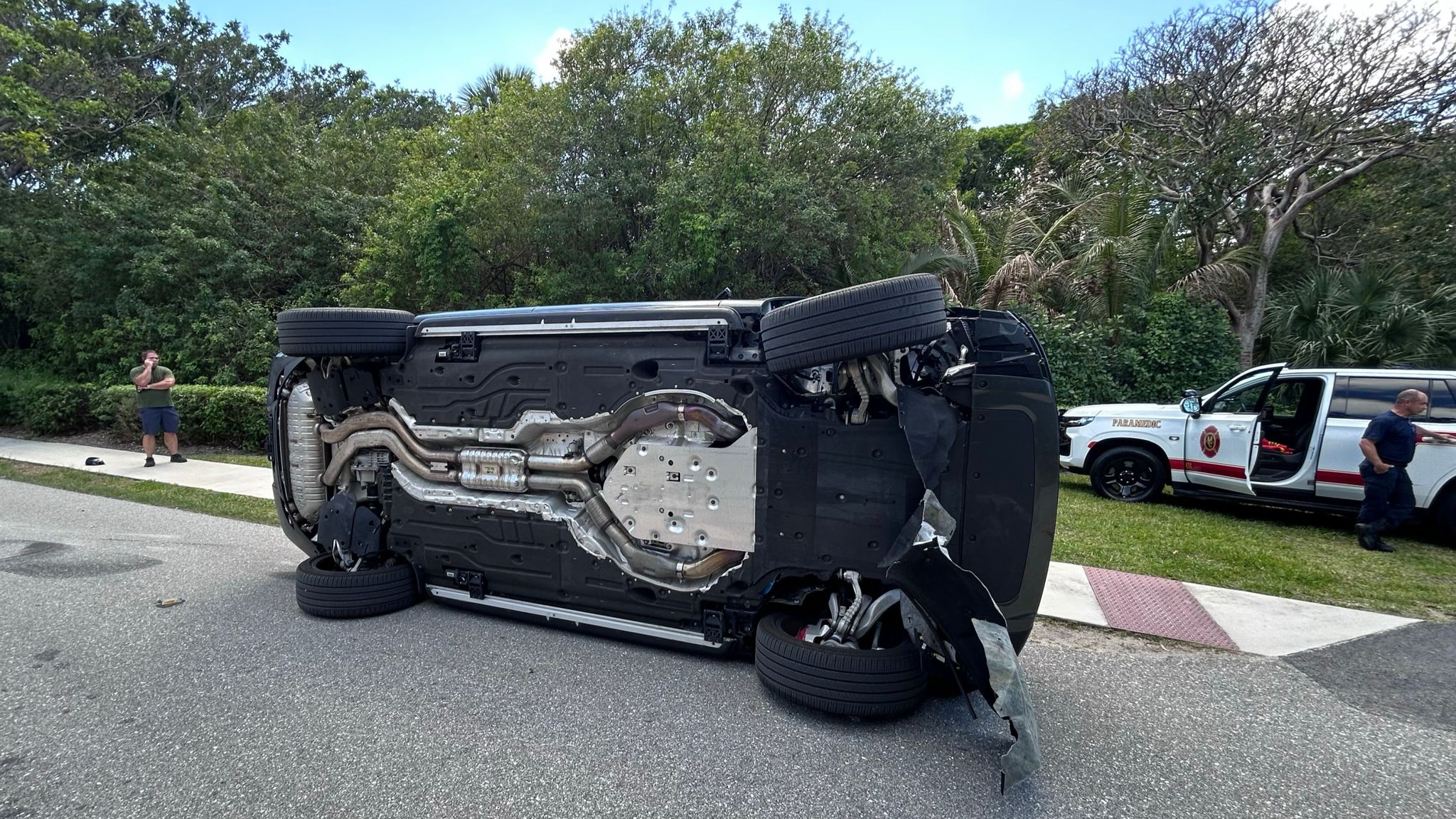
On February 23, 2021, golf icon Tiger Woods survived a high-speed, single-vehicle rollover accident in Rolling Hills Estates, California. Traveling at estimated speeds between 84 and 87 mph in a 45 mph zone, Woods lost control of a 202...
On February 23, 2021, golf icon Tiger Woods survived a high-speed, single-vehicle rollover accident in Rolling Hills Estates, California. Traveling at estimated speeds between 84 and 87 mph in a 45 mph zone, Woods lost control of a 2021 Genesis GV80 SUV, suffering complex open fractures to his right leg that required immediate emergency orthopedic surgery and extensive long-term rehabilitation.
Contents
Chronology of the Accident: What Happened on Hawthorne Boulevard
The incident occurred at approximately 7:12 AM PST on a notoriously steep, winding stretch of Hawthorne Boulevard near Blackhorse Road, along the border of Rolling Hills Estates and Rancho Palos Verdes. Woods was driving north on Hawthorne Boulevard en route to the Rolling Hills Country Club for a media shoot with Golf Digest and GOLFTV. He was operating a 2021 Genesis GV80, a midsize luxury SUV provided to him as a tournament courtesy vehicle following the Genesis Invitational at Riviera Country Club days prior.
According to accident reconstruction experts and the official report by the Los Angeles County Sheriff's Department (LASD), the vehicle struck the center median, crossed two oncoming southbound lanes, knocked down a street sign, sheared off a tree, and rolled down an embankment before coming to rest on its driver’s side in the brush off the shoulder.
- Northbound Hawthorne Blvd
- Mounts Center Median
- Crosses Southbound Lanes
- Collides with Street Sign & Tree
- Rollover down Embankment (Vehicle comes to rest on driver's side)
The first law enforcement officer on the scene, Deputy Carlos Gonzalez, reported that Woods was conscious and lucid, strapped into his seatbelt in the driver's seat. However, due to severe frontal collision damage and cabin distortion around the footwell, Woods was trapped inside. Responders from the Los Angeles County Fire Department utilized a specialized pry tool and an axe to remove the front windshield, safely extricating Woods without the need for heavy hydraulic shears.
Law Enforcement Investigation and Black Box Data Analysis
The official investigation into the crash relied heavily on the vehicle's onboard Event Data Recorder (EDR), commonly referred to as the black box. The Los Angeles County Sheriff's Department executed a search warrant to retrieve and extract the telemetry data from the Genesis GV80, providing precise parameters of the vehicle's mechanical inputs immediately preceding the crash.
Key Telemetry and Data Findings
- Vehicle Speed: Telemetry indicated that the Genesis GV80 was traveling between 84 mph and 87 mph in a posted 45 mph speed zone prior to leaving the roadway.
- Throttle Input: Data showed the accelerator pedal was depressed at 99% at the moment of impact. Investigators concluded that Woods likely intended to step on the brake pedal during the loss of control but inadvertently engaged the accelerator—a phenomenon known in accident reconstruction as pedal misapplication during a panic response.
- Braking and Steering Controls: The black box registered zero braking input until milliseconds before impact, combined with minimal steering adjustments. The vehicle hit the tree at an estimated speed of 75 mph.
- Impairment Evaluation: Sheriff Alex Villanueva confirmed that there was no evidence of impairment, alcohol, or narcotics at the scene. No field sobriety tests were administered by first responders because Woods was suffering from severe acute trauma requiring immediate medical transportation.
Because the crash involved no other vehicles or injuries to third parties, law enforcement treated the event as a single-vehicle traffic collision resulting from excessive speed and failure to negotiate a curve. No criminal charges or traffic citations were issued, and Woods gave permission to the Sheriff's Department to publicly disclose the detailed findings of the incident report.
For technical parameters on vehicle crash data recovery standard operating procedures, investigators refer to guidelines maintained by the National Highway Traffic Safety Administration (NHTSA).
Vehicle Safety Architecture: Genesis GV80 Crash Performance
The severity of the impact highlighted the structural engineering and passive safety features of the 2021 Genesis GV80. The vehicle had earned a 5-Star Safety Rating and a Top Safety Pick+ award from safety testing organizations due to its advanced occupant protection cage.
- Genesis GV80 Safety Cell:
- Engine Bay Crumple Zone: Absorbed Kinetic Energy
- Ultra-High-Strength Cage: Maintained Structural Frame
- 10-Airbag System Deploy: Cushioned Upper Torso & Head
- Footwell Intrusions: Caused Right Leg Compression
Crash Cushioning and Structural Integrity
The front engine bay acted as a controlled crumple zone, absorbing the primary kinetic energy when the vehicle struck the tree and median. This dissipation of force prevented the engine block from penetrating into the main passenger compartment.
- Passenger Safety Cell: The passenger cabin stayed largely intact despite rolling down an embankment. The ultra-high-strength steel frame maintained headroom and side-impact structural rigidity.
- Airbag Deployment: All 10 internal airbags deployed correctly, including the driver's knee airbag, front side airbags, and curtain airbags. This equipment protected Woods' head, neck, and torso from fatal impact force.
- Seatbelt Retraction: Pre-tensioner seatbelts locked instantaneously, keeping Woods firmly fixed within the driver's seat and preventing secondary impacts inside the cabin.
While the cabin frame remained intact, the tremendous force of the collision drove the front bumper, suspension components, and footwell panel backward into the driver's footwell area. This mechanical intrusion concentrated severe crush forces directly onto Woods' lower extremities, resulting in life-threatening trauma to his right leg and foot.
Surgical Breakdown: Medical Trauma, Compartment Syndrome, and Reconstruction
Following extrication, emergency medical technicians transported Woods to Harbor-UCLA Medical Center, a Level 1 Trauma Center in Torrance, California. Chief Medical Officer Dr. Anish Mahajan released a detailed breakdown of the emergency orthopedic procedures required to stabilize Woods' right lower leg.
- Right Lower Extremity Fractures (Tibia & Fibula)
- Surgical Insertion of Intramedullary Rod (Stabilizes Tibia)
- Screws & Pins Placed in Ankle & Foot Bones
- Emergency Fasciotomy (Releases Compartment Syndrome Pressure)
Orthopedic Damage and Emergency Interventions
- Comminuted Open Fractures: The severe crush injuries shattered both the upper and lower portions of Woods' right tibia (shinbone) and fibula into multiple pieces. The term "open fracture" indicates that the fractured bones pierced the skin, dramatically increasing the risk of deep bone infections (osteomyelitis).
- Intramedullary Rod Placement: Orthopedic trauma surgeons inserted a long titanium intramedullary rod directly down the central shaft of the tibia to align and hold the fragmented bones together.
- Ankle and Foot Reconstruction: Additional fractures throughout the bones of the right foot and ankle were reconstructed and stabilized using a combination of orthopedic screws, pins, and external plates.
- Surgical Fasciotomy: Severe crush trauma leads to rapid internal swelling within muscle compartments. To prevent compartment syndrome—a critical condition where rising intra-compartmental pressure cuts off blood supply, leading to muscle tissue necrosis and amputation—surgeons performed emergency fasciotomies. This procedure involves surgical incisions through the muscle fascia to relieve trapped fluid pressure and restore peripheral blood flow.
After stabilization at Harbor-UCLA Medical Center, Woods was transferred to Cedars-Sinai Medical Center in Los Angeles for further reconstructive surgeries and soft-tissue treatment before being discharged home to Florida in March 2021 to begin a multi-year rehabilitation process.
For details on trauma classification and surgical guidelines for open fractures, review standard documentation provided by the American Academy of Orthopaedic Surgeons (AAOS).
Incident Summary and Technical Specifications
The table below summarizes the key technical parameters, vehicle metrics, medical interventions, and investigative outcomes associated with the 2021 collision.
| Parameter Category | Specific Detail / Data Point |
|---|---|
| Date and Time | February 23, 2021, at approximately 7:12 AM PST |
| Location | Hawthorne Blvd near Blackhorse Rd, Rolling Hills Estates, CA |
| Vehicle Make & Model | 2021 Genesis GV80 Luxury SUV |
| Estimated Travel Speed | 84 mph to 87 mph (Posted Limit: 45 mph) |
| Estimated Impact Speed | Approximately 75 mph (Tree collision point) |
| Primary Crash Cause | Excessive speed and pedal misapplication (99% throttle input) |
| Investigating Agency | Los Angeles County Sheriff's Department (LASD) |
| Extrication Method | Windshield removal via hand tools (Pry tool and axe) |
| Primary Hospital | Harbor-UCLA Medical Center (Level 1 Trauma Center) |
| Medical Diagnostics | Open comminuted tibia/fibula fractures, severe ankle/foot trauma |
| Surgical Fixations | Titanium intramedullary rod, foot/ankle pins, muscle fasciotomy |
| Legal Status | No criminal charges, citations, or impairment findings |
Long-Term Physical Rehabilitation and Golf Career Impact
The physical damage sustained in the 2021 crash fundamentally altered Tiger Woods' physical capacity and career timeline. Beyond bone union, deep tissue damage from a fasciotomy creates permanent scar tissue, reduced ankle mobility, and altered gait biomechanics.
- Phase 1: Bedrest & Non-Weight-Bearing (Months 0 - 3)
- Phase 2: Assisted Mobility & Hydrotherapy (Months 4 - 8)
- Phase 3: Walking Biomaterial Adaptation & Range Motion (Months 9 - 13)
- Phase 4: Return to Limited Competitive Golf (2022 Masters Onward)
Physical Challenges and Adaptation
- Subtalar Joint Fusion and Mobility Limits: Severe injuries to the right ankle joint reduced lateral motion, limiting Woods' ability to load weight onto his right trail leg during the golf swing. In 2023, Woods underwent a subtalar joint fusion procedure to address post-traumatic arthritis in his right ankle.
- Stamina and Walking Limitations: Modern professional golf requires walking between five to six miles per round over uneven topography. The residual pain, structural hardware, and reduced muscle tissue in his right calf made continuous walking the primary obstacle to playing full 72-hole PGA Tour events.
- Swing Modifications: Working with biomechanists, Woods adapted his golf swing to minimize shear stress on his right leg. This adjustment relies more heavily on upper-body rotational velocity and core engagement rather than explosive ground force production through the right foot.
Despite these physical constraints, Woods returned to competitive golf at the 2022 Masters Tournament—just 14 months after the crash—making the cut. He has since maintained a schedule focused exclusively on the four major championships and select signature events, balancing his recovery protocol with elite-level competition.
Frequently Asked Questions
What caused the Tiger Woods car crash?
The official investigation by the Los Angeles County Sheriff's Department determined that the primary cause of the crash was driving at excessive speed for the road conditions (84-87 mph in a 45 mph zone) and the inability to negotiate the downhill curve on Hawthorne Boulevard. Black box data showed 99% accelerator pedal depression at impact, indicating pedal misapplication during a panic reaction.
Was Tiger Woods under the influence of drugs or alcohol during the accident?
No. Sheriff Alex Villanueva confirmed that there was no evidence of impairment, alcohol, or drugs at the scene or during the investigation. First responders focused entirely on emergency trauma response. No criminal charges or civil citations were issued.
What injuries did Tiger Woods sustain in the accident?
Woods suffered severe open comminuted fractures to the upper and lower portions of his right tibia and fibula. He also experienced extensive trauma to the bones in his right foot and ankle, along with severe soft-tissue damage that required a surgical fasciotomy to prevent compartment syndrome.
What vehicle was Tiger Woods driving during the crash?
Woods was driving a 2021 Genesis GV80 midsize luxury SUV. The vehicle was a tournament courtesy vehicle provided to him during his hosting duties at the Genesis Invitational. Safety experts credited the structural integrity of the vehicle's passenger cabin and its 10 airbags with saving his life.
How did surgeons repair Tiger Woods' injured right leg?
Surgeons at Harbor-UCLA Medical Center inserted a titanium intramedullary rod into the central cavity of the tibia to align and stabilize the bone fractures. Screws and pins were used to stabilize complex fractures in his right ankle and foot, while surgical cuts were made in the fascia of the leg to relieve pressure from swelling.
When did Tiger Woods return to competitive golf after the crash?
Tiger Woods returned to professional competition at the 2022 Masters Tournament at Augusta National Golf Club in April 2022, roughly 14 months after the accident. He successfully made the cut, finishing all four rounds despite significant physical discomfort.
Key Takeaways and Practical Guidance
For individuals researching vehicle collision telemetry, road safety dynamics, or severe lower-extremity trauma rehabilitation, the 2021 Tiger Woods incident highlights several key realities:
- Vehicle Telemetry Standard: Modern vehicles collect extensive pre-crash parameters via Event Data Recorders (EDRs), including throttle percentage, brake application, steering angle, and seatbelt usage. This data remains the definitive evidence standard in single-vehicle accident reconstruction.
- Pedal Misapplication Dynamics: High-stress emergency situations can lead drivers to inadvertently press the accelerator instead of the brake pedal. Advanced vehicle autonomous emergency braking (AEB) systems continue to evolve to mitigate these driver panic responses.
- Orthopedic Trauma Timelines: Comminuted open fractures involving soft-tissue fasciotomies require multi-year recovery plans. Rehabilitation must balance structural bone healing, scar tissue management, joint fusion outcomes, and altered joint mechanics.
To review vehicle safety ratings or official recall and crash testing data for modern vehicles, consult the Insurance Institute for Highway Safety (IIHS).
Image Gallery