Europe Air Conditioning: Guide to Systems, Costs, and Regulations
In 2026, air conditioning in Europe has transitioned from a seasonal luxury to an essential infrastructure component due to intensifying summer heatwaves and EU-driven electrification. The market is currently dominated by reversible ai...
In 2026, air conditioning in Europe has transitioned from a seasonal luxury to an essential infrastructure component due to intensifying summer heatwaves and EU-driven electrification. The market is currently dominated by reversible air-to-air heat pumps, which provide both cooling and high-efficiency heating. Installation requires adherence to strict F-Gas regulations and local building permits, especially in historic urban centers.
Contents
The Evolution of Cooling in Europe: A 2026 Perspective
Historically, Europe maintained a lower adoption rate of residential air conditioning compared to North America or East Asia. This was largely due to a temperate climate, high energy costs, and traditional architectural designs—such as thick stone or brick walls—that provided natural thermal mass. However, the landscape has shifted dramatically. By 2026, the frequency and intensity of extreme heat events have made passive cooling insufficient for many households and businesses.
The European Green Deal and the subsequent REPowerEU plan have also influenced the air conditioning sector. Instead of viewing cooling as an isolated comfort feature, European policy now treats it as part of a holistic approach to building decarbonization. This means that "air conditioning" in the European context is almost synonymous with reversible heat pumps. These systems move heat rather than generating it, offering a highly efficient way to keep interiors at a stable temperature year-round.
Technical Specifications and Energy Efficiency Standards
When evaluating air conditioning in Europe, two metrics are paramount: the Seasonal Energy Efficiency Ratio (SEER) for cooling and the Seasonal Coefficient of Performance (SCOP) for heating. In 2026, EU regulations have pushed the minimum allowable efficiency ratings higher, making the entry-level units of five years ago obsolete.
SEER and SCOP Ratings
A high SEER rating (typically 8.5 or higher for A+++ units) indicates that the unit can provide significant cooling with minimal electricity consumption. This is critical in the European market where electricity prices remain relatively high compared to global averages. Modern systems use inverter technology, which allows the compressor to vary its speed rather than simply turning on and off. This reduces wear and tear and prevents the power surges associated with older, non-inverter models.
The Shift to Natural Refrigerants
Under the updated F-Gas Regulation (EU) 2024/573, Europe has accelerated the phase-down of hydrofluorocarbons (HFCs). As of 2026, many new small-scale split systems are transitioning toward natural refrigerants like R290 (propane) or low-GWP (Global Warming Potential) synthetics like R32. R290 is particularly valued for its excellent thermodynamic properties and near-zero GWP, although it requires specialized installation protocols due to its flammability.
Common Types of Air Conditioning Systems in Europe
The choice of system depends largely on the building type, local climate, and the presence of outdoor space for condenser units.
1. Fixed Split Systems (Single and Multi-Split)
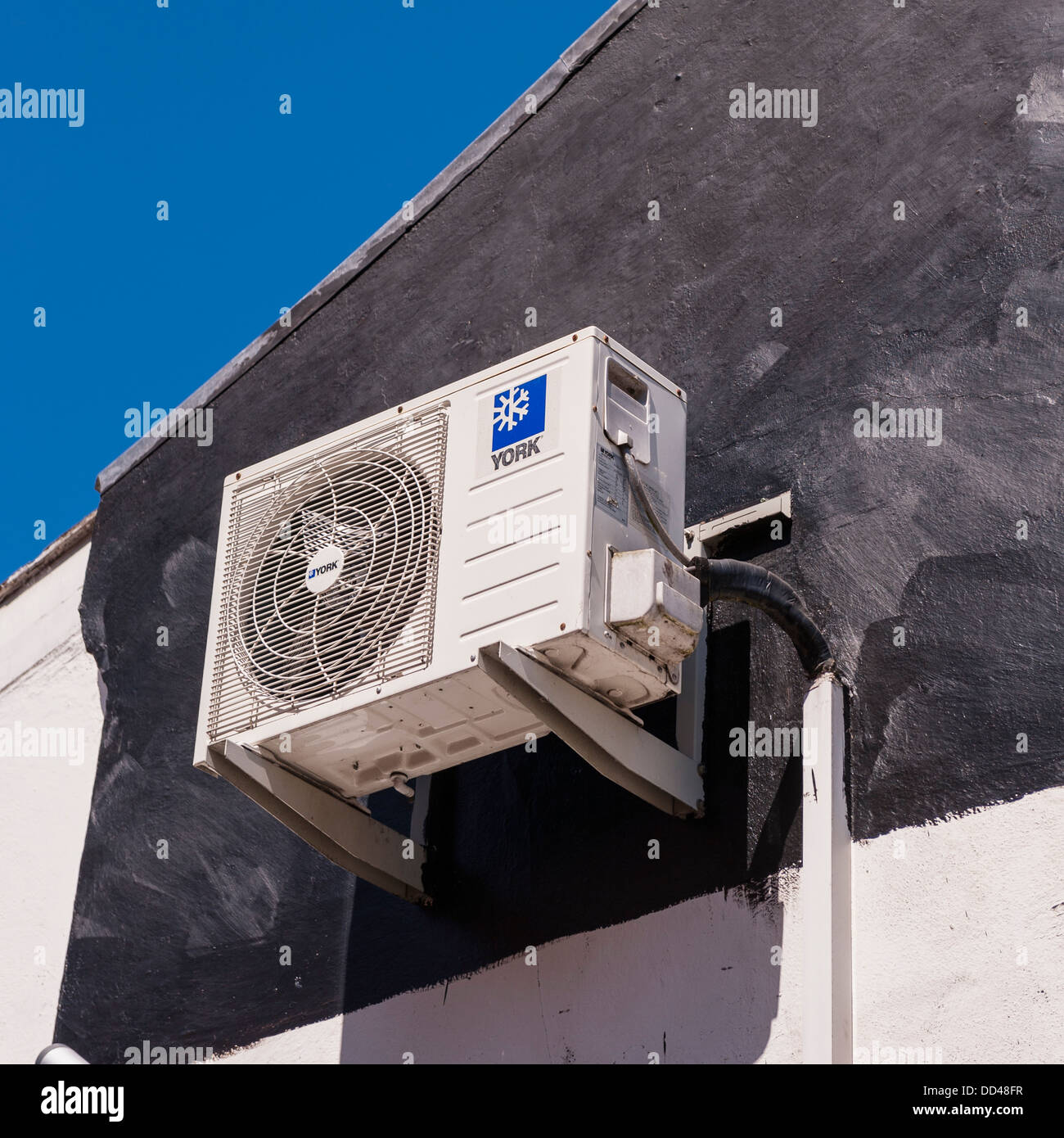
The single-split system remains the most popular choice for European apartments and small houses. It consists of one indoor unit (evaporator) and one outdoor unit (condenser).
- Multi-split systems allow up to five indoor units to connect to a single, more powerful outdoor unit. This is ideal for cooling multiple bedrooms while minimizing the visual impact on the building’s exterior.
2. Monoblock (Pipe-less) Systems
In many European cities, such as Paris, Rome, or Amsterdam, strict heritage laws prohibit placing a condenser on the facade of a building. Monoblock air conditioners solve this by housing all components within a single indoor unit. They only require two small holes drilled through the wall for air intake and exhaust, which are covered by discreet grilles. While slightly noisier and less efficient than split systems, they are often the only legal option for historic properties.
3. Portable Units
Portable air conditioners are the "last resort" for tenants or those in temporary housing. These units vent hot air through a flexible hose placed in a window. In 2026, most portable units in Europe are required to meet stricter noise and energy labels, but they still struggle to match the efficiency of fixed installations.
Installation Challenges and Building Regulations
Installing air conditioning in Europe is rarely a "plug-and-play" process. It involves a complex intersection of environmental law, electrical safety, and urban planning.
The F-Gas Certification Requirement
It is illegal in the European Union for an uncertified individual to install a split-system air conditioner. Under the F-Gas Regulation, anyone handling fluorinated gases must hold a valid certificate. This ensures that refrigerants are not leaked into the atmosphere during commissioning. When purchasing a unit, many retailers are now required to verify that the buyer has contracted a certified installer before the unit can be shipped or collected.
Municipal Permits and Heritage Restrictions
In many European jurisdictions, the exterior of a building is considered public space or part of a protected skyline. Before mounting an outdoor unit, homeowners must often obtain:
- Condominium (Co-proprieté) Approval: If you live in an apartment, the building's homeowners' association must typically vote to approve the installation.
- Urban Planning Permits: Local councils may restrict where units can be placed (e.g., they cannot be visible from the street) or mandate that they be painted to match the building color.
- Noise Ordinances: European units must adhere to strict decibel limits, particularly at night. High-end manufacturers now offer "silent modes" specifically designed to meet these urban noise regulations.
Cost Analysis and Comparison for 2026
The cost of air conditioning in Europe includes the hardware, the "F-Gas" certified installation, and potential electrical upgrades. Prices vary by region, with labor being significantly more expensive in Northern Europe than in Southern or Eastern Europe.
| System Type | Typical Hardware Cost (2026) | Installation Cost (Est.) | Efficiency Rating (Typical) | Best For |
|---|---|---|---|---|
| Single-Split (Wall) | €600 – €1,500 | €800 – €1,200 | A++ to A+++ | Single rooms, modern flats |
| Multi-Split (3 Units) | €2,500 – €4,500 | €1,500 – €2,500 | A++ | Entire apartments |
| Monoblock (No Outdoor) | €1,200 – €2,200 | €300 – €600 | A to A+ | Historic / Heritage buildings |
| Portable (Hose-vented) | €300 – €800 | €0 (DIY) | A | Renters, temporary use |
| Ducted / Centralized | €5,000+ | €3,000+ | A+++ | New builds, total renovations |
Note: Costs are indicative of 2026 market averages and exclude VAT, which varies between 5% (for energy-efficiency upgrades in some countries) and 25%.
Regional Variations in Cooling Needs
Air conditioning requirements are not uniform across the continent. The European market is generally segmented into three climatic zones:
Mediterranean Europe (Spain, Italy, Greece, Southern France)
In these regions, cooling is now a standard feature in almost all new constructions and many renovations. Demand is high for high-capacity systems that can handle sustained temperatures above 35°C. Many of these countries offer tax credits for "green" renovations that include reversible heat pumps.
Central and Western Europe (Germany, France, Benelux, UK)
This region is seeing the fastest growth in the 2020s. While historically these countries relied on natural ventilation, the "urban heat island" effect in cities like London and Berlin has made AC a priority. The focus here is heavily on discreet installation and dual-purpose heating/cooling to replace gas boilers.
Northern Europe and Scandinavia
AC is less about comfort in the summer and more about decarbonizing heat. Air-to-air heat pumps are extremely common in Norway and Sweden, used primarily for heating in winter. However, with warmer summers, the cooling function of these existing units is being utilized more frequently than in previous decades.
Operational Maintenance and Best Practices
To maintain the efficiency of a European AC system in 2026, regular maintenance is mandatory in some jurisdictions for systems over a certain cooling capacity.
- Filter Cleaning: Users should clean the dust filters every two to four weeks during peak season to maintain airflow and indoor air quality.
- Annual Professional Check: A certified technician should check the refrigerant pressures and clean the outdoor heat exchanger annually.
- Condensate Management: Because European buildings are often close together, "dripping" units can cause legal disputes. Ensuring the condensate drain is properly routed into a wastewater pipe or a dedicated collection point is essential.
Frequently Asked Questions
Can I install air conditioning myself in Europe?
No, for split systems, you cannot legally perform the installation yourself. EU law requires a certified professional to handle the refrigerant connection. You may be able to mount the units on the wall and prepare the piping (the "pre-install"), but the final connection and commissioning must be signed off by a licensed F-Gas technician. Portable units and some specific "quick-connect" DIY kits (where the lines are pre-charged) are exceptions, though the latter are becoming rarer under 2026 environmental standards.
How much does it cost to run AC in Europe?
In 2026, running a modern A+++ unit for 8 hours a day during a heatwave typically costs between €0.80 and €1.50 per day, depending on local electricity tariffs. Because reversible units are so efficient, they are often cheaper to run for cooling than traditional electric space heaters are for heating.
Are there subsidies for installing air conditioning?
Yes, but usually only if the unit is a reversible heat pump that serves as a primary or secondary heating source. Many EU member states offer "Energy Efficiency" grants or reduced VAT rates (often as low as 5% or 10%) to encourage homeowners to move away from fossil fuel heating (gas and oil). Check your local national energy agency for current 2026 schemes.
Why do some European cities ban outdoor units?
Aesthetics and heritage preservation. Cities with significant historic architecture view outdoor condensers as "visual pollution." In these cases, you must use an internal monoblock unit or a system where the condenser is hidden in a cellar or attic with ducted air intake.
Is air conditioning bad for the environment?
Modern European systems are significantly more eco-friendly than those of the past. By using low-GWP refrigerants and achieving high SEER ratings, their carbon footprint is minimized. Furthermore, when powered by a decarbonized electrical grid (solar, wind, nuclear), the environmental impact of cooling is vastly reduced compared to older technologies.
Final Recommendation
If you are looking to install air conditioning in Europe in 2026, the most future-proof investment is a high-efficiency reversible air-to-air heat pump using R32 or R290 refrigerant. Prioritize units with an A+++ energy label to mitigate high electricity costs and ensure your installer provides the necessary F-Gas certification for your warranty and legal compliance. Before purchasing, always verify with your local municipality or building association to ensure your chosen outdoor unit location meets local noise and aesthetic regulations.
Image Gallery