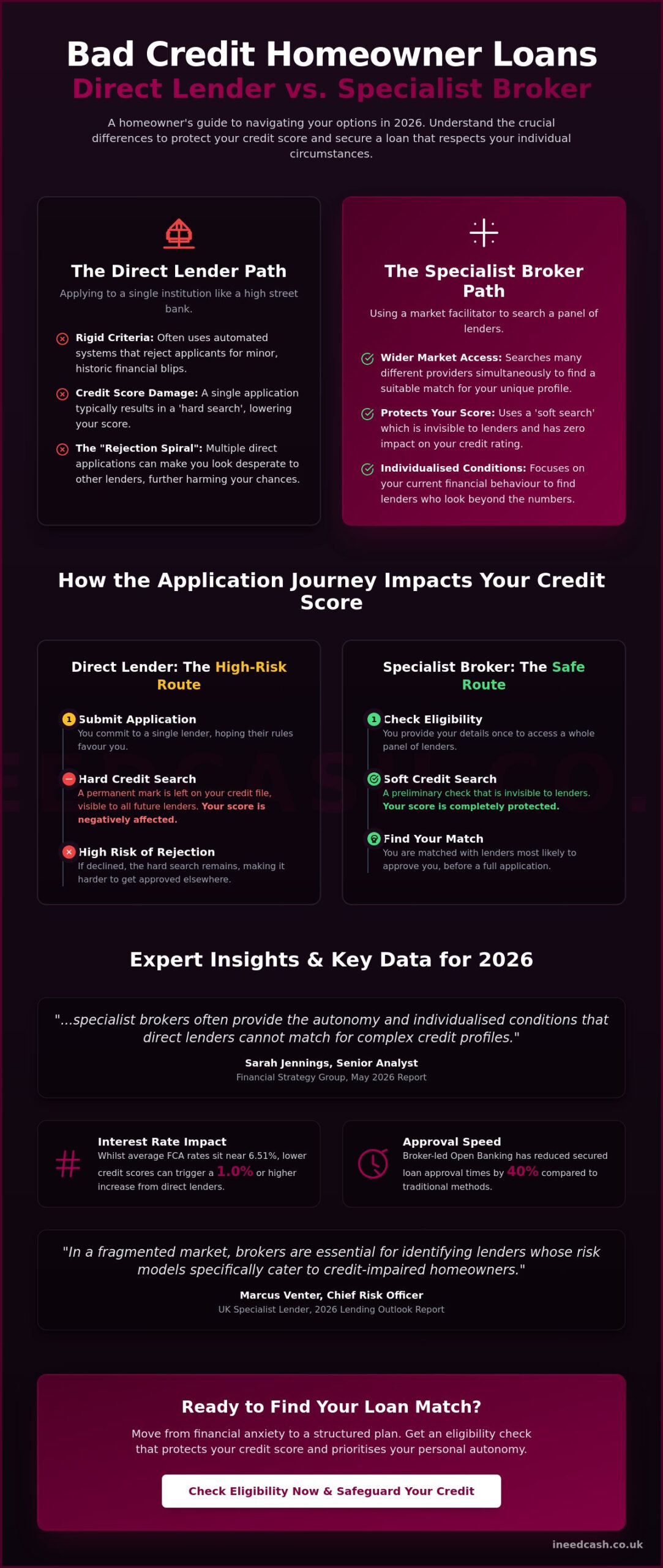
Expert Guide to Navigating Mortgages with a Bad Credit Home Loan Broker
A bad credit home loan broker acts as a specialized intermediary between borrowers with low credit scores and niche lenders willing to accept higher risk. These professionals access non-QM (Non-Qualified Mortgage) products and governme...
A bad credit home loan broker acts as a specialized intermediary between borrowers with low credit scores and niche lenders willing to accept higher risk. These professionals access non-QM (Non-Qualified Mortgage) products and government-backed programs that traditional retail banks often decline, focusing on compensating factors like income stability and down payment size to secure financing.
Contents
Securing a mortgage when your credit history is less than perfect can be a daunting experience. In the financial landscape of 2026, traditional lenders remain conservative, often relying on automated underwriting systems that immediately reject applicants below specific FICO thresholds. This is where a bad credit home loan broker becomes an essential asset. Unlike a standard loan officer at a local bank, a specialist broker understands the nuances of "subprime" or "alternative" lending and maintains relationships with wholesale lenders who do not advertise to the general public.
The Role of a Specialized Mortgage Broker
A bad credit home loan broker does more than just submit paperwork; they act as a strategist. Their primary objective is to present a borrower’s financial profile in the most favorable light possible. They look beyond the three-digit credit score to identify the root causes of past financial distress—such as medical emergencies, divorce, or temporary unemployment—and emphasize current financial recovery.
Brokers in this niche typically have access to a broader array of loan products, including:
- Government-Backed Loans: FHA, VA, and USDA loans which have lower credit requirements by design.
- Non-QM Loans: Mortgages that do not meet the standards of Fannie Mae or Freddie Mac, often used for self-employed borrowers or those with recent credit events.
- Portfolio Loans: Loans kept on the lender’s own books, allowing for more flexible, manual underwriting.
- Private Money Lenders: Often used as short-term "bridge" solutions to help a borrower secure a property while they work on credit repair.
How Brokers Evaluate Credit Challenges in 2026
In 2026, the definition of "bad credit" is not monolithic. Brokers categorize credit issues into several tiers, each requiring a different tactical approach. Understanding these distinctions is the first step in the brokerage process.
Recent vs. Aged Credit Events
Lenders are generally more forgiving of a 580 credit score if the negative marks occurred four or five years ago. However, recent 30-day or 60-day late payments on a current mortgage or auto loan are significant "red flags." A broker will analyze your credit report to determine if you are in a "rebounding" phase or if you are still in active financial distress.
Debt-to-Income (DTI) Ratios
For a bad credit borrower, the Debt-to-Income ratio becomes the most critical metric after the credit score. If your credit is poor, lenders want to see that you have ample "residual income." Brokers often advise clients to pay down high-interest revolving credit (credit cards) to lower their DTI, which can sometimes provide a double benefit by also boosting the credit score through lower credit utilization.
The Importance of Compensating Factors
When a loan file is on the "borderline," brokers lean on compensating factors. These are positive financial attributes that offset the risk of a low credit score. Common factors include:
- Large Down Payment: Putting down 15-20% instead of the minimum 3.5% significantly reduces the lender's risk.
- Substantial Cash Reserves: Having six to twelve months of mortgage payments in a savings account proves you can handle a financial emergency.
- Long-Term Employment Stability: Staying with the same employer for five or more years suggests a reliable income stream.
Standard vs. Bad Credit Brokerage Comparison
The following table highlights the operational differences between a general mortgage broker and one specializing in bad credit scenarios.
| Feature | Standard Mortgage Broker | Bad Credit Home Loan Broker |
|---|---|---|
| Primary Lender Base | Major banks, Fannie/Freddie sellers | Wholesale non-QM, private, and regional banks |
| Credit Score Focus | Usually 620 to 740+ | Often 500 to 620 |
| Underwriting Style | Automated (AUS) | Manual underwriting focus |
| Required Documentation | Standard W2s and tax returns | May use bank statements or asset depletion |
| Turnaround Time | 21–30 days | 30–45 days (due to manual review) |
| Interest Rates | Market competitive | 1% to 3% above prime rates |
The Application Process: A Step-by-Step Breakdown
Working with a bad credit home loan broker requires a higher level of transparency and documentation than a conventional loan.
1. Initial Credit Audit and Discovery
The process begins with a "soft pull" or a review of your existing credit reports from Equifax, Experian, and TransUnion. The broker will ask for the "story" behind every late payment or collection account. According to the Consumer Financial Protection Bureau (CFPB), you have the right to dispute inaccuracies, and a good broker will help identify these before formal application.
2. The Letter of Explanation (LOE)
This is perhaps the most critical document in a bad credit file. The broker will help you draft a formal letter to the underwriter explaining past hardships. The goal is to prove that the circumstances leading to the bad credit were isolated, non-recurring, and are now resolved.
3. Pre-Approval and Rate Quoting
Once the broker identifies a willing lender, they will provide a pre-approval letter. It is important to note that interest rates for bad credit loans in 2026 are typically higher to compensate for the lender's risk. You may also see higher "origination points"—fees paid upfront to the broker or lender.
4. Manual Underwriting
While conventional loans are often approved by a computer, bad credit loans usually go to a human underwriter. This individual will scrutinize every bank statement and pay stub. During this phase, the broker acts as your advocate, answering the underwriter's questions and providing additional "conditions" (documents) as requested.
Common Loan Programs for Low-Credit Borrowers
A specialist broker will typically steer clients toward specific programs designed for credit flexibility.
FHA Loans
The Federal Housing Administration (FHA) remains the cornerstone of bad credit lending. In 2026, FHA guidelines technically allow for scores as low as 500 with a 10% down payment, or 580 with a 3.5% down payment. Brokers often prefer FHA because it allows for high DTI ratios and the use of gift funds for the down payment. Information on current FHA limits and requirements can be found at HUD.gov.
VA Loans
For veterans and active-duty service members, VA loans are the gold standard. The Department of Veterans Affairs does not set a minimum credit score, though individual lenders (overlays) usually do. A bad credit broker knows which VA lenders have the lowest score requirements and the most flexible "residual income" calculations.
Non-QM Bank Statement Loans
For self-employed individuals with bad credit, standard tax returns might not reflect their true ability to pay. Non-QM brokers use 12 to 24 months of bank statements to calculate qualifying income. These loans are vital for entrepreneurs who have significant write-offs on their taxes but strong cash flow.
Costs and Financial Implications
It is essential to be realistic about the costs associated with using a bad credit home loan broker. Because these loans require more labor to move through the pipeline, and because the lenders are taking on more risk, the "price" of the loan is higher.
- Interest Rate Spreads: You can expect to pay anywhere from 100 to 300 basis points (1% to 3%) more than a borrower with a 740 credit score.
- Closing Costs: While many costs are standard (appraisal, title insurance), you might pay higher origination fees.
- Mortgage Insurance (PMI/MIP): For FHA loans, mortgage insurance is mandatory and adds to the monthly cost. For non-QM loans, the "insurance" is often baked into the higher interest rate itself.
Strategic Actions to Take Before Contacting a Broker
Before engaging a broker, taking specific steps can improve your chances of approval and potentially secure a lower rate.
- Avoid New Credit Inquiries: Do not apply for new credit cards or auto loans at least six months before a mortgage application. New inquiries can drop your score and increase your DTI.
- Resolve Small Collections: Sometimes paying off a small $200 medical collection can result in a quick 20-point score increase. Discuss this with your broker before paying, as sometimes "awakening" an old debt can temporarily hurt your score.
- Save for a "Shock" Fund: Lenders worry about "payment shock"—the difference between your current rent and your new mortgage payment. If you can show you have been saving the difference between your rent and your projected mortgage for six months, it proves you can afford the new lifestyle.
Frequently Asked Questions
Can a broker help if I have a recent bankruptcy?
Yes, but timing is everything. For Chapter 7 bankruptcy, most FHA lenders require a two-year waiting period from the discharge date. However, some non-QM "just-missed" products available through brokers may allow for financing just one day out of bankruptcy, though these require significantly higher down payments (often 20-30%).
Will working with a bad credit broker hurt my credit score further?
Initially, a broker may perform a "hard pull" to get an accurate view of your standing. However, multiple inquiries for the same type of loan within a short window (usually 14–45 days) are typically treated as a single inquiry for scoring purposes. A specialist broker is usually careful to only pull credit when a viable path to funding is identified.
How do bad credit brokers get paid?
Brokers are generally paid via "Lender Paid Compensation" (a percentage of the loan amount paid by the lender) or "Borrower Paid Compensation" (a fee paid by you at closing). Under the Truth in Lending Act (TILA), they cannot be paid based on the interest rate they give you, which protects you from brokers unnecessarily inflating your rate to make more money.
Can I get a home loan with a 500 credit score?
While technically possible through some FHA lenders or private money sources, it is extremely challenging. A 500 score usually indicates active collections or very recent defaults. Most brokers will recommend a "rapid rescore" or a few months of credit rebuilding to get you to at least 580, where the pool of available lenders grows significantly.
Final Recommendation
If you are struggling with a low credit score, your first step should be to pull your own reports and highlight every error or old debt. Once you have a clear picture, engage a bad credit home loan broker who specializes in manual underwriting. Do not simply accept the first "no" from a retail bank. In the 2026 mortgage market, the path to homeownership often requires a specialized navigator who knows which doors are still open for those in a financial rebuilding phase. Focus on saving a larger down payment, as this remains the most powerful tool for overcoming a poor credit history.
Image Gallery