All the Kings and Queens of England in Order: A Historical Chronology
Tracing the lineage of English monarchs provides a structured look at the evolution of the British Isles, transitioning from fragmented Anglo-Saxon kingdoms to a unified nation and eventually the global British Empire. This chronology...
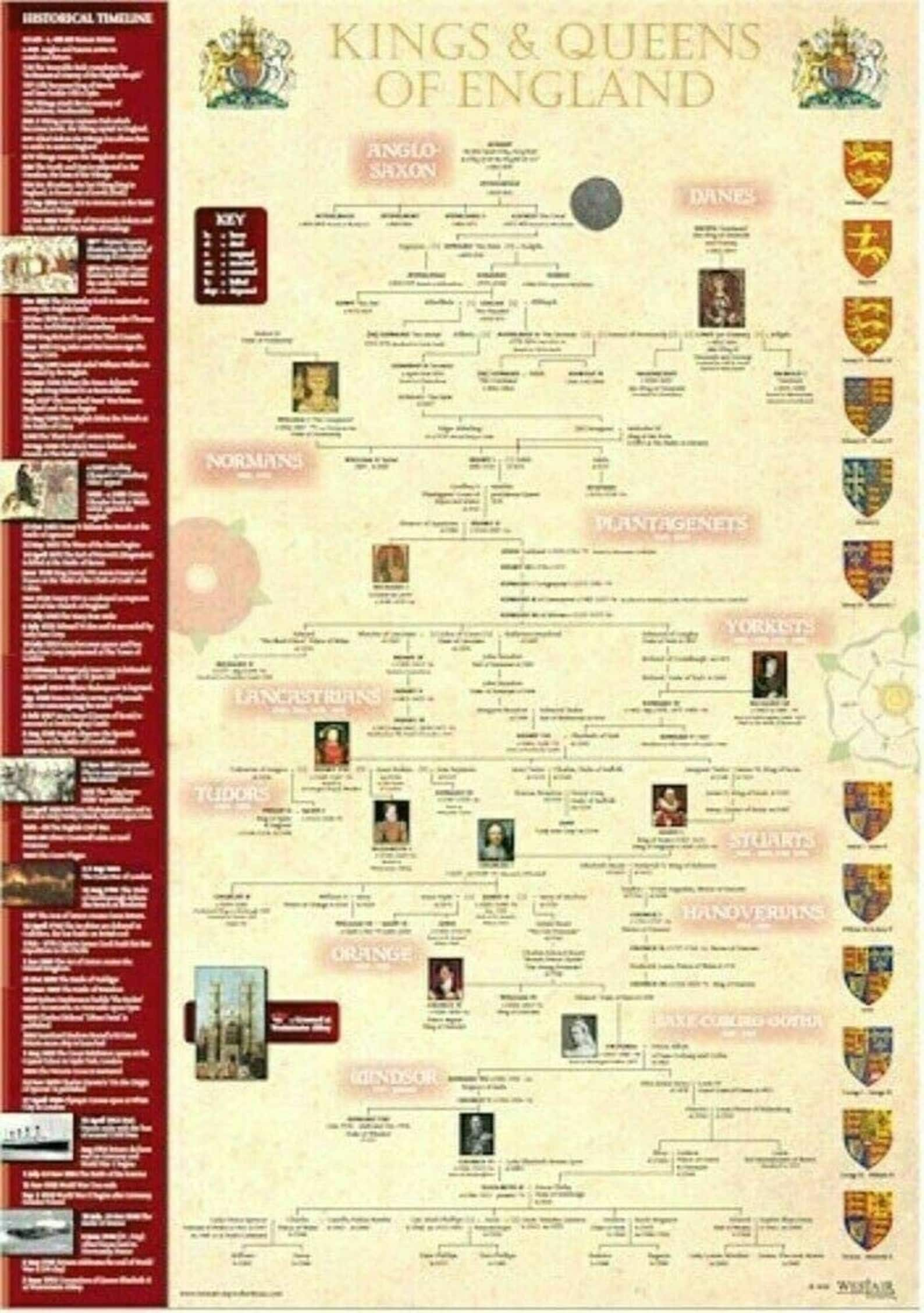
Tracing the lineage of English monarchs provides a structured look at the evolution of the British Isles, transitioning from fragmented Anglo-Saxon kingdoms to a unified nation and eventually the global British Empire. This chronology covers the recognized sovereigns starting from the House of Wessex, through the Norman Conquest, the medieval dynasties, the tumultuous Tudor and Stuart eras, and continuing into the modern Windsor line.
Contents
Establishing the Monarchy: The House of Wessex
The concept of a single "King of England" solidified under the House of Wessex. While earlier rulers held sway over parts of the territory, Athelstan is widely recognized as the first true King of All England, having unified the various Saxon kingdoms following his victory at the Battle of Brunanburh in 937.
The Wessex line faced consistent pressure from Viking invasions, leading to the brief interruption of the Danish House of Knýtlinga (the House of Denmark), most notably under Cnut the Great. However, the restoration of Edward the Confessor brought the throne back to the Wessex line, setting the stage for the succession crisis of 1066.
The Norman Transition and the Plantagenets
The Battle of Hastings in 1066 marked a fundamental shift in the English monarchy. William the Conqueror introduced the Norman-French administration, feudalism, and a new architectural and legal landscape. This era saw the introduction of the Angevin (Plantagenet) dynasty, which expanded English influence significantly into France.
The Plantagenet era is characterized by internal conflict, specifically the Wars of the Roses—a dynastic struggle between the House of Lancaster and the House of York. This period ended when Henry Tudor defeated Richard III at the Battle of Bosworth Field, effectively ending the medieval era of English governance and establishing the Tudor dynasty.
The Tudor and Stuart Eras
The Tudor period is defined by the English Reformation, the expansion of naval power, and the consolidation of absolute power under monarchs like Henry VIII and Elizabeth I. The shift from the Tudors to the Stuarts occurred in 1603 with the Union of the Crowns, linking the English and Scottish thrones under James I.
The 17th century was marked by the English Civil War, the execution of Charles I, and the brief republican experiment under Oliver Cromwell. The monarchy was restored in 1660 under Charles II, leading to the Glorious Revolution, which permanently altered the balance of power between the monarch and Parliament, establishing the foundation for a constitutional monarchy.
The Evolution Toward Constitutional Monarchy
Following the Act of Union in 1707, the Kingdom of England and the Kingdom of Scotland merged into the Kingdom of Great Britain. The House of Hanover succeeded the Stuarts, bringing a new line of German-born monarchs. During this time, the office of the Prime Minister gained prominence, and the monarch’s role shifted from direct executive governance to a symbolic, ceremonial head of state.
In 1901, the House of Saxe-Coburg and Gotha began, later renamed the House of Windsor in 1917 by King George V due to anti-German sentiment during World War I. Today, the monarchy remains an integral part of the constitutional structure, operating within established parliamentary frameworks.
Chronological List of Sovereigns
The following table outlines the sequence of monarchs. Note that the dates provided denote the start and end of their reign.
| Monarch | House | Reign Start | Reign End |
|---|---|---|---|
| Athelstan | Wessex | 927 | 939 |
| Edmund I | Wessex | 939 | 946 |
| Eadred | Wessex | 946 | 955 |
| Eadwig | Wessex | 955 | 959 |
| Edgar the Peaceful | Wessex | 959 | 975 |
| Edward the Martyr | Wessex | 975 | 978 |
| Ethelred the Unready | Wessex | 978 | 1016 |
| Cnut (Canute) | Denmark | 1016 | 1035 |
| Harold Harefoot | Denmark | 1035 | 1040 |
| Harthacnut | Denmark | 1040 | 1042 |
| Edward the Confessor | Wessex | 1042 | 1066 |
| Harold Godwinson | Wessex | 1066 | 1066 |
| William I | Normandy | 1066 | 1087 |
| William II | Normandy | 1087 | 1100 |
| Henry I | Normandy | 1100 | 1135 |
| Stephen | Blois | 1135 | 1154 |
| Henry II | Plantagenet | 1154 | 1189 |
| Richard I | Plantagenet | 1189 | 1199 |
| John | Plantagenet | 1199 | 1216 |
| Henry III | Plantagenet | 1216 | 1272 |
| Edward I | Plantagenet | 1272 | 1307 |
| Edward II | Plantagenet | 1307 | 1327 |
| Edward III | Plantagenet | 1327 | 1377 |
| Richard II | Plantagenet | 1377 | 1399 |
| Henry IV | Lancaster | 1399 | 1413 |
| Henry V | Lancaster | 1413 | 1422 |
| Henry VI | Lancaster | 1422 | 1461 |
| Edward IV | York | 1461 | 1483 |
| Edward V | York | 1483 | 1483 |
| Richard III | York | 1483 | 1485 |
| Henry VII | Tudor | 1485 | 1509 |
| Henry VIII | Tudor | 1509 | 1547 |
| Edward VI | Tudor | 1547 | 1553 |
| Mary I | Tudor | 1553 | 1558 |
| Elizabeth I | Tudor | 1558 | 1603 |
| James I | Stuart | 1603 | 1625 |
| Charles I | Stuart | 1625 | 1649 |
| Charles II | Stuart | 1660 | 1685 |
| James II | Stuart | 1685 | 1688 |
| William III & Mary II | Stuart | 1689 | 1702 |
| Anne | Stuart | 1702 | 1714 |
| George I | Hanover | 1714 | 1727 |
| George II | Hanover | 1727 | 1760 |
| George III | Hanover | 1760 | 1820 |
| George IV | Hanover | 1820 | 1830 |
| William IV | Hanover | 1830 | 1837 |
| Victoria | Hanover | 1837 | 1901 |
| Edward VII | Saxe-Coburg | 1901 | 1910 |
| George V | Windsor | 1910 | 1936 |
| Edward VIII | Windsor | 1936 | 1936 |
| George VI | Windsor | 1936 | 1952 |
| Elizabeth II | Windsor | 1952 | 2022 |
| Charles III | Windsor | 2022 | Present |
Understanding Historical Succession
Succession in the English monarchy has not always followed a direct path of primogeniture. Throughout the medieval and early modern periods, civil wars, religious disputes, and parliamentary acts often dictated who would hold the crown.
The "Acts of Union" of 1707 and 1800 significantly changed the political entity that the monarchs presided over. Consequently, while monarchs before 1707 were technically Kings or Queens of England, subsequent monarchs were sovereigns of Great Britain and eventually the United Kingdom.
Frequently Asked Questions
Who was the last monarch of the House of Tudor? Elizabeth I was the final Tudor monarch. She reigned for 45 years, and upon her death in 1603, the throne passed to her cousin, James VI of Scotland, beginning the Stuart dynasty.
Why did the House of Saxe-Coburg become the House of Windsor? During World War I, King George V felt that the German-sounding name Saxe-Coburg and Gotha was problematic given the ongoing hostilities. He issued a royal proclamation in 1917, legally changing the name of his family to Windsor.
What is the difference between the reign of the monarch and the government? In the modern British system, the monarch serves as the ceremonial head of state, while the Prime Minister and Parliament hold executive legislative authority. This distinction evolved gradually, particularly following the Bill of Rights in 1689.
Did England ever have a period without a monarch? Yes. Following the English Civil War and the execution of Charles I in 1649, England was declared a Commonwealth and later a Protectorate under Oliver Cromwell. This period, known as the Interregnum, lasted until the restoration of the monarchy in 1660.
How does the current line of succession work? Succession is governed by the Act of Settlement 1701 and the Succession to the Crown Act 2013. The 2013 act replaced male-preference primogeniture with absolute primogeniture, meaning that the eldest child succeeds to the throne regardless of gender.
Recommendation for Further Research
For those interested in the intricacies of individual reigns, primary documents such as the Calendar of State Papers or the official records kept by the National Archives of the United Kingdom provide unparalleled insight into the administrative challenges faced by each monarch. For a broader overview of how constitutional changes impacted the monarchy, the website of the official Royal Household provides verified historical timelines and explanations of the role of the sovereign in the current political structure.
Image Gallery