Navigating Cloud Security with Orca AI Security Cloud
Orca AI Security Cloud represents a paradigm shift in cloud-native application protection by utilizing a side-scanning architecture that inspects cloud workloads, configurations, and identities without requiring agents or runtime overh...
Orca AI Security Cloud represents a paradigm shift in cloud-native application protection by utilizing a side-scanning architecture that inspects cloud workloads, configurations, and identities without requiring agents or runtime overhead. This platform maps multi-cloud environments to identify toxic combinations of vulnerabilities, misconfigurations, and lateral movement risks efficiently.
Contents
Understanding the Evolution of Cloud Security and the Orca Approach
Cloud environments have expanded rapidly across multi-cloud and hybrid ecosystems, introducing vast complexity that traditional security tooling struggles to manage. Securing modern infrastructure requires continuous visibility into not just individual misconfigurations, but how multiple minor flaws can compound into critical attack vectors.
Traditional Cloud Workload Protection Platforms (CWPP) and Cloud Security Posture Management (CSPM) tools historically relied on installing agents within individual virtual machines or containers. While functional, this agent-based paradigm introduces operational friction, performance latency, maintenance overhead, and blind spots in serverless architectures or immutable infrastructure where agents cannot be easily deployed.
Orca Security addressed this challenge by developing SideScanning technology. Instead of relying on host-based agents, Orca reads the cloud configuration and storage volumes—specifically the runtime block storage and metadata—out-of-band. By analyzing these snapshots directly from the cloud provider's infrastructure layer, the platform obtains complete visibility into the operating system, applications, middleware, configurations, and data layers without touching the running instance. This approach ensures 100% coverage across dynamic cloud assets from the moment they are spun up, minimizing operational drag and eliminating agent fatigue.
Core Architecture and SideScanning Technology
The operational backbone of Orca AI Security Cloud is its SideScanning mechanism, paired with the patented SideScanning architecture that constructs a comprehensive virtual asset graph. Understanding how this technology works requires examining its interaction with cloud-native APIs and block storage volumes.
When an organization integrates its cloud accounts (such as Amazon Web Services, Microsoft Azure, Google Cloud Platform, or Kubernetes clusters) with Orca, the platform maps the environment by querying control plane APIs. For deeper workload inspection, Orca securely accesses read-only snapshots of the storage volumes or disk images. It evaluates these snapshots for vulnerabilities, malware, leaked credentials, weak passwords, and misconfigurations.
- Cloud Environment
- Workloads
- Identity & IAM
- Storage/DBs
- Read-Only API & Storage Snapshots
- Orca AI Security Cloud
- SideScanning Engine
- Context-Aware Graph Analysis
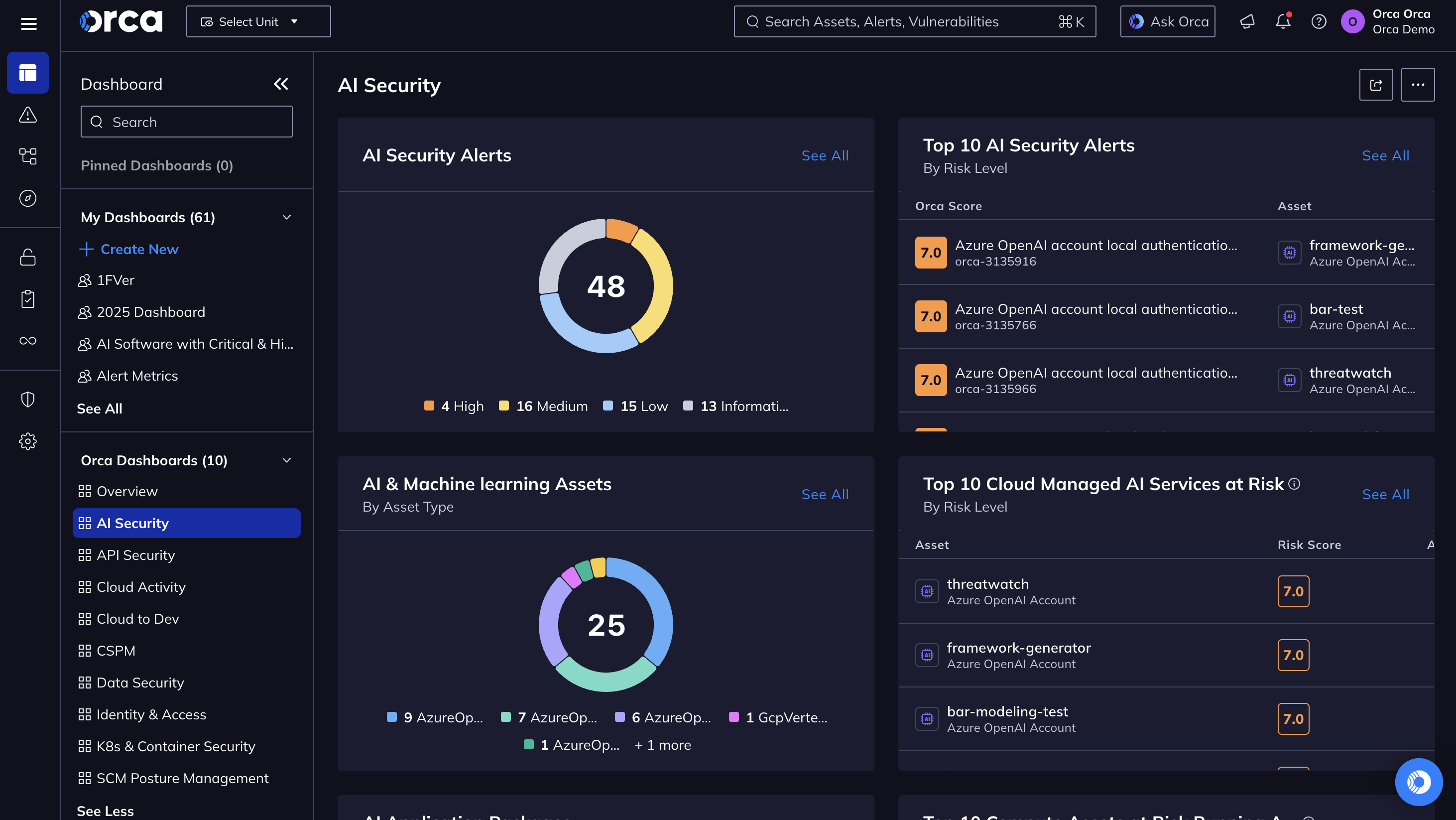
- AI-Driven Risk Prioritization
This out-of-band methodology provides several distinct architectural advantages over legacy security tools:
- Zero Performance Impact: Because scanning occurs externally via snapshots, compute resources are never consumed for security processing, preventing application latency or crashes.
- Universal Asset Discovery: Assets that are ephemeral, auto-scaling, or serverless are automatically captured because storage volumes and control plane metadata are perpetually monitored.
- Comprehensive Depth: The engine inspects beyond surface-level configurations to examine installed packages, libraries, configuration files, and embedded secrets down to the file system level.
AI-Driven Risk Prioritization and the SideScanning Graph
Security teams are frequently overwhelmed by thousands of alerts generated by disparate tooling, leading to alert fatigue and delayed remediation of genuine threats. Orca AI Security Cloud addresses this through its context-aware Unified Data Model and AI-driven risk scoring system.
Rather than treating vulnerabilities, IAM misconfigurations, exposed secrets, and network accessibility as isolated events, Orca synthesizes these data points into a connected graph model. This contextual engine evaluates how disparate flaws interact to form an exploitable attack path. For example, a high-severity vulnerability on a virtual machine may not pose an immediate threat if the machine is entirely isolated from the public internet and possesses restricted IAM permissions. Conversely, a medium-severity vulnerability combined with an overly permissive role, an unencrypted database, and a path to the internet constitutes a critical "toxic combination" that demands immediate intervention.
The integration of artificial intelligence within the platform helps automate the prioritization process. By assessing contextual risk factors—such as whether a vulnerability is actively being exploited in the wild, whether an asset contains sensitive data, and the blast radius of potential lateral movement—Orca ranks remediation tasks based on real-world impact rather than arbitrary CVSS scores alone.
Comprehensive Feature Set Across the Cloud Security Lifecycle
Orca AI Security Cloud delivers a wide array of capabilities consolidated into a single unified SaaS platform. This consolidation reduces the need for disparate point solutions spanning CSPM, CWPP, Identity Threat Detection and Response (ITDR), and Application Security Posture Management (ASPM).
Cloud Security Posture Management (CSPM)
The CSPM module continuously evaluates cloud resource configurations against industry frameworks, compliance standards, and custom organizational policies. It detects misconfigured storage buckets, insecure network security groups, unauthorized IAM policies, and compliance drift across multi-cloud and Kubernetes environments.
Cloud Workload Protection (CWPP)
Leveraging SideScanning, the CWPP component scans operating systems, containers, and serverless functions for vulnerabilities, malware, and misconfigurations. It maintains inventory accuracy without requiring agent deployment or maintenance cycles, ensuring deep visibility into container registries and serverless runtimes.
Identity and Access Management (IAM) Security
Cloud identities represent one of the largest attack surfaces in modern enterprise infrastructure. Orca maps human and non-human identities (such as service accounts, roles, and API keys), analyzes effective permissions versus actual usage, and flags excessive privileges or toxic permission combinations that enable privilege escalation.
Data Security Posture Management (DSPM)
Orca identifies, classifies, and maps sensitive data across cloud storage accounts, databases, and file systems. It detects where personally identifiable information (PII), intellectual property, or financial records reside, and correlates data exposure with external accessibility and workload vulnerabilities.
Shift-Left Security and Infrastructure as Code (IaC)
To catch vulnerabilities before production deployment, Orca integrates with developer workflows and CI/CD pipelines. It scans Infrastructure as Code templates (such as Terraform, AWS CloudFormation, and Kubernetes manifests) to prevent misconfigurations and compliance violations from reaching the cloud environment.
Comparison of Cloud Security Architectures
Evaluating cloud security platforms requires understanding how architectural choices impact operational overhead, visibility, and risk reduction. The following table contrasts agent-based models with Orca's agentless SideScanning approach.
| Architectural Dimension | Agent-Based Security Tools | Orca AI Security Cloud (SideScanning) |
|---|---|---|
| Deployment & Onboarding | Requires installing agents on every workload; complex in auto-scaling environments. | Single API integration per cloud account; instantaneous visibility. |
| Performance Impact | Consumes host CPU, memory, and disk I/O; potential application instability. | Zero runtime footprint; analysis runs out-of-band via cloud storage snapshots. |
| Coverage Completeness | Blind spots in serverless, PaaS, containers, and ephemeral assets where agents cannot run. | Comprehensive coverage across VMs, containers, serverless, and cloud-native storage. |
| Contextual Analysis | Treats vulnerabilities, IAM, and network configs in isolation; high alert noise. | Synthesizes all security layers into a unified graph to identify toxic combinations. |
| Maintenance Overhead | High operational burden managing agent updates, compatibility issues, and broken deployments. | Maintenance-free operational model managed entirely through platform updates. |
Operational Implementation and Best Practices
Deploying Orca AI Security Cloud involves a structured onboarding process designed to minimize friction while establishing immediate security visibility. Organizations typically follow a standardized implementation lifecycle.
- Account Integration: Connect cloud accounts to the Orca platform using native read-only IAM roles or service accounts. This grants the platform secure, least-privilege access to API control planes and storage snapshots.
- Initial Environment Discovery: Allow the scanning engine to execute its initial baseline assessment. Within minutes, the platform builds the Unified Data Model, mapping all assets, identities, and configurations.
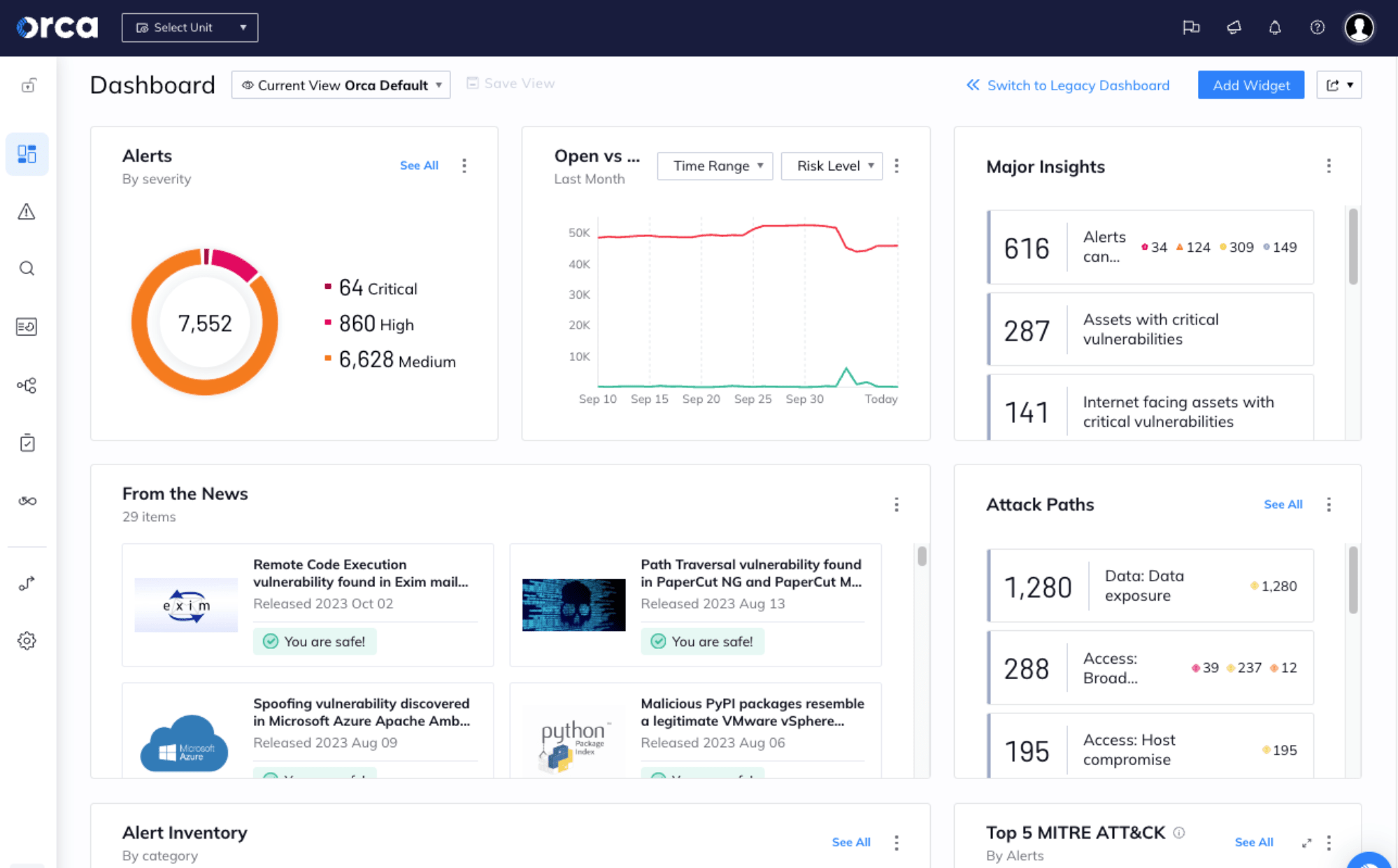
- Triage and Prioritization: Review the generated dashboard, focusing primarily on prioritized "toxic combinations" rather than raw vulnerability counts. Establish baseline remediation workflows for critical attack paths.
- Integration with Workflow Systems: Configure notifications and ticket routing to connect Orca findings with developer tools, SIEM platforms, and ticketing systems such as Jira, ServiceNow, PagerDuty, or Slack.
- Continuous Governance and Compliance: Enable automated compliance reporting against frameworks such as SOC 2, ISO 27001, HIPAA, PCI-DSS, and NIST, establishing continuous monitoring for configuration drift.
Common Operational Challenges and Mitigation Strategies
Organizations adopting cloud security platforms frequently encounter specific organizational and technical hurdles. Navigating these challenges effectively ensures maximum return on investment and sustained security posture improvement.
- Alert Fatigue and Triage Overload: Security teams accustomed to traditional vulnerability scanners often struggle with the transition to graph-based risk scoring. Mitigation: Focus remediation efforts strictly on attack paths and toxic combinations identified by Orca rather than attempting to patch every isolated low-severity vulnerability.
- IAM Complexity and Non-Human Identities: Modern applications rely heavily on service accounts and cross-account roles that are difficult to manually audit. Mitigation: Utilize Orca's identity mapping features to automatically identify unused privileges and restrict effective permissions to align with the principle of least privilege.
- Cross-Departmental Collaboration: Security teams often operate in silos separate from development and DevOps engineers. Mitigation: Integrate shift-left scanning into CI/CD pipelines early, empowering developers to remediate misconfigurations in Infrastructure as Code templates before code reaches production.
Frequently Asked Questions
Does Orca AI Security Cloud impact application performance during scans?
No. Because Orca utilizes an agentless SideScanning architecture that analyzes cloud storage snapshots and API metadata out-of-band, it consumes zero host CPU, memory, or network bandwidth, ensuring zero runtime impact on running applications.
How does Orca handle data privacy and security during snapshot scanning?
Orca accesses read-only snapshots of block storage volumes within the customer's cloud environment. Data is processed securely according to strict compliance standards, and ephemeral scan data is discarded after analysis is complete, ensuring customer data privacy is maintained.
Can Orca replace both CSPM and CWPP tools?
Yes. Orca consolidates Cloud Security Posture Management (CSPM), Cloud Workload Protection (CWPP), Identity Threat Detection and Response (ITDR), Data Security Posture Management (DSPM), and Infrastructure as Code (IaC) security into a single unified platform.
What cloud providers are supported by the platform?
Orca supports major cloud service providers including Amazon Web Services (AWS), Microsoft Azure, Google Cloud Platform (GCP), Kubernetes, and Alibaba Cloud, providing a unified dashboard for multi-cloud environments.
How does the platform prioritize which vulnerabilities to fix first?
Rather than relying solely on CVSS scores, Orca uses its context-aware Unified Data Model to identify toxic combinations—such as when a vulnerable asset is also exposed to the internet, possesses high-privilege IAM roles, and contains sensitive data. This highlights attack paths that represent actual exploitability.
Next Steps for Cloud Security Teams
Evaluating or expanding a cloud security strategy requires assessing current tooling blind spots and architectural overhead. Organizations looking to modernize their cloud defense should conduct an inventory of existing multi-cloud assets, evaluate current agent maintenance burdens, and schedule a targeted proof-of-concept to measure visibility improvements across complex workloads and serverless environments.
Image Gallery