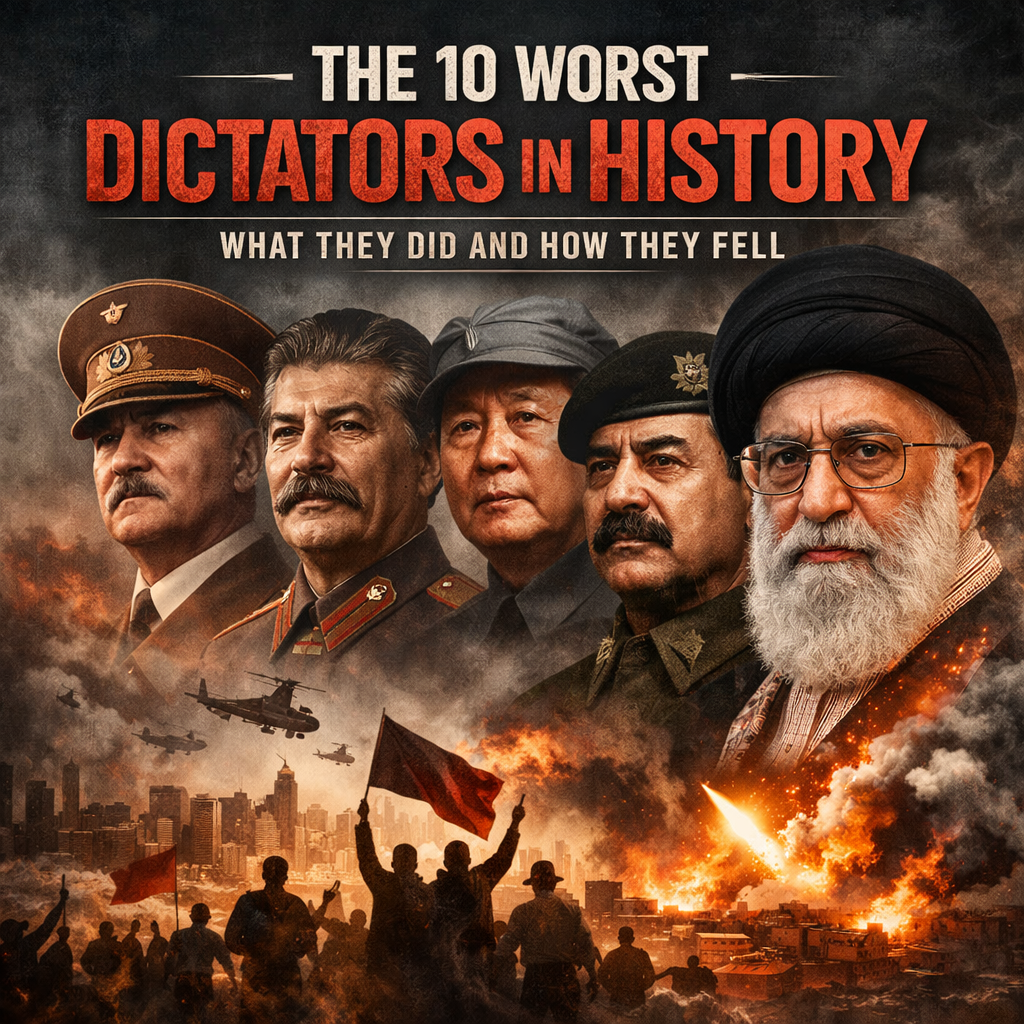
The Evolution of Famous Dictators and the Debates That Follow
The evolution of famous dictators has transitioned from classical military autocracy and absolute monarchy to 20th-century ideological totalitarianism, eventually reaching the modern "spin dictatorship" of 2026. This progression trigge...
The evolution of famous dictators has transitioned from classical military autocracy and absolute monarchy to 20th-century ideological totalitarianism, eventually reaching the modern "spin dictatorship" of 2026. This progression triggers enduring debates regarding the influence of individual agency versus systemic failure and the ethics of historical memorialization in modern society.
Contents
Throughout human history, the figure of the "dictator" has transformed from a legitimate, temporary legal office in the Roman Republic to a symbol of absolute power and systemic oppression. In 2026, as we analyze the remnants of 20th-century regimes alongside emerging digital autocracies, the study of these figures remains essential for understanding how democratic institutions erode. The evolution is not merely a change in personnel but a sophisticated adaptation of control mechanisms, moving from raw physical terror to the manipulation of information and legal frameworks.
The Classical Origin and the Roman Precedent
The term "dictator" did not always carry the pejorative weight it does today. In the early Roman Republic, the dictatura was a legal constitutional office. During times of extreme emergency, such as war or internal sedition, the Roman Senate could appoint a single individual with near-absolute power for a strictly limited period, usually six months.
The most cited example is Cincinnatus, who was granted dictatorial powers to defend Rome, defeated the enemy in fifteen days, and immediately resigned to return to his farm. This "classical" model of dictatorship was characterized by its temporary nature and its subservience to the law. However, the evolution toward permanent autocracy began with Lucius Cornelius Sulla and reached its apex with Julius Caesar, who was named dictator perpetuo (dictator in perpetuity). Caesar’s transition from a temporary magistrate to an eternal ruler signaled the death of the Republic and set the template for the absolute monarchs of the middle ages and the Enlightenment.
The primary debate following this era focuses on Institutionalism. Historians argue whether the Roman Republic fell because of the "greatness" or "ambition" of Caesar, or because the institutions themselves had already decayed due to wealth inequality and military professionalization. This tension—between the individual leader and the failing system—remains a central pillar of political science.
The 20th Century: The Rise of the Totalitarian Ideologues
The industrial revolution and the advent of mass media in the 20th century facilitated an evolution in autocracy: the transition from authoritarianism to totalitarianism. Unlike classical tyrants who were content with outward obedience and tax revenue, totalitarian dictators like Adolf Hitler, Joseph Stalin, and Mao Zedong sought total control over the private lives, thoughts, and beliefs of their subjects.
The Mechanism of Ideology and Terror
This era introduced the "Cult of Personality." Dictators were no longer just rulers; they were depicted as infallible, quasi-divine figures who embodied the will of "the people" or the "proletariat." The evolution here was technological. The radio and cinema allowed Hitler and Goebbels to bypass traditional hierarchies and speak directly to the masses. Stalin utilized the secret police (NKVD) to create a climate of pervasive fear where the state was the only source of truth.
The Intentionalist vs. Functionalist Debate
One of the most profound debates in the study of 20th-century dictators is the Intentionalist vs. Functionalist controversy.
- Intentionalists argue that the horrors of these regimes, such as the Holocaust or the Great Purge, were the direct result of the dictator's long-term master plan. They place the agency entirely on the leader's will.
- Functionalists (or Structuralists) suggest that these outcomes were the result of "cumulative radicalization" within a chaotic bureaucracy. In this view, lower-level officials competed to "work toward the Führer," leading to increasingly radical policies that the dictator may have only vaguely endorsed.
This debate is crucial for 2026 policymakers because it determines whether preventing autocracy requires monitoring individual "strongmen" or strengthening the bureaucratic guardrails that prevent radicalization.
The Digital Age and the "Spin Dictator" (2020–2026)
As we stand in 2026, the evolution of dictators has taken a more subtle, "illiberal" turn. Modern dictators, often referred to by political scientists Sergei Guriev and Daniel Treisman as "Spin Dictators," have largely abandoned the mass violence and overt censorship of the 20th century. Instead, they maintain power through the manipulation of information and the subversion of democratic institutions from within.
Control Through Information and Law
Current autocrats in the mid-2020s focus on maintaining high popularity ratings rather than relying on fear. They use state-controlled media and sophisticated social media bots to drown out dissent with "noise" rather than "silence." They do not abolish elections; they tilt the playing field so far that the opposition cannot realistically win. This evolution is seen in the "democratic backsliding" of nations where leaders use legal "lawfare" to bankrupt critics or disqualify rivals.
The debate following this evolution concerns the "Dictator’s Dilemma" in the digital age. Can a regime remain economically competitive while restricting the free flow of information? The 2026 landscape shows a split: some regimes have successfully implemented "Digital Authoritarianism," using AI and facial recognition to monitor citizens, while others struggle with the transparency that global trade demands.
Comparative Analysis of Dictatorial Evolution
The following table outlines the key differences in how dictatorial power has been exercised and justified across different historical epochs.
| Feature | Classical Dictatorship | 20th-Century Totalitarianism | 21st-Century Spin Dictatorship (2026) |
|---|---|---|---|
| Source of Power | Legal/Military Appointment | Revolutionary Ideology/Mass Party | Electoral Manipulation/Legalism |
| Duration | Temporary (Emergency) | Life-long / Perpetual | Indefinite through Term-limit Removal |
| Primary Tool | Legions/Army | Secret Police/State Terror | Media Control/AI Surveillance |
| Public Relationship | Obedience & Tax | Total Ideological Commitment | Passive Support/Cynicism |
| Economic Strategy | Conquest/Agriculture | State-Directed Industry | Crony Capitalism/Global Integration |
| Example Figures | Sulla, Caesar | Stalin, Hitler, Mao | Orbán, Putin, Various Digital Autocrats |
The Enduring Debates: Agency, Memory, and "Benevolence"
The evolution of dictators leaves a trail of psychological and ethical debates that societies must navigate long after the regimes fall. These debates are not merely academic; they influence modern law and international relations.
The Myth of the "Benevolent Dictator"
A recurring debate is whether a "benevolent dictator" can exist—a leader who uses absolute power to force through necessary economic reforms that a fractious democracy cannot achieve. Proponents often point to Lee Kuan Yew of Singapore or Augusto Pinochet’s economic "miracle" in Chile. However, critics argue that "benevolence" is a subjective mask for the suppression of human rights, and that economic gains under autocracy are often fragile and concentrated among a small elite.
The Banality of Evil
Post-World War II, the philosopher Hannah Arendt introduced the concept of the "banality of evil" during the trial of Adolf Eichmann. This sparked a debate that continues in 2026: are dictators supported by monsters, or by ordinary bureaucrats who simply "follow orders"? This shifts the focus of the "evolution of dictators" away from the person at the top and toward the social psychology of the populace.
Memorialization and Historical Revisionism
In 2026, many nations are grappling with how to handle the physical and cultural legacy of former dictators. The debate over whether to preserve or destroy statues of figures like Stalin or Franco touches on the tension between preserving history and refusing to honor oppression. Some argue that removing these markers is a form of revisionism, while others contend that their presence in public squares continues the "psychological evolution" of the dictatorship even after the leader is gone.
Practical Recommendations for Monitoring Autocratic Trends
Understanding the evolution of dictators is the first step toward preventing their resurgence. In 2026, students of history and political science should prioritize the following actions to identify and mitigate autocratic shifts:
- Monitor "Lawfare" and Regulatory Capture: Watch for instances where the executive branch uses tax audits, defamation suits, or sudden regulatory changes to silence independent media and business leaders.
- Evaluate Information Integrity: Use decentralized verification tools to distinguish between organic public opinion and state-sponsored "astroturfing" on social media platforms.
- Strengthen Local Institutions: Historical data suggests that dictators evolve most effectively when power is highly centralized. Supporting federalism and local municipal autonomy creates "speed bumps" for aspiring autocrats.
- Engage with Comparative History: Avoid viewing modern leaders in a vacuum. Compare current rhetoric with the historical patterns of 20th-century "Cult of Personality" development to spot early warning signs.
Frequently Asked Questions
What is the main difference between an authoritarian and a totalitarian dictator?
An authoritarian dictator focuses on political control and maintaining the status quo, often allowing some private freedoms as long as the regime's power is not challenged (e.g., Pinochet). A totalitarian dictator seeks to regulate every aspect of life, including private thoughts, culture, and family dynamics, through a mandatory state ideology (e.g., North Korea's Kim dynasty).
Why do some people still support dictators in 2026?
Support often stems from a desire for "order" or "efficiency" in the face of perceived democratic gridlock or economic crisis. Dictators frequently use "identity politics" or external threats to create a "rally 'round the flag' effect," convincing the populace that only a strongman can protect them from an existential enemy.
Has AI changed the way dictators evolve?
Yes. In 2026, AI allows for "predictive policing" and automated censorship. Modern autocrats no longer need thousands of physical spies; they can use algorithms to identify potential dissenters before they even organize, making the modern evolution of dictatorship more efficient and less visibly violent.
What was the "Great Man Theory" debate?
The Great Man Theory, popularized by Thomas Carlyle in the 19th century, suggested that history is shaped primarily by the decisions of unique, powerful individuals. The debate follows that this ignores the "Structuralist" view—that dictators are merely products of their time, rising to power because of economic collapses, class struggles, or historical momentum that would have produced a similar leader regardless of the individual.
Can a democracy "evolve" into a dictatorship legally?
Historically, many dictators have come to power through legal or semi-legal means. Both Hitler and Mussolini utilized existing constitutional frameworks to achieve power before dismantling those same frameworks from the inside. This "legal evolution" is a primary concern for modern international watchdogs.
Image Gallery