Best Trading Books for Beginners: A Complete Educational Roadmap
Finding the best trading books for beginners requires focusing on texts that teach market mechanics, technical analysis, risk management, and trading psychology. High-quality educational books provide a structured foundation, helping n...
Finding the best trading books for beginners requires focusing on texts that teach market mechanics, technical analysis, risk management, and trading psychology. High-quality educational books provide a structured foundation, helping new market participants understand price action, risk-to-reward ratios, and emotional discipline before risking real capital in stock, forex, futures, or options markets.
Contents
Why Literature Remains the Strongest Starting Point for New Traders
Entering the financial markets without practical knowledge frequently results in rapid capital loss. While short-form video tutorials and online social forums offer quick snapshots of trading, structured books written by seasoned market professionals offer deep, systematic frameworks. Reading comprehensive literature forces beginners to slow down, absorb core concepts, and build a theoretical baseline before dealing with live market volatility.
A common pitfall for novice market participants is confusing trading with pure speculation or gambling. Authors with decades of institutional or private trading experience emphasize that sustainable market participation relies heavily on risk management and statistical probability. Books provide the context necessary to evaluate strategies objectively, build personalized trading plans, and avoid predictable mistakes made by uneducated market participants.
Disclaimer: Trading stocks, options, futures, and currencies involves substantial risk of financial loss. Educational materials and book recommendations serve strictly informational purposes and do not constitute individualized financial, investment, or legal advice.
Core Pillars Every Beginner Trading Book Should Cover
Before purchasing market literature, beginners should understand the core disciplines required to navigate active trading. A well-rounded trading curriculum balances four core pillars:
- CORE PILLARS OF TRADING STUDY
- Market Mechanics: Order types, bid-ask, liquidity.
- Technical Analysis: Price charts, trends, and indicators.
- Risk Management: Position size, stop-losses, risk ratios.
- Trading Psychology: Emotional discipline, mindset.
- Market Mechanics and Microstructure: Understanding how order books operate, how buyers and sellers interact, the role of liquidity, bid-ask spreads, and order routing (limit vs. market orders).
- Technical Analysis: Learning how to read price charts, identify trends, recognize support and resistance levels, and interpret volume and momentum indicators.
- Risk Management: Mastering position sizing, calculating risk-to-reward ratios, setting stop-loss orders, and preserving capital during market drawdowns.
- Trading Psychology: Developing emotional control, managing fear and greed, cultivating patience, and adhering strictly to execution rules under pressure.
Essential Trading Books for Beginners Categorized by Focus
1. Foundational Systems and Market Mechanics
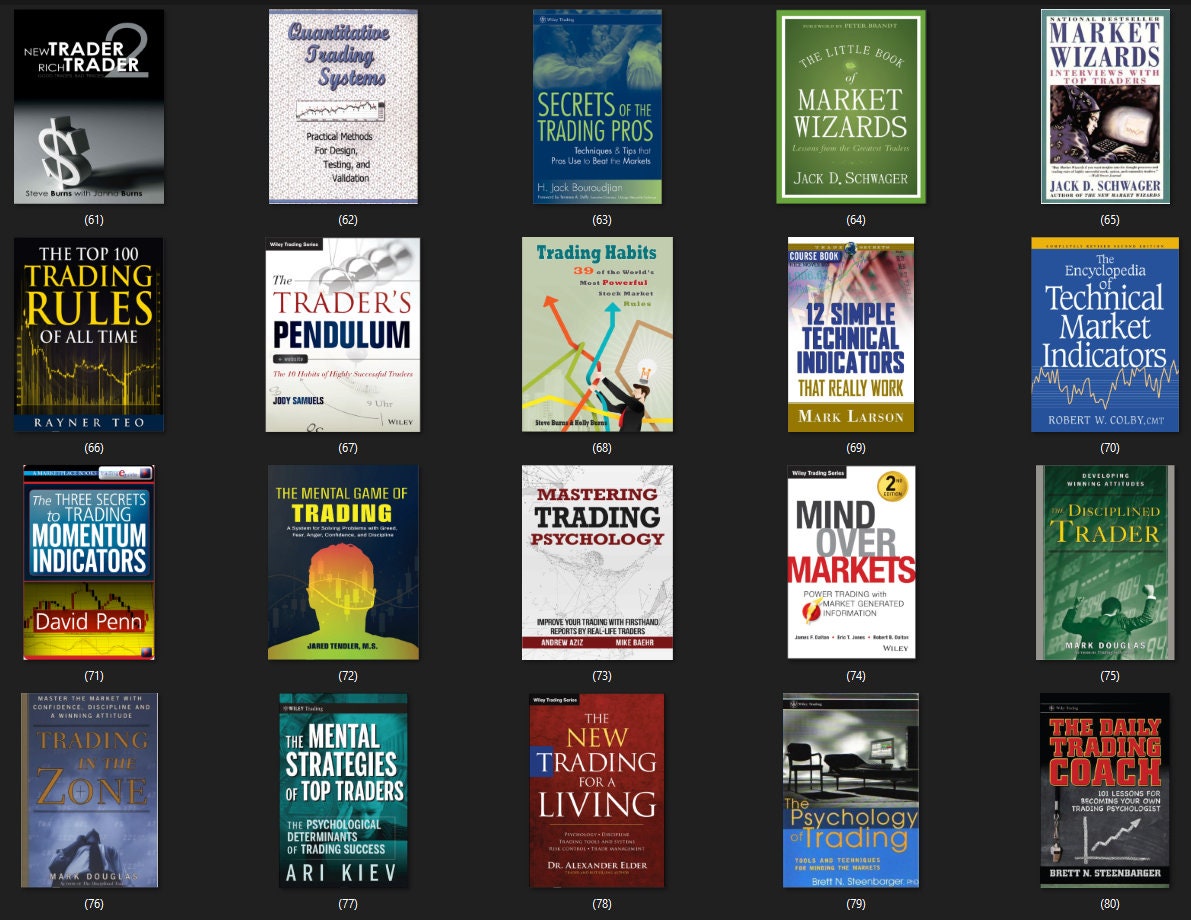
The New Trading for a Living by Dr. Alexander Elder
Dr. Alexander Elder’s classic work is widely considered one of the definitive primers for novice retail traders. Elder organizes the text around the "3 Ms": Mind (psychology), Method (charting and indicators), and Money (risk management).
- Key Takeaway: Success does not come from a single technical secret; it requires equal mastery of psychological discipline, system rules, and strict risk control.
- Why It Suits Beginners: Elder explains complex technical tools—such as moving averages, MACD, and impulse systems—in plain language while providing actionable guidelines for position sizing (such as the 2% rule per trade).
How to Make Money in Stocks by William J. O'Neil
Written by the founder of Investor's Business Daily, this classic introduces the CAN SLIM investment and trading methodology. It bridges fundamental analysis (company earnings, sales growth, product innovation) with technical entry points (chart patterns like cup-with-handle breakouts).
- Key Takeaway: Combining strong underlying fundamental factors with precise technical timing maximizes the probability of identifying high-performing growth stocks.
- Why It Suits Beginners: It offers a rule-based approach to stock selection, teaching beginners exactly when to buy growth stocks and, more importantly, when to cut losses short (e.g., establishing a hard stop-loss limit at 7% to 8% below entry).
2. Technical Analysis and Chart Reading
Technical Analysis of the Financial Markets by John J. Murphy
Often referred to as the "bible" of technical analysis, John Murphy’s comprehensive text covers every major aspect of chart interpretation. From trendlines and price patterns to momentum indicators, volume analysis, and intermarket relationships, this book serves as an exhaustive reference guide.
Sample Technical Analysis Concepts Covered:
- Trend Lines: Support (Floor) & Resistance (Ceiling)
- Price Patterns: Head & Shoulders, Double Bottoms, Flags
- Oscillators: Relative Strength Index (RSI), Stochastics, MACD
- Intermarket Analysis: Stock/Bond yields, Currencies, Commodities
- Key Takeaway: Price charts reflect all known fundamental information, market expectations, and human psychology in real time.
- Why It Suits Beginners: Although detailed, it is structured logically. Beginners can read the introductory chapters on chart types and trend determination before referencing more advanced topics like point-and-figure charting or Elliott Wave theory.
A Beginner's Guide to Day Trading for a Living by Andrew Aziz
For readers specifically interested in short-term day trading dynamics, Andrew Aziz breaks down the tools, software requirements, and precise day trading setups necessary to navigate intraday market volatility.
- Key Takeaway: Day trading requires operational discipline, professional execution software, and strict adherence to predetermined risk limits.
- Why It Suits Beginners: Aziz avoids vague generalities and instead presents concrete setups (e.g., VWAP breakouts, bull flag patterns) along with real-world examples of order entry, stop placement, and trade management.
3. Trading Psychology and Behavioral Finance
Trading in the Zone by Mark Douglas
Mark Douglas addresses the psychological hurdles that cause traders to sabotage their own accounts. The book explores why intelligence and academic brilliance do not guarantee trading profits, focusing instead on probabilistic thinking.
- Key Takeaway: The market is an environment of dynamic uncertainty. To trade consistently, one must accept risk completely and think in terms of probabilities rather than individual trade outcomes.
- Why It Suits Beginners: Novice traders frequently suffer from severe emotional reactions to losses. Douglas explains how to eliminate fear, trade without hesitation, and build a process-oriented mindset detached from outcome bias.
The Daily Trading Coach by Brett N. Steenbarger
Dr. Brett Steenbarger, a clinical psychologist and trading coach for hedge funds and proprietary trading desks, presents 101 self-improvement lessons designed to help traders act as their own performance coaches.
- Key Takeaway: Sustainable trading improvement requires daily assessment, structured goal-setting, deliberate practice, and cognitive reframing of trading errors.
- Why It Suits Beginners: Rather than offering abstract advice, each chapter outlines a specific lesson, a deep-dive explanation, and a practical exercise that beginners can execute immediately in their daily journal routines.
Side-by-Side Comparison of Essential Beginner Books
| Book Title | Author | Core Focus Area | Technical Level | Primary Target Audience |
|---|---|---|---|---|
| The New Trading for a Living | Dr. Alexander Elder | System Development & Risk | Beginner to Intermediate | General Retail Traders |
| How to Make Money in Stocks | William J. O'Neil | CAN SLIM / Growth Stocks | Beginner | Swing Traders & Investors |
| Technical Analysis of Financial Markets | John J. Murphy | Charting & Technical Indicators | Beginner to Advanced | Technical Chartists |
| A Beginner's Guide to Day Trading | Andrew Aziz | Intraday Mechanics & Setups | Absolute Beginner | Day Traders |
| Trading in the Zone | Mark Douglas | Mindset & Behavioral Finance | All Levels | All Active Market Participants |
| The Daily Trading Coach | Brett N. Steenbarger | Performance & Self-Coaching | Intermediate | Process-Oriented Traders |
How to Apply Book Knowledge Without Losing Capital
Reading trading literature provides theoretical knowledge, but real skill develops through deliberate application. Beginners should follow a structured sequence to transition from passive reader to active market participant.
- Step 1: Read & Annotate Core Texts
- Learn terms, risk rules, and setup definitions.
- Step 2: Forward-Test on Paper Trading / Demo Platforms
- Execute 50-100 trades without real capital to test rules.
- Step 3: Analyze Trade Performance in a Journal
- Record win rate, risk-reward ratios, and execution errors.
- Step 4: Transition to Micro-Sized Live Accounts
- Trade minimal share/lot sizes to adapt to real psychological pressure.
1. Build a Rules-Based Trading Plan
Never execute a real trade based on a single chapter highlight. Extract specific concepts from your reading—such as entry triggers, profit targets, and maximum stop losses—and organize them into a written trading plan.
2. Practice via Paper Trading
Before committing capital, utilize a paper trading (demo) account on a recognized broker platform like Interactive Brokers or Thinkorswim. Execute a minimum of 50 to 100 simulated trades adhering strictly to the guidelines learned from books like Elder's or Aziz's. This verifies whether you understand order execution, slippage, and platform tools.
3. Maintain a Quantitative Trading Journal
Keep a detailed log of every trade executed during your learning phase. Document:
- Date and time of entry/exit
- Ticker symbol and market condition
- Planned risk vs. actual realized risk
- Chart pattern or catalyst relied upon
- Emotional state during management
Common Mistakes Beginners Make When Reading Financial Books
Even dedicated students fall into common traps when consuming market literature:
- Searching for a "Holy Grail" Strategy: Beginners often jump from book to book, searching for a mechanical trading strategy with a 100% win rate. Highly profitable systems do not exist; sustainable traders manage downside risk while allowing statistical advantages (edges) to play out over large sample sizes.
- Ignoring Risk Management Chapters: Readers frequently skim over chapters detailing position sizing formulas and capital preservation in order to focus exclusively on entry indicators. Without risk management, even a strategy with an 80% win rate can suffer catastrophic account blowouts during a bad streak.
- Overloading on Conflicting Methodologies: Trying to combine O’Neil’s growth stock momentum rules with deep value investing or high-frequency intraday setups creates analysis paralysis. Stick to one core methodology until you understand its strengths and weaknesses.
- Confusing Theoretical Understanding with Execution Skill: Understanding technical indicators on a static historical chart in a book is vastly different from managing a position in live markets as price moves rapidly against your entry.
Frequently Asked Questions
Which trading book should I read absolute first?
The New Trading for a Living by Dr. Alexander Elder is widely considered the best initial read. It balances market fundamentals, risk parameters, technical indicator calculations, and psychological management in an accessible structure.
How many trading books should I read before trading with real money?
Rather than targeting a specific number of books, focus on demonstrating execution consistency. Read 3 to 5 core texts covering overall methodology, technical analysis, risk management, and psychology. Then, prove your execution discipline by achieving consistent results in a demo account for several consecutive months before using real funds.
Do older trading books still apply to modern algorithmic markets?
Yes. Modern electronic trading features automated algorithms and high-frequency systems, but the core foundation of technical analysis remains rooted in human psychology—specifically supply, demand, fear, and greed. While precise execution speeds and order routing tools have changed, foundational books on price action, risk-to-reward ratios, and mental discipline remain highly relevant.
Is technical analysis or fundamental analysis better for beginners?
Neither approach is superior in isolation; choice depends heavily on your trading time horizon. Intraday and short-term swing traders rely heavily on technical analysis and price action. Long-term investors rely primarily on fundamental balance sheet analysis. Combining fundamental filters with technical chart entries often yields balanced results for beginner swing traders.
Can reading books make someone a profitable trader?
Reading books provides necessary theoretical understanding, but knowledge alone does not guarantee profitability. Trading profit requires disciplined risk management, routine self-review, market experience, and emotional control under live stress conditions. Books build the roadmap, but consistent execution builds profitability.
Recommended Next Steps
- Select Your First Focus Area: Choose one pillar to study first—such as general market mechanics (The New Trading for a Living) or chart analysis (Technical Analysis of the Financial Markets).
- Obtain an Educational Trading Journal: Create a electronic spreadsheet or purchase a specialized trade log to record paper trades and notes while reading.
- Open a Demo Account: Register for a risk-free paper trading platform offered by a regulated brokerage to practice chart drawing, order execution, and stop placement.
- Define Your Personal Risk Allowance: Establish a hard rule that you will never risk more than 1% to 2% of your total account equity on any single trade setup.
Image Gallery