Dennis Rodman's NBA Career Earnings: A Complete Breakdown of Contracts and Salary
Dennis Rodman earned a total of $27,031,189 in cumulative salary over his 14-season NBA career. His highest single-season payout occurred during the 1996-97 season with the Chicago Bulls, where he earned $9 million. While these figures...
Dennis Rodman earned a total of $27,031,189 in cumulative salary over his 14-season NBA career. His highest single-season payout occurred during the 1996-97 season with the Chicago Bulls, where he earned $9 million. While these figures appear modest compared to modern supermax contracts, they represent significant earnings within the salary cap environment of the 1990s.
Contents
The Evolution of Dennis Rodman’s NBA Market Value
To understand Dennis Rodman's earnings, one must first look at the era in which he played. Rodman entered the league in 1986, a time when the NBA salary cap was just $4.9 million. By the time he retired from the league in 2000, the cap had grown to approximately $34 million. Rodman’s financial trajectory followed the league's explosive growth in popularity, though his "specialist" status often meant he earned less than the high-scoring superstars of his time.
Rodman was never a primary scoring option, which historically limited a player's earning potential. However, his elite rebounding and defensive versatility made him a "force multiplier" for championship teams. This unique value proposition allowed him to command high-value, short-term contracts during his peak years in Chicago, even as his off-court antics made long-term investments risky for many front offices.
Team-by-Team Salary Breakdown
Rodman’s career can be divided into four distinct financial phases: his time as an undervalued star in Detroit, his transitional period in San Antonio, his high-earning championship years in Chicago, and his final short-lived stints in Los Angeles and Dallas.
Detroit Pistons (1986–1993): The Underpaid Defensive Anchor
Dennis Rodman was drafted 27th overall in the second round of the 1986 NBA Draft. Because he was not a high first-round pick, his initial earning power was severely limited. During his rookie season (1986-87), he earned a mere $75,000.
As he became a pivotal part of the "Bad Boys" Pistons, winning two championships and two Defensive Player of the Year awards, his salary remained relatively low. Even during the 1990-91 season, when he was arguably the best defender in the world, he earned just $880,000. It wasn't until the 1991-92 season that he broke the million-dollar mark, earning $1.075 million. For the Pistons, Rodman was one of the greatest "value for money" players in NBA history.
San Antonio Spurs (1993–1995): A Spike in Earnings
Following a tumultuous exit from Detroit, Rodman was traded to the San Antonio Spurs. During his two seasons in Texas, his salary saw a significant jump. He earned $2.45 million in 1993-94 and $2.5 million in 1994-95.
While his production on the court remained elite—leading the league in rebounding both years—his relationship with the Spurs management soured. His eccentric behavior and clashes with the front office led to a diminished trade value, which ultimately allowed the Chicago Bulls to acquire him for what would become a bargain price both in terms of trade assets and salary.
Chicago Bulls (1995–1998): The Championship Paydays
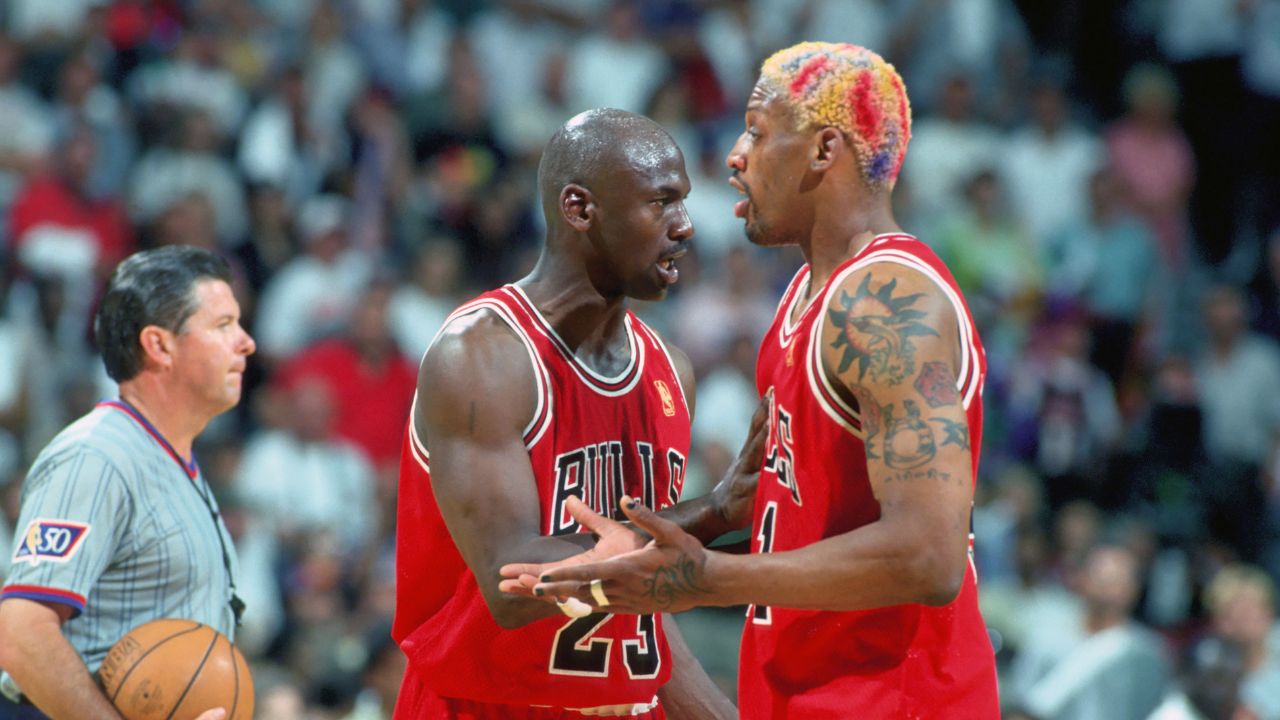
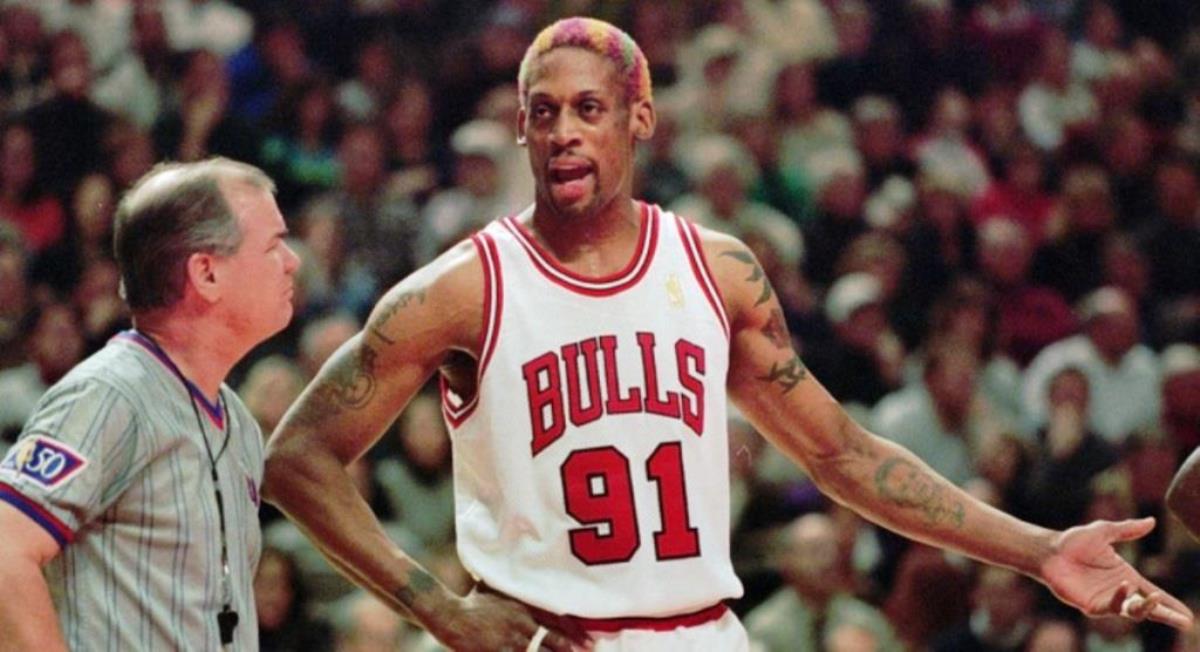
The Chicago Bulls era was the pinnacle of Rodman’s financial success. Joining Michael Jordan and Scottie Pippen, Rodman was the missing piece of the puzzle for a second "three-peat."
In his first year with Chicago (1995-96), he earned $2.5 million. However, after proving his worth during the historic 72-10 season, Rodman signed a massive one-year deal for the 1996-97 season worth $9 million. To put this in perspective, $9 million in 1996 accounted for nearly 37% of the total team salary cap ($24.3 million).
His final full season with the Bulls (1997-98) saw his salary drop to $4.5 million, as the team managed a ballooning payroll that included Michael Jordan’s then-record $33 million single-season salary.
Lakers and Mavericks (1999–2000): The Final Stretches
After the Bulls' dynasty dissolved, Rodman had two brief, unsuccessful stints. He joined the Los Angeles Lakers in the lockout-shortened 1998-99 season, earning a pro-rated portion of $1 million ($510,000). His final NBA stop was with the Dallas Mavericks in 1999-2000, where he earned $441,176 before being waived after just 12 games.
Detailed NBA Salary History Table
The following table outlines the estimated annual earnings for Dennis Rodman throughout his NBA career. These figures represent base salary and do not include performance bonuses or outside endorsements.
| Season | Team | Salary (USD) | Inflation Adjusted (2026 Est.) |
|---|---|---|---|
| 1986-87 | Detroit Pistons | $75,000 | $215,000 |
| 1987-88 | Detroit Pistons | $160,000 | $440,000 |
| 1988-89 | Detroit Pistons | $550,000 | $1,450,000 |
| 1989-90 | Detroit Pistons | $600,000 | $1,500,000 |
| 1990-91 | Detroit Pistons | $880,000 | $2,100,000 |
| 1991-92 | Detroit Pistons | $1,075,000 | $2,450,000 |
| 1992-93 | Detroit Pistons | $2,350,000 | $5,200,000 |
| 1993-94 | San Antonio Spurs | $2,450,000 | $5,300,000 |
| 1994-95 | San Antonio Spurs | $2,500,000 | $5,250,000 |
| 1995-96 | Chicago Bulls | $2,500,000 | $5,100,000 |
| 1996-97 | Chicago Bulls | $9,000,000 | $18,200,000 |
| 1997-98 | Chicago Bulls | $4,500,000 | $8,800,000 |
| 1998-99 | L.A. Lakers | $510,000 | $980,000 |
| 1999-00 | Dallas Mavericks | $441,176 | $830,000 |
| Total | $27,031,189 | ~$57,815,000 |
Note: Inflation adjustments are approximations based on historical Consumer Price Index (CPI) trends projected to 2026.
The "Cost of Controversy": Fines and Suspensions
While Rodman’s gross earnings were significant, his net take-home pay was frequently impacted by league fines and suspensions. Rodman’s career was marked by several high-profile incidents that carried heavy financial penalties.
- The Cameraman Incident (1997): After tripping over a sideline photographer and subsequently kicking him, Rodman was suspended for 11 games without pay. This suspension cost him approximately $1.1 million in lost salary, in addition to a $200,000 settlement paid to the photographer.
- The Headbutt (1996): Rodman headbutted referee Ted Bernhardt during a game, resulting in a six-game suspension and a $20,000 fine. This cost him roughly $200,000 in salary.
- General Technical Fouls: Rodman was a frequent recipient of technical fouls. Over his career, these cumulative fines totaled hundreds of thousands of dollars.
When accounting for taxes, agent fees, and these substantial fines, Rodman’s actual liquid wealth from NBA basketball was considerably lower than his gross career earnings might suggest.
Outside the NBA: Endorsements and Media Income
It is impossible to discuss Dennis Rodman’s finances without mentioning his off-court income. During the mid-to-late 1990s, Rodman was a global icon whose marketability occasionally rivaled that of Michael Jordan, albeit in a "counter-culture" niche.
- Footwear Deals: Rodman had significant sneaker contracts, most notably with Nike (the Air Darwin) and later a major signature line with Converse (the All-Star Rodman). These deals were estimated to be worth millions annually during his peak.
- Media and Wrestling: Rodman’s forays into professional wrestling (WCW) alongside Hulk Hogan earned him substantial appearance fees. His 1996 autobiography, "Bad as I Wanna Be," was a New York Times bestseller, generating massive royalty checks.
- Film and TV: Appearances in films like "Double Team" and various reality TV shows (including "Celebrity Big Brother" and "The Celebrity Apprentice" in later years) provided income streams long after his NBA salary dried up.
Why Rodman’s Earnings Differed from Modern Stars
By 2026 standards, a player with Rodman’s accolades—five-time champion, two-time All-Star, and seven-time rebounding champion—would likely command a contract worth $40 million to $50 million per year. Why was his $27 million career total so low?
The primary reason is the NBA Salary Cap structure of the 1980s and 1990s. Until the late 90s, there were fewer protections for players, and the league’s total revenue from television deals was a fraction of what it is today. Furthermore, Rodman’s age played a role; he didn’t enter the league until he was 25, meaning he missed out on the early-career "max" extensions that modern 19-year-old prospects receive.
Additionally, Rodman’s volatility made him a "short-term" investment. Teams were often hesitant to offer him five or six-year guaranteed deals, fearing his unpredictable lifestyle would lead to a decline in play or a breach of contract. Consequently, he often signed one-year or two-year "prove it" deals.
Frequently Asked Questions
Was Dennis Rodman the highest-paid player on the Bulls?
No. While Dennis Rodman’s $9 million salary in 1996-97 was substantial, he was never the highest-paid player on the Chicago Bulls. Michael Jordan held that distinction, earning $30.1 million in 1996-97 and $33.1 million in 1997-98. Even Scottie Pippen, who was famously underpaid for much of the dynasty, had a higher career earnings total than Rodman due to the length of his contracts.
How much did Dennis Rodman make per game?
In his highest-earning season (1996-97), Rodman played 55 games. With a salary of $9 million, he earned approximately $163,636 per game played. In contrast, during his rookie season, he earned less than $1,000 per game.
Does Dennis Rodman still receive money from the NBA?
Yes, like all NBA veterans with at least three years of service, Rodman is eligible for the NBA Pension Plan. For a player with Rodman’s 14 years of service and championship pedigree, this provides a stable monthly payment, which is inflation-adjusted and serves as a financial safety net for retired players.
What was Rodman's biggest single contract?
Rodman's biggest single-season contract was the one-year, $9 million deal he signed with the Chicago Bulls for the 1996-97 season. He never signed a long-term "mega-deal" that spanned 5 or more years for high annual values, primarily due to his age and the era's cap restrictions.
How much did Rodman lose in fines?
Estimates suggest Dennis Rodman lost between $1.5 million and $2 million in career earnings due to NBA-imposed fines and lost salary from suspensions. This does not include legal fees or civil settlements resulting from his on-court actions.
Final Perspective: Value Beyond the Box Score
While $27 million in career earnings is a vast sum for the average person, in the context of professional sports history, Dennis Rodman is often viewed as a player who was underpaid relative to his impact. He provided the defensive backbone for two different dynasties and was the greatest rebounder of the modern era.
For those researching Rodman’s financial history, it is important to remember that his NBA salary was only one part of his "brand." His ability to leverage his personality into wrestling, movies, and books allowed him to maintain a lifestyle that far exceeded what his basketball contracts alone would have supported. If you are analyzing athlete wealth, Rodman serves as a primary case study on how individual "branding" can be just as lucrative as the sport itself.
Image Gallery