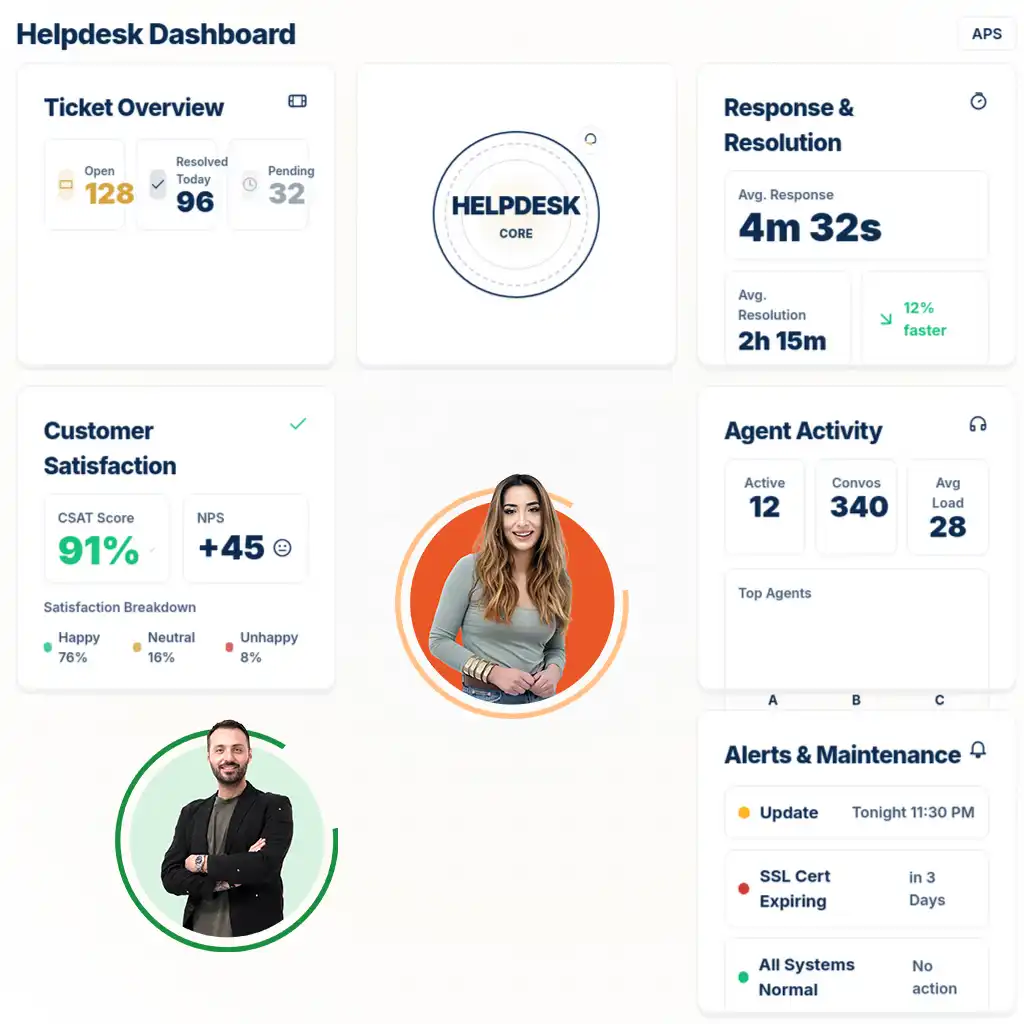
How AI Solutions Enable 24/7 IT Helpdesk Coverage
Artificial Intelligence enables 24/7 IT helpdesk coverage by deploying autonomous AI agents and sophisticated AIOps platforms that resolve tier-one and tier-two technical issues without human intervention. By integrating Large Language...
Artificial Intelligence enables 24/7 IT helpdesk coverage by deploying autonomous AI agents and sophisticated AIOps platforms that resolve tier-one and tier-two technical issues without human intervention. By integrating Large Language Models (LLMs) with enterprise systems, these solutions provide instant, accurate support across all time zones, eliminating the logistical and financial burdens of traditional shift rotations.
Contents
In 2026, the demand for "always-on" IT services has moved from a competitive advantage to a fundamental requirement. Modern digital infrastructure never sleeps, and neither can the support systems that maintain it. Historically, achieving 24/7 coverage required expensive "follow-the-sun" models, where organizations hired staff across multiple continents to cover various time zones. AI solutions have fundamentally disrupted this model, offering a scalable, cost-effective alternative that maintains high service levels regardless of the hour.
The Evolution of the 24/7 Helpdesk in 2026
The landscape of IT support has undergone a radical transformation. We have moved past the era of simple rule-based chatbots that frequently frustrated users with "I don't understand" responses. Today’s AI-enabled helpdesks utilize Agentic AI, a paradigm where AI does not just talk about a problem but possesses the permissions and integration to execute solutions.
The primary driver for this shift is the increasing complexity of the hybrid work environment. With employees distributed globally and relying on a diverse stack of SaaS applications, IT issues can arise at any moment. Human-centric helpdesks often struggle with "surge" periods or the "graveyard shift," where staffing is thin and expertise is limited. AI solutions mitigate these risks by providing a consistent baseline of intelligence that is active 365 days a year.
Key AI Technologies Powering Constant Coverage
Understanding how AI maintains 24/7 availability requires looking at the specific technologies that allow it to function as a digital colleague rather than a static FAQ page.
Agentic AI and Autonomous Resolution
The most significant advancement in 2026 is the rise of AI Agents. Unlike traditional software, these agents are goal-oriented. When a user reports a VPN connectivity issue at 3:00 AM, the AI agent doesn't just provide a link to a troubleshooting guide. It can verify the user’s credentials in Microsoft Entra ID (formerly Azure AD), check the status of the gateway, and even initiate a remote reset of the user's network profile if necessary. This capability allows for the autonomous resolution of Tier 1 and many Tier 2 tickets without a human technician being paged.
Retrieval-Augmented Generation (RAG)
To ensure accuracy and prevent "hallucinations," modern helpdesks use Retrieval-Augmented Generation (RAG). This architecture allows the AI to ground its responses in the organization's specific documentation, security policies, and historical ticket data. When an employee asks how to access a specific proprietary software during the weekend, the AI retrieves the exact, current protocol from the internal knowledge base rather than relying on generalized training data.
Multi-modal Interaction
AI helpdesks in 2026 are no longer restricted to text. They support voice recognition and visual processing. An employee working late can use their mobile device to film a flickering server light or a hardware error code; the AI analyzes the video frames in real-time to identify the hardware fault and provides immediate instructions or logs a high-priority hardware replacement request.
AIOps: The Proactive Pillar of 24/7 Support
AI-driven coverage is not merely reactive; it is increasingly proactive through AIOps (Artificial Intelligence for IT Operations). AIOps platforms monitor system telemetry—logs, metrics, and traces—around the clock to identify patterns that precede a failure.
For example, if a database cluster shows an unusual trend in latency at 2:00 AM, the AIOps engine can automatically scale resources or clear cache buffers before any user experiences a slowdown. This "self-healing" capability reduces the volume of tickets that reach the helpdesk in the first place, allowing the 24/7 AI coverage to focus on user-specific issues rather than systemic outages.
Comparing Traditional Helpdesks vs. AI-Enabled Solutions
The following table outlines the operational differences between the traditional human-centered support model and the modern AI-integrated approach.
| Feature | Traditional 24/7 (Follow-the-Sun) | AI-Enabled 24/7 Coverage |
|---|---|---|
| Response Time | Dependent on queue size (Minutes to Hours) | Instantaneous (Seconds) |
| Operational Cost | High (Shift differentials, global offices) | Predictable (SaaS/API licensing) |
| Scalability | Slow (Requires hiring and training) | Infinite (Elastic cloud computing) |
| Consistency | Variable (Based on individual skill) | High (Standardized knowledge base) |
| Language Support | Limited by staff demographics | Native support for 100+ languages |
| Problem Solving | Reactive to ticket submission | Proactive (AIOps self-healing) |
Implementation Strategies for Global IT Desks
Transitioning to an AI-enabled 24/7 model requires more than just "turning on" a chatbot. It involves a strategic integration of data and permissions.
- Permission Scoping: For AI to be effective 24/7, it must have the authority to act. Organizations must implement Least Privilege Access models where the AI agent has just enough permission to perform specific tasks—like resetting passwords or checking server status—without compromising the overall security architecture.
- Knowledge Integration: AI is only as good as the data it accesses. Companies must maintain a "living" knowledge base. In 2026, many AI solutions include "Knowledge Engineering" features that automatically flag outdated documentation when the AI notices a discrepancy between the manual and the actual system state.
- Human-in-the-Loop (HITL) Fallbacks: While AI handles the majority of the load, a 24/7 strategy must include an escalation path. For critical, high-complexity issues that the AI cannot resolve, an automated paging system (like PagerDuty or Opsgenie) can alert an on-call human engineer. The AI provides this engineer with a complete summary of what has already been attempted, drastically reducing the "Mean Time to Resolution" (MTTR).
Overcoming Barriers to 24/7 AI Adoption
Despite the advantages, organizations often face hurdles when deploying these solutions. Data privacy remains a top concern. In 2026, enterprise AI solutions must adhere to strict regulations such as the EU AI Act and updated CCPA guidelines. This means ensuring that PII (Personally Identifiable Information) is redacted before being processed by the AI models.
Another challenge is User Trust. If users feel the AI is a barrier to "real help," they will attempt to bypass it. To combat this, IT leaders must ensure the AI is high-utility from day one. This is achieved by focusing the AI’s initial capabilities on high-volume, low-complexity tasks—the "low-hanging fruit"—before expanding its scope to more complex architectural troubleshooting.
Measuring the Success of AI Helpdesk Coverage
To validate the investment in 24/7 AI solutions, organizations track specific Key Performance Indicators (KPIs):
- Deflection Rate: The percentage of issues resolved by AI without human intervention.
- Mean Time to Acknowledge (MTTA): In AI-driven models, this should be near zero.
- CSAT (Customer Satisfaction): Measured specifically for after-hours AI interactions to ensure the quality of support remains high.
- Cost Per Ticket: Typically, AI-enabled support reduces the average cost per ticket by 60-80% compared to human-led 24/7 models.
Frequently Asked Questions
Can AI solutions handle hardware-related IT issues after hours?
While AI cannot physically replace a hard drive, it can diagnose hardware failures through system logs and telemetry. Once a fault is identified, the AI can automatically trigger a hardware replacement workflow, order the part from a vendor, and schedule an on-site technician for the following business morning, all while keeping the user informed.
How does AI manage 24/7 support for multiple languages?
Modern AI solutions use neural machine translation and multilingual LLMs that understand the intent and context in over 100 languages. This allows a user in Tokyo to receive the same level of technical support in Japanese as a user in New York receives in English, without the organization needing to hire bilingual staff for every shift.
Is it difficult to integrate AI helpdesks with existing ITSM tools?
Most enterprise AI solutions in 2026 feature "out-of-the-box" connectors for major IT Service Management (ITSM) platforms like ServiceNow, Jira Service Management, and Freshservice. These integrations allow the AI to read historical tickets, update current ones, and maintain a seamless audit trail of all automated actions.
What happens if the AI makes a mistake during an automated fix?
Robust AI solutions include "rollback" capabilities. If an automated script or configuration change does not produce the intended result, the system can automatically revert to the previous stable state. Additionally, all AI actions are logged for forensic review by human IT managers during standard business hours.
Does 24/7 AI coverage mean human IT roles will be eliminated?
No. Rather than replacing humans, AI shifts the human role toward more strategic work. Humans are freed from the "toil" of password resets and basic troubleshooting, allowing them to focus on infrastructure design, security posture, and high-level problem-solving that requires human creativity and intuition.
Final Recommendation for IT Leaders
To successfully enable 24/7 IT helpdesk coverage, organizations should adopt a hybrid-first approach. Start by implementing AI agents to handle the most frequent after-hours requests, such as account lockouts and software access. Gradually expand the AI’s capabilities by feeding it more diverse documentation and granting it deeper integration into your AIOps ecosystem. By the end of 2026, the goal should be an autonomous "First Response" layer that ensures no employee, anywhere in the world, ever has to wait for business hours to solve a technical problem.
Image Gallery