Who Investigates Money Laundering? Agencies, Roles, and Investigative Processes
Money laundering is investigated by a coordinated network of federal law enforcement agencies, financial intelligence units, regulatory authorities, and private sector compliance teams. Primary U.S. agencies include the Financial Crime...
Money laundering is investigated by a coordinated network of federal law enforcement agencies, financial intelligence units, regulatory authorities, and private sector compliance teams. Primary U.S. agencies include the Financial Crimes Enforcement Network (FinCEN), IRS Criminal Investigation (IRS-CI), the Federal Bureau of Investigation (FBI), Homeland Security Investigations (HSI), and the Department of Justice (DOJ), supported internationally by organizations like Interpol and the Financial Action Task Force.
Contents
The Architecture of Financial Crime Investigations
Money laundering involves concealing the origin, identity, or destination of illicitly gained funds to make them appear legitimate. Because financial crimes cross geographic, corporate, and digital boundaries, no single organization handles these cases in isolation. Instead, investigations rely on a multi-tiered ecosystem spanning private financial institutions, specialized administrative bureaus, criminal law enforcement agencies, and international bodies.
The investigative process operates across four distinct levels:
- Private Sector Detection: Banks, brokerages, cryptocurrency exchanges, and casinos serve as the frontline. Under federal law, these institutions monitor transactions and flag anomalies.
- Intelligence Aggregation: Financial intelligence units collect, analyze, and disseminate transactional data to identify systemic patterns and criminal networks.
- Criminal Investigation: Federal, state, and international law enforcement agencies execute search warrants, issue subpoenas, conduct surveillance, and trace assets.
- Prosecution and Adjudication: Federal prosecutors and judicial bodies pursue criminal indictments, asset forfeitures, civil fines, and corporate sanctions.
Understanding who investigates money laundering requires examining how these distinct tiers interact across federal, state, corporate, and global jurisdictions.
Primary U.S. Federal Investigative Agencies
At the federal level in the United States, several law enforcement and regulatory entities hold specialized authority to investigate money laundering under Title 18 of the U.S. Code (specifically 18 U.S.C. § 1956 and § 1957) and the Bank Secrecy Act (BSA).
Financial Crimes Enforcement Network (FinCEN)
As a bureau of the U.S. Department of the Treasury, the Financial Crimes Enforcement Network (FinCEN) serves as the nation’s Financial Intelligence Unit (FIU). FinCEN does not typically arrest suspects or execute search warrants directly. Instead, it serves as the central repository for financial intelligence gathered under the BSA.
FinCEN collects millions of filings each year, including Suspicious Activity Reports (SARs) and Currency Transaction Reports (CTRs). Its intelligence analysts map financial networks, identify trends in illicit finance, and share actionable intelligence with law enforcement agencies nationwide. Additionally, under the Corporate Transparency Act, FinCEN manages beneficial ownership information registries to prevent anonymous shell companies from hiding illicit funds.
Internal Revenue Service – Criminal Investigation (IRS-CI)
IRS Criminal Investigation is the law enforcement arm of the IRS and one of the world's premier financial investigative agencies. IRS-CI special agents possess statutory authority to investigate tax crimes, money laundering, and BSA violations.
Because money laundering invariably involves income derived from unlawful activities (such as drug trafficking, fraud, public corruption, or cybercrime), perpetrators rarely report these funds on tax returns. IRS-CI agents specialize in forensic accounting, net-worth reconstruction, and digital asset tracing. They frequently serve as lead financial investigators on major inter-agency task forces.
Federal Bureau of Investigation (FBI)
The FBI investigates money laundering across its complex financial crime, counterterrorism, organized crime, and cyber divisions. Within the bureau, specialized units such as the Money Laundering and Asset Recovery Unit (MLARU) and the Virtual Asset Unit (VAU) target sophisticated laundering schemes.
The FBI’s primary focus centers on money laundering linked to:
- High-level public corruption and bribery
- Transnational organized crime syndicates
- Complex corporate fraud and embezzlement
- Cyber extortion, ransomware, and darknet marketplace financing
- Terrorist financing networks
FBI special agents leverage wiretaps, confidential informants, undercover operations, and financial subpoenas to dismantle money laundering operations from street-level couriers to foreign bank executives.
Homeland Security Investigations (HSI)
Homeland Security Investigations, the principal investigative arm of the U.S. Department of Homeland Security, plays a central role in combating international money laundering. HSI focuses heavily on cross-border financial crimes, including bulk cash smuggling, trade-based money laundering (TBML), commercial fraud, and illicit contraband networks.
HSI manages specialized National Bulk Cash Smuggling Centers and leads multi-agency Trade Transparency Units (TTUs). TTUs analyze international trade data to spot discrepancies in invoices, pricing, and shipping manifests used to move value across borders covertly.
Drug Enforcement Administration (DEA)
The DEA investigates money laundering linked directly to illegal drug production, transportation, and distribution. Because drug cartels generate billions of dollars in physical cash, the DEA focuses on money brokers, underground banking systems (such as the Black Market Peso Exchange), and trade-based laundering schemes used to repatriate drug proceeds back to foreign origins.
Department of Justice (DOJ) Prosecutorial Sections
While federal agents conduct field investigations, attorneys within the U.S. Department of Justice direct grand jury proceedings and prosecute cases. The DOJ’s Money Laundering and Asset Recovery Section (MLARS) provides policy guidance, leads complex national and international prosecutions, and handles global asset forfeiture proceedings. MLARS works closely with U.S. Attorney’s Offices in federal judicial districts across the country.
Comparative Overview of Major Investigative Bodies
| Agency / Organization | Jurisdiction Level | Primary Focus & Scope | Key Investigative Tools |
|---|---|---|---|
| FinCEN | U.S. Federal (Treasury) | Financial intelligence, BSA administration, beneficial ownership | SAR/CTR databases, administrative subpoenas, geographic targeting orders |
| IRS-CI | U.S. Federal (Treasury) | Tax evasion, forensic accounting, offshore tax fraud, crypto tracing | Net-worth analysis, search warrants, financial grand jury subpoenas |
| FBI | U.S. Federal (DOJ) | Organized crime, public corruption, cybercrime, terror finance | Undercover operations, wiretaps, informant networks, grand jury subpoenas |
| HSI | U.S. Federal (DHS) | Cross-border financial crimes, trade-based money laundering, cash smuggling | Trade Transparency Units, customs inspections, border interdictions |
| State AGs & Local DA Financial Crime Squads | U.S. State / Local | Regional fraud, local money laundering, state tax evasion | State grand jury subpoenas, localized bank record requests, state search warrants |
| FATF & Interpol | International | Global standard setting, cross-border intelligence sharing | Mutual Legal Assistance Treaties (MLATs), Red Notices, global policy evaluations |
The Role of Private Financial Institutions
Private entities do not possess law enforcement arrest powers, yet they perform a substantial portion of initial money laundering detection. Under Anti-Money Laundering (AML) regulations, financial institutions must maintain robust compliance programs staffed by certified specialists.
- Transaction Monitoring System: Algorithm flags unusual activity
- Internal Compliance Review: AML Analysts investigate account
- Suspicious Activity Report: SAR filed confidentially to FinCEN
- Federal Law Enforcement Access: FBI, IRS-CI, HSI extract data
Key Compliance Duties
- Customer Due Diligence (CDD) and Know Your Customer (KYC): Institutions must verify customer identities, establish risk profiles, and identify ultimate beneficial owners of corporate accounts.
- Transaction Monitoring: Automated systems scan millions of daily wire transfers, cash deposits, and security trades to flag unusual patterns, such as structuring (depositing funds just below the $10,000 reporting threshold).
- Filing Suspicious Activity Reports (SARs): If an institution suspects funds stem from illegal activity or lack an apparent lawful purpose, it must confidentially file a SAR with FinCEN within 30 days. Financial institutions are legally prohibited from informing the account holder that a SAR has been filed.
When law enforcement agents open a money laundering inquiry, SAR database queries are frequently their first step to map out account numbers, associate names, and track fund flows.
How a Money Laundering Investigation Unfolds
Money laundering investigations follow a structured multi-phase process designed to establish two mandatory legal elements: that the funds were derived from a specific unlawful activity (SUA), and that the financial transactions were conducted to disguise the nature, location, source, ownership, or control of those funds.
Phase 1: Initiation and Intelligence Gathering
Investigations begin through multiple triggers:
- A cluster of high-priority SARs filed by several banks.
- Information provided by whistleblowers or cooperating witnesses.
- Spin-off leads from existing drug, fraud, or public corruption cases.
- Intelligence shared by foreign governments or international partner agencies.
Investigators query federal databases, perform open-source intelligence (OSINT) searches, and review corporate filings to establish baseline facts.
Phase 2: Grand Jury Subpoenas and Forensic Accounting
Once preliminary suspicion is established, prosecutors use grand juries to issue subpoenas for financial records. Agents obtain bank statements, wire transfer logs, loan applications, tax returns, and corporate ledgers.
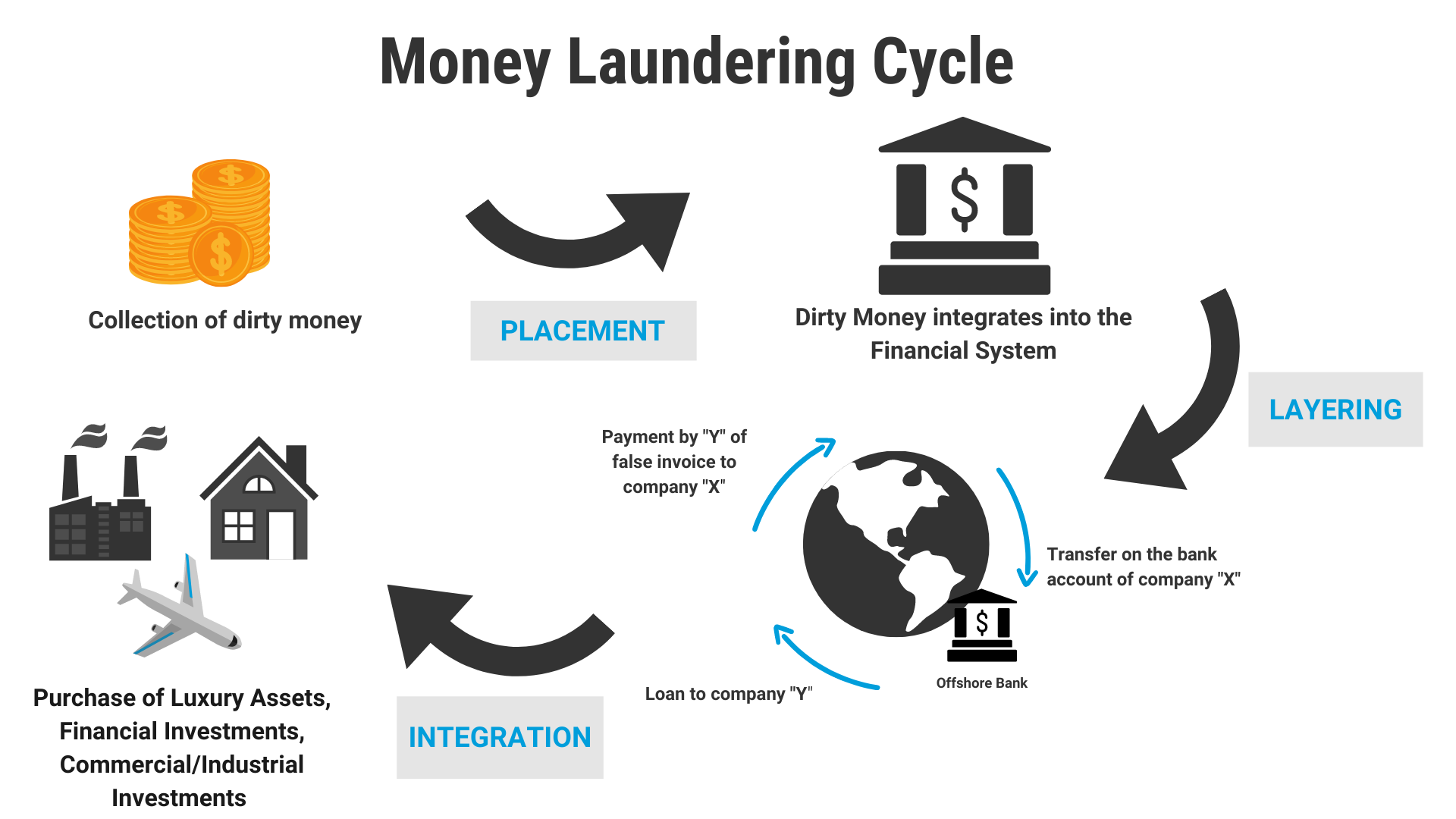
Forensic accountants reconstruct the movement of funds across three traditional stages of money laundering:
- Placement: Introducing illicit cash into the legitimate financial system.
- Layering: Passing funds through complex layers of transactions, offshore accounts, shell companies, and conversion into different assets to sever the audit trail.
- Integration: Returning laundered funds to the criminal in an apparently legitimate form, such as real estate investments, business capital, or luxury asset purchases.
Phase 3: Covert Operations and Electronic Surveillance
In high-profile or organized crime cases, investigators use advanced techniques:
- Undercover Operations: Law enforcement agents act as money launderers or financial brokers to infiltrate money-clearing networks.
- Title III Wiretaps: Court-authorized wiretaps monitor phone calls, encrypted messages, and electronic communications of key suspects.
- Blockchain Analytics: In cases involving digital assets, specialized tools trace transactions across transparent public ledgers to identify cryptocurrency exchange off-ramps requiring KYC verification.
Phase 4: Asset Seizure, Charges, and Forfeiture
If evidence confirms money laundering, prosecutors obtain judicial warrants to freeze bank accounts, seize real estate, and impound luxury vehicles prior to trial. Under federal civil and criminal asset forfeiture laws, the government can permanently seize assets linked to or derived from money laundering activities. Grand juries then return indictments leading to arrests and trial proceedings.
International Money Laundering Authorities
Money laundering routinely crosses international borders, requiring multilateral cooperation.
Financial Action Task Force (FATF)
The Financial Action Task Force (FATF) is an intergovernmental organization established to set global standards for combating money laundering and terrorist financing. While FATF does not conduct direct criminal investigations, it sets global AML standards (the 40 Recommendations) and evaluates countries' legal frameworks. Non-compliant jurisdictions face inclusion on FATF "grey" or "black" lists, severely restricting their access to global banking systems.
Interpol and Europol
- Interpol: The International Criminal Police Organization facilitates cross-border police cooperation. Its Financial Crime and Anti-Corruption Centre (IFACC) provides operational assistance, coordinates global interdictions, and issues "Red Notices" to locate and arrest international fugitives wanted for financial crimes.
- Europol: The European Union's law enforcement agency operates the European Financial and Economic Crime Centre (EFECC), supporting EU member states in complex multi-jurisdictional financial crime inquiries.
Egmont Group of Financial Intelligence Units
The Egmont Group is a global organization composed of over 170 Financial Intelligence Units (including FinCEN). It provides a secure platform for FIUs to exchange intelligence on suspected money laundering and terrorist financing activities rapidly across borders.
Practical Actions and Compliance Steps
Entities and individuals navigating financial monitoring standards or regulatory inquiries should maintain rigorous compliance practices.
For Financial Institutions and Businesses
- Maintain Up-to-Date Risk Assessments: Regularly evaluate operational vulnerabilities regarding new payment methods, customer profiles, and geographic transaction destinations.
- Implement Automated Screening Tools: Ensure sanctions lists (such as the Treasury's OFAC list) and PEP (Politically Exposed Persons) databases are updated continuously.
- Audit Compliance Regularly: Schedule independent third-party audits of internal BSA/AML programs to verify effectiveness and flag gaps early.
For Individuals or Entities Under Investigation
- Engage Specialized Legal Counsel: Money laundering investigations carry heavy federal prison sentences and financial penalties. Seek immediate representation from attorneys specializing in white-collar defense and federal criminal procedures.
- Preserve All Relevant Records: Do not alter, delete, or destroy financial records, communications, or corporate ledgers upon learning of an inquiry. Spoliation of evidence leads to independent federal obstruction charges.
- Avoid Unadvised Communications: Refrain from answering questions from federal agents without defense counsel present, as statements made during preliminary interviews can be used to establish intent or false-statement violations under 18 U.S.C. § 1001.
Frequently Asked Questions
Can state or local police investigate money laundering?
Yes. Many state statutes explicitly criminalize money laundering. State attorneys general, county district attorneys, and state police agencies operate financial crime units to investigate regional money laundering. However, when schemes cross state or national borders or involve significant dollar amounts, state agencies usually partner with or refer cases to federal task forces.
What triggers a federal money laundering investigation?
Investigations are typically triggered by Suspicious Activity Reports (SARs) filed by financial institutions, irregularities flagged in tax filings by the IRS, whistleblower reports, international intelligence leads, or financial evidence uncovered during baseline investigations into predicate crimes such as drug trafficking, healthcare fraud, or cybercrime.
What is the difference between FinCEN and the FBI in financial investigations?
FinCEN is a regulatory intelligence bureau that collects, analyzes, and shares financial data (like SARs and CTRs) but does not arrest suspects or conduct criminal trials. The FBI is a federal law enforcement agency whose special agents conduct active criminal investigations, execute search warrants, make arrests, and build cases for prosecution by the Department of Justice.
How do law enforcement agencies trace laundered cryptocurrency?
Investigators use specialized blockchain analysis software to map transactions across public ledgers. By tracking the flow of funds through wallets, mixing services, and decentralized applications, agents can trace cryptocurrency until it reaches a centralized Virtual Asset Service Provider (VASP) or exchange that enforces Know Your Customer (KYC) rules, allowing agents to subpoena the user's real-world identity.
What penalties do individuals or corporate entities face for money laundering?
Under federal law (18 U.S.C. § 1956), individuals convicted of money laundering face up to 20 years in federal prison per count, along with criminal fines up to $500,000 or twice the value of the property involved, whichever is greater. Corporate entities face severe financial penalties, regulatory license revocations, deferred prosecution agreements, and court-appointed independent compliance monitors.
Image Gallery