What Tucson, AZ Is Known For: Culture, Geography, and Heritage
Nestled within the Sonoran Desert and ringed by dramatic mountain ranges, Tucson, Arizona, is widely celebrated for its rich blend of Native American, Spanish colonial, and Mexican histories, its world-renowned astronomical research, a...
Nestled within the Sonoran Desert and ringed by dramatic mountain ranges, Tucson, Arizona, is widely celebrated for its rich blend of Native American, Spanish colonial, and Mexican histories, its world-renowned astronomical research, and a UNESCO City of Gastronomy designation that highlights its unique culinary heritage.
Contents
Tucson, Arizona, occupies a unique position in the American Southwest. Far from being just another desert municipality, it is a metropolitan center defined by its deep cultural roots, ecological diversity, and vibrant academic presence. Surrounded by the "Sky Islands"—mountain ranges that rise sharply from the desert floor—Tucson offers a striking juxtaposition of arid lowlands and pine-forested peaks. Understanding what makes this city distinct requires looking at the interconnected pillars of its identity: its food, its night skies, its protected landscapes, and its enduring architectural and historical heritage.
A UNESCO City of Gastronomy: The Culinary Heritage of Tucson
Tucson earned its designation as a UNESCO Creative City of Gastronomy in 2015, becoming the first city in the United States to receive this honor. This recognition is not merely a nod to modern restaurant trends; it honors a continuous agricultural history spanning more than 4,000 years.
The culinary tradition of the region begins with the San Xavier del Bac and the original O'odham people, who cultivated crops suited to the harsh desert environment using sophisticated irrigation canals. When Spanish missionaries introduced European livestock, wheat, and fruit orchards in the late 17th century, they merged with indigenous ingredients like tepary beans, cholla buds, chiltepín peppers, and mesquite flour.
Today, this heritage translates into a vibrant culinary scene anchored by traditional Sonoran style Mexican food—most notably characterized by the carne seca (dried beef) and oversized flour tortillas unique to the region. Local chefs and food artisans actively preserve agricultural biodiversity through organizations like Native Seeds/SEARCH, ensuring that ancient heritage crops remain a functional, delicious part of everyday Tucson life.
Astronomy Capital of the World: Starlight and Science
Clear night skies, low humidity, and strict regional lighting ordinances designed to protect scientific observations have earned Tucson the title of the astronomy capital of the world. The city and its surrounding peaks host some of the most advanced optical and radio telescopes on the planet.
The Steward Observatory at the University of Arizona operates major facilities locally, while institutions from around the globe utilize regional sites:
- Kitt Peak National Observatory: Situated on the Quinlan Mountains southwest of Tucson, it features one of the largest collections of optical and radio telescopes in the world.
- Mount Lemmon Observatory: Perched in the Santa Catalina Mountains, it serves as a high-altitude research station and hosts public stargazing programs.
- The Mirror Lab: Located beneath Arizona Stadium on the University of Arizona campus, the Richard F. Caris Mirror Lab casts and polishes giant, honeycomb-shaped glass mirrors for the next generation of global telescopes, including the Giant Magellan Telescope.
Sonoran Desert Ecology and the Saguaro Cactus
The landscape of Tucson is synonymous with the Sonoran Desert, the only place on Earth where the iconic saguaro cactus (Carnegiea gigantea) grows naturally in vast, forest-like concentrations. These slow-growing giants can reach heights of over 40 feet, live for upwards of 150 to 200 years, and serve as vital habitats for desert wildlife, including the Gila woodpecker and elf owl.
Tucson preserves this fragile ecosystem through two distinct districts of Saguaro National Park, which flank the city to the east (Rincon Mountain District) and west (Tucson Mountain District). Visitors and researchers flock to these protected areas to witness dramatic seasonal wildflower blooms, encounter desert tortoises and javelinas, and explore miles of rugged hiking trails.
Adjacent to the city, Sabino Canyon Recreation Area offers perennial streams, cascading waterfalls during the monsoon season, and accessible canyon tram tours, demonstrating that the desert is an ecosystem defined by life and water rather than barren desolation.
Architectural Identity: Spanish Colonial and Desert Modernism
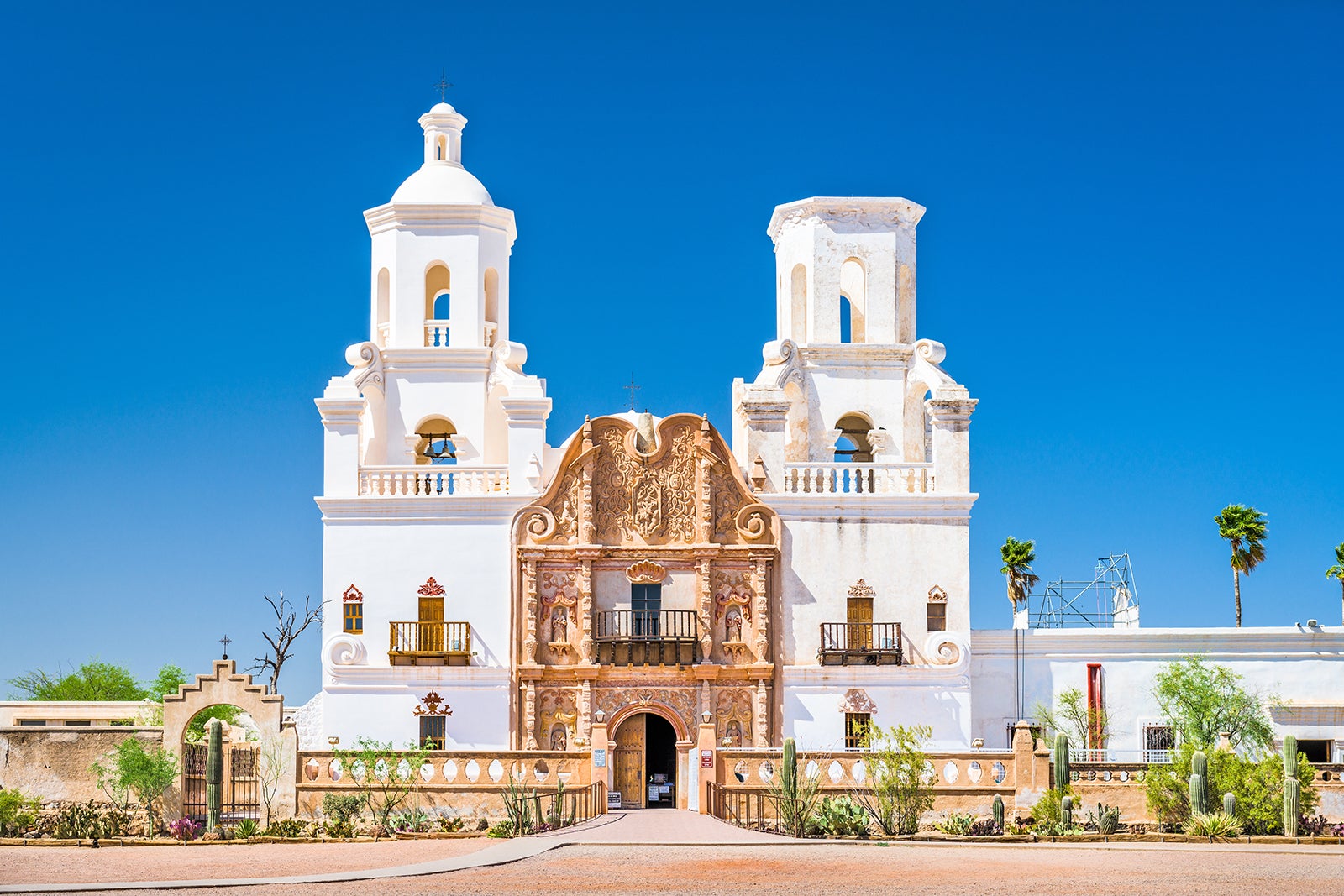
Tucson’s built environment reflects a layered history that rejects homogenous suburban development in favor of distinct regional styles. At the historical core stands the San Xavier del Bac Mission, often called the "White Dove of the Desert." Founded in 1692 by Father Eusebio Kino and constructed in its current form between 1783 and 1797, this masterpiece of Spanish colonial architecture features ornate Baroque facades, hand-carved wooden sculptures, and intricate interior frescoes.
Moving into the 20th century, Tucson became a major incubator for Desert Modernism. Architects such as Josias Joesler, Arthur Brown, and later structural innovators integrated indoor-outdoor living spaces, local adobe bricks, rammed earth, and deep roof overhangs to combat intense summer heat. Neighborhoods like Sam Hughes and El Presidio showcase historic preservation efforts that protect 19th-century Territorial architecture alongside mid-century residential design.
Cultural Institutions and Annual Traditions
Beyond its geography and food, Tucson maintains a thriving arts community and hosts events that draw international participants.
The University of Arizona, founded in 1885 as the Arizona Territory's first university, anchors the intellectual and cultural life of the city. Its campus museums—including the Center for Creative Photography, which houses the archives of Ansel Adams and Edward Weston, and the University of Arizona Museum of Art—offer world-class cultural programming.
Every February, the city hosts the Tucson Gem, Mineral & Fossil Showcase, the largest event of its kind in the world. Collectors, scientists, and traders from dozens of countries converge on dozens of simultaneous shows across the city, transforming Tucson into the global epicenter of mineralogy for several weeks.
Similarly, the annual Tucson Festival of Books on the University of Arizona campus is one of the largest literary events in the United States, drawing tens of thousands of attendees to celebrate reading, writing, and education while raising funds for local literacy programs.
Key Aspects of Tucson Identity
| Category | Primary Feature | Significance |
|---|---|---|
| Culinary | UNESCO City of Gastronomy | Recognized for a 4,000-year agricultural history and unique Sonoran-indigenous fusion cuisine. |
| Science | Astronomy Capital | Home to Kitt Peak, Mount Lemmon, and the UA Mirror Lab due to clear skies and dark-sky ordinances. |
| Environment | Saguaro National Park | Protects the iconic, towering saguaro cactus exclusive to the Sonoran Desert. |
| Architecture | San Xavier del Bac | An 18th-century Spanish colonial mission displaying classic Baroque and Moorish design elements. |
| Events | Gem and Mineral Showcase | The world's largest gathering of lapidary and geological science enthusiasts, held annually in February. |
Frequently Asked Questions
Why is Tucson called a UNESCO City of Gastronomy?
Tucson received this designation because of its deep agricultural roots stretching back four millennia. The city preserves ancient farming techniques and heritage foods, combining indigenous desert ingredients with Spanish colonial flavors to create a distinct, thriving culinary identity recognized globally by the United Nations.
What makes Tucson a hub for professional astronomy?
The region benefits from high altitude, low relative humidity, and reliable clear-night visibility throughout the year. Furthermore, municipal and county light-pollution ordinances strictly regulate outdoor lighting, keeping the night sky remarkably dark and ideal for deep-space observation.
Where is the best place to see saguaro cacti in Tucson?
Saguaro National Park is divided into two distinct sections—the East (Rincon Mountain District) and the West (Tucson Mountain District). Both districts feature dense forests of saguaro cacti, well-maintained hiking trails, and scenic drive loops that provide panoramic views of the desert floor.
What is the historical significance of the San Xavier del Bac Mission?
Built in the late 18th century, San Xavier del Bac is widely considered the finest example of Spanish colonial architecture in the United States. It remains an active parish church serving the Tohono O'odham Nation and stands as a testament to the complex religious and cultural interactions of the early Southwest.
When is the best time of year to visit Tucson?
The late autumn, winter, and early spring months (from October through April) offer mild daytime temperatures ideal for outdoor recreation. While summer temperatures regularly exceed 100 degrees Fahrenheit, the monsoon season in July and August brings dramatic thunderstorms, lower humidity spikes, and sudden desert greening.
Image Gallery