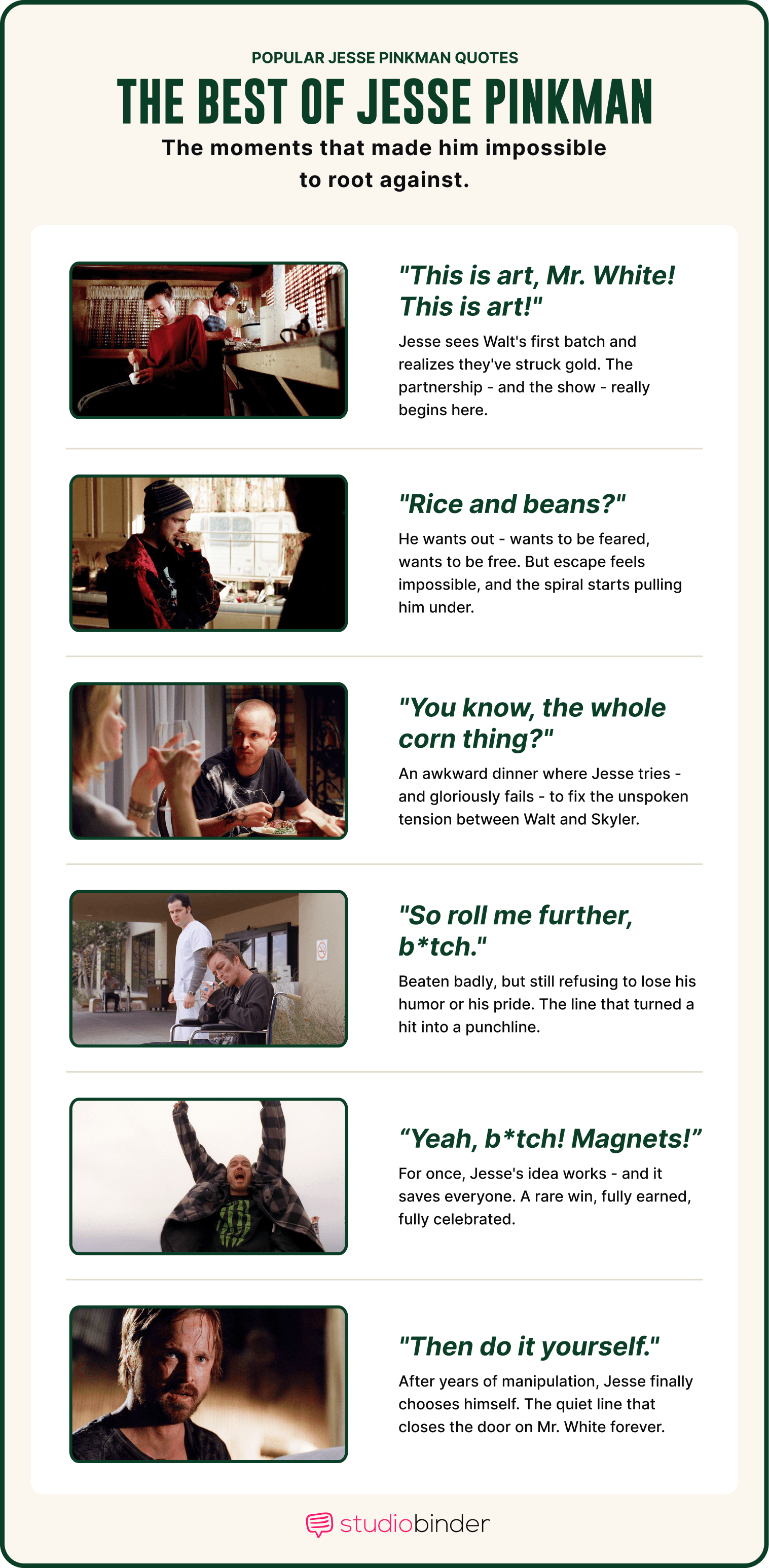
A Comprehensive Analysis of Jesse Pinkman’s Notable Lines from Breaking Bad
Jesse Pinkman’s dialogue in Breaking Bad serves as the emotional and moral heartbeat of the series, evolving from a street-level dealer’s idiosyncratic slang to the poignant, trauma-informed reflections of a man seeking redemption. Cre...
Jesse Pinkman’s dialogue in Breaking Bad serves as the emotional and moral heartbeat of the series, evolving from a street-level dealer’s idiosyncratic slang to the poignant, trauma-informed reflections of a man seeking redemption. Created by Vince Gilligan, the character played by Aaron Paul represents the human cost of the methamphetamine trade, and his unique linguistic style—marked by his frequent use of "bitch," emotional vulnerability, and sharp wit—remains a defining element of television history.
Contents
The Evolution of Jesse Pinkman’s Voice
At the onset of the series, Jesse Pinkman is characterized by a specific brand of bravado that masks a deep-seated need for validation. His early lines are peppered with colloquialisms and a forced "tough guy" persona. As the series progresses, the weight of his experiences with Walter White and the Gus Fring organization strips away this facade.
The linguistic shift is stark. By the final seasons, Pinkman’s speech becomes sparser, heavier, and more intentional. He moves away from the posturing of "Yeah, science!"—a line that has become an internet staple—to the guttural, raw pain expressed in his confrontations with Walt. This transition is not merely a change in writing; it is a meticulous character study of a person losing their innocence and attempting to reclaim a soul that has been systematically eroded by the criminal underworld.
Iconic Lines and Contextual Significance
To understand the impact of Jesse Pinkman, one must examine the lines that transcend the script to become cultural touchstones. These phrases often highlight the disconnect between Jesse’s moral compass and his environment.
1. "Yeah, science, bitch!"
Perhaps the most recognizable quote from the series, this line from the episode "4 Days Out" (Season 2) epitomizes Jesse’s misguided but genuine enthusiasm for the chemistry Walt teaches him. It highlights his role as a student, even within a criminal enterprise, and captures the rare, fleeting moments of camaraderie between the two protagonists.
2. "I’m the bad guy?"
In "Problem Dog" (Season 4), Jesse’s monologue during a Narcotics Anonymous meeting represents a critical turning point. He confesses to the murder of Gale Boetticher, though he disguises it as a "problem dog." This scene deconstructs the show’s central conflict: while Walt frequently insists he is the protagonist, Jesse acknowledges the irreparable damage he has caused, signaling a level of self-awareness that Walt never achieves.
3. "He can't keep getting away with it!"
This outburst from the episode "Crawl Space" (Season 4) captures the helplessness Jesse feels as he realizes he is a passenger in Walt’s ego-driven descent into madness. It serves as a rallying cry for the audience, articulating the frustration of watching an unstoppable force—Walt—obliterate everyone in his wake.
Comparative Analysis of Character Dialogue
The following table highlights the progression of Jesse’s dialogue across different stages of the series, showing how his tone shifts from defensive to introspective.
| Season | Primary Linguistic Tone | Key Theme | Representative Line |
|---|---|---|---|
| 1-2 | Defiant, Colloquial | Street-Level Bravado | "This is my own private domicile and I will not be harassed." |
| 3-4 | Vulnerable, Anxious | Moral Crisis | "I'm the bad guy?" |
| 5 | Broken, Resolute | Trauma and Survival | "I'm not doing your bidding anymore." |
The Role of Humor and Tragedy
Jesse Pinkman is arguably the only character in Breaking Bad who consistently experiences true remorse. While Walt becomes increasingly detached from humanity, Jesse’s lines often highlight the tragedy of his situation. His humor, often unintentional or darkly ironic, serves as a defense mechanism against the horrors he witnesses.
When he speaks, he is often trying to mediate between the pragmatic, cold calculations of Walt and his own buried sense of right and wrong. This internal conflict is what makes his dialogue so resonant. He does not use complex, Machiavellian speeches; he uses simple, direct, and often messy language that makes his struggle relatable to the audience.
Behind the Script: Writing the Character
The writing team for Breaking Bad specifically cultivated Jesse’s unique vernacular to contrast with Walter White’s precise, academic, and often condescending tone. By giving Jesse a lexicon rooted in the subculture of the Albuquerque drug scene, the writers created a power imbalance that made the partnership compelling.
Crucially, the writers allowed the character to grow beyond his initial "junkie" trope. By Season 5, the "bitch" count drops significantly as Jesse sheds his armor. This evolution demonstrates the writers' commitment to character-first storytelling, ensuring that his lines were always an accurate reflection of his current mental state and status within the illicit empire.
Frequently Asked Questions
Why does Jesse Pinkman say "bitch" so often?
In the context of the series, the term is a manifestation of his insecurity and his attempt to mimic the street-tough persona he believes is required to survive in the meth trade. Over time, it becomes a verbal tic that highlights his immaturity before the traumatic events of later seasons force him to grow up.
What is the most important line in Jesse’s arc?
While "Yeah, science!" is the most popular, many critics argue that his confession in the Narcotics Anonymous meeting regarding the "problem dog" is the most important. It is the moment Jesse finally stops lying to himself about who he is and the actions he has taken.
How did the writing for Jesse change after season 3?
As the plot became darker, the writers shifted Jesse’s dialogue from comedic or aggressive bursts to more somber, reflective, and often silent moments. He speaks less, but when he does, his words carry the weight of his trauma, reflecting his isolation from his family and society.
Does Jesse ever truly find peace in his dialogue?
By the final episode of the series, "Felina," Jesse has very little dialogue. This lack of speech is a deliberate creative choice, signaling that he has moved beyond the need to justify his actions or use bravado to hide his pain. His final act is one of silent action, not words.
Are there any real-world influences on Jesse’s slang?
The writers researched local drug culture in the Southwestern United States to create a grounded, authentic feel for Jesse’s character. While stylized for television, the vernacular was designed to reflect the youth culture and socioeconomic environment he inhabited in Albuquerque.
Next Steps for Fans and Researchers
If you are analyzing Jesse Pinkman’s dialogue for a creative writing project or a media study, the best approach is to categorize his lines by the "trauma event" that precedes them. Focus on how his vocabulary shrinks as his agency is taken away by Walt. To see how these lines perform in context, revisit the specific episodes mentioned above—"4 Days Out," "Problem Dog," and "Crawl Space"—to observe how Aaron Paul’s delivery matches the tonal shift in the script.
Image Gallery