Why Java Web Development Still Matters for Modern Businesses
Java web development remains a cornerstone of enterprise software engineering because it delivers unmatched stability, security, high-throughput concurrency, and long-term maintainability. Through rapid innovation cycles—highlighted by...
Java web development remains a cornerstone of enterprise software engineering because it delivers unmatched stability, security, high-throughput concurrency, and long-term maintainability. Through rapid innovation cycles—highlighted by Virtual Threads, ahead-of-time compilation via GraalVM, and modern frameworks like Spring Boot—Java provides modern businesses with cloud-native agility while preserving decades of proven enterprise reliability.
Contents
The Evolution of Modern Java: Beyond the Legacy Stereotype
For technology decision-makers evaluating stack modernization, Java is sometimes mistakenly viewed through the lens of early 2000s enterprise architectures. Historically associated with complex XML configurations, heavyweight Java Enterprise Edition (Java EE) application servers, and slow startup times, legacy perceptions no longer reflect the reality of modern Java development.
Over the past decade, the Java platform underwent an extraordinary engineering transformation. Driven by the six-month release cadence introduced by Oracle and the OpenJDK community, the platform continuously delivers core language refinements, enhanced memory management, and modern concurrency paradigms.
Modern Java balances enterprise resilience with developer productivity. Features such as record classes, pattern matching, sealed interfaces, and text blocks have stripped away historical verbosity. At the runtime level, innovations in garbage collection—such as the Z Garbage Collector (ZGC)—deliver sub-millisecond pause times across terabyte-scale heaps. Consequently, Java empowers businesses to run latency-critical, high-volume web services without the unpredictability associated with dynamic runtimes.
| Layer | Stack Component |
|---|---|
| Application Layer | Spring Boot 3 / Quarkus / Micronaut |
| Concurrency Model | Virtual Threads (Project Loom - Structured) |
| Runtime Layer | OpenJDK JVM / GraalVM Native Image |
| Infrastructure | Containers (Docker) / Kubernetes Platforms |
Key Architectural Advantages Driving Enterprise Adoption
Choosing a technology stack for enterprise web applications requires evaluating how an architecture performs under heavy load, handles security compliance, and manages long-term technical debt. Java excels across all three dimensions.
1. High-Throughput Concurrency with Virtual Threads
The introduction of Virtual Threads (developed under Project Loom) fundamentally redefined how Java handles concurrent web requests. Historically, Java mapped each thread directly to an operating system (OS) thread. Because OS threads are resource-intensive, traditional web applications relied on limited thread pools or complex reactive programming models to handle tens of thousands of concurrent connections.
Virtual Threads are lightweight, user-mode threads managed directly by the Java Virtual Machine (JVM). Instead of blocking an expensive OS thread during I/O operations (such as database queries or downstream API calls), the JVM unmounts the virtual thread, freeing the underlying platform thread to execute other tasks.
- Simplified Programming Model: Developers write straightforward, blocking thread-per-request code without sacrificing reactive-scale throughput.
- Lower Infrastructure Costs: Applications handle significantly higher request volumes on identical server footprints.
- Easier Debugging: Stack traces remain readable and linear, unlike the fragmented call stacks common in asynchronous reactive code.
2. Enterprise-Grade Security and Governance
Security breaches present existential financial and reputational risks to modern enterprises. Java addresses security at multiple levels of its architectural lifecycle:
- Strong Typing and Memory Safety: Java avoids manual pointer arithmetic, protecting applications from memory corruption vulnerabilities like buffer overflows.
- Robust Cryptographic APIs: The platform natively supports modern encryption protocols, key management, and secure communication libraries maintained by security specialists.
- Granular Access Control: The JVM provides strong encapsulation boundaries, restricting access to internal APIs and preventing unauthorized reflection routines.
- Active Vulnerability Management: Major open-source libraries in the Java ecosystem receive rapid security patches backed by dedicated corporate security teams and community maintainers.
3. Long-Term Backward Compatibility
One of the highest hidden costs in enterprise software engineering is platform churn—rewriting application logic simply because underlying language runtimes or frameworks broke backward compatibility. Java maintains a strict commitment to backward compatibility.
Applications written on older Java versions routinely run on modern JVMs with minimal modifications. This stability enables enterprises to focus engineering resources on building new customer value rather than executing continuous platform migrations.
The Modern Ecosystem: Frameworks Built for Cloud-Native Scale
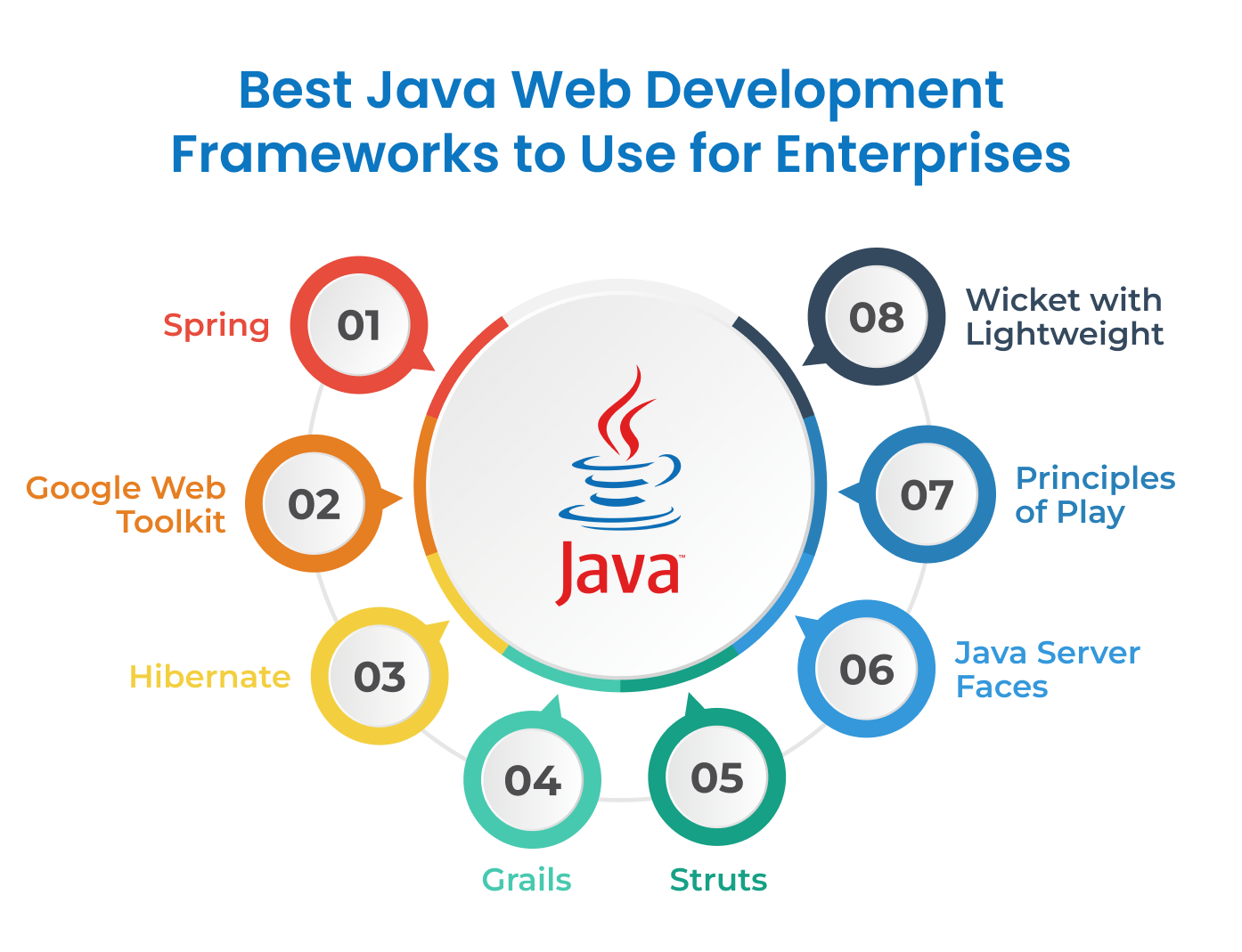
Java’s continued dominance in web development is sustained by a mature, highly active framework ecosystem. Modern Java frameworks abstract complex infrastructure setup, enabling engineering teams to deploy microservices and web APIs efficiently.
- Enterprise Java Web APIs
- Spring Boot / Spring 6
- Standard Enterprise Stack
- Deep Ecosystem Integration
- Production-Grade Actuators
- Cloud-Native (Quarkus/GraalVM)
- Sub-Second Startup Times
- Minimal Memory Footprint
- Native Kubernetes Support
- Spring Boot / Spring 6
Spring Boot and Spring Framework
Spring Boot remains the industry standard for enterprise Java web applications. By pairing opinionated defaults with comprehensive configuration options, Spring Boot simplifies building web endpoints, managing data persistence, and enforcing security policies.
- Spring Framework Integration: Leverages the broader Spring ecosystem, including Spring Security for authentication/authorization and Spring Data for database abstraction.
- Production Readines: Built-in observability tools (Actuator metrics, health checks, distributed tracing) simplify monitoring in distributed enterprise environments.
- Virtual Thread Support: Recent versions natively leverage JVM virtual threads to boost API throughput out of the box.
Quarkus and Micronaut for Microservices
For serverless architectures and containerized deployments where instant startup and low memory usage are critical, cloud-native frameworks like Quarkus and Micronaut offer alternative approaches:
- Compile-Time Dependency Injection: Avoids runtime reflection, reducing application startup overhead from seconds to milliseconds.
- Native Image Compilation: Integrates with GraalVM to ahead-of-time (AOT) compile Java bytecodes directly into architecture-specific native executables.
- Optimized Resource Usage: Enables running Java microservices within tight container memory limits, directly reducing cloud hosting expenditures.
Financial and Operational Case for Java
Beyond technical performance, executive leadership must evaluate language selection based on operational feasibility, total cost of ownership (TCO), and human resource management.
| Category | Details |
|---|---|
| Talent Pool Availability | Global workforce reduces hiring friction |
| Risk Mitigation | Predictable 2-Year LTS Support Cadence |
| Ecosystem Longevity | Tens of thousands of tested enterprise libs |
| Infrastructure Efficiency | JVM JIT optimization reduces compute costs |
Access to Talent
Java consistently ranks among the most widely used programming languages worldwide. Higher education institutions and technical bootcamps globally teach Java as a baseline language. For businesses, this translates to:
- Lower Recruitment Friction: Teams spend less time sourcing specialized candidates compared to niche functional or emerging languages.
- Team Transferability: Standardized enterprise design patterns mean new engineering hires become productive quickly.
- Onshoring and Offshoring Capabilities: Established global development teams understand Java architectural standards.
Predictable Release and Support Cadence
The OpenJDK community operates on a transparent release schedule. Feature updates arrive every six months, while Long-Term Support (LTS) versions arrive every two years.
This model offers clear advantages:
- Predictable Upgrade Budgets: Enterprises can plan upgrades around LTS releases (such as Java 17, Java 21, and subsequent LTS iterations) on a multi-year timeline.
- Commercial Support Options: Multiple vendors—including Oracle, Red Hat, Azul Systems, and Amazon (Corretto)—provide long-term enterprise maintenance agreements for mission-critical systems.
Enterprise Technology Comparison: Java vs. Alternatives
Selecting a runtime requires weighing tradeoffs against operational priorities. The following matrix illustrates how Java compares to other prominent backend environments across enterprise dimensions:
| Dimension | Modern Java (JVM) | Node.js (JavaScript/TypeScript) | Go (Golang) | Python |
|---|---|---|---|---|
| Primary Use Cases | Enterprise web APIs, financial platforms, microservices | Real-time web APIs, single-page app backends | Distributed systems, network tools, cloud infrastructure | Data science, machine learning, prototyping |
| Concurrency Model | Virtual Threads (Lightweight thread-per-request) | Event Loop (Single-threaded non-blocking I/O) | Goroutines (CSP-style channels/routines) | GIL-constrained threading / AsyncIO |
| Type System | Static, Strong | Dynamic (Static via TypeScript) | Static, Strong | Dynamic, Optional type hints |
| Runtime Performance | High (JIT optimized + Native options) | Medium to High | High (Native binary) | Low to Medium |
| Ecosystem Maturity | Exceptionally High (30+ years of libraries) | High (NPM ecosystem) | Moderate to High | High (Data & AI focus) |
| Backward Compatibility | Industry-leading strict stability | Variable (Node core vs NPM package churn) | High stability guarantees | Moderate (Historical Python 2/3 friction) |
Overcoming Traditional Java Challenges
While Java offers substantial benefits, technical teams must navigate specific architectural considerations to maximize its utility in modern deployments.
Memory Overhead Management
Historically, the JVM required a static heap memory allocation that was larger than dynamic alternatives. In modern containerized environments (such as Kubernetes), unoptimized JVM configurations risk hitting Out-Of-Memory (OOM) limits.
- Mitigation: Modern JVMs (Java 11+) are fully container-aware, automatically respecting cgroup limits for CPU and RAM allocation. Furthermore, tuning garbage collector selection (e.g., using Shenandoah or ZGC) or using GraalVM Native Images reduces memory footprints to levels competitive with Go or C#.
Addressing Cold Start Latency
For serverless architectures (such as AWS Lambda), traditional Java applications experienced "cold starts" while the JVM initialized and executed Just-In-Time (JIT) compilation routines.
- Mitigation: Developers resolve cold-start latency through two primary mechanisms:
- GraalVM Native Image: Compiles application code into a binary executable ahead of time, allowing instant execution.
- Coordinated Restore at Checkpoint (CRaC): Pauses a running JVM instance, snapshots its state to disk, and restores it instantly upon execution.
Frequently Asked Questions
Is Java still relevant for cloud-native microservices?
Yes. With cloud-native frameworks like Spring Boot 3, Quarkus, and Micronaut, Java integrates natively into containerized Kubernetes environments. When compiled with GraalVM, Java microservices startup in milliseconds and run with low memory consumption.
How do Virtual Threads differ from traditional Java threads?
Traditional Java threads map 1:1 to operating system threads, making them resource-intensive. Virtual Threads are lightweight, user-mode threads managed internally by the JVM. Hundreds of thousands of virtual threads can run concurrently on a single machine without exhausting OS memory or CPU resources.
Why do banks and financial institutions prefer Java for web backend services?
Financial institutions rely on Java due to its strong static typing, memory safety, robust security libraries, predictable performance under high load, and strict long-term backward compatibility, which preserves decades of business logic.
Should new web projects use Spring Boot or Jakarta EE?
Spring Boot is the dominant choice for greenfield commercial web applications due to its extensive ecosystem, developer tooling, and cloud integration. Jakarta EE (managed by the Eclipse Foundation) remains vital for standardized enterprise specifications and legacy system migrations.
How does Java's long-term cost compare to dynamic languages like Python or JavaScript?
While initial setup for dynamic languages can be faster, Java typically offers a lower total cost of ownership (TCO) for complex, long-lived applications. Java’s static typing catches bugs early in development, while its strict backward compatibility minimizes upkeep costs caused by breaking library updates.
Strategic Recommendations for Engineering Leaders
To maximize the business value of Java web development, technology organizations should implement the following actionable strategies:
- Adopt Recent LTS Versions: Migrate legacy codebases from end-of-life versions (such as Java 8) to modern LTS releases (Java 17, Java 21, or newer). Upgrading grants immediate access to performance improvements, reduced memory overhead, and modern concurrency features.
- Leverage Virtual Threads for I/O-Bound Services: Update web frameworks to versions supporting Virtual Threads. Refactor complex reactive codebases back to straightforward synchronous models where appropriate to simplify maintenance and debugging.
- Containerize with Container-Aware Runtimes: Ensure deployment environments run modern OpenJDK builds configured with explicit CPU and memory constraints matching container resource limits.
- Evaluate Native Compilation for Edge and Serverless: Where fast startup times are critical, incorporate GraalVM Native Image builds into CI/CD pipelines to produce lean binaries tailored for cloud execution.
By pairing modern platform innovations with decades of enterprise reliability, Java remains a strategic technology investment for businesses building scalable, secure, and resilient web applications.
Image Gallery