Comprehensive Guide to Electric Propulsion Systems in Aerospace Engineering
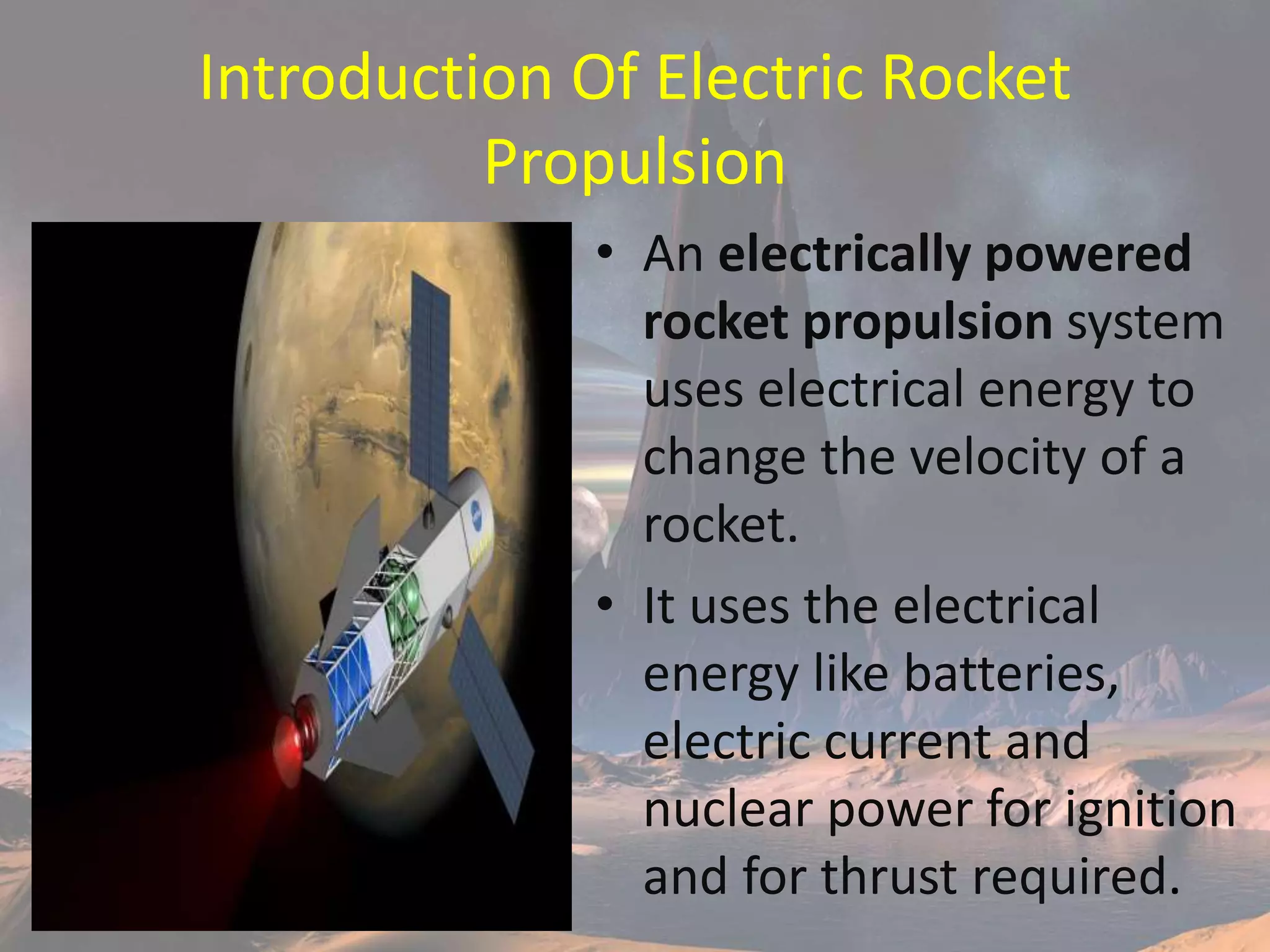
Electric propulsion represents a transformative paradigm shift in aerospace engineering, utilizing electrical power to accelerate propellant via electromagnetic, electrostatic, or electrothermal mechanisms to generate thrust for spacec...
Electric propulsion represents a transformative paradigm shift in aerospace engineering, utilizing electrical power to accelerate propellant via electromagnetic, electrostatic, or electrothermal mechanisms to generate thrust for spacecraft and advanced aircraft. Unlike traditional chemical rockets that rely on high-temperature combustion, electric propulsion systems achieve significantly higher specific impulse, making them exceptionally efficient for deep-space exploration, satellite station-keeping, and orbital transfer maneuvers in 2026.
Contents
Fundamental Principles of Electric Propulsion
Understanding the mechanics of electric propulsion requires looking beyond conventional chemical rocketry. While chemical thrusters derive their energy from chemical bonds breaking during combustion, electric propulsion systems decouple the energy source from the propellant.
External solar arrays or nuclear power sources provide electrical energy to ionize and accelerate the propellant. This fundamental separation allows electric propulsion to achieve exhaust velocities that are an order of magnitude higher than chemical systems.
The core performance metric for any propulsion system is specific impulse ($I_{sp}$), measured in seconds. It quantifies how efficiently a propulsion system uses propellant.
| Propulsion Type | Typical Specific Impulse ($I_{sp}$) | Thrust Range | Primary Applications |
|---|---|---|---|
| Chemical Monopropellant | 200 - 240 seconds | 1 N to 500 N | Attitude control, orbital insertion |
| Chemical Bipropellant | 300 - 450 seconds | 10 N to 50,000 N | Launch vehicles, primary orbit raising |
| Electrothermal (Arcjet) | 500 - 1,000 seconds | 0.1 N to 2 N | Station-keeping, drag makeup |
| Electrostatic (Ion Thruster) | 1,500 - 5,000+ seconds | 10 mN to 500 mN | Deep space probes, station-keeping |
| Electromagnetic (Hall Effect) | 1,000 - 3,000 seconds | 20 mN to 1 N | LEO/GEO satellite maneuvering |
Major Types of Electric Propulsion Technologies
Engineers categorize electric propulsion into three primary classifications based on the physical mechanism used to accelerate the propellant: electrothermal, electrostatic, and electromagnetic. Each architecture serves distinct mission profiles based on power availability, thrust demands, and orbital lifetimes.
Electrothermal Thrusters
Electrothermal systems heat a propellant using electrical resistance heaters or electric arcs before expanding the heated gas through a converging-diverging nozzle.
- Resistojets: Pass propellant over an electrically heated filament, offering a modest increase in $I_{sp}$ over chemical cold-gas systems with high reliability.
- Arcjets: Establish an electric arc directly through the propellant gas stream, creating a plasma state that increases enthalpy and exhaust velocity.
Electrostatic Ion Thrusters
Electrostatic thrusters ionize a propellant—most commonly xenon, krypton, or iodine—and use high-voltage electrostatic grids to accelerate the resulting ions to extreme velocities.
- Grid ion thrusters feature multi-aperture grids that establish intense electric fields.
- These systems yield exceptionally high specific impulse values (exceeding 4,000 seconds), making them the preferred choice for long-duration interplanetary missions where propellant mass must be minimized.
Electromagnetic Plasma Thrusters
Electromagnetic devices utilize both electric and magnetic fields to accelerate plasma through the Lorentz force ($\mathbf{F} = q(\mathbf{E} + \mathbf{v} \times \mathbf{B})$).
- Hall Effect Thrusters (HETs): Utilize a radial magnetic field and an axial electric field to trap electrons, which in turn ionize the propellant and accelerate ions via the Hall current. They provide an optimal balance between thrust and specific impulse.
- Magnetoplasmadynamic (MPD) Thrusters: Handle high power levels to generate substantial thrust, though they require dedicated megawatt-class power systems currently under development.
Engineering Advantages and Operational Limitations
Deploying electric propulsion involves balancing significant efficiency gains against operational constraints. Mission planners must weigh these factors during the preliminary design phase.
Key Trade-Offs in System Architecture Electric propulsion systems drastically reduce propellant mass fractions, enabling smaller launch vehicles or larger payload capacities. However, their low thrust-to-weight ratios require extended thrust arcs, meaning maneuvers that take minutes with chemical rockets may take weeks or months using electric thrusters.
Primary Advantages
- Mass Efficiency: High specific impulse dramatically reduces the propellant mass required for a given mission delta-v budget.
- Precise Control: Capable of throttle control down to millinewton levels, allowing ultra-precise attitude control and formation flying.
- Extended Mission Lifespans: Smaller propellant tanks leave more spacecraft mass budget available for advanced scientific payloads or communication transponders.
Notable Limitations
- Power Demand: Requires heavy, high-output solar arrays or nuclear reactors capable of delivering kilowatts to megawatts of continuous electrical power.
- Low Thrust: Inability to perform impulsive, high-thrust maneuvers needed for rapid escape trajectories without prolonged spiral-out phases through radiation belts.
- Thermal Management: Dissipating waste heat from power processing units (PPUs) and thruster walls in the vacuum of space requires sophisticated radiator arrays.
Mission Integration and Step-by-Step Design Workflow
Integrating an electric propulsion subsystem into a spacecraft requires a rigorous engineering workflow to ensure compatibility between power generation, thermal control, and navigation architectures.
- Mission Delta-V Budgeting: Calculate the total velocity change required across the spacecraft's lifecycle, including station-keeping, orbit raising, and end-of-life de-orbiting.
- Power Architecture Sizing: Determine available bus power from solar arrays or radioisotope thermoelectric generators (RTGs) to ensure the Power Processing Unit (PPU) can draw adequate current without starving spacecraft avionics.
- Propellant Selection and Tank Design: Choose between pressurized gas (xenon/krypton) or solid/iodine storage mediums, sizing the composite overwrapped pressure vessels (COPVs) accordingly.
- Thermal and Magnetic Shielding Analysis: Model plasma interactions with the spacecraft body and design magnetic shielding or placement strategies to prevent plume erosion of solar arrays.
- Ground Testing and Qualification: Subject engineering development units (EDUs) to vacuum chamber firing tests, vibration testing, and lifetime wear-testing to validate thruster longevity.
Frequently Asked Questions
What is the primary difference between chemical and electric propulsion?
Chemical propulsion derives energy from internal chemical reactions and provides high thrust with low specific impulse. Electric propulsion uses external electrical power to accelerate propellant electromagnetically or electrostatically, yielding low thrust but exceptionally high specific impulse.
Why is xenon the most common propellant for ion and Hall effect thrusters?
Xenon is a high-atomic-number noble gas that is easily ionized, chemically inert, and dense enough to store efficiently in high-pressure tanks, maximizing thruster efficiency and preventing chemical contamination of spacecraft surfaces.
Can electric propulsion systems operate in Earth's atmosphere?
Most electric propulsion systems are designed strictly for vacuum operation because ambient atmospheric pressure disrupts the plasma discharge and causes electrical breakdown. However, experimental air-breathing electric thrusters are being researched for very low Earth orbit (VLEO) applications.
How do electric thrusters affect satellite orbital maneuvers?
Because electric thrusters produce low thrust, they cannot perform sudden orbit insertions. Instead, spacecraft execute continuous or segmented spiral trajectories over weeks or months to raise their orbits gradually.
What is a Power Processing Unit (PPU) in an electric propulsion system?
The PPU is a critical electronic subsystem that converts raw spacecraft bus voltage into the high-voltage, precisely regulated currents required to operate the thruster's cathode, anodes, and electromagnets.
Strategic Outlook and Implementation
Electric propulsion remains a cornerstone of modern satellite design and deep-space exploration. As power generation technologies advance and alternative propellants like iodine and krypton gain widespread adoption, aerospace engineers will continue pushing the boundaries of payload efficiency and operational longevity. Success in modern mission architectures requires a thorough understanding of plasma physics, power electronics, and integrated spacecraft thermal management.
Image Gallery