Why the Employment Labor Law Poster Matters for Offices: A 2026 Compliance Guide
Employment labor law posters are mandatory legal notices that inform employees of their rights under federal and state statutes. For offices, these posters are critical for maintaining regulatory compliance, avoiding significant govern...
Employment labor law posters are mandatory legal notices that inform employees of their rights under federal and state statutes. For offices, these posters are critical for maintaining regulatory compliance, avoiding significant government fines, and providing a legal defense against claims of "lack of notice" regarding wage, safety, and anti-discrimination protections.
Contents
In the corporate and administrative landscape of 2026, the "poster on the wall" remains a fundamental pillar of human resources and legal risk management. While many office functions have migrated to digital platforms, the legal requirement to display specific labor law notices has not diminished. Whether you manage a small local agency or a large corporate headquarters, understanding why these posters matter is essential for shielding your organization from liability and ensuring a transparent relationship with your workforce.
The Legal Mandate: Federal and State Requirements
The primary reason employment labor law posters matter is that they are mandated by law. In the United States, various federal agencies—including the Department of Labor (DOL), the Equal Employment Opportunity Commission (EEOC), and the Occupational Safety and Health Administration (OSHA)—require employers to post notices in a conspicuous place where employees can regularly view them.
Failure to display these posters is a violation of federal law. However, the complexity arises because there is no single "master poster" provided by the government that covers every requirement. Instead, different laws have different posting requirements. Furthermore, state governments have their own set of mandatory notices that often cover areas not addressed by federal law, such as state-specific minimum wages, meal break requirements, and family leave policies.
Core Federal Statutes Requiring Notices
As of 2026, several key federal statutes require visible posting in the workplace:
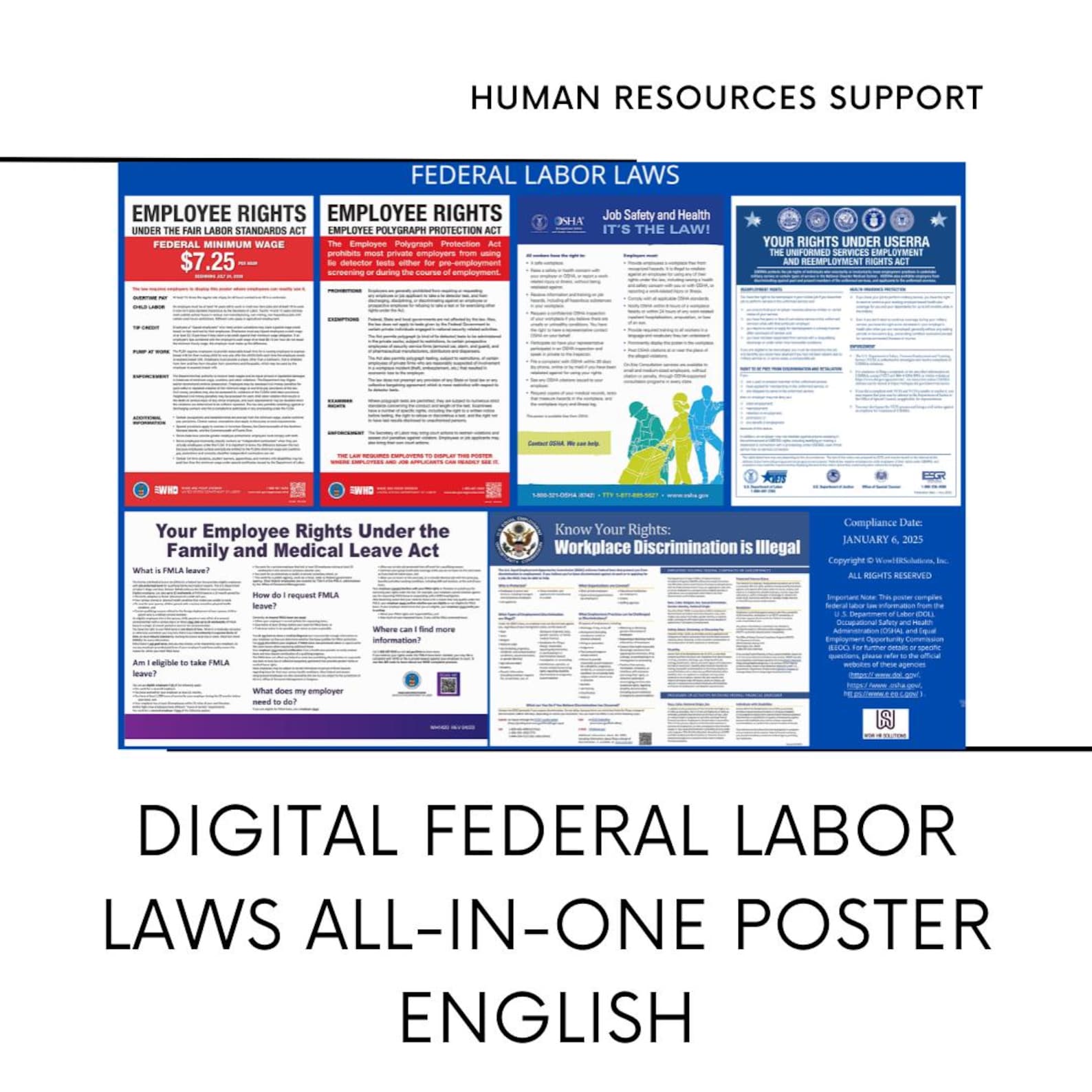
- Fair Labor Standards Act (FLSA): This poster outlines minimum wage, overtime pay, and child labor protections. Even in "white-collar" office environments, this is vital for non-exempt staff.
- Family and Medical Leave Act (FMLA): Essential for offices with 50 or more employees, explaining the right to unpaid, job-protected leave for specified family and medical reasons.
- Know Your Rights: Workplace Discrimination is Illegal (EEOC): This notice summarizes the laws prohibiting discrimination based on race, color, religion, sex, national origin, age, disability, or genetic information.
- Occupational Safety and Health Act (OSHA): Even in low-risk office settings, the "Job Safety and Health: It's the Law" poster must be displayed to inform workers of their right to a safe workplace.
- Employee Polygraph Protection Act (EPPA): This law prohibits most private employers from using lie detector tests for pre-employment screening or during the course of employment.
- Uniformed Services Employment and Reemployment Rights Act (USERRA): This notice informs service members of their right to return to their civilian jobs after military service.
Financial Consequences: The Cost of Non-Compliance
For many office managers, the motivation to keep posters updated is driven by the potential for heavy fines. Government agencies do not view missing posters as minor clerical errors; rather, they are seen as a failure to inform workers of their fundamental rights.
In 2026, federal penalty amounts for posting violations have been adjusted for inflation, reaching levels that can significantly impact a business's bottom line. For example, failing to post the mandatory OSHA notice or the EEOC anti-discrimination notice can result in fines exceeding $15,000 to $20,000 per violation. If an office is found to have multiple missing or outdated posters during a DOL audit, the cumulative fines can easily reach six figures.
Beyond government-imposed fines, missing posters can become a major liability during private litigation. If an employee sues for unpaid overtime or discrimination, their attorney may argue that the "statute of limitations" should be extended because the employer failed to post the required notices, thereby keeping the employee in the dark about their rights. This can allow claims that would otherwise be expired to proceed in court, dramatically increasing the employer's legal exposure.
Protecting the Organization Against Litigation
One of the most overlooked reasons why labor law posters matter for offices is their role in a "Good Faith" legal defense. When an organization displays all required notices in a highly visible area, it establishes a record of transparency.
In the event of an employment-related lawsuit, being able to prove that the company complied with all posting requirements serves as evidence that the employer took proactive steps to educate its workforce. This can be particularly relevant in cases involving the Pregnant Workers Fairness Act (PWFA) or the PUMP Act, both of which have seen increased enforcement and updated posting requirements leading into 2026. By having the most current version of these posters visible, an office manager demonstrates a commitment to compliance that can mitigate punitive damages in a legal dispute.
The Office Environment: Placement and Visibility
A common mistake in office settings is placing the labor law posters in an obscure location, such as a closet or a low-traffic hallway. To satisfy the "conspicuous" requirement, posters must be placed where employees naturally congregate or pass through frequently.
Ideal locations for office posters include:
- The Breakroom: This is the most common and generally accepted location, as employees spend non-working time here.
- Near the Time Clock: If your office uses a physical time clock or a centralized sign-in kiosk, this is a high-traffic zone that meets federal standards.
- Human Resources Lobby: For larger corporate environments, the HR department’s entrance or waiting area is an appropriate site.
- Main Employee Entrance: Ensuring the posters are visible upon entry or exit reinforces their importance.
It is important to note that posters must be physically accessible. They cannot be placed behind a locked glass case unless all employees have a key, and they cannot be obscured by other office decorations or announcements.
The Challenge of the Hybrid and Remote Office
By 2026, the definition of an "office" has expanded to include thousands of home offices and co-working spaces. This shift has raised questions about whether physical posters are still necessary.
The Department of Labor has clarified that while electronic posting (via a company intranet, email, or a dedicated portal) is encouraged and often necessary for remote workers, it generally does not replace the requirement for a physical poster in the physical office location if any employees report there even occasionally.
For offices with a significant remote or hybrid workforce, the best practice is a dual approach:
- Physical Posters: Maintained at the physical headquarters or regional hubs.
- Digital Notices: Posted on the company’s internal HR portal or distributed via a digital compliance service. This ensures that employees who never visit the physical office are still informed of their rights, which is a key requirement for modern compliance.
Comparison of Key Federal Posting Requirements
The following table outlines the specific federal posters that most general office environments must display as of 2026.
| Poster Name | Governing Agency | Primary Purpose | Who Must Post? |
|---|---|---|---|
| FLSA - Minimum Wage | Dept. of Labor (WHD) | Notifies workers of minimum wage and overtime rules. | All employers covered by FLSA. |
| EEOC - Know Your Rights | EEOC | Summarizes anti-discrimination laws (Title VII, ADA, GINA). | Employers with 15+ employees. |
| FMLA Notice | Dept. of Labor (WHD) | Explains leave rights for family/medical needs. | Public agencies & private firms with 50+ employees. |
| OSHA - It's the Law | OSHA | Outlines safety rights and reporting procedures. | Most private sector employers. |
| EPPA Notice | Dept. of Labor (WHD) | Outlines restrictions on polygraph testing. | Most private employers. |
| USERRA Notice | Dept. of Labor (VETS) | Outlines reemployment rights for veterans. | All employers with military-service employees. |
Common Mistakes and How to Avoid Them
Even well-intentioned office managers often fall into compliance traps. The most frequent error is using an "all-in-one" poster that is several years out of date. Labor laws change frequently; for example, between 2024 and 2026, multiple states increased their minimum wages and expanded paid leave protections, requiring immediate poster updates.
Another mistake is ignoring local city or county ordinances. In many jurisdictions, local governments have passed "Fair Workweek" or local minimum wage laws that require their own specific posters. A federal and state poster might not be enough to satisfy a local labor inspector.
To avoid these pitfalls, offices should:
- Conduct an Annual Audit: Check all posters every January to ensure they reflect current laws.
- Monitor State Agencies: Subscribe to updates from your State Department of Labor.
- Verify Language Requirements: If a significant portion of your office staff speaks a language other than English (typically 5% to 10% depending on the state), you may be legally required to post the notices in that language as well.
Frequently Asked Questions
How often do labor law posters need to be updated?
There is no fixed schedule for updates; posters must be replaced whenever the underlying law or a specific regulation changes. For instance, if the federal government or your state legislature raises the minimum wage, the poster must be updated by the effective date of the new wage. In 2026, many states have moved to annual inflation-based adjustments, making yearly updates a necessity for many offices.
Can I just print the posters from the internet?
Yes, you can download and print mandatory posters for free from the official websites of the DOL, EEOC, and OSHA. However, you must ensure they meet the size and font requirements specified by each agency. Many offices prefer to purchase "all-in-one" laminated posters from reputable compliance vendors to ensure all required notices are in one place and professionally formatted.
Do small offices with only 2 or 3 employees need these posters?
Yes. Most federal labor laws, such as the FLSA and the OSHA Act, apply to businesses regardless of size. While some specific laws like the FMLA only apply to larger employers (50+ employees), the core posters regarding wages, safety, and polygraph protection are required for even the smallest professional offices.
What happens if an employee works 100% remotely?
For fully remote employees who never visit a physical office, the employer should provide the notices electronically. This can be done via a link on a company website or through an intranet system that the employee can access at all times. Simply emailing them once is often considered insufficient; the employee must have continuous access to the information.
Are "Labor Law Poster Subscription" services worth it?
For many office managers, subscription services provide peace of mind. These services automatically send a new poster whenever a mandatory change occurs. Given that tracking updates for federal, state, and local laws can be time-consuming, the cost of a subscription is often much lower than the cost of a single non-compliance fine.
Final Recommendation for Office Compliance
To ensure your office remains compliant in 2026, your first step should be a physical walk-through of your common areas. If your current posters are yellowed, torn, or dated prior to 2025, they likely need replacement.
We recommend designating a specific person—typically an HR coordinator or Office Manager—to be responsible for compliance updates. Furthermore, integrate a digital "Labor Law Notice" section into your employee handbook and internal portal to cover your hybrid and remote staff. By treating labor law posters as a critical component of your legal infrastructure rather than just an office decoration, you protect your business from unnecessary financial and legal peril.
Image Gallery