ROCE Formula Explained: Calculating and Interpreting Return on Capital Employed
Return on Capital Employed (ROCE) is a financial ratio that measures a company’s profitability and the efficiency with which its capital is utilized. It is calculated by dividing Earnings Before Interest and Taxes (EBIT) by Capital Emp...
Return on Capital Employed (ROCE) is a financial ratio that measures a company’s profitability and the efficiency with which its capital is utilized. It is calculated by dividing Earnings Before Interest and Taxes (EBIT) by Capital Employed, representing the percentage return a business generates for every dollar of long-term capital invested in its operations.
Contents
As of 2026, ROCE remains a cornerstone metric for fundamental analysis, particularly when evaluating capital-intensive industries such as manufacturing, energy, and telecommunications. Unlike other metrics that focus solely on equity, ROCE provides a holistic view by considering both equity and debt obligations. This makes it an indispensable tool for comparing the performance of companies with different capital structures.
The ROCE Formula and Its Components
To understand ROCE, one must first deconstruct the two primary components of the equation. The standard formula is expressed as:
ROCE = Earnings Before Interest and Taxes (EBIT) / Capital Employed
While the formula appears simple, the accuracy of the result depends heavily on how the numerator and denominator are defined and extracted from financial statements.
1. Earnings Before Interest and Taxes (EBIT)
EBIT, often referred to as operating profit, is found on the income statement. It represents the profit a company earns from its core business operations before the impact of interest expenses and corporate taxes.
Using EBIT instead of Net Income is critical for ROCE because it allows for a "clean" comparison of operational efficiency. By excluding interest, the formula focuses on the returns generated by the assets themselves, regardless of whether those assets were financed through debt or equity. By excluding taxes, it removes the variance caused by different tax jurisdictions or deferred tax assets/liabilities, which can fluctuate significantly year over year.
2. Capital Employed
Capital Employed represents the total amount of capital that a company has utilized to generate profits. There are two common ways to calculate this figure using the balance sheet:
- The Asset Approach: Total Assets minus Current Liabilities.
- The Financing Approach: Total Equity plus Non-Current Liabilities (long-term debt).
Both methods should yield the same result. The logic behind subtracting current liabilities is that short-term obligations—such as accounts payable or accrued expenses—are often considered "spontaneous" or "free" financing from suppliers and do not represent the long-term capital "employed" by investors and lenders to grow the business.
In 2026, many analysts prefer using Average Capital Employed (the sum of capital at the beginning and end of the year divided by two) to smooth out seasonal fluctuations in debt or asset purchases.
Step-by-Step Calculation of ROCE
To calculate ROCE accurately, follow these technical steps using a company’s annual report (10-K) or quarterly filing (10-Q).
Step 1: Identify EBIT
Locate the Operating Income or EBIT on the Consolidated Statement of Income. If EBIT is not explicitly listed, you can calculate it by taking Net Income and adding back Interest and Taxes.
Step 2: Determine Total Assets and Current Liabilities
On the Consolidated Balance Sheet, find the "Total Assets" figure. Then, locate "Total Current Liabilities." Subtract the liabilities from the assets.
Step 3: Perform the Division
Divide the EBIT by the Capital Employed.
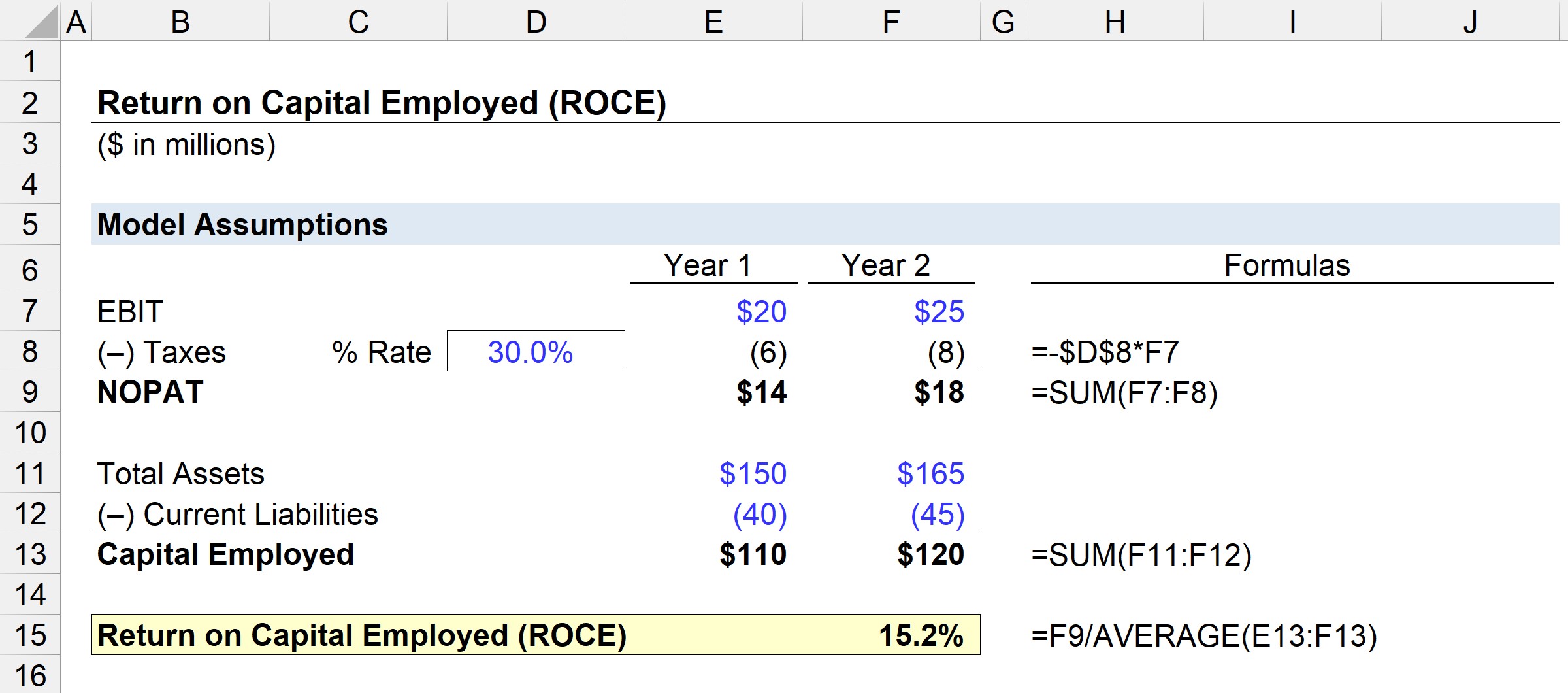
Example Calculation: Assume a company in 2026 reports the following:
- EBIT: $500,000
- Total Assets: $3,000,000
- Current Liabilities: $500,000
Capital Employed = $3,000,000 - $500,000 = $2,500,000 ROCE = $500,000 / $2,500,000 = 20%
This means for every $1 of long-term capital the company uses, it generates $0.20 in operating profit.
Why ROCE Matters: Efficiency and Value Creation
The primary utility of ROCE lies in its ability to reveal how well a management team is deploying the company’s resources. A high ROCE suggests an efficient business model that can generate significant profits from a relatively small amount of capital.
ROCE vs. Cost of Capital (WACC)
For a company to truly "create value" for shareholders, its ROCE must be higher than its Weighted Average Cost of Capital (WACC). If a company’s WACC is 10% and its ROCE is 15%, it is creating a positive spread of 5%. Conversely, if a company has a ROCE of 8% but its cost of capital is 10%, it is effectively "destroying value," as it would be more profitable for investors to put their money elsewhere.
Benchmarking and Industry Standards
ROCE is highly industry-dependent. Comparing the ROCE of a software-as-a-service (SaaS) company to that of an oil refinery is generally unhelpful.
| Industry Sector | Typical ROCE Range (2026 Trends) | Capital Intensity |
|---|---|---|
| Technology / Software | 25% – 50% | Low (High Intangibles) |
| Retail / Consumer Goods | 15% – 25% | Moderate |
| Manufacturing / Heavy Industry | 10% – 18% | High |
| Utilities / Energy | 5% – 12% | Very High |
Software companies often have exceptionally high ROCE because they require very little physical "capital" (factories, heavy machinery) to scale. In contrast, utility companies must invest billions in infrastructure, leading to a lower, though often more stable, ROCE.
ROCE vs. ROE and ROIC: Understanding the Differences
Investors often confuse ROCE with Return on Equity (ROE) and Return on Invested Capital (ROIC). While related, they serve different diagnostic purposes.
Return on Equity (ROE)
ROE measures the return specifically on the shareholders' equity. The danger of relying solely on ROE is that a company can artificially inflate this number by taking on excessive debt. Since debt reduces equity (the denominator), the ROE percentage rises even if the company's fundamental performance hasn't improved. ROCE corrects for this by including debt in the denominator, providing a more honest view of performance in leveraged companies.
Return on Invested Capital (ROIC)
ROIC is similar to ROCE but often more granular. While ROCE uses EBIT, ROIC typically uses Net Operating Profit After Taxes (NOPAT). Furthermore, ROIC often excludes non-operating assets like excess cash. In 2026, ROCE is frequently used as a "quick" diagnostic tool, while ROIC is reserved for deeper, more specialized valuation modeling.
Common Pitfalls and Limitations of ROCE
While ROCE is a powerful metric, it is not without flaws. Financial analysts must be aware of the following factors that can distort the results.
1. Asset Age and Depreciation
ROCE can be misleading when comparing an old company with a new one. Because Capital Employed is based on the book value of assets (cost minus accumulated depreciation), an older company with fully depreciated assets will have a much smaller denominator. This results in an artificially high ROCE, even if the older company’s machinery is less efficient than a competitor’s brand-new equipment.
2. Large Cash Reserves
If a company maintains a massive "cash pile" that is not being used for operations, it is still technically part of "Total Assets." This can deflate the ROCE, making the company look less efficient than it actually is. Some analysts adjust the formula by subtracting "Non-Operating Cash" from the Capital Employed to see the "Adjusted ROCE."
3. Intangible Assets and Brand Value
In the modern economy of 2026, many of the most valuable assets (brand equity, proprietary algorithms, and data) are not always accurately reflected on the balance sheet unless the company was recently acquired. This can cause ROCE to appear disproportionately high for companies that rely on intellectual property rather than physical plants and equipment.
Strategic Implementation of ROCE in Investment Analysis
When using ROCE to evaluate a potential investment or a business's health, look for consistency and trend direction.
- The Upward Trend: A rising ROCE over a 5-year period indicates that a company is successfully squeezing more profit out of its existing capital or is investing new capital into high-margin projects.
- The "Lumpy" ROCE: In cyclical industries like mining or semiconductors, ROCE will fluctuate. In these cases, look for the "mid-cycle" ROCE to determine if the company remains profitable during downturns.
- Capital Allocation Quality: If a company’s ROCE is significantly higher than its competitors, it usually possesses a "moat"—a competitive advantage such as superior technology, scale, or brand loyalty that prevents competitors from eroding its margins.
Frequently Asked Questions
What is a good ROCE percentage?
Generally, a ROCE of 15% or higher is considered good across most industries. However, a "good" ROCE must always be compared to the company’s previous years and its direct industry peers. A company with a 12% ROCE in a sector where the average is 8% is performing exceptionally well.
How does debt affect ROCE?
Debt increases the "Capital Employed" (the denominator). If a company takes on debt to fund a project that generates less EBIT than the cost of that debt, the ROCE will decrease. If the debt is used to fund high-growth, high-margin expansion, the ROCE should eventually increase.
Can ROCE be negative?
Yes. If a company reports an operating loss (negative EBIT), the ROCE will be negative. This is common in early-stage startups or companies facing severe financial distress, indicating that the business is actively losing capital rather than generating a return on it.
Is ROCE better than Net Profit Margin?
They measure different things. Net Profit Margin measures how much of every dollar of revenue is kept as profit. ROCE measures how efficiently the company uses its entire capital base to generate that profit. A company can have a high profit margin but a low ROCE if it requires an enormous amount of expensive equipment to generate those sales.
Why do analysts subtract current liabilities from capital employed?
Current liabilities, such as accounts payable, are essentially short-term interest-free loans from vendors. They are part of the daily operating cycle but are not considered part of the long-term "funding" (like bank loans or shareholder investment) that management uses to build the business's foundation.
Practical Recommendation
When performing financial analysis in 2026, do not rely on ROCE in isolation. Instead, pair it with the Free Cash Flow (FCF) yield to ensure that the "earnings" in the EBIT are actually being converted into cash. Furthermore, always check for "off-balance sheet" liabilities, such as certain lease obligations, which should be added back to Capital Employed to get the most accurate picture of a company's financial efficiency. If a company consistently maintains a ROCE that exceeds its WACC by at least 5%, it is likely a strong candidate for long-term value appreciation.
Image Gallery