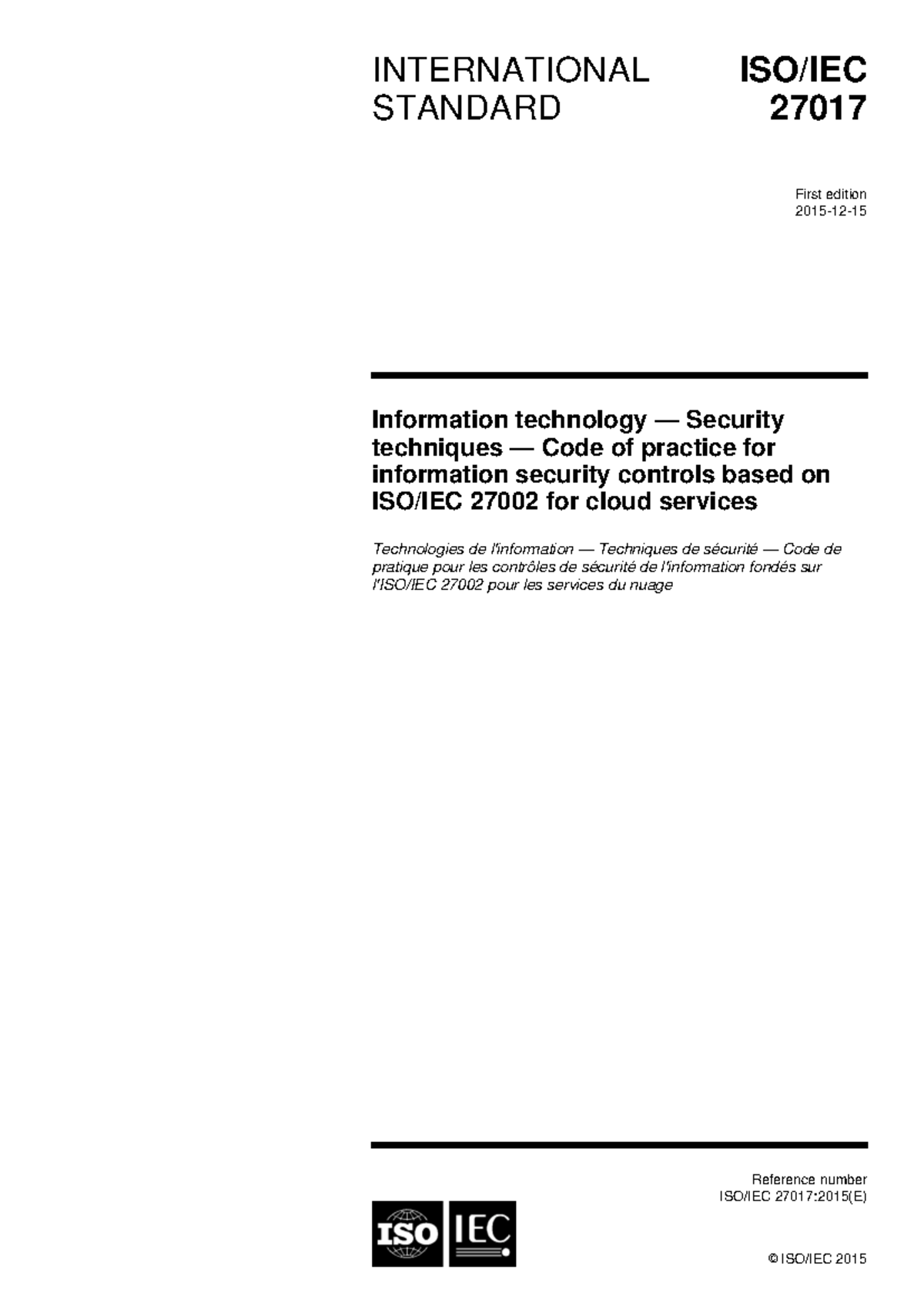
Understanding ISO/IEC 27017 Cloud Services Information Security Controls
ISO/IEC 27017 serves as an international code of practice for information security controls based on ISO/IEC 27002, specifically tailored for cloud services. It provides actionable guidelines for both cloud service providers and cloud...
ISO/IEC 27017 serves as an international code of practice for information security controls based on ISO/IEC 27002, specifically tailored for cloud services. It provides actionable guidelines for both cloud service providers and cloud service customers, addressing the unique risks associated with cloud environments such as shared responsibility, data segregation, and virtualized resource management.
Contents
The Role of ISO/IEC 27017 in the Security Landscape
The rapid adoption of cloud computing has fundamentally shifted how organizations manage their data and infrastructure. While the foundational ISO/IEC 27001 standard provides a framework for an Information Security Management System (ISMS), it was not originally designed with the nuances of cloud computing in mind. ISO/IEC 27017 fills this gap by acting as a supplementary standard, or a "cloud-specific extension," to ISO/IEC 27002.
The standard functions by mapping cloud-specific controls to the existing controls found in ISO/IEC 27002. This ensures that organizations already familiar with the ISO 27000 family of standards can integrate cloud security into their existing compliance framework without reinventing their entire management system. It clarifies the roles and responsibilities of the provider versus the customer, a critical distinction in environments where physical control of hardware is removed from the data owner.
Core Principles and Shared Responsibility
The central tenet of ISO/IEC 27017 is the principle of shared responsibility. In a traditional on-premises data center, the organization owns and manages every layer of the security stack. In a cloud model—whether Infrastructure as a Service (IaaS), Platform as a Service (PaaS), or Software as a Service (SaaS)—the responsibility is partitioned.
ISO/IEC 27017 explicitly defines which security controls must be managed by the Cloud Service Provider (CSP) and which remain the obligation of the Cloud Service Customer (CSC). For instance, while a CSP is responsible for physical security and hardware isolation, the customer often retains the responsibility for configuring access management policies, encryption of stored data, and the management of virtual machine security settings. Failure to document these boundaries often leads to security gaps, which the standard seeks to minimize through clear guidance on accountability.
Key Control Categories
The standard provides guidance across several specific domains that are critical to cloud environments. These controls go beyond general IT security to address the volatile and interconnected nature of cloud platforms.
1. Identity and Access Management (IAM)
In the cloud, identity is the new perimeter. ISO/IEC 27017 mandates strict controls over the provisioning and de-provisioning of cloud service user accounts. It emphasizes the necessity of multi-factor authentication and the principle of least privilege, ensuring that users have only the permissions necessary to perform their jobs.
2. Virtual Network and Resource Isolation
Unlike physical networks, cloud networks are defined by software. The standard provides guidance on ensuring that logical separation between different customers' data remains intact. This involves auditing the configuration of virtual private clouds (VPCs), firewalls, and segmentation of sensitive workloads to prevent lateral movement of threats between tenants.
3. Data Segregation and Deletion
When a customer terminates a contract with a cloud provider, ensuring the permanent deletion of data is paramount. ISO/IEC 27017 offers specific requirements regarding the secure destruction of data and the return of assets, preventing "data remanence," where residual information persists on storage media after logical deletion.
Comparative Analysis of Security Standards
Understanding how ISO/IEC 27017 interacts with other frameworks helps organizations streamline their compliance efforts.
| Feature | ISO/IEC 27001 | ISO/IEC 27017 | ISO/IEC 27018 |
|---|---|---|---|
| Primary Focus | General ISMS Framework | Cloud Security Controls | Cloud Privacy (PII) |
| Application | Organizational level | Cloud service specific | Cloud data protection |
| Relation | Foundation | Extension of 27002 | Extension of 27002 |
| Goal | Risk management system | Mitigation of cloud risks | Protection of personal data |
Implementing the Standard: A Strategic Approach
Implementing ISO/IEC 27017 is not merely a technical task; it is a management process that requires coordination across IT, legal, and operational departments.
- Conduct a Gap Analysis: Compare existing security controls against the requirements defined in ISO/IEC 27017. Determine which controls are currently under the responsibility of your cloud provider and which are internal to your organization.
- Assign Responsibility: Formally document the shared responsibility model. For every control listed in the standard, define who is responsible for implementation and who is responsible for monitoring.
- Control Configuration: Align cloud configurations with the standard's recommendations. This includes enabling logging and monitoring, enforcing encryption at rest and in transit, and restricting administrative access to the cloud management console.
- Third-Party Auditing: While the standard is often used for self-assessment, many organizations seek certification to build trust with clients. Engaging a qualified auditor ensures that the controls are not only implemented but are also effective in practice.
Common Pitfalls and Troubleshooting
Many organizations stumble during the implementation phase by underestimating the "customer" portion of the responsibility. A common mistake is the "set it and forget it" mentality regarding cloud security configurations. As cloud services evolve, the default security settings provided by vendors may change. Organizations must implement continuous monitoring to ensure their cloud environment remains aligned with the standard as patches and service updates are deployed.
Another challenge is documentation. Auditors often find that organizations have implemented the technical security controls but lack the policy documentation to prove that these controls are part of a managed process. Ensure that every cloud security control is mapped to an internal policy and that there is a documented process for periodically reviewing these policies.
Frequently Asked Questions
Is ISO/IEC 27017 mandatory for all cloud users? No, it is a code of practice. However, many industries with strict regulatory requirements—such as finance and healthcare—often mandate adherence to these controls as part of vendor risk management.
Does certification in ISO 27001 automatically mean compliance with ISO 27017? No. ISO 27001 focuses on the management system. ISO 27017 provides the specific technical controls for the cloud environment that may not be covered in a baseline ISO 27001 audit.
How often should an organization audit its cloud controls? ISO/IEC 27017 recommends periodic reviews. Given the rapid nature of cloud updates, most mature organizations perform a formal audit annually, with automated, continuous monitoring for configuration drifts.
Can a small business benefit from ISO 27017? Yes. Even for small organizations, the standard provides a clear checklist of what to ask their cloud provider and how to harden their own configurations, reducing the risk of a data breach.
Does this standard cover physical data center security? While the standard acknowledges physical security, it emphasizes the provider's responsibility. The customer’s focus should be on the virtualized controls that allow them to use that infrastructure securely.
Next Steps for Implementation
If your organization is looking to adopt these controls, start by requesting the "Cloud Security Responsibility Matrix" from your current cloud service provider. This document identifies which of the ISO/IEC 27017 controls are natively supported by the provider’s platform. Once you have this matrix, focus your internal efforts on the controls that remain your responsibility. Prioritize Identity and Access Management (IAM) and encryption as your immediate areas of focus, as these typically offer the highest reduction in risk per unit of effort.
Image Gallery