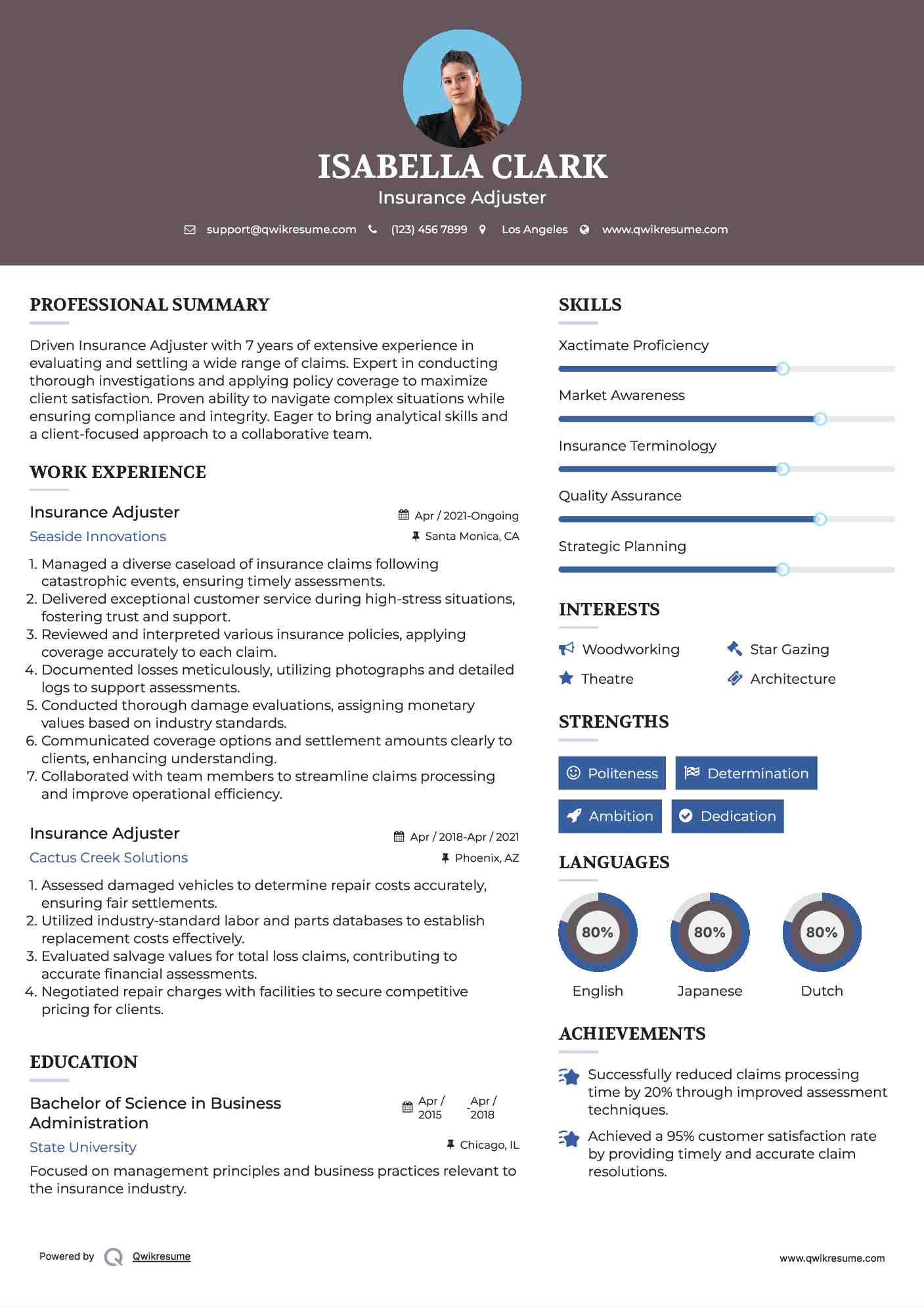
How to Write an Effective Auto Insurance Claims Adjuster Resume (With Sample)
To write an effective auto insurance claims adjuster resume, structure your document around quantified achievements, active adjuster licenses, collision estimation software proficiency, and deep knowledge of liability determination. Po...
To write an effective auto insurance claims adjuster resume, structure your document around quantified achievements, active adjuster licenses, collision estimation software proficiency, and deep knowledge of liability determination. Position your state licensing prominently near the top, highlight experience with industry tools like CCC ONE or Mitchell, and prove your efficiency using concrete metrics such as claim resolution speed, cycle time reduction, and settlement accuracy.
Contents
Key Components of a High-Impact Auto Claims Adjuster Resume
Hiring managers at insurance carriers, third-party administrators (TPAs), and independent adjusting firms process hundreds of applications for open claims positions. To pass both Automated Tracking Systems (ATS) and human review, your resume must clearly articulate your technical competence in physical damage appraisal, coverage verification, and negotiation while demonstrating operational efficiency.
A compelling auto claims adjuster resume relies on a strategic layout that leads with your credentials. State licensing status is often the primary filter used by recruiters, making it vital to present license numbers and state reciprocity details upfront.
- HEADER & CONTACT INFORMATION
- SUMMARY STATEMENT / LICENSING BLOCK (State Licenses & Certs)
- PROFESSIONAL EXPERIENCE (Bullet points with metrics & software)
- TECHNICAL SKILLS & ESTIMATING SOFTWARE COMPETENCIES
- EDUCATION & CONTINUING PROFESSIONAL DEVELOPMENT
Header and Professional Contact Details
Keep your header simple and legible. Include your full name, location (city and state), phone number, professional email address, and a customized LinkedIn profile link. If you hold independent adjuster licenses across multiple states, state your resident license state directly under your name (e.g., Licensed Auto Claims Adjuster – Resident State: Texas).
Writing a Strong Resume Summary
Avoid outdated resume objectives that focus on what you want from the employer. Instead, craft a 3-to-4 sentence executive summary that highlights your years of experience, specific adjusting focus (such as bodily injury, total loss, non-standard auto, or field appraisal), key state licenses held, and core achievements.
- Weak Example: "Motivated auto claims professional seeking an adjuster position with a growing insurance carrier to leverage strong communication skills."
- Strong Example: "Licensed Auto Insurance Claims Adjuster with 7+ years of experience managing complex physical damage, bodily injury, and total loss claims for top-tier national carriers. State-licensed in TX, FL, and GA with expertise in CCC ONE, Mitchell, and Audatex estimating platforms. Proven track record of maintaining a 98% audit compliance score while maintaining an average claim cycle time under 5 days."
Highlighting Essential Adjuster Licenses and Certifications
In the insurance industry, regulatory compliance is non-negotiable. Operating without a valid license in required jurisdictions exposes carriers to legal penalties. Consequently, hiring managers inspect licensing credentials before evaluating work history.
Create a dedicated Licensing & Certifications section immediately below your summary or within your sidebar if using a two-column layout. Include the following details for each credential:
- Exact License Title: State Resident Adjuster License (e.g., Texas All-Lines Adjuster License or Florida 620 All-Lines License).
- License Number: Providing your license number allows recruiters to verify status quickly via National Insurance Producer Registry (NIPR) or state insurance department databases.
- Non-Resident/Reciprocal States: List key non-resident states where you maintain active reciprocal licenses.
- Designations: Include professional designations such as Senior Claim Law Associate (SCLA), Chartered Property Casualty Underwriter (CPCU), Associate in Claims (AIC), or I-CAR certifications for auto collision repair knowledge.
Core Technical Skills and Software Competencies
Auto adjusting relies heavily on standardized software platforms, vehicle structural knowledge, valuation tools, and legal frameworks governing tort liability. Your resume must incorporate both technical hard skills and interpersonal negotiation capabilities.
| Skill Category | Key Competencies & Software Tools | Practical Application on Resume |
|---|---|---|
| Estimating Systems | CCC ONE, Mitchell Estimating, Audatex, Solera | Writing accurate physical damage repair estimates and reviewing shop supplements. |
| Valuation Platforms | CCC ONE Market Valuation, AutoSource, Mitchell WorkCenter | Determining Actual Cash Value (ACV) for total loss vehicle settlements. |
| Claim Management Systems | Guidewire ClaimCenter, Snapsheet, ClaimIQ, Salesforce | Managing claims file notes, diary systems, reserves, and payment issuance. |
| Technical Knowledge | OEM repair guidelines, subrogation, comparative negligence, SIU fraud indicators | Evaluating comparative fault, identifying fraudulent claims, and recovering payouts. |
| Communication & Dispute Resolution | Policyholder negotiation, attorney representation calls, mediation, salvage management | De-escalating customer disputes and negotiating settlements with opposing counsel. |
Structuring Professional Experience with Quantifiable Metrics
The body of your resume must focus on achievements rather than listing basic job descriptions. Every bullet point should follow a structured formula: Action Verb + Context/Task + Software/Tool Used + Quantified Result.
Using Metrics to Demonstrate Value
Carriers evaluate claims departments based on key performance indicators (KPIs). Frame your daily work around these specific business metrics:
- Cycle Time: How fast do you open, investigate, appraise, and close claims?
- Pending Inventory: How efficiently do you manage your active caseload?
- Settlement Accuracy / Audit Scores: How consistently do you follow file guidelines and statutory requirements?
- Subrogation Recovery: How much money did you recover from third-party carriers on liability-proven claims?
- Customer Satisfaction (CSAT): What rating scores or Net Promoter Scores (NPS) did you maintain?
Weak vs. Strong Bullet Point Comparisons
Weak: Responsible for investigating auto accidents and settling claims with drivers.
Strong: Investigated 40+ high-complexity auto collision claims weekly, establishing coverage, determining comparative negligence, and executing settlements within carrier guidelines.
Weak: Wrote estimates for damaged cars using CCC ONE.
Strong: Drafted precise physical damage repair estimates utilizing CCC ONE, averaging $3,200 per vehicle while keeping appraisal re-inspection variance below 2%.
Weak: Handled total loss vehicles and talked to salvage yards.
Strong: Processed an average of 15 auto total loss files per week, negotiating Actual Cash Value (ACV) settlements with vehicle owners and expediting title transfers to reduce average salvage hold times by 4 days.
Auto Insurance Claims Adjuster Resume Sample
Use the text-based sample template below as a structural reference when building your own document. Customize the bracketed details to match your background.
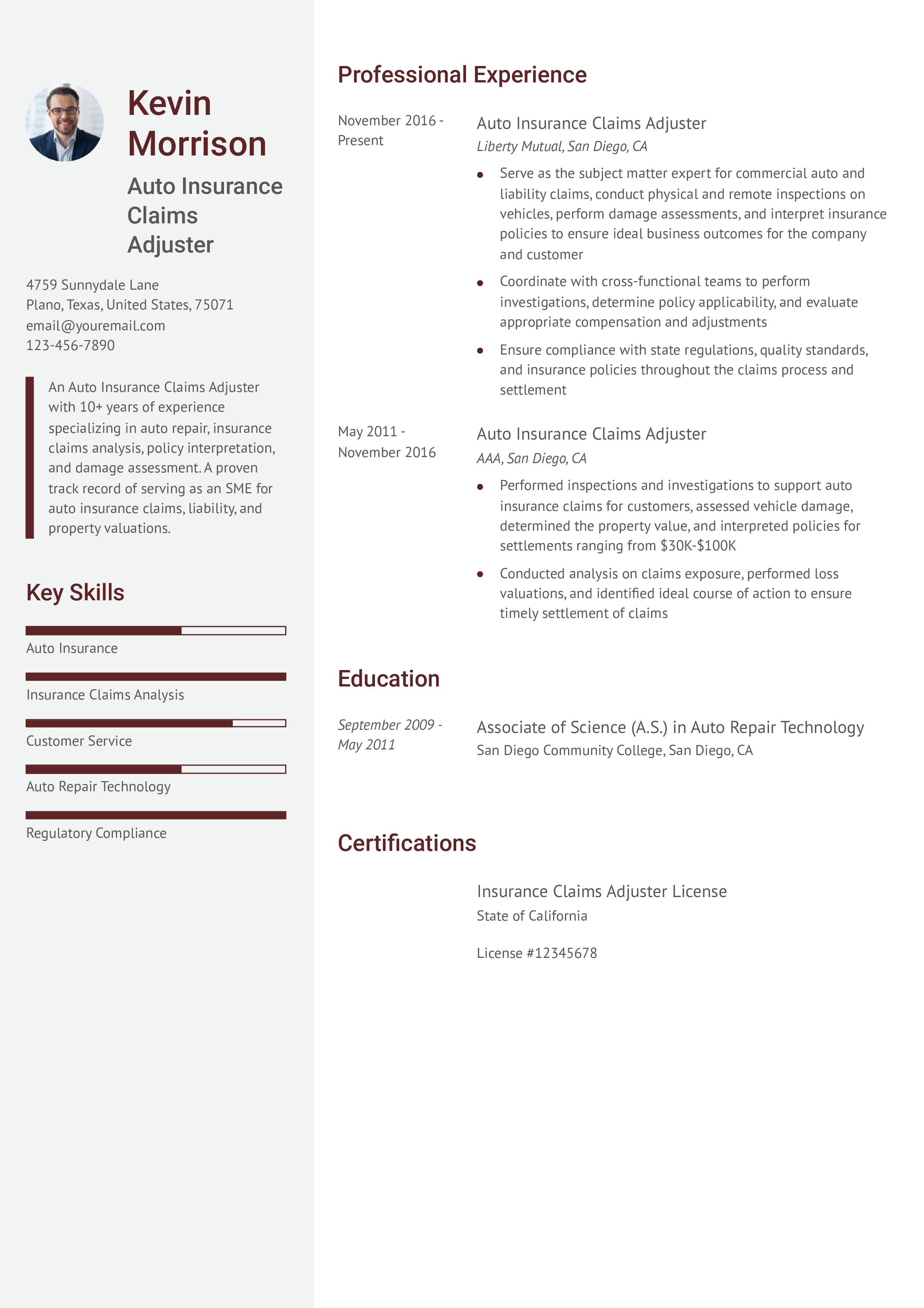
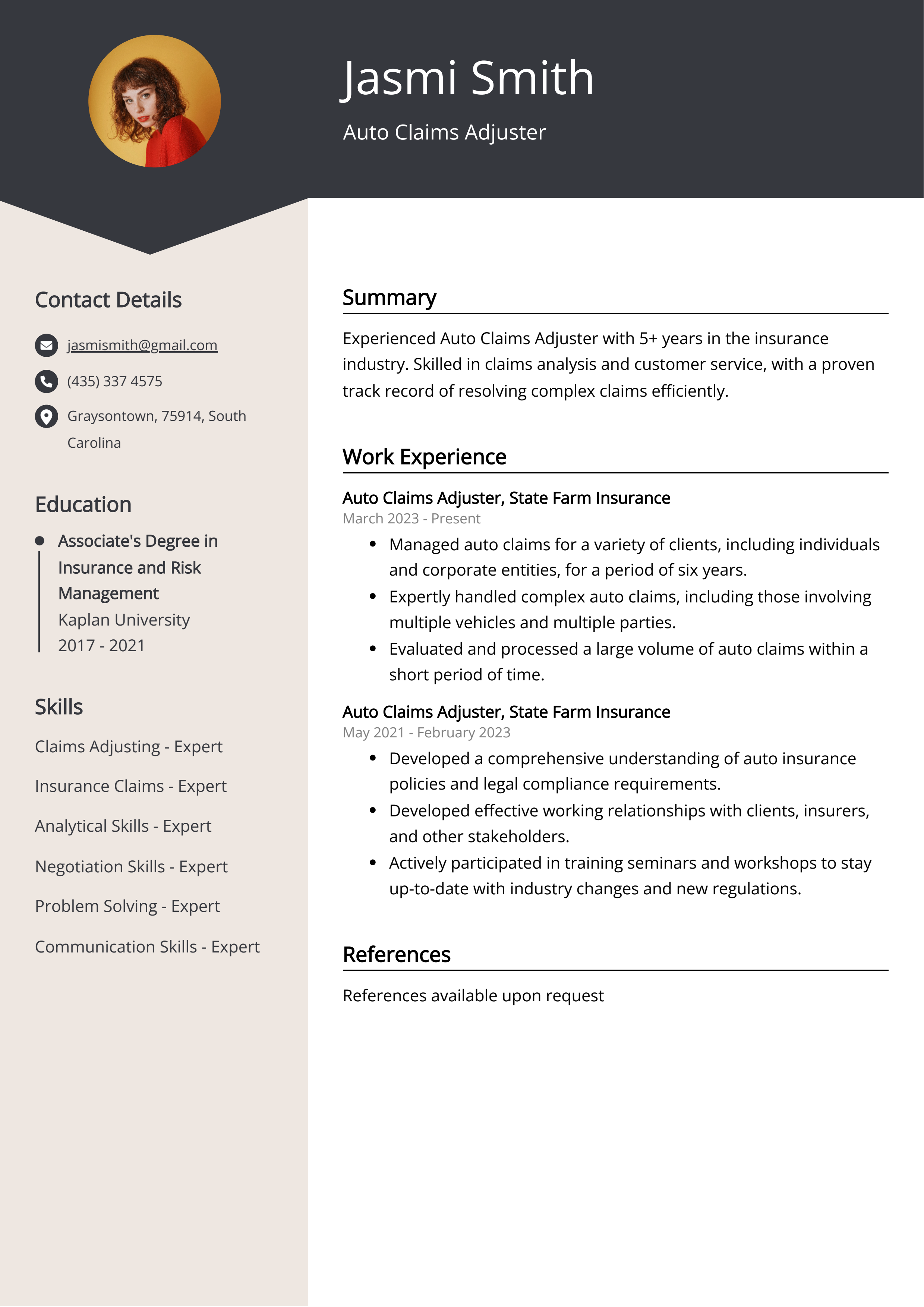
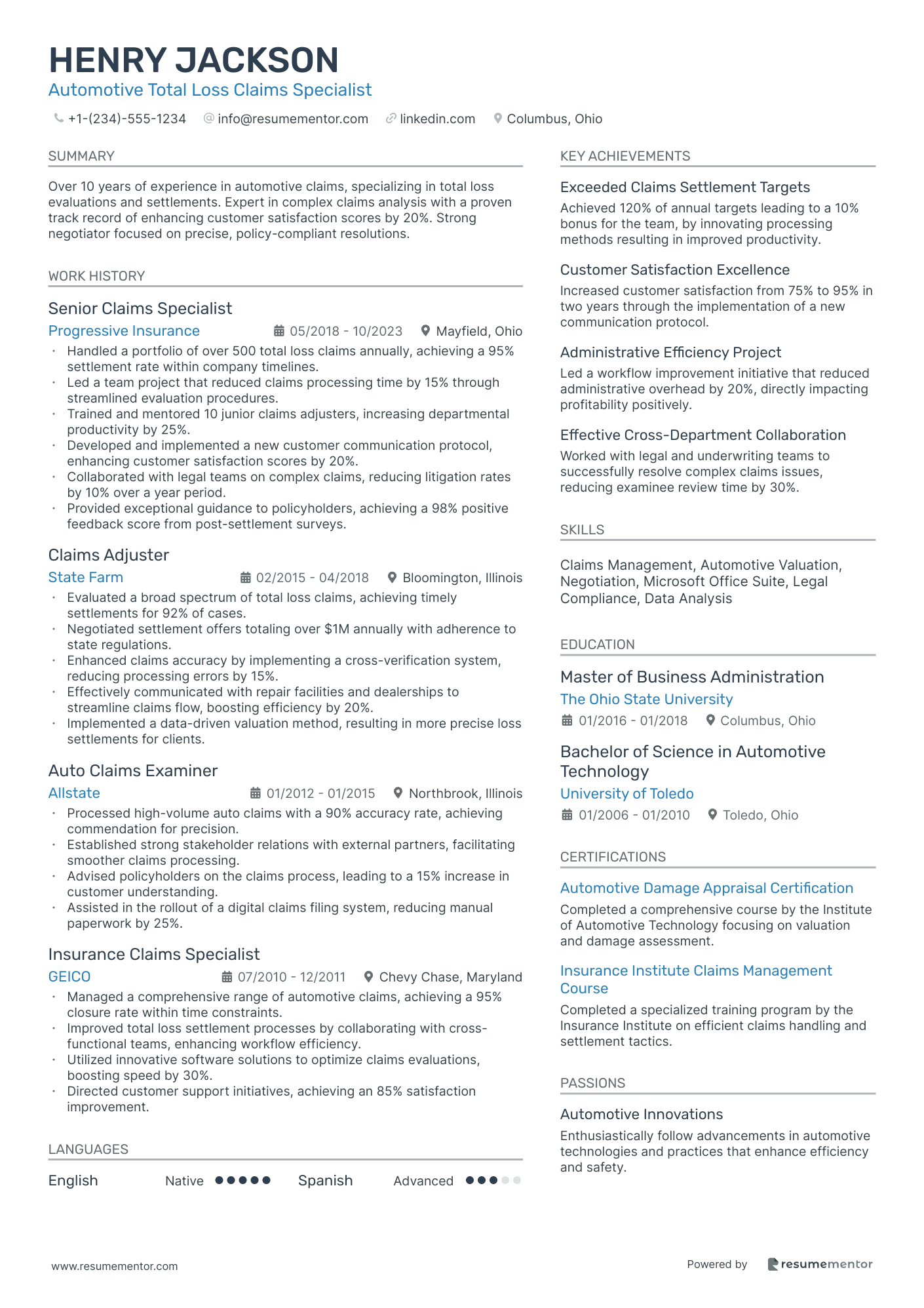
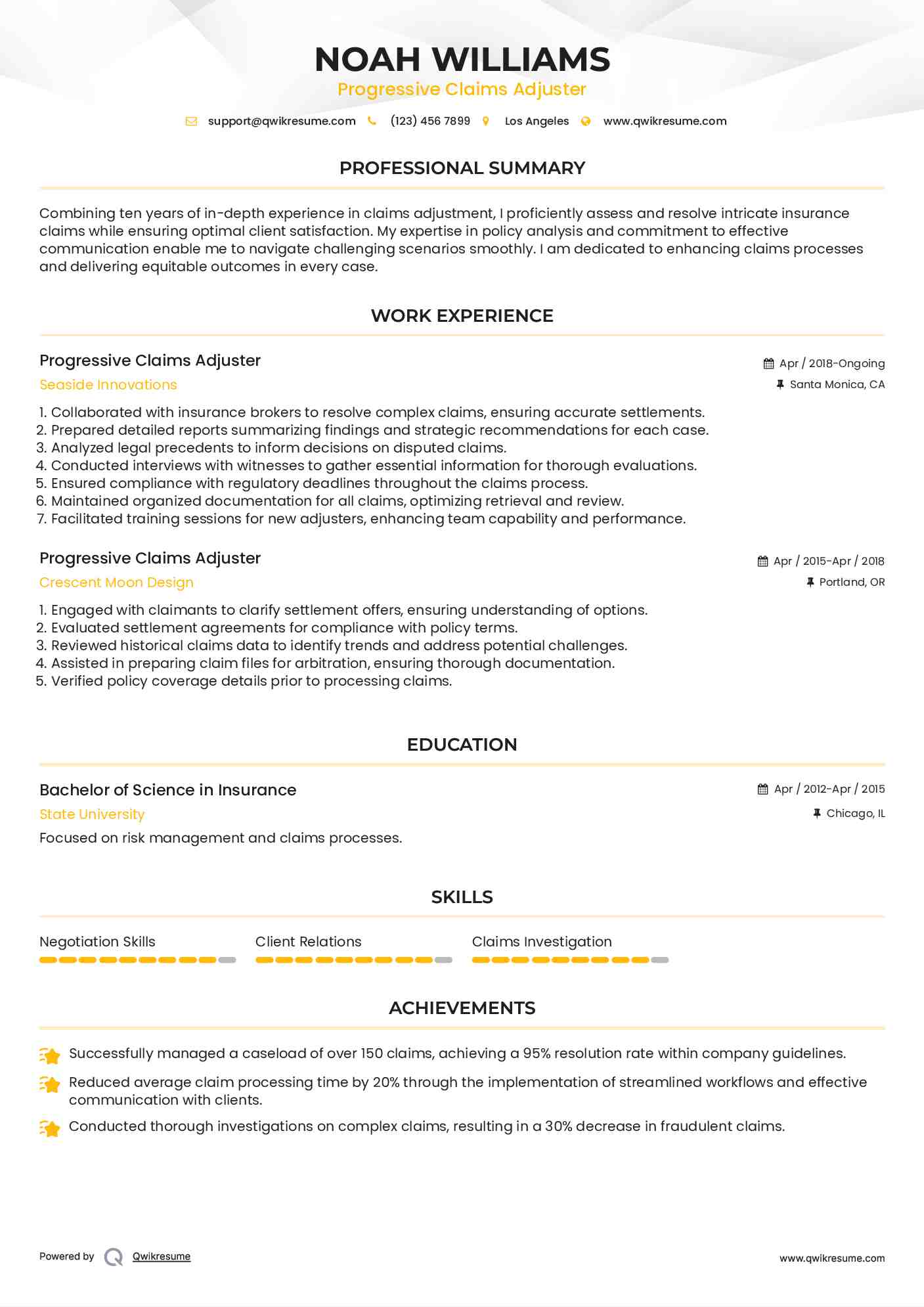
FIRST NAME LAST NAME, AIC City, State Zip | (555) 321-7654 | email@example.com | linkedin.com/in/yourprofile Resident State Adjuster License: Texas (License #1234567) Non-Resident Licenses: FL, GA, NC, SC (NIPR #9876543)
PROFESSIONAL SUMMARY Results-driven Auto Insurance Claims Adjuster with over 6 years of experience evaluating complex vehicle damage claims, determining liability, and negotiating multi-party settlements. Expert user of CCC ONE, Mitchell, and Guidewire ClaimCenter. Proven track record of managing high-volume caseloads while maintaining an active pending inventory below department benchmarks and securing a 97% quarterly audit rating. Strong knowledge of state tort laws, comparative negligence standards, and total loss valuation.
LICENSING & CERTIFICATIONS
- Resident All-Lines Adjuster License – Texas Department of Insurance (Active)
- Associate in Claims (AIC) – The Institutes
- I-CAR Non-Structural Damage Analysis Certification
- Active Reciprocal Adjuster Licenses: Florida (620), Georgia, North Carolina, South Carolina
PROFESSIONAL EXPERIENCE
SENIOR AUTO CLAIMS ADJUSTER | Premier National Insurance Co. | Dallas, TX January 2023 – Present
- Manage a continuous caseload of 45+ complex auto physical damage and low-impact bodily injury claims per week across multi-state territories.
- Conduct thorough coverage analyses, recorded statements, and liability determinations applying state-specific comparative negligence frameworks.
- Utilizing CCC ONE Estimating, write and review vehicle repair appraisals, supplement requests, and shop estimate reconciliations to ensure OEM compliance and cost accuracy.
- Negotiate claim settlements directly with policyholders, third-party claimants, and legal counsel, resolving 85% of assigned files within 14 calendar days.
- Achieved a 98.5% compliance rating on internal quality audits for file documentation, reserve accuracy, and prompt statutory notifications.
AUTO PHYSICAL DAMAGE ADJUSTER | Regional Mutual Insurance | Fort Worth, TX March 2020 – December 2022
- Appraised structural and mechanical vehicle damage for personal and commercial line auto policies using Mitchell WorkCenter.
- Evaluated total loss claims by establishing Actual Cash Value (ACV) using CCC Market Valuation tools, negotiating vehicle buybacks, and coordinating title transfers.
- Identified potential fraud indicators on questionable losses, collaborating with the Special Investigation Unit (SIU) to mitigate fraudulent payouts totaling over $140,000 annually.
- Partnered with subrogation teams to prepare evidence packages, recovering over $350,000 from third-party carriers in fiscal year 2022.
- Maintained a 94% customer satisfaction (CSAT) rating based on post-claim policyholder surveys.
CLAIMS EXPRESS REPRESENTATIVE | National General Claims Services | Arlington, TX June 2018 – February 2020
- Completed First Notice of Loss (FNOL) intake, coverage verification, and rental vehicle assignments for up to 30 new claims daily.
- Managed initial triage for driveable vs. non-driveable vehicles, dispatching direct repair network (DRP) shops or field appraisers.
- Issued initial claim payouts and deductible waivers in alignment with binding authority limits up to $5,000.
TECHNICAL SKILLS & SOFTWARE
- Claim Systems: Guidewire ClaimCenter, Snapsheet, Salesforce Service Cloud
- Estimating & Valuation Tools: CCC ONE, Mitchell Estimating, Audatex, AutoSource
- Technical Capabilities: Damage Appraisal, Total Loss Valuation, Comparative Negligence, Subrogation, Recorded Statements, SIU Triage, Direct Repair Network Management
EDUCATION Bachelor of Science in Business Administration University of North Texas, Denton, TX
Tailoring Your Resume: Field Adjusters vs. Desk Adjusters
Auto claims adjusters generally work in one of two environments: field operations or desk/virtual operations. Tailoring your resume to match the precise requirements of the target position increases your interview call-back rate.
| Field Adjuster Focus | Desk / Virtual Adjuster Focus |
|---|---|
| On-site physical inspections | Remote photo/video triage |
| Direct shop/tow yard travel | High file turnover/volume |
| Structural damage appraisal | Digital workflow efficiency |
| In-person dispute management | Phone/email negotiation |
Writing a Field Auto Adjuster Resume
Field adjusters perform physical inspections at direct repair facilities, independent body shops, salvage yards, and policyholder homes. If applying for field roles, emphasize:
- Mobile appraisal technology and field-estimating hardware proficiency.
- Valid driver's license, clean motor vehicle record (MVR), and willingness to travel or deploy for catastrophe (CAT) events.
- In-person negotiation skills with auto body shop managers regarding labor rates, paint times, and aftermarket vs. OEM parts usage.
- Expertise in structural frame alignment, mechanical damage diagnosis, and suspension assessment.
Writing a Desk or Virtual Auto Adjuster Resume
Desk adjusters work remotely or in regional service centers handling claims digitally via photo appraisal tools and telephone communications. If applying for virtual roles, emphasize:
- Proficiency with photo-estimating tools like Snapsheet or CCC ONE Photo Appraise.
- High file turnover rates and ability to balance heavy phone volume with file documentation.
- Fast digital communication skills, remote file management, and paperless workflow expertise.
- Strong desk-auditing skills for reviewing shop-submitted estimates and electronic supplement requests.
Common Resume Mistakes Auto Adjusters Must Avoid
- Omitting State License Details: Failing to clearly display your resident state license number and reciprocal licenses forces recruiters to search public databases manually. Many will simply skip to the next candidate.
- Focusing on General Tasks Instead of Estimating Tools: Listing generic terms like "processed paperwork" without naming industry-standard platforms (CCC ONE, Mitchell, Guidewire) signals a lack of practical industry technical skill.
- Ignoring Quantified Results: Omitting numbers makes it difficult for hiring managers to judge your production capacity. Always include average monthly claim volume, settlement limits, and compliance percentages.
- Vague Liability Terminology: Claim managers look for specific legal terminology. Use phrases like pure comparative fault, modified comparative negligence, joint and several liability, and last clear chance rule rather than vague phrases like "decided who caused the accident."
- Failing to Highlight Fraud/SIU Experience: Insurance carriers lose billions annually to fraudulent claims. Omitting your experience identifying staged accidents, inflated shop bills, or pre-existing damage leaves valuable expertise off the table.
Frequently Asked Questions
What format is best for an auto insurance claims adjuster resume?
A reverse-chronological resume format is best. Insurance recruiters want to see your most recent carrier experience, current licensing status, and latest estimating software proficiency first. Functional formats are generally discouraged in the insurance industry because they obscure career progression and volume metrics.
How do I write an auto claims resume if I have no direct claims experience?
Focus on transferable skills from related fields such as auto body repair, service advising, car rental management, or customer service. Emphasize vehicle mechanical knowledge, customer dispute resolution, policy comprehension, and administrative speed. Obtaining your state adjuster license prior to applying demonstrates commitment and eliminates hiring friction for prospective carriers.
Should I list every state license I hold on my resume?
If you hold multiple state licenses, list your primary resident license number prominently at the top, followed by a bulleted list of key reciprocal states. If you hold 10 or more non-resident licenses, list the total count and major states (e.g., Licensed in 15 states including TX, FL, GA, NC, VA), and offer a complete list upon request or link to your NIPR profile.
How far back should my work history go?
Limit your detailed work history to the past 10 to 15 years. Older experience can be summarized briefly in a "Prior Career History" section to keep the focus on recent software tools, regulatory compliance, and recent adjusting achievements.
Recommended Next Steps
To maximize the impact of your auto insurance claims adjuster resume:
- Verify Your NIPR Profile: Ensure all non-resident licenses and state renewals are accurately reflected in the National Insurance Producer Registry database.
- Audit Your Metric Data: Review past performance appraisals to gather exact metrics on file cycle times, audit compliance scores, and subrogation dollars recovered.
- Match Keyword Requirements: Scan the target job description for specific software requirements (e.g., CCC ONE vs. Mitchell) and adjust your resume terms to align precisely with the employer's tech stack.
- Prepare Supporting Materials: Ensure your license numbers, continuing education (CE) transcripts, and professional references are compiled and ready for submission alongside your resume.
Image Gallery