The State of Voice Technology in Japan: Implementation, Challenges, and Market Integration
Voice technology in Japan has evolved into a sophisticated ecosystem that balances advanced natural language processing (NLP) with the unique linguistic and cultural nuances of the Japanese language. By 2026, the market has matured fro...
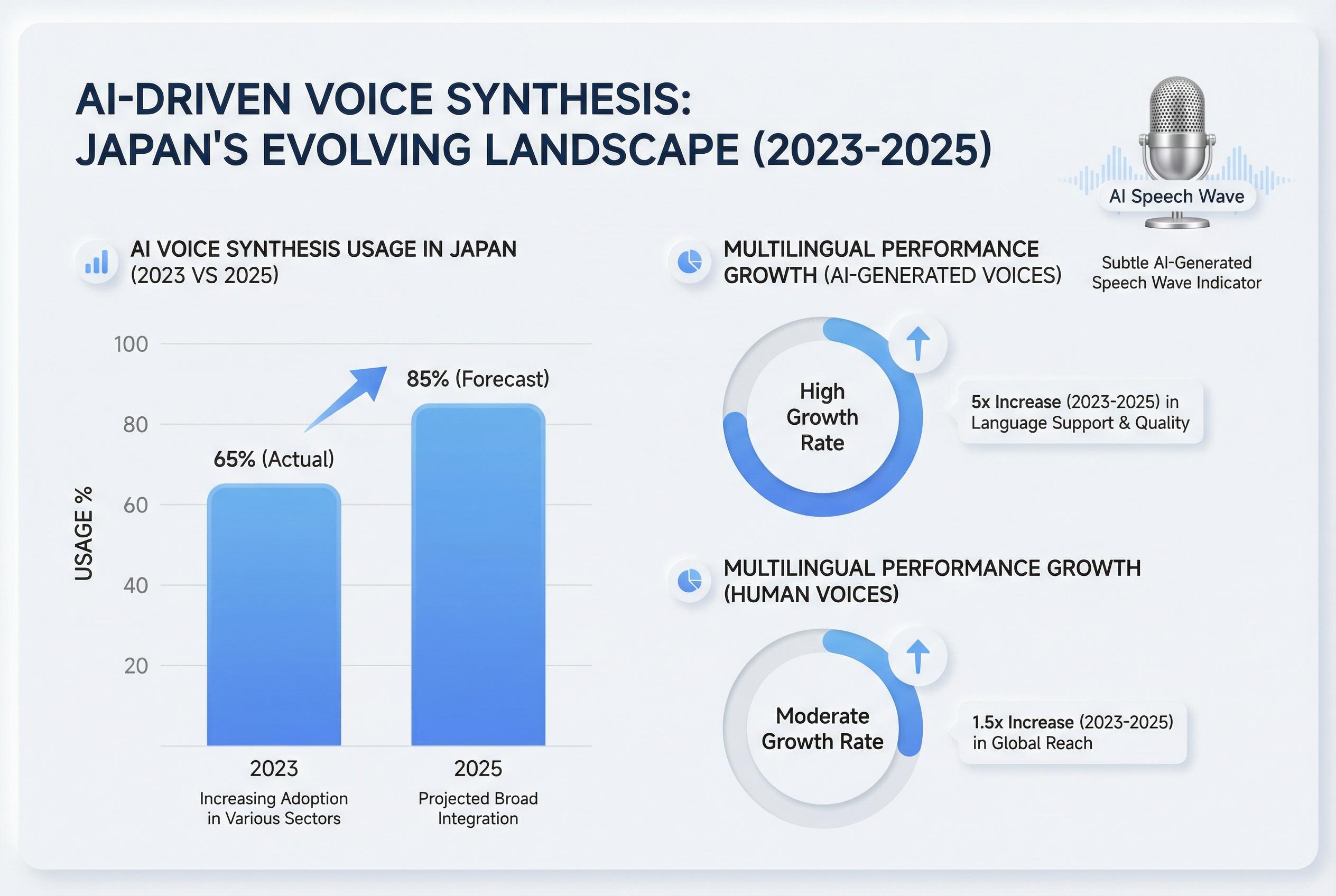
Voice technology in Japan has evolved into a sophisticated ecosystem that balances advanced natural language processing (NLP) with the unique linguistic and cultural nuances of the Japanese language. By 2026, the market has matured from early consumer-grade smart speakers to deep integration across enterprise customer service, healthcare, and public infrastructure, addressing the persistent challenge of labor shortages through automated voice-driven interfaces.
Contents
The Linguistic and Technical Landscape
The primary hurdle for voice technology in Japan is the inherent complexity of the Japanese language. Unlike English, Japanese relies on a mix of three writing systems—Hiragana, Katakana, and Kanji—alongside a complex honorific system (keigo) that dictates speech levels based on social context.
Modern voice systems in Japan must account for these variations to provide accurate speech-to-text (STT) and text-to-speech (TTS) synthesis. Developers often prioritize "Contextual Awareness," where AI models are trained on specific domain-centric vocabularies to distinguish between homophones, which are prevalent in Japanese. By 2026, the industry standard has shifted toward hybrid models that combine cloud-based large language models (LLMs) with edge computing to ensure low-latency responses for real-time interpretation and voice-command tasks.
Core Applications and Market Verticals
Voice technology is currently deployed across several critical sectors in Japan. These implementations are largely designed to mitigate the operational impacts of a shrinking workforce and an aging demographic.
Enterprise Customer Service
Contact centers are the largest adopters of voice technology. Automated Voice Response (AVR) systems, bolstered by generative AI, now handle routine inquiries, appointment scheduling, and basic troubleshooting. These systems are specifically programmed to recognize regional dialects (hōgen) and varying levels of formality, significantly reducing wait times for human agents.
Healthcare and Elderly Care
Japan’s high elderly population has fueled the development of "Companion AI" and voice-enabled health monitoring systems. These devices function not only as assistants for setting reminders or controlling smart home devices but also as passive monitoring tools that can detect changes in speech patterns, which may indicate cognitive or physical health declines.
Smart Infrastructure and Public Services
Public transportation and municipal kiosks increasingly utilize voice-controlled navigation. By 2026, many major rail stations and city halls in metropolitan areas like Tokyo and Osaka have integrated voice-to-multilingual-translation interfaces, allowing international visitors and local residents to access services through voice commands rather than manual touch-screen navigation, which is often considered more hygienic and accessible.
Comparative Overview of Voice Technology Solutions
The following table outlines the primary modalities of voice technology currently active in the Japanese market and their respective deployment focus.
| Technology Type | Primary Function | Primary User Base | Key Limitation |
|---|---|---|---|
| Generative Voice AI | Conversational agents | Enterprise/Customer Support | High latency in low-bandwidth areas |
| Speech-to-Text (STT) | Transcription and archiving | Legal/Medical/Media | Difficulty with overlapping speakers |
| Voice Authentication | Biometric security | Banking/Private Finance | False rejection in noisy environments |
| Multilingual Translation | Real-time interpretation | Tourism/Public Services | Loss of cultural nuance/honorifics |
Challenges and Operational Considerations
Despite the rapid adoption of voice tech, several technical and social obstacles remain. Privacy concerns are particularly acute in Japan, where regulatory frameworks regarding data harvesting are stringent. Businesses must comply with the Act on the Protection of Personal Information (APPI), which imposes strict requirements on how voice data—often considered personal biometric data—is collected, stored, and processed.
Furthermore, technical accuracy remains a point of friction. While AI can handle standard Japanese effectively, "Domain-Specific Jargon" remains a challenge. For example, a voice system designed for the financial sector may struggle to interpret medical terminology accurately, and vice versa. Companies must invest in high-quality training datasets that reflect the specific industry jargon used by their target demographic.
Implementation Best Practices for Organizations
For organizations considering the integration of voice technology in Japan, the following steps are essential to ensure a successful rollout:
- Localize Datasets: Do not rely on "global" models. Ensure the voice recognition engine is tuned to Japanese grammar and honorific conventions.
- Hybrid Security Architectures: Given the sensitivity of personal voice data, utilize on-premise or private cloud architectures to process data locally, rather than routing all voice inputs through public global servers.
- Human-in-the-Loop (HITL) Verification: For critical services like healthcare or banking, incorporate a secondary layer of human verification to confirm sensitive commands or transcripts.
- UX Design for Accessibility: Implement voice systems with visual backups. If the voice system fails to capture a command due to background noise or accent, the system should seamlessly transition the user to a visual input method.
Frequently Asked Questions
Does voice technology in Japan support regional dialects? While general-purpose models are becoming better at handling regional dialects (hōgen), they are not perfect. Most specialized enterprise solutions require custom training on localized datasets to achieve high accuracy for specific regional speech patterns.
Is voice biometric authentication legally compliant in Japan? Yes, but it is classified as sensitive personal data under the APPI. Organizations must obtain explicit consent from users before collecting voice prints and must provide clear documentation on how that biometric data is encrypted and stored.
What is the difference between standard Japanese TTS and emotional synthesis? Standard TTS focuses on reading text with natural cadence, whereas emotional synthesis adjusts the pitch, tone, and pacing of the voice to convey empathy or urgency, which is crucial for applications in mental health or high-stress customer support.
Are there latency issues with current voice AI in Japan? Latency has been significantly reduced by 2026 through the use of localized edge computing and 5G network integration. However, the use of large generative models still requires significant bandwidth and processing power, which can occasionally lead to delays.
How does voice technology handle the Japanese honorific system? High-end systems now incorporate "Role-Playing" datasets that categorize responses into Desu/Masu (polite) or Kenjōgo/Sonkeigo (humble/respectful) registers, depending on the detected persona of the user.
Future Outlook and Recommendation
The trajectory for voice technology in Japan points toward deeper integration with ambient computing. By the end of 2026, the focus will likely shift from "command-based" interfaces to "predictive" voice systems that anticipate user needs based on behavioral patterns.
For stakeholders and businesses, the recommended next step is to conduct a "voice accessibility audit." Evaluate your current customer touchpoints to identify where a voice-integrated interface would provide the highest return on investment, particularly in scenarios where hands-free operation or linguistic accessibility is prioritized. Focus on providers who offer localized support for Japanese business etiquette and, most importantly, those who maintain local data residency to ensure compliance with Japanese privacy regulations.
Image Gallery