Navigating Hotel CRM Software in the US: Features, Integrations, and Compliance
Hotel Customer Relationship Management (CRM) software in the United States centralizes guest data, automates personalized marketing, manages loyalty programs, and drives direct bookings. By integrating seamlessly with Property Manageme...
Hotel Customer Relationship Management (CRM) software in the United States centralizes guest data, automates personalized marketing, manages loyalty programs, and drives direct bookings. By integrating seamlessly with Property Management Systems (PMS) and point-of-sale setups, modern hotel CRMs enable US hoteliers to streamline operations, maintain state and federal privacy compliance, and maximize Revenue Per Available Room.
Contents
The Role of CRM Software in the US Hospitality Market
The United States hospitality industry operates in an increasingly competitive, digital-first environment. Hotel properties—ranging from independent boutique lodges in rural markets to large-scale urban convention resorts—face two ongoing challenges: rising distribution costs associated with Online Travel Agencies (OTAs) like Expedia and Booking.com, and shifting guest expectations around digital personalization.
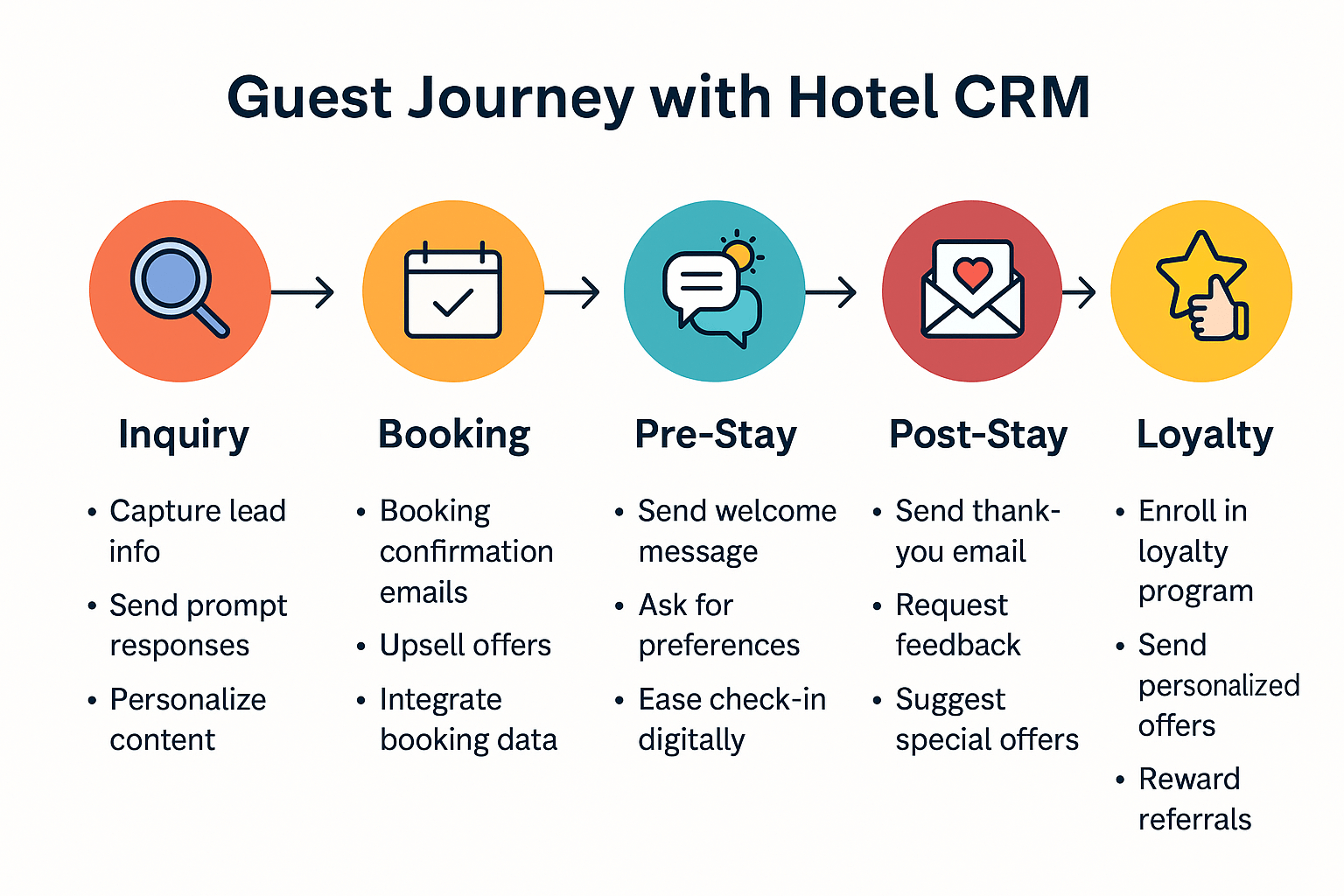
A specialized hotel CRM serves as the central intelligence engine of a property's technology stack. Unlike generic business-to-business (B2B) CRMs designed for sales pipelines, hospitality-specific CRMs are architected around the guest lifecycle: pre-arrival, on-property stay, post-departure, and long-term loyalty re-engagement.
- PMS / POS Systems
- Hotel CRM Data Hub
- Unified Guest Master Profile
- Targeted Campaigns & Guest Messaging
By consolidating fragmented transactional data from Property Management Systems (PMS), central reservation systems (CRS), food and beverage point-of-sale (POS) terminals, Wi-Fi captive portals, and digital concierge apps, a hotel CRM builds a unified "Master Guest Profile." This single source of truth allows hotel operators to recognize repeat guests, tailor messaging based on historical preferences, automate revenue-driving upsells, and calculate accurate Guest Lifetime Value (GLTV).
In the US market, where third-party commission fees can range from 15% to 25% per booking, shifting even a modest fraction of reservation volume from third-party channels to direct brand channels delivers an immediate, substantial margin improvement.
Essential Features of Top US Hotel CRM Solutions
Selecting an effective hotel CRM requires evaluating capabilities against operational objectives. Leading platforms serving the US market provide several core functional modules:
1. Advanced Data Deduplication and Profile Merging
Guest records entered into a hotel PMS often suffer from inaccuracies, formatting differences, and duplication. For example, "John Smith" staying at a Miami property might appear as a distinct database record from "J. Smith" booking a room in Chicago. Hotel CRM systems utilize sophisticated algorithms—matching parameters like email addresses, phone numbers, loyalty IDs, and postal codes—to merge duplicate records into one comprehensive profile without losing transaction history.
2. Dynamic Audience Segmentation
Targeted guest communications consistently outperform broad email blasts. Modern hospitality CRMs allow marketers to build dynamic customer segments using multi-attribute filters, such as:
- Booking behavior: Lead times, length of stay, booking channel, and cancellation history.
- Spend profiles: Room revenue tier, spa usage, dining expenditures, and ancillary purchases.
- Demographic & geographic location: ZIP codes, drive-to feeder markets, or corporate affiliations.
- Stay status: Confirmed upcoming arrivals, checked-in guests, or lapsed past guests who have not stayed within 12 months.
3. Automated Guest Journey Orchestration
Automated messaging workflows ensure timely communication across preferred channels, including email, SMS, and WhatsApp:
- Pre-Arrival Campaigns: Sent 3 to 7 days before check-in, offering targeted room upgrades, early check-in add-ons, or spa reservations.
- In-Stay Engagement: Welcoming guests upon check-in, offering digital concierge support, and sharing property amenities.
- Post-Stay Feedback & Reputation Management: Prompting verified guests to complete private satisfaction surveys or leave public reviews on platforms like TripAdvisor or Google.
- Win-Back & Anniversary Campaigns: Automated incentives sent to past guests to encourage direct re-booking on key dates.
4. Direct Booking & Upsell Engines
By integrating intelligent upselling mechanisms, CRMs generate incremental revenue before a guest steps foot on the property. Automated pre-arrival upsell offers (such as suite upgrades, champagne on arrival, or late checkout) boast high conversion rates because they hit guests when their travel intent is highest.
5. Multi-Property & Enterprise Portfolio Management
For management companies and franchise owners operating multiple brands or locations across the US, enterprise CRM capabilities allow cross-property data sharing. System administrators can track guest behavior across an entire portfolio, run cross-promotional campaigns, and view aggregated performance analytics while maintaining appropriate data partitioning per property.
Comparing Leading Hotel CRM Software Solutions
The US market offers specialized platforms tailored to diverse hotel categories, from independent boutique properties to global enterprise chains.
Revinate
Revinate is widely adopted by independent hotels, boutique collections, and mid-sized hotel groups across North America. Known for its intuitive interface, Revinate combines guest feedback management, automated email marketing, and call center voice sales support into a unified platform. It excels at driving direct bookings through targeted drip campaigns and offers strong out-of-the-box integration with major cloud PMS providers.
Cendyn
Cendyn offers a comprehensive enterprise hospitality cloud, including its flagship eCRM module. Cendyn is heavily focused on full-service luxury hotels, large resorts, and multi-property management enterprises requiring deep data architecture, sophisticated loyalty program administration, and algorithmic revenue management integration.
Amadeus Hospitality CRM
Amadeus provides enterprise-level hospitality solutions designed for large hotel chains, regional groups, and multi-brand operators. Its CRM platform focuses on deep two-way integration with central reservation networks, rich business intelligence reporting, and global guest data synchronization across complex tech stacks.
Canary Technologies
Canary Technologies provides a modern, guest-facing hotel platform that combines CRM capabilities with mobile check-in, digital authorization, and upsell automation. It is particularly popular among mid-scale to upscale boutique properties seeking to modernize guest communications via mobile channels without heavy legacy infrastructure.
Agilysys GuestExpress / Insight
Agilysys specializes in hospitality tech ecosystems for resorts, tribal casinos, and large gaming properties across the US. Its CRM components tie closely into property management, point-of-sale, golf management, and spa reservation software, enabling comprehensive non-room spend tracking.
| Platform | Primary Target Market | Key Strengths | Key Integrations | Deployment Type |
|---|---|---|---|---|
| Revinate | Independent & Boutique Hotels, Regional Groups | User-friendly UI, strong upsell automation, voice channel integration | Oracle Opera, Stayntouch, Cloudbeds, Mews | Cloud-based SaaS |
| Cendyn | Luxury Resorts, Enterprise Chains, Casino Hotels | Advanced guest intelligence, complex loyalty management, deep analytics | Oracle Opera, Agilysys, Infor, Sabre | Cloud-based SaaS |
| Amadeus CRM | Enterprise Chains, Multi-Property Operators | Scalable data infrastructure, central reservation alignment, global profile management | Amadeus CRS/PMS, Oracle Opera, Salesforce | Hybrid / Cloud SaaS |
| Canary Technologies | Boutique, Lifestyle, and Mid-Scale Properties | Mobile-first guest check-in, digital messaging, contactless upsells | Cloudbeds, Stayntouch, Oracle Opera, Lightspeed | Cloud-based SaaS |
| Agilysys Insight | Resorts, Gaming Properties, Enterprise Hospitality | Multi-outlet spend tracking (golf, spa, F&B), robust guest preference logging | Agilysys Visual One/Stay, POS systems | Cloud / On-Premise Hybrid |
Technical Integration: Connecting CRM to the Hospitality Tech Stack
A hotel CRM does not function in isolation; its value depends on seamless real-time data exchange across the property's digital ecosystem. Legacy hotel systems often relied on periodic batch processing, but modern hospitality demands real-time API integrations.
- Central Reservation System (CRS)
- Property Management System (PMS)
- Point of Sale Systems (F&B/Spa)
- Property Management System (PMS)
- Property Management System (PMS)
- Hotel CRM Platform
- Guest Messaging & Email Engines
- Hotel CRM Platform
1. Two-Way PMS Integration
The primary data pipeline connects the CRM to the Property Management System (PMS)—such as Oracle Opera, Stayntouch, Cloudbeds, or Infor. A robust two-way integration ensures that:
- When a reservation is created, modified, or canceled in the PMS, the CRM updates the guest profile immediately.
- Guest preference updates made in the CRM (e.g., room preferences, dietary restrictions, VIP status) flow back into the daily PMS registration cards and housekeeping reports.
Integrations typically leverage open industry standards such as HTNG (Hospitality Technology Next Generation) guidelines or modern RESTful APIs to maintain secure, low-latency communication between systems.
2. POS and Ancillary Outlet Integration
For full-service resorts and hotels with food and beverage outlets, spa facilities, or golf courses, connecting the CRM to POS systems (such as Toast, Agilysys InfoGenesis, or Oracle Micros) enables holistic spend tracking. Hoteliers can identify "high-value non-room spenders"—guests who may book standard rooms but spend significantly on dining and leisure—and tailor personalized offers accordingly.
3. Central Reservation Systems (CRS) and Booking Engines
Connecting the CRM to direct booking engines on the hotel's website allows real-time cart abandonment tracking. If a guest initiates a room booking but drops off before completing payment, an integrated CRM can trigger an automated abandoned-booking email or offer a direct incentive to complete the reservation.
Data Privacy, Security, and Compliance in the United States
Operating a hotel CRM in the US requires navigating a complex patchwork of state and federal regulatory frameworks governing privacy, electronic marketing, and financial security. Hotel CRMs process sensitive personally identifiable information (PII), travel patterns, and credit card details, making data security and legal compliance paramount.
1. State-Level Consumer Privacy Laws
Unlike Europe's unified General Data Protection Regulation (GDPR), the US privacy landscape is governed by state-specific laws. Hoteliers hosting residents of these states must ensure their CRM practices comply regardless of where the physical hotel is located:
- California Consumer Privacy Act (CCPA) / CPRA: Grants California residents the right to know what personal data is collected, request deletion of their data, opt out of the sale or sharing of personal information, and limit the use of sensitive personal info. Detailed regulatory requirements are accessible through the California Privacy Protection Agency.
- Other State Statutes: States including Virginia (VCDPA), Colorado (CPA), Connecticut (CTDPA), and Utah (UCPA) have enacted comprehensive privacy laws requiring clear privacy notices, data minimization, and secure opt-out mechanisms embedded in CRM systems.
2. Federal Marketing Compliance: The CAN-SPAM Act
Commercial email communications sent by US hotel CRMs must strictly adhere to the CAN-SPAM Act. Key legal requirements include:
- Unambiguous identifier that the message is an advertisement (where applicable).
- Clear, non-deceptive email header information and subject lines.
- A visible, functional physical postal address of the business.
- A clear, single-click unsubscribe mechanism that processes opt-out requests within 10 business days.
Detailed compliance guidance for business operators is published by the Federal Trade Commission.
3. Payment Card Industry Data Security Standard (PCI-DSS)
While CRMs generally avoid storing raw credit card primary account numbers (PANs), they frequently store transaction values, payment tokens, and billing addresses linked to guest profiles. Hotel CRMs must maintain strict security protocols—such as end-to-end encryption (E2EE) and tokenization—to comply with PCI-DSS guidelines managed by the PCI Security Standards Council.
Step-by-Step CRM Implementation Strategy
Implementing or migrating to a new hotel CRM requires careful planning to prevent operational disruption and data corruption.
- Step 1: Tech Stack Audit
- Step 2: Data Cleaning
- Step 3: API Setup
- Step 4: Staff Training
Step 1: Conduct a Technology Stack and Data Audit
Document every guest touchpoint across your property, including your PMS, CRS, POS, Wi-Fi login portals, and website booking engines. Evaluate API compatibility and identify whether legacy on-premise systems require middleware bridges to integrate with a modern cloud CRM.
Step 2: Establish Data Hygiene Protocols
Before migrating historical records to a new CRM, clean legacy datasets:
- Remove invalid, formatted, or hard-bounced email addresses.
- Establish standard formatting rules for phone numbers (e.g., E.164 international format) and addresses.
- Deduplicate existing historical PMS databases to avoid importing duplicate profiles into the new CRM environment.
Step 3: Configure Segmentation Rules and Dynamic Campaigns
Build dynamic guest segments tailored to your hotel’s primary revenue drivers. Configure automated transactional and marketing journeys:
- Booking Confirmation & Pre-Arrival Drip: Introduce amenities, upsell room categories, and outline parking or check-in instructions.
- Post-Departure Surveys: Triggered 24 hours post-checkout to capture guest sentiment while memories are fresh.
- Lapsed Guest Win-Back: Scheduled for 9 to 12 months post-stay targeting seasonal travelers.
Step 4: Train Staff and Monitor Operational Metrics
Ensure front desk staff, reservation agents, and marketing teams understand how CRM profile notes integrate into daily operations. Monitor primary performance metrics, including:
- Direct booking conversion rates.
- Email open rates, click-through rates (CTR), and campaign-driven revenue.
- Incremental revenue per available room achieved via pre-arrival upselling.
Industry trends, operational guidelines, and technological benchmarks are continuously updated by regional associations such as the American Hotel & Lodging Association.
Frequently Asked Questions
What is the primary difference between a Hotel PMS and a Hotel CRM?
A Property Management System (PMS) is an operational system used to manage day-to-day front desk tasks, room inventory, housekeeping assignments, folio billing, and guest check-ins. A Hotel CRM is a marketing and guest-intelligence platform that aggregates historical guest data across multiple touchpoints to manage guest relationships, run targeted automated marketing campaigns, and analyze long-term Guest Lifetime Value.
How does a hotel CRM help lower distribution costs?
A hotel CRM lowers customer acquisition costs by driving direct repeat bookings, reducing reliance on third-party Online Travel Agencies (OTAs). By retaining guest contact details and stay preferences, the CRM allows hoteliers to remarket directly to past guests through automated email campaigns, personalized loyalty incentives, and targeted pre-arrival upsells, avoiding third-party commission fees.
Can independent boutique hotels benefit from enterprise-grade CRMs?
Yes. Modern cloud-based hotel CRMs offer tiered subscription pricing suited for independent boutique properties. Independent hotels often benefit significantly from CRMs because personalized, high-touch guest experiences and hyper-targeted marketing allow boutique properties to compete effectively against large chain loyalty programs.
Is cloud-based hotel CRM software secure enough for guest privacy compliance?
Reputable cloud-based hotel CRMs utilize enterprise-grade encryption standard protocols (TLS in transit, AES-256 at rest), maintain SOC 2 certification, and adhere to state privacy frameworks like CCPA/CPRA. They provide automated consent tracking, privacy opt-out mechanisms, and data deletion workflows to maintain legal compliance.
How much does hotel CRM software typically cost in the US market?
Hotel CRM pricing in the US is typically structured as a Software-as-a-Service (SaaS) model based on property room count, active module subscriptions, and database record volume. Small independent properties may pay between $150 and $450 per month, while mid-scale to upscale hotels generally range from $500 to $1,500 per month. Large enterprise resorts or multi-property portfolios receive custom enterprise quotes.
Strategic Recommendation for Hotel Operators
When evaluating hotel CRM software in the US market, prioritize seamless two-way PMS integration over peripheral standalone features. A CRM is only as powerful as the quality and immediacy of the guest data feeding into it. Independent properties seeking rapid ROI should select platforms with out-of-the-box automated email journeys and pre-arrival upselling tools, such as Revinate or Canary Technologies. Larger resorts and multi-property groups requiring comprehensive loyalty administration and multi-outlet spend tracking should evaluate enterprise-grade data platforms such as Cendyn or Agilysys. Ensure that whichever platform you deploy includes built-in compliance toolkits for US state privacy laws (such as CCPA/CPRA) and federal marketing mandates.
EDITORIAL CATEGORY METADATA:
Image Gallery