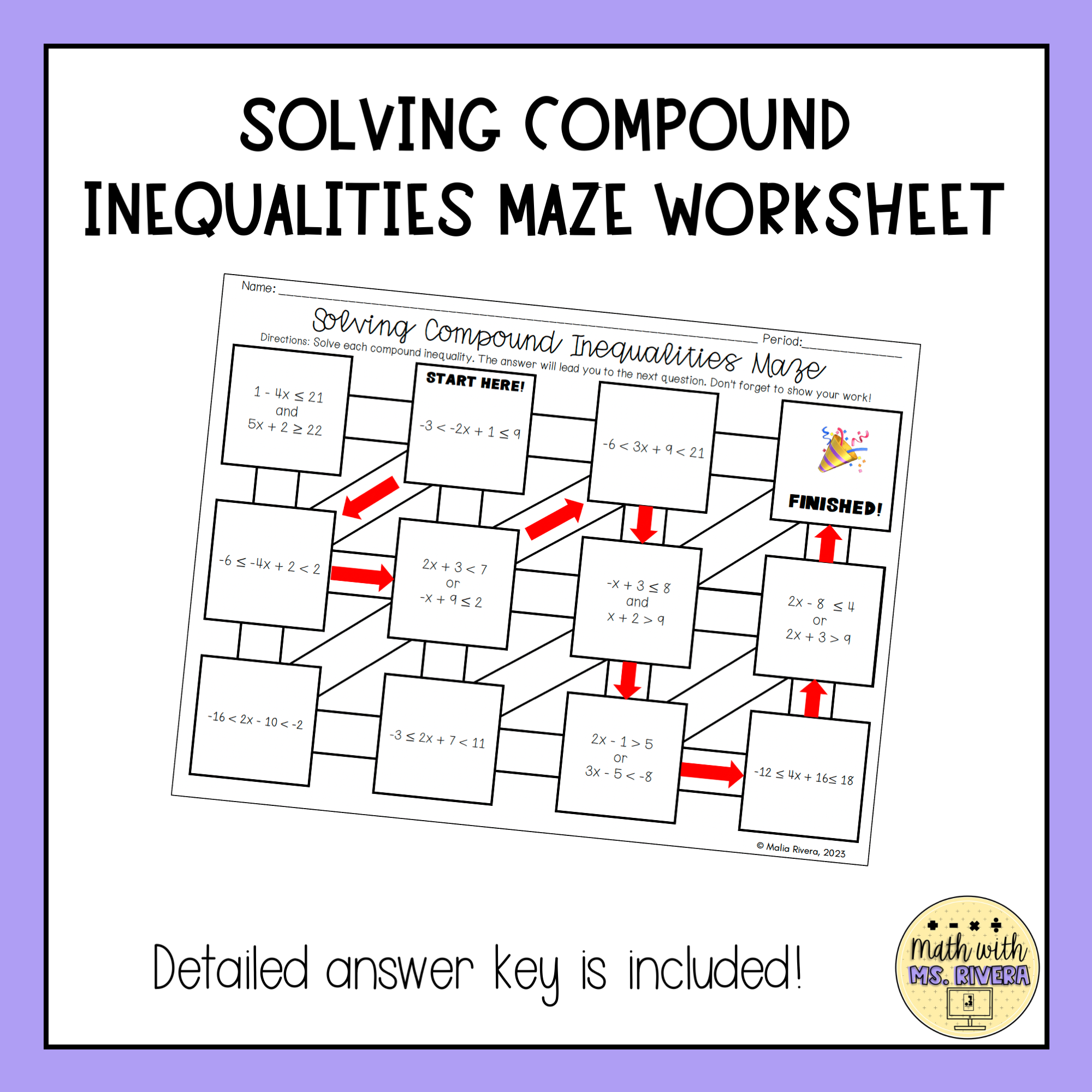
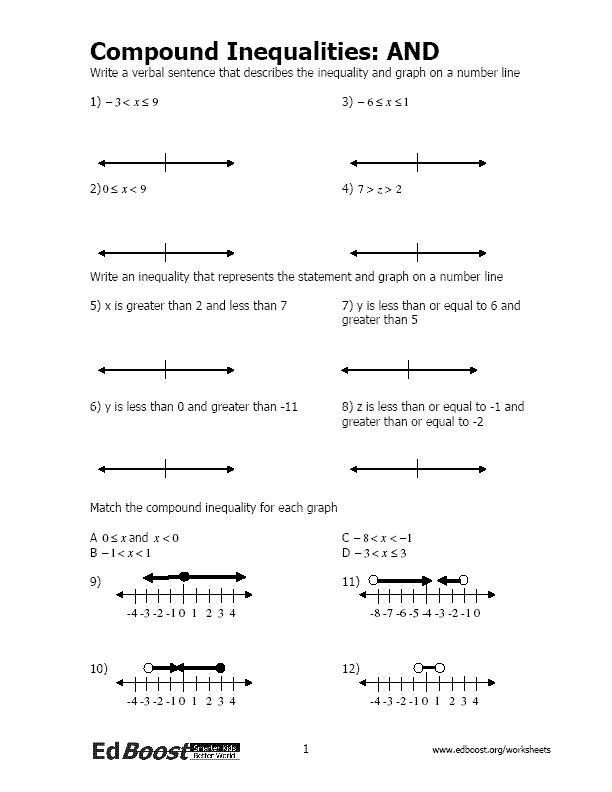
A Comprehensive Guide on How to Use a Compound Inequalities Worksheet PDF
Using a compound inequalities worksheet PDF effectively requires a blend of mathematical understanding, strategic practice, and the right digital or physical tools to facilitate learning. Whether you are a student preparing for algebra...
Using a compound inequalities worksheet PDF effectively requires a blend of mathematical understanding, strategic practice, and the right digital or physical tools to facilitate learning. Whether you are a student preparing for algebra assessments or an educator designing a curriculum, these documents serve as structured repositories for mastering the intersection and union of solution sets. By following a systematic approach—from initial conceptual review to verifying your final answers—you can transform a static document into a high-impact study resource.
Contents
Understanding the Role of Compound Inequalities in Algebra
Compound inequalities are mathematical statements that join two individual inequalities with the words "and" (conjunctions) or "or" (disjunctions). A worksheet focused on this topic provides a sequence of problems designed to build fluency in solving, graphing, and expressing solutions in interval notation. The primary value of a PDF-based worksheet is its portability and consistency; once downloaded, it provides a stable set of problems that do not change, allowing you to track your progress over time as your speed and accuracy improve.
Phase 1: Preparation and Essential Prerequisites
Before you attempt to solve the problems within your worksheet, ensure you have the necessary mathematical foundations. A compound inequality is essentially two standard linear inequalities hidden in one expression. You must be comfortable with:
- Isolating variables: Applying inverse operations to solve for $x$ in expressions like $2x + 5 > 9$.
- The Golden Rule of Inequalities: Remembering that multiplying or dividing by a negative number flips the inequality symbol.
- Number Line Visualization: Understanding the difference between open circles (used for $<$ or $>$) and closed circles (used for $\leq$ or $\geq$).
Ensure you have a reliable PDF reader installed, such as Adobe Acrobat Reader or a modern web browser like Microsoft Edge or Google Chrome, which can handle annotation if you prefer solving digitally.
Phase 2: Systematic Execution of Worksheet Problems
To derive the maximum benefit from your worksheet, avoid rushing through the problems. Follow this iterative process for every exercise:
- Analyze the Structure: Identify whether the problem is an "and" statement (often written as $a < x < b$) or an "or" statement. "And" statements represent an intersection (where both conditions are true), while "or" statements represent a union (where either condition is true).
- Solve Separately: If the worksheet presents the inequalities as two distinct parts (e.g., $x+3 > 5$ or $x-2 < 1$), solve each inequality independently before attempting to graph the result.
- Graph the Components: Draw the number line for each part. For "and" problems, look for the overlapping region. For "or" problems, include all points covered by either graph.
- Translate to Notation: Convert your visual graph into interval notation (e.g., $(-\infty, 2] \cup (5, \infty)$) or set-builder notation if the worksheet requires it.
Comparison of Solution Formats
Different worksheets may require different output formats for the same problem. The table below outlines how to distinguish between common notations.
| Notation Type | Typical Use Case | Key Characteristics |
|---|---|---|
| Inequality Notation | Introductory Algebra | Uses signs like $<, >, \leq, \geq$ directly. |
| Interval Notation | Calculus Readiness | Uses brackets [] for inclusive and parentheses () for exclusive. |
| Set-Builder Notation | Formal Mathematics | Uses the format ${x \mid x > 5}$. |
| Graphing | Visual Conceptualization | Uses circles and shaded regions on a number line. |
Common Pitfalls and Troubleshooting
Even experienced students encounter recurring issues when working with inequality PDFs. The most common error involves failing to reverse the inequality sign when dividing by a negative coefficient. If your answer does not match the provided answer key, re-examine your work for this specific step.
Another frequent mistake occurs when interpreting "and" statements as "or" statements. Always remember that a compound inequality like $3 < x < 7$ implies $x > 3$ and $x < 7$. If you incorrectly interpret this as a union, you will likely shade the number line in the wrong direction, leading to incorrect results on your worksheet.
Managing Digital versus Printed Worksheets
In 2026, many learners choose between digital annotations and traditional printing. If you are using a tablet with a stylus, digital annotation allows you to save multiple versions of your work without creating clutter. Conversely, printing the PDF provides a tactile experience that often aids memory retention during long study sessions. If you choose the printed route, use a pencil to allow for corrections. For digital users, ensure you are using a PDF editor that allows you to "flatten" your layers if you intend to save your work as a final document.
How to Verify Your Progress
Most high-quality compound inequalities worksheet PDFs include an answer key—often found on the final page or in a separate document. Do not use this as a crutch. Attempt the entire page first, then use a different color pen or a digital highlighting tool to mark your corrections. If you consistently miss problems, return to the "Prerequisites" section and review basic linear equation steps. Mastering compound inequalities is a cumulative process; there is no shortcut to the fluency gained through manual practice.
Frequently Asked Questions
What should I do if the worksheet has no answer key? Use a graphing tool like Desmos or GeoGebra. Type in your individual inequalities to see if the resulting shaded region on the graph matches the solution you derived by hand. This is an excellent way to verify your conceptual understanding.
Are there different types of compound inequalities? Yes. They are generally categorized into "conjunctions" (and) and "disjunctions" (or). Conjunctions represent the intersection of two solution sets, while disjunctions represent their union. Your worksheet will likely alternate between these to ensure you can distinguish between the two logic types.
Can I solve these problems using a scientific calculator? Most standard calculators cannot solve inequalities directly. They are designed for equalities. You must rely on your algebraic manipulation skills to isolate the variable before checking the result.
What is the best way to practice with a PDF if I don't have a printer? You can use the "Snipping Tool" on Windows or "Shift+Command+4" on macOS to take screenshots of individual problems and paste them into a blank document or digital notepad. This allows you to solve each problem in a dedicated workspace.
How do I know if I’ve mastered the worksheet? You have achieved mastery when you can correctly identify the intersection or union without needing to draw two separate graphs first. Accuracy and speed in writing the final interval notation are the primary indicators of proficiency.
Final Recommendation
To master the material, dedicate at least 30 minutes to uninterrupted practice. Start by completing the first five problems of the worksheet without the answer key to gauge your baseline ability. Once completed, compare your results against the key, identify your recurring errors—such as sign reversals or notation mistakes—and repeat the problematic steps until the process becomes intuitive. Consistent, daily practice with these structured documents is the most reliable path to mathematical fluency.
Image Gallery