Understanding the Virginia Workers Compensation Certificate: Requirements, Acquisition, and Compliance in 2026
A Virginia workers compensation certificate is a document—typically an ACORD 25 Certificate of Insurance—that provides formal proof that a business carries active workers' compensation coverage as required by the Commonwealth of Virgin...
A Virginia workers compensation certificate is a document—typically an ACORD 25 Certificate of Insurance—that provides formal proof that a business carries active workers' compensation coverage as required by the Commonwealth of Virginia. It details the insurance carrier, policy number, effective dates, and coverage limits, ensuring compliance with the Virginia Workers’ Compensation Act.
Contents
In the complex landscape of Virginia business operations, the "workers compensation certificate" serves as the primary currency of trust between contractors, clients, and state regulators. Whether you are a small business owner hiring your first two employees or a general contractor vetting a dozen subcontractors, understanding the nuances of this document is critical for legal protection and financial stability. As of 2026, the Virginia Workers' Compensation Commission (VWC) continues to strictly enforce coverage mandates, making the verification of these certificates a daily necessity for the state’s workforce.
The Purpose and Definition of a Virginia Workers Compensation Certificate
In technical terms, there is often a distinction between a "Certificate of Insurance" (COI) issued by a private insurance agency and a "Certificate of Compliance" or verification record maintained by the Virginia Workers' Compensation Commission. For most commercial transactions, when a party requests a "virginia workers compensation certificate," they are asking for the ACORD 25 form. This standardized document summarizes the essential elements of an insurance policy without requiring the disclosure of the entire policy document, which can be hundreds of pages long.
The certificate serves three primary functions in 2026:
- Proof of Statutory Compliance: It demonstrates that the employer has met the requirements of Virginia Code § 65.2, which mandates insurance for most employers with more than two employees.
- Risk Transfer: It assures a hiring party (the "Principal") that if a subcontractor’s employee is injured, the subcontractor’s insurance will pay the claim, preventing the claim from flowing "up the chain" to the Principal.
- Audit Readiness: During annual premium audits, insurance carriers require these certificates from any subcontractors used during the policy period to ensure the policyholder isn't charged premiums for those subcontractors' exposures.
Who is Required to Maintain Coverage in Virginia?
To understand the certificate, one must understand the mandate. In Virginia, the law regarding who must be insured is specific and has remained robust through 2026. Any employer that regularly employs more than two employees—including part-time workers, corporate officers, and managers of LLCs—must carry workers' compensation insurance.
It is a common misconception that "independent contractors" do not count toward this total. In Virginia, the VWC often looks past the label of "independent contractor" to the degree of control exercised over the worker. If you hire three subcontractors who function as employees under the law, you are required to have a policy and, by extension, should be able to produce a certificate.
Furthermore, even if an employer has only one or two employees and is not technically required by law to carry insurance, they may still find that a certificate is required by contract. Most general contractors in Virginia will not allow a subcontractor on-site without a valid workers' compensation certificate, regardless of whether the subcontractor is legally exempt from the state mandate.
How to Obtain a Virginia Workers Compensation Certificate
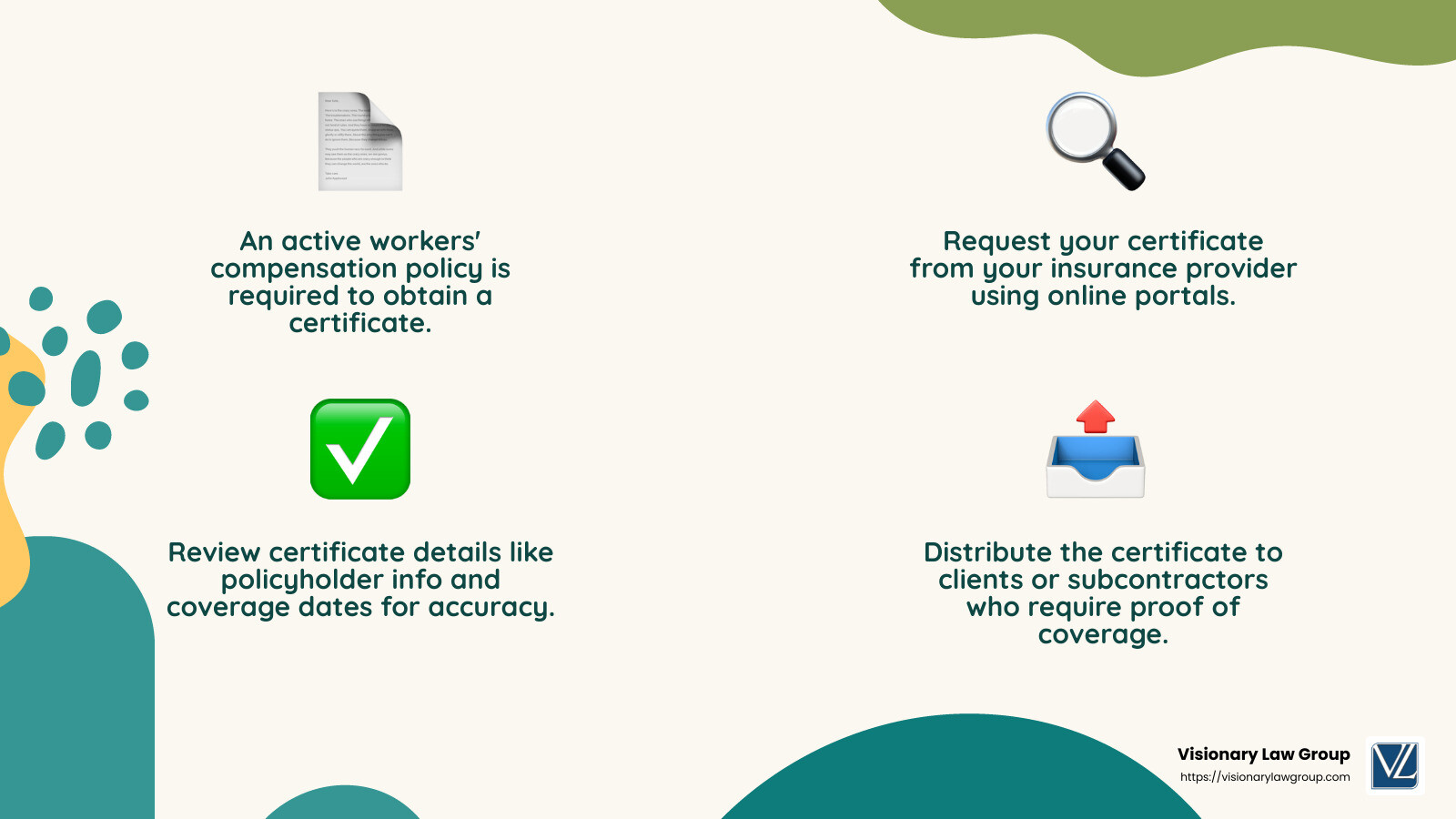
Obtaining the certificate is a multi-step process that begins with securing a valid insurance policy. The document itself is not something you "apply for" from the state; rather, it is "issued" by your insurance representative.
Step 1: Secure a Workers' Compensation Policy
You must purchase coverage through a licensed insurance agent or directly from a carrier authorized to write business in Virginia. If you are a high-risk business unable to find coverage in the voluntary market, your agent may assist you in applying for coverage through the Virginia Assigned Risk Pool, managed by the National Council on Compensation Insurance (NCCI).
Step 2: Request the Certificate
Once the policy is bound and active, you can request a certificate of insurance from your broker. You will need to provide the name and address of the "Certificate Holder"—the entity asking for proof of your insurance. In 2026, most digital insurance platforms allow business owners to generate these certificates instantly via a mobile app or web portal.
Step 3: Specify Necessary Endorsements
In some cases, a standard certificate is insufficient. A hiring party may require a "Waiver of Subrogation" or a "30-Day Notice of Cancellation" endorsement. These must be added to your policy (often for a small fee) and then noted on the certificate to be valid.
Verifying a Certificate via the Virginia Workers’ Compensation Commission
Possessing a piece of paper that says a company is insured is not always enough. Fraudulent certificates are a persistent issue. The Virginia Workers' Compensation Commission provides a public tool called the Insurance Coverage Search (ICS) system.
By entering a business name or Federal Employer Identification Number (FEIN) into the ICS database, anyone can verify if a business has a valid policy on file with the state. This database is updated daily by insurance carriers who are required by law to report policy issuances and cancellations to the VWC. If a contractor provides a certificate but the ICS system shows "No Coverage Found" for the dates in question, the certificate should be treated as suspicious.
Comparison of Proof of Coverage Methods
The following table outlines the different ways workers' compensation coverage is documented and verified in Virginia as of 2026.
| Document/Method | Issuer | Primary Use | Level of Detail |
|---|---|---|---|
| ACORD 25 (COI) | Insurance Agent/Broker | Commercial contracts, job site entry. | High (Policy #, limits, dates). |
| VWC Insurance Search | VWC Public Portal | Public verification of compliance. | Moderate (Carrier name, policy dates). |
| VWC Form 22 | VWC (Self-Insurance) | For large, self-insured corporations. | High (Authorization for self-insurance). |
| Information Page | Insurance Carrier | The actual "declarations" of the policy. | Full (Detailed payroll and class codes). |
The Consequences of Failing to Provide or Maintain a Certificate
The absence of a valid workers' compensation certificate carries severe implications for both the employer and the hiring entity.
For the Uninsured Employer
If an employer is required to have insurance but fails to do so, the VWC can assess civil penalties. As of 2026, these fines can reach up to $250 per day for every day the employer is uninsured, with a maximum penalty of $50,000. Beyond fines, the employer is personally liable for all medical expenses and lost wages if an employee is injured—costs that can easily bankrupt a small business.
For the General Contractor (The "Statutory Employer" Rule)
Virginia follows the "Statutory Employer" doctrine. If a subcontractor is uninsured and one of their employees is injured, the liability for that injury shifts upward to the general contractor. This is why general contractors are so diligent about collecting certificates. If they cannot produce a valid certificate for a subcontractor during their own year-end audit, their own insurance company will charge them additional premiums as if the subcontractor’s payroll belonged to the general contractor.
Best Practices for Managing Certificates in 2026
For businesses that hire multiple vendors or subcontractors, managing certificates is a significant administrative task. In 2026, many Virginia firms have moved to automated tracking systems. Here are the professional standards for certificate management:
- Check the "Description of Operations": Ensure the certificate specifically mentions the project or the type of work being performed.
- Validate the Limits: Virginia law requires statutory limits for Part 1 (Workers' Compensation), but Part 2 (Employers' Liability) usually has specific minimums (e.g., $500,000/$500,000/$500,000) requested by clients.
- Monitor Expiration: A certificate is only a "snapshot" in time. If a policy expires mid-project, you must request a renewal certificate immediately.
- Verify with the Carrier: For high-value contracts, it is prudent to call the issuing agency listed on the certificate to confirm the policy is in "good standing" and has not been cancelled for non-payment.
FAQs About Virginia Workers Compensation Certificates
Does a sole proprietor need a certificate if they have no employees?
While a sole proprietor with no employees is not legally required to carry workers' compensation in Virginia, many clients will still demand a certificate before allowing them on a job site. In this case, the sole proprietor may need to purchase a "Minimum Premium" policy or a "Ghost Policy" just to generate the necessary certificate for contract compliance.
How much does it cost to get a Virginia workers compensation certificate?
The certificate itself is usually provided free of charge by your insurance agent as part of their service. However, the underlying insurance policy has a cost based on your total payroll and the risk level of your industry. For example, a clerical business will pay much less per $100 of payroll than a roofing company.
Can I use an out-of-state certificate for work performed in Virginia?
If your business is based in another state but you are performing work in Virginia, your certificate must show that Virginia is a covered state under "Section 3.A." of your policy. If Virginia is only listed in "Section 3.C." (Other States Insurance), it may not be sufficient for long-term projects or if you have a permanent location in the Commonwealth.
What is a "Ghost Policy" in the context of Virginia certificates?
A "Ghost Policy" is a slang term for a workers' compensation policy where the owner is excluded from coverage and there are no employees. It is used primarily by independent contractors to provide a certificate of insurance to a general contractor, proving they have a policy in place should they eventually hire someone, even if the owner is not currently covered.
How do I check if a certificate is fake?
The most reliable method is to use the VWC Insurance Coverage Search tool. Compare the policy number and carrier name on the certificate to the data in the state's system. If they do not match, or if the VWC shows no coverage, contact the insurance agent listed on the certificate for clarification.
Does the certificate cover the business owner?
In Virginia, sole proprietors, partners, and members of an LLC are often excluded from coverage by default unless they specifically "elect" to be covered. If a client requires the owner to be covered, the certificate must specifically state that the "Officers/Owners are included."
Moving Forward with Compliance
Managing your Virginia workers compensation certificate is an ongoing responsibility, not a one-time task. For business owners, it represents your entry ticket into the state's commercial marketplace. For hiring entities, it is your primary shield against unforeseen liability and audit expenses. To ensure your business remains compliant in 2026, regularly consult with a licensed Virginia insurance professional and utilize the digital verification tools provided by the Virginia Workers' Compensation Commission.
Image Gallery