What Is a Universal Life Insurance Policy Face Value?
The face value of a universal life insurance policy is the baseline dollar amount of life insurance coverage selected by the policyholder when the policy is established. It acts as the stated death benefit contractually agreed upon by...
The face value of a universal life insurance policy is the baseline dollar amount of life insurance coverage selected by the policyholder when the policy is established. It acts as the stated death benefit contractually agreed upon by the insurer, serving as the foundational figure for calculating monthly policy fees, insurance risk, and ultimate beneficiary payouts.
Contents
Defining Face Value in Universal Life Insurance
In permanent life insurance, misunderstanding core contract terms can lead to unexpected beneficiary payouts or unmanageable policy costs. To understand a universal life (UL) insurance policy, you must first distinguish between three distinct financial metrics: face value, cash value, and total death benefit.
| Universal Life Policy Component | Description |
|---|---|
| Face Value (Stated Coverage) | Baseline coverage chosen at policy issue (e.g., $500,000) |
| Cash Value (Savings Accumulation) | Tax-deferred account funded by excess premiums and interest |
| Total Death Benefit (Payout) | Final check paid to heirs based on DB Option, loans, & corridor |
- Face Value (Stated Amount): The initial face amount of insurance coverage specified on the policy specifications page. For instance, if you purchase a policy with a $500,000 stated limit, $500,000 is the policy's face value.
- Cash Value: The internal tax-deferred savings component of the universal life policy. Cash value grows through credited interest (or equity-index tracking in Indexed UL) funded by premium payments that exceed the monthly policy charges.
- Total Death Benefit: The actual net cash amount paid to your named beneficiaries when you pass away. Depending on the design of the policy, the total death benefit may equal the face value, exceed the face value, or be reduced by outstanding policy debt.
While traditional whole life insurance features a fixed face value that remains static for life, universal life insurance is designed with flexible terms. Universal life policyholders can adjust their face value up or down as financial obligations evolve, subject to specific underwriting rules and contractual limits.
Universal Life Death Benefit Options: How Face Value Dictates Payouts
In a universal life insurance policy, the relationship between your face value and your accumulated cash value depends entirely on the death benefit option selected in the contract. Insurers typically offer two primary options (and occasionally a third), which fundamentally alter how your beneficiaries are paid.
Option A (Level Death Benefit)
Under Option A (often called Option 1), the total death benefit payable to beneficiaries remains fixed at the policy's original face value.
- How Payout Works: If you hold an Option A policy with a $500,000 face value and accumulate $150,000 in cash value, your beneficiaries receive $500,000 upon your death—not $650,000. The $150,000 cash value absorbs part of the insurer's financial risk.
- Impact on Fees: Option A lowers internal policy expenses over time. Because the insurer only pays out the fixed $500,000, your growing cash value offsets the insurer's net outlay. This reduces the Net Amount at Risk (NAAR), which lowers the monthly Cost of Insurance (COI) deductions subtracted from your cash value as you age.
Option B (Increasing Death Benefit)
Under Option B (often called Option 2), the total death benefit equals the policy's original face value PLUS the accumulated cash value.
- How Payout Works: If you hold an Option B policy with a $500,000 face value and accumulate $150,000 in cash value, your beneficiaries receive $650,000 ($500,000 face value + $150,000 cash value).
- Impact on Fees: Option B provides a larger death benefit for your heirs, but it comes at a higher ongoing cost. The insurer's Net Amount at Risk remains equal to the full $500,000 face value throughout the policy's lifespan. As the insured ages, the rate charged per dollar of risk increases significantly, leading to higher monthly COI charges that can rapidly drain the policy's cash account if premiums are underfunded.
Option C (Return of Premium)
Some universal life contracts offer Option C (or Option 3), where the death benefit equals the face value plus the cumulative total of all premiums paid into the contract, minus any withdrawals. This option is less common and carries higher monthly cost-of-insurance charges similar to Option B.
Comparing Universal Life Death Benefit Structure
The table below outlines how policy face value interacts with cash value and insurance charges under the standard death benefit options:
| Feature / Metric | Option A (Level Benefit) | Option B (Increasing Benefit) | Option C (Return of Premium) |
|---|---|---|---|
| Total Death Benefit Formula | Face Value (Stated Amount) | Face Value + Cash Value | Face Value + Total Premiums Paid |
| Net Amount at Risk (NAAR) | Decreases as cash value increases | Remains constant at original Face Value | Increases as additional premiums are paid |
| Monthly Cost of Insurance (COI) | Generally lower; decreases relative to total equity | Higher; stays proportional to full face amount | Highest; scales with cumulative premium input |
| Primary Advantage | Maximizes internal cash value growth by minimizing fees | Maximizes total payout to beneficiaries upon death | Guarantees return of gross capital contributions |
| Ideal For | Income accumulation, supplemental retirement funding | Estate planning, maximizing legacy transfers | Premium recovery strategies |
The Role of Face Value in Calculating Policy Charges
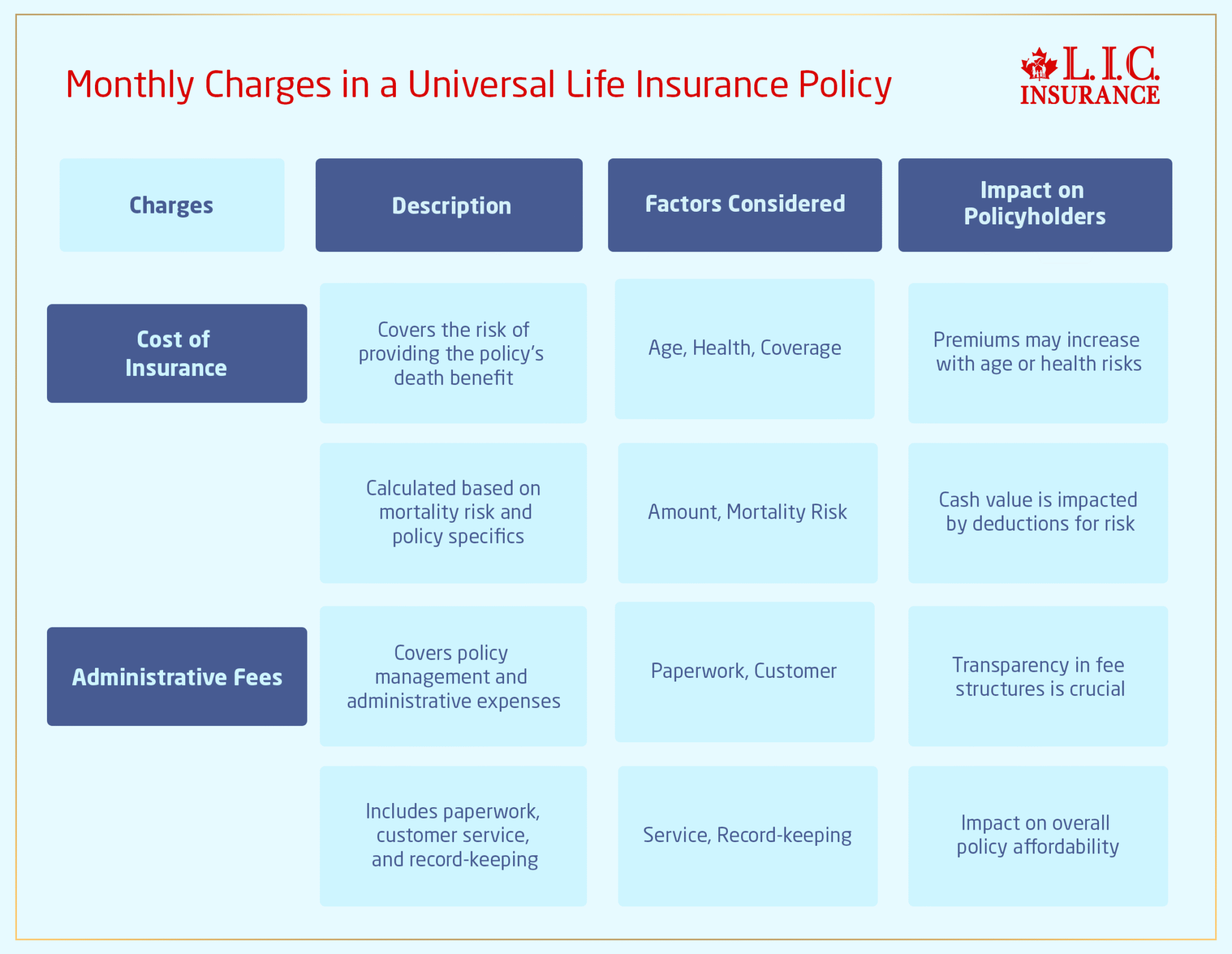
Universal life insurance uses unbundled pricing, meaning policyholders can see every deduction subtracted from their account balance each month. The face value plays a critical role in determining the policy's monthly expenses.
Net Amount at Risk (NAAR)
The insurance company calculates its risk exposure every month using a metric called the Net Amount at Risk:
$$\text{Net Amount at Risk (NAAR)} = \text{Total Death Benefit} - \text{Cash Value}$$
Monthly Cost of Insurance charges are calculated by multiplying the NAAR by the monthly COI rate for the insured’s current age:
$$\text{Monthly COI Charge} = \text{NAAR} \times \left(\frac{\text{COI Rate per } $1,000}{1,000}\right)$$
In an Option A policy with a $1,000,000 face value and $400,000 in cash value, the NAAR is only $600,000 ($1,000,000 - $400,000). The policyholder only pays insurance costs on $600,000 of risk, rather than the full $1,000,000 face value. Understanding this relationship helps policyholders manage their insurance costs as they age.
- Option A: Level Death Benefit ($500k Face Value)
- Insurance Risk (NAAR): $350k (Insurer Cost)
- Cash Value: $150k (Policyholder Equity)
- Total Death Benefit Paid = $500,000
- Option B: Increasing Death Benefit ($500k Face Value)
- Insurance Risk (NAAR): $500k (Insurer Cost)
- Cash Value: $150k (Policyholder Equity)
- Total Death Benefit Paid = $650,000
Factors That Can Adjust or Reduce the Stated Face Value
While the policy contract specifies a face value at issue, several events can alter the actual death benefit paid to beneficiaries or require contractual adjustments.
1. Outstanding Policy Loans and Interest
Policyholders can borrow against their cash value tax-free. However, if a policy loan remains unpaid at the time of the insured’s death, the carrier subtracts the outstanding loan principal plus any accrued, unpaid loan interest directly from the death benefit.
- Example: A policy with a $500,000 face value and an unpaid policy loan balance of $45,000 will pay out a net death benefit of $455,000 to beneficiaries.
2. Cash Value Partial Surrenders (Withdrawals)
Unlike whole life insurance policy loans, universal life permits direct partial withdrawals (surrenders) of cash value. In an Option A contract, taking a partial withdrawal automatically reduces the face value of the policy by the exact amount withdrawn to maintain the required insurance corridor.
3. IRS Section 7702 Corridor Requirements
To maintain tax-exempt status on death benefits and tax-deferred growth under Internal Revenue Code Section 7702, a universal life contract must satisfy specific mathematical tests (the Guideline Premium Test or Cash Value Accumulation Test). These regulations mandate a minimum "corridor" or percentage gap between the cash value and the death benefit.
If your cash value grows exceptionally fast and threatens to breach the Section 7702 corridor limit, the insurance carrier will automatically increase the total face value/death benefit to preserve the policy's status as life insurance. If the cash value gets too close to the death benefit without an automatic correction, the contract risks conversion into a Modified Endowment Contract (MEC), stripping away tax-free withdrawal advantages.
4. Accelerated Death Benefit Riders
If a policyholder triggers an accelerated death benefit rider due to a qualifying terminal, critical, or chronic illness, the insurer advances a portion of the policy's face value to cover medical or living costs while the insured is living. Any amount accelerated, plus associated administrative fees, permanently reduces the remaining face value payable to heirs.
How to Adjust a Universal Life Policy's Face Value
One of the defining benefits of universal life insurance is the contractual right to adjust your coverage level as your financial needs change.
Requesting a Decrease in Face Value
If your children graduate college, your mortgage is paid off, or your financial obligations drop, maintaining a large face value may create unnecessary Cost of Insurance fees.
- Process: You can submit a service request to your insurer asking to decrease the face value (e.g., from $1,000,000 down to $500,000).
- Requirements: Decreases usually do not require medical underwriting. However, carriers typically enforce a minimum face value floor (such as $50,000 or $100,000 depending on contract rules).
- Benefit: Reducing the face value immediately lowers the Net Amount at Risk, significantly reducing monthly COI deductions and preserving remaining cash value in your later years.
Requesting an Increase in Face Value
If you experience a life event that requires more coverage—such as getting married, having children, or expanding a business—you can request an increase in your policy's face value.
- Process: An application for a face value increase is treated similarly to applying for a new policy.
- Requirements: You must provide evidence of insurability. The insurer will evaluate your current medical history, lifestyle factors, and financial status. If your health has declined, the company may decline the request or approve it at a higher risk class rating.
Frequently Asked Questions
Is face value the same as cash value in universal life insurance?
No. Face value is the stated baseline coverage amount purchased from the insurer. Cash value is the internal tax-deferred savings component built up over time through premium payments and earned interest.
Does the beneficiary get both the face value and the cash value?
Under Option A (Level Death Benefit), the beneficiary receives only the face value; the cash value absorbs part of the insurer's risk. Under Option B (Increasing Death Benefit), the beneficiary receives the face value plus the accumulated cash value.
Can face value decrease if cash value drops?
The policy's stated face value does not automatically decrease when cash value drops. However, if cash value drops to zero and fails to cover monthly cost-of-insurance fees, the policy enters a grace period and will lapse, terminating the face value entirely unless additional premiums are paid.
What happens to the face value if I take out a policy loan?
Taking a policy loan does not directly change the policy's contractually stated face value. However, any unpaid loan principal and accrued interest will be deducted from the total payout upon death, resulting in a lower net benefit for your beneficiaries.
Can changing the face value create a tax liability?
Yes. Dropping the face value too aggressively while holding a large cash value balance can violate IRC Section 7702 limits, transforming the policy into a Modified Endowment Contract (MEC). Distributions from a MEC are taxed on a last-in, first-out (LIFO) basis and may incur a 10% tax penalty if taken prior to age 59½.
Practical Guidance for Policyholders
Managing a universal life insurance policy requires regular reviews to ensure the face value matches your financial goals without burdening your cash accumulation:
- Review Your Annual Statement: Inspect the policy specifications on your annual statement to confirm your current face value, cash value, Net Amount at Risk (NAAR), and chosen death benefit option (Option A or Option B).
- Monitor Cost of Insurance (COI) Drag: As you age, standard COI rates per unit of risk increase. If your goal is wealth accumulation or supplemental retirement income, evaluate whether switching from Option B to Option A, or reducing your face value, will lower your monthly charges and preserve cash growth.
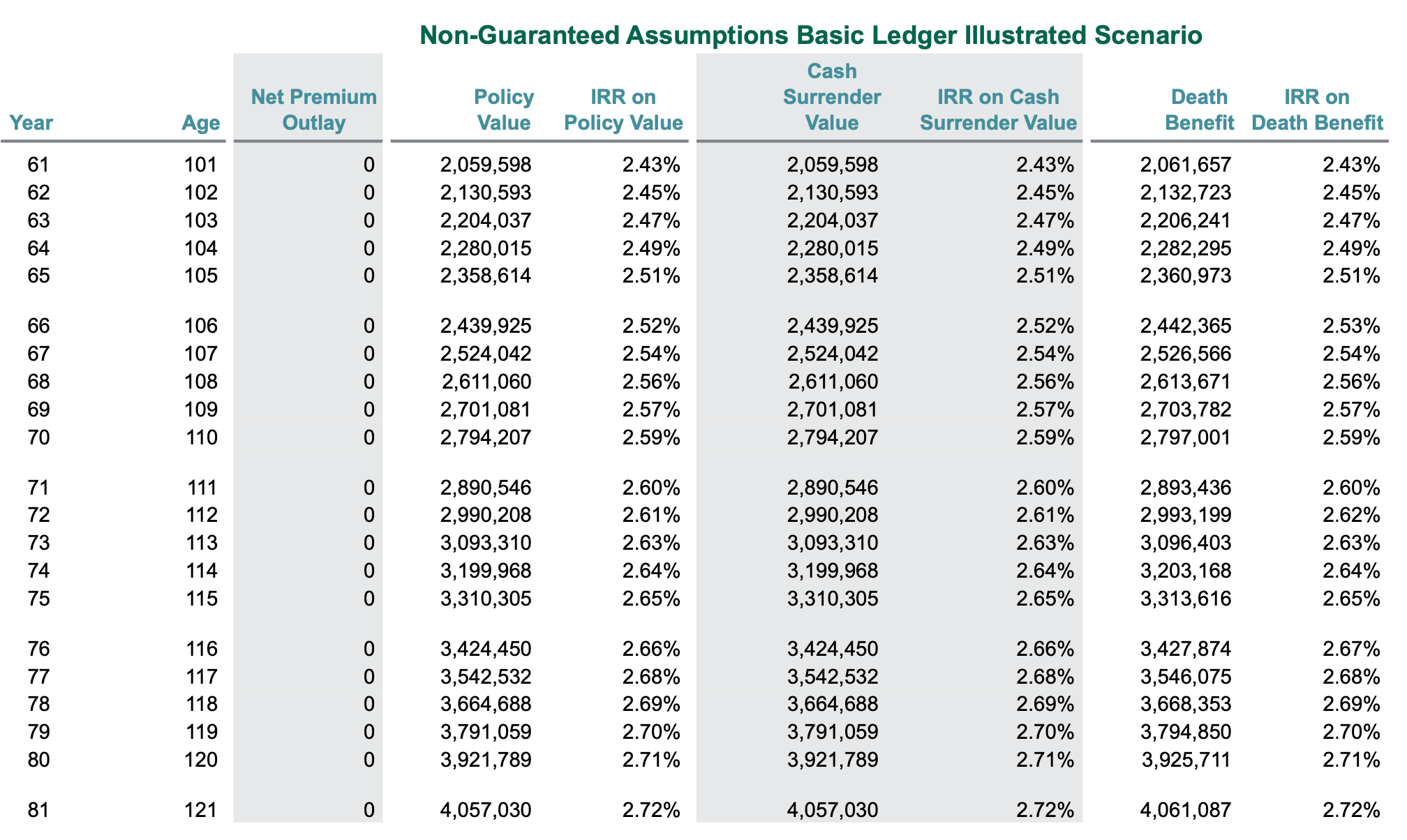
- Run an In-Force Illustration: Request an in-force illustration from your insurance company annually. This project how your current face value and premium payment schedule will perform over time under updated interest rates and fee structures, helping you prevent unexpected policy lapses.
Image Gallery