Understanding Front-End vs. Back-End DTI: Key Differences for Mortgage Approval
Front-end debt-to-income (DTI) ratio measures the percentage of your gross monthly income dedicated specifically to housing costs, while back-end DTI calculates the percentage used for all monthly debt obligations combined. Lenders use...
Front-end debt-to-income (DTI) ratio measures the percentage of your gross monthly income dedicated specifically to housing costs, while back-end DTI calculates the percentage used for all monthly debt obligations combined. Lenders use both metrics to determine your creditworthiness and set loan limits during the mortgage application process.
Contents
The Debt-to-Income ratio (DTI) remains one of the most significant metrics in the 2026 lending landscape. It serves as a primary indicator of a borrower's financial "bandwidth"—the capacity to take on a new monthly mortgage payment without defaulting on other obligations. While credit scores reflect how you have handled debt in the past, DTI ratios predict how you will handle debt in the future. For anyone seeking to purchase a home or refinance an existing mortgage, understanding the nuance between front-end and back-end ratios is essential for successful qualification.
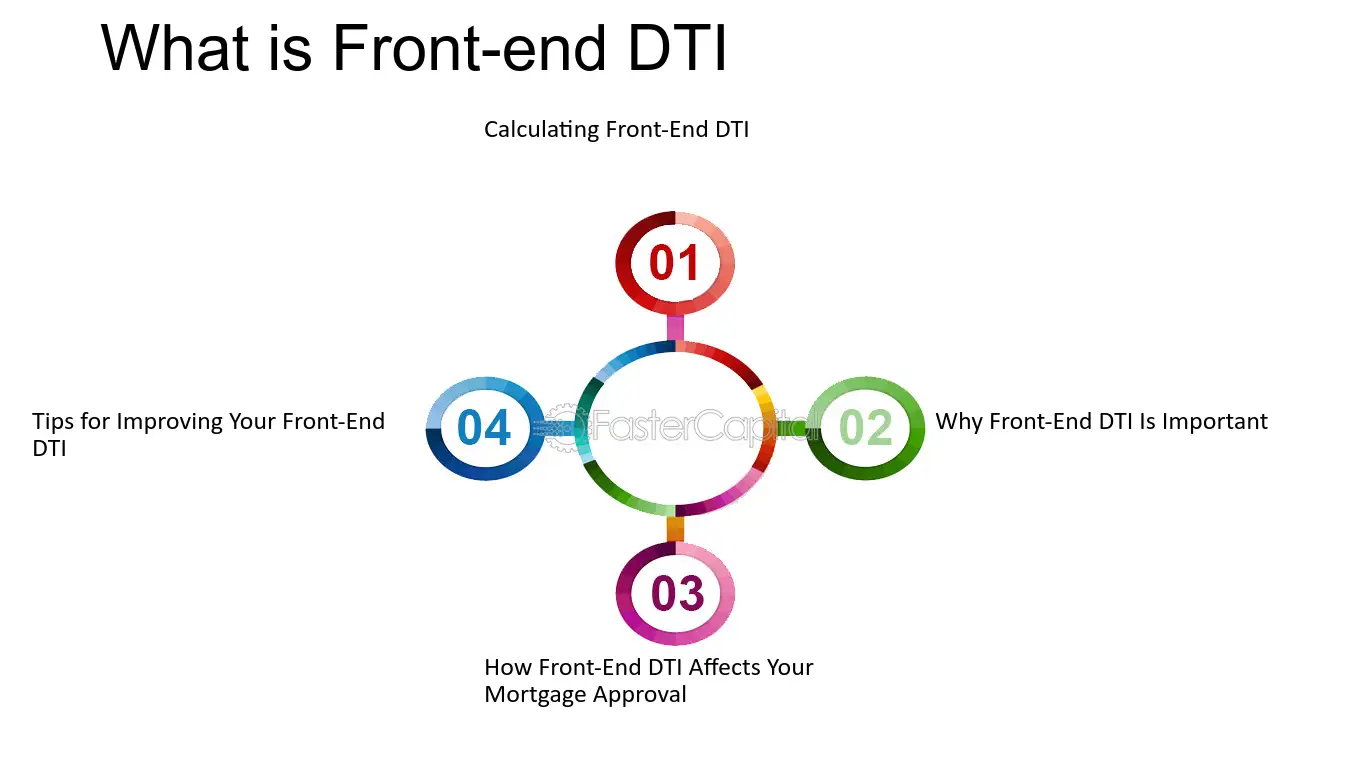
What is Front-End DTI?
The front-end DTI ratio, often referred to as the "housing ratio," focuses exclusively on the costs directly associated with your residence. Lenders calculate this by totaling your anticipated monthly housing expenses and dividing that sum by your gross monthly income (your income before taxes and deductions).
Components of the Front-End Ratio
In 2026, the components of a housing payment are collectively known as PITI, but the calculation often extends beyond just the mortgage itself:
- Principal: The portion of the payment that reduces the remaining balance of the loan.
- Interest: The cost charged by the lender for borrowing the capital.
- Taxes: Monthly escrow amounts for local property taxes.
- Insurance: Homeowners insurance premiums required to protect the asset.
- Private Mortgage Insurance (PMI): Required for most conventional loans with less than a 20% down payment.
- Homeowners Association (HOA) Fees: If the property is a condo or part of a planned unit development, these mandatory monthly dues are included in the front-end calculation.
Lenders prefer to see a front-end DTI of 28% or lower. A ratio exceeding this threshold suggests that a borrower might be "house-poor," meaning a disproportionate amount of their income is tied up in the property, leaving little room for maintenance, utilities, or emergency savings.
What is Back-End DTI?
The back-end DTI ratio, or the "total debt ratio," is arguably the more critical number in a lender's risk assessment. This figure represents the percentage of your gross monthly income required to cover all recurring monthly debt payments.
What is Included in the Back-End Calculation?
The back-end ratio starts with the total housing payment (the front-end PITI) and adds every other debt obligation that appears on your credit report:
- Minimum Credit Card Payments: Lenders use the minimum required payment, not the amount you choose to pay each month.
- Automobile Loans: Monthly installments for car financing or leases.
- Student Loans: Even if loans are in deferment or on an income-driven repayment plan, lenders must factor in a calculated monthly obligation.
- Personal Loans and Lines of Credit: Any installment or revolving debt.
- Alimony and Child Support: Legally mandated payments that reduce your available cash flow.
Expenses like groceries, utilities, health insurance, and cell phone bills are not included in DTI ratios. The back-end ratio is a snapshot of contractual debt rather than general living expenses. In the 2026 market, many lenders seek a back-end DTI of 36% to 43%, though specific loan programs offer flexibility up to 50% for borrowers with high credit scores or significant cash reserves.
Critical Differences and the "28/36 Rule"
The primary difference between the two lies in the scope of financial responsibility. The front-end ratio is a measure of the "house burden," whereas the back-end ratio is a measure of "total lifestyle burden."
Historically, the "28/36 rule" served as the gold standard for mortgage lending. This guideline suggested that a borrower should spend no more than 28% of their gross income on housing and no more than 36% on total debt. However, as housing prices and interest rates have fluctuated through 2026, many lenders have moved away from strict adherence to the 28% front-end limit, focusing more heavily on the back-end ratio to ensure the borrower is not over-leveraged across their entire financial life.
| Feature | Front-End DTI (Housing Ratio) | Back-End DTI (Total Debt Ratio) |
|---|---|---|
| Primary Focus | Costs associated strictly with the property. | Total monthly debt obligations. |
| Included Expenses | PITI (Principal, Interest, Taxes, Insurance) + HOA. | All Front-End costs + Credit cards, car loans, student loans. |
| Ideal Standard | 28% or lower. | 36% (Conventional) to 43% (QM limit). |
| Lender Priority | Used to assess the risk of "house-poor" status. | Primary indicator of overall default risk. |
| Excluded Items | Utilities, groceries, general savings. | Utilities, groceries, life insurance, gas. |
Calculating Your DTI: A Practical Example
To understand how these ratios interact, consider a borrower in 2026 with a gross monthly income of $8,000.
- Determine Housing Costs: The borrower is looking at a home where the total PITI and HOA fees come to $2,200.
- Front-End Calculation: $2,200 / $8,000 = 27.5%. (This is within the ideal 28% limit).
- Determine Total Debt: The borrower also has a $400 car payment, a $200 student loan payment, and $150 in minimum credit card payments.
- Total Monthly Debt: $2,200 (housing) + $400 + $200 + $150 = $2,950.
- Back-End Calculation: $2,950 / $8,000 = 36.8%. (This is slightly above the traditional 36% but well within the 43% threshold for most lenders).
In this scenario, the borrower is likely to qualify for a conventional loan, provided their credit score meets the lender's 2026 standards. If the student loan payment were $800 instead of $200, the back-end ratio would jump to 44.3%, which might require an FHA loan or a larger down payment to lower the front-end portion.
Impact on Different Loan Programs in 2026
Different mortgage products have varying "appetites" for debt. Understanding these limits helps borrowers choose the right path for their specific financial profile.
Conventional Loans
Fannie Mae and Freddie Mac typically prefer a back-end DTI of 36%, but they often allow up to 45% or even 50% if the borrower has "compensating factors." These factors include a credit score above 740, a down payment of 20% or more, or at least six months of cash reserves in the bank. According to Fannie Mae's Selling Guide, the maximum DTI for a manual underwrite is often lower than for those processed through automated underwriting systems.
FHA Loans
The Federal Housing Administration (FHA) is generally more lenient. FHA guidelines often allow for a front-end DTI of 31% and a back-end DTI of 43%. However, in 2026, many FHA borrowers are approved with back-end ratios as high as 50% or 57% if they possess high credit scores or can demonstrate a history of managing high rent payments successfully.
VA Loans
Loans backed by the Department of Veterans Affairs are unique. While the VA suggests a benchmark back-end DTI of 41%, they do not technically have a hard "maximum" DTI. Instead, the VA places more emphasis on residual income—the amount of money left over each month for living expenses after all debts and housing costs are paid. This allows veterans more flexibility in their DTI ratios.
Strategies to Improve Your DTI Ratios
If your ratios are currently too high for the loan you want, there are two primary levers you can pull: increase income or decrease debt.
Reducing the Back-End Ratio
The most effective way to lower your back-end DTI is to pay off small, high-payment debts. For example, a $2,000 credit card balance with a $100 minimum payment affects your DTI exactly the same way as a $2,000 personal loan with a $100 payment. Focusing on "debt snowballs" where you eliminate monthly obligations entirely will have a greater impact than simply lowering the balances on multiple accounts without closing the monthly payment requirement.
Reducing the Front-End Ratio
Lowering the front-end ratio usually requires a change in the loan structure or the property itself:
- Larger Down Payment: This reduces the principal amount borrowed, lowering the monthly PITI.
- Lower Interest Rates: Monitoring the 2026 market for rate dips or buying "points" to lower your permanent rate.
- Shopping for Insurance: Sometimes, finding a more affordable homeowners insurance policy can shave enough off the monthly payment to bring the front-end ratio into compliance.
- Avoiding High HOA Areas: If you are on the edge of qualification, a property without an HOA fee can significantly improve your front-end DTI.
Common Pitfalls and Expert Guidance
One of the most frequent mistakes borrowers make is taking on new debt during the mortgage application process. In 2026, lenders perform a "soft pull" of your credit just days before closing. If you financed a new furniture set or a car after your initial pre-approval, your back-end DTI could spike, causing a last-minute loan denial.
Furthermore, borrowers should be aware that "Gross Income" is calculated differently for self-employed individuals. Lenders typically look at your net taxable income from your tax returns rather than your total revenue. For those in the "gig economy" or running small businesses, this distinction often makes their DTI appear much higher than their actual cash flow would suggest.
According to the Consumer Financial Protection Bureau (CFPB), maintaining a back-end DTI below 43% is vital for obtaining a "Qualified Mortgage," which provides consumers with certain legal protections and generally lower interest rates.
FAQ: Frequently Asked Questions
Does my DTI include my monthly utility bills or cell phone plan?
No. DTI ratios only include "hard" debts—obligations that typically appear on a credit report or are legally mandated (like alimony). Utilities, insurance premiums (other than homeowners), and subscription services are considered general living expenses and are not factored into the front-end or back-end calculations.
Is front-end DTI or back-end DTI more important for approval?
Lenders prioritize the back-end DTI ratio because it provides a holistic view of your financial health. A borrower could have a perfect front-end ratio of 20%, but if they have massive student loan and credit card debt pushing their back-end ratio to 60%, they are a high-risk candidate for default.
Can I include my spouse's income to help my DTI?
Yes, but only if they are a co-borrower on the loan. If you apply for the mortgage individually, you can only use the income associated with your name, even if your spouse contributes to the household bills. Conversely, if you apply together, both your incomes and both your debts will be used to calculate the joint DTI.
How do student loans in deferment count toward my DTI?
In 2026, most loan programs (FHA, VA, Conventional) require lenders to include a monthly payment for student loans even if they are deferred. If the credit report doesn't show a payment, lenders often use a percentage of the total balance (usually 0.5% or 1%) as a "proxy" payment for the back-end DTI calculation.
What is a good DTI ratio for a first-time homebuyer?
While many programs allow for higher limits, a "good" target for a first-time buyer is a 28% front-end and a 36% back-end ratio. This leaves enough room in the monthly budget to handle the unexpected costs of homeownership, such as emergency repairs or rising property taxes.
Practical Recommendation
Before applying for a mortgage in 2026, calculate both your front-end and back-end DTI using your current gross income and the estimated PITI of your target home price. If your back-end DTI exceeds 43%, prioritize paying off revolving credit card balances or installment loans with small remaining balances. This will not only improve your DTI but may also boost your credit score, potentially qualifying you for lower interest rates that further reduce your front-end ratio. Consult with a mortgage professional early in the process to identify which specific loan programs offer the flexibility your unique debt profile requires.
Image Gallery