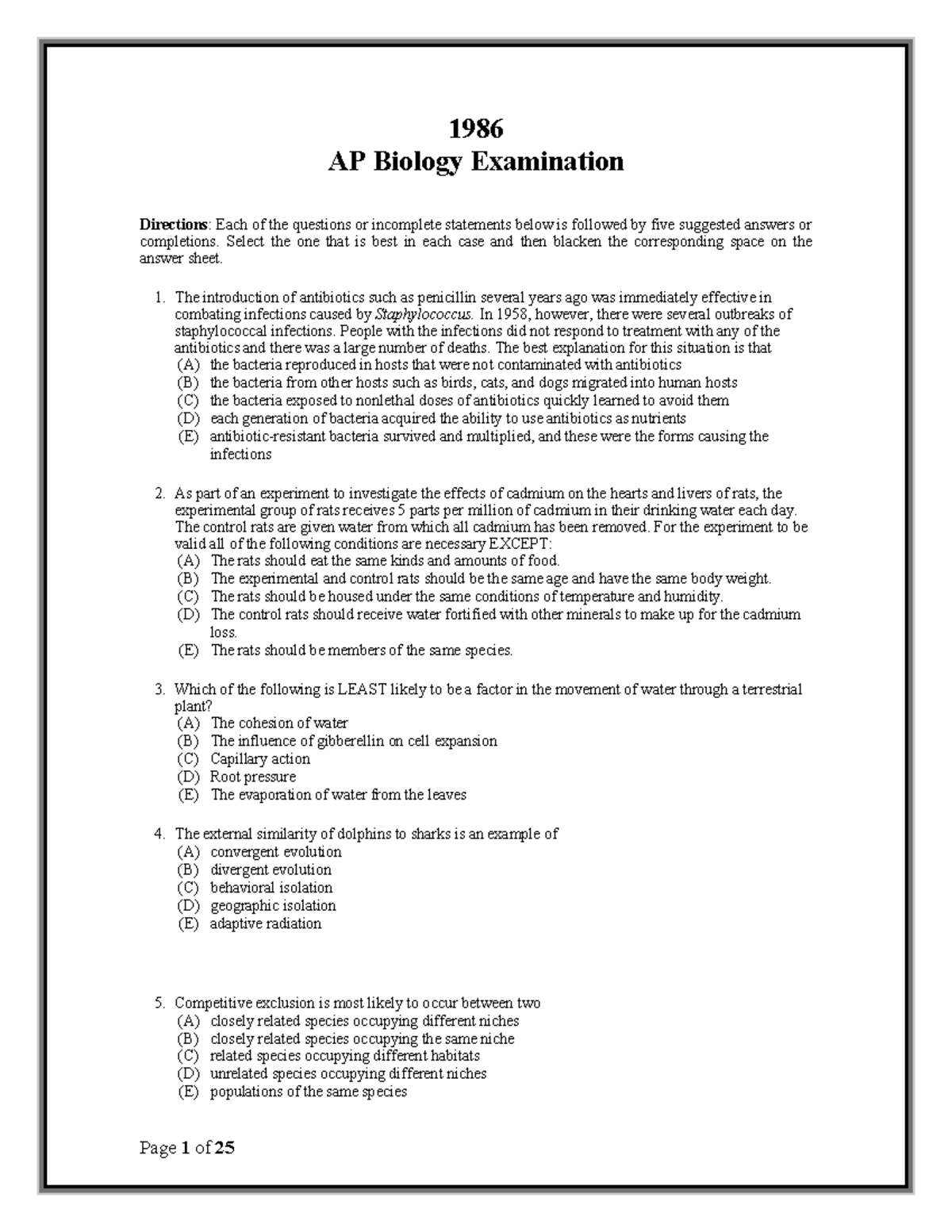
AP Biology Past Exams: Essential Strategies and Resources for 2026
Accessing official AP Biology past exams is the single most effective preparation strategy for students aiming to master the College Board curriculum and earn a top score on exam day. Because the test structure emphasizes scientific pr...
Accessing official AP Biology past exams is the single most effective preparation strategy for students aiming to master the College Board curriculum and earn a top score on exam day. Because the test structure emphasizes scientific practices, experimental design, and data analysis over rote memorization, reviewing authentic past free-response questions and multiple-choice sections provides unmatched diagnostic value.
Contents
Understanding the AP Biology Exam Structure and Modern Framework
The Advanced Placement Biology exam evaluates student understanding of core biological concepts and scientific practices through a rigorous, standardized format. Mastering the exam requires deep familiarity with its structural components, time constraints, and the specific cognitive skills tested by the College Board.
The exam is divided into two distinct sections, each weighted equally at 50% of the overall composite score:
- Section I: Multiple-Choice Questions (MCQ) consists of 60 questions administered over 90 minutes. This section tests individual questions as well as sets of questions based on shared data, models, or experimental scenarios.
- Section II: Free-Response Questions (FRQ) consists of 6 questions administered over 90 minutes. Students must answer 2 long-form questions and 4 short-form questions requiring written explanations, data graph construction, mathematical calculations, and experimental design proposals.
The exam assesses four overarching Big Ideas that unify biological principles: Evolution, Energetics, Information Storage and Transmission, and Systems Interactions. Success depends on connecting these conceptual frameworks to concrete experimental data found within authentic past exams.
Where to Find Official and Authorized AP Biology Past Exams
Securing authentic, College Board-released materials ensures that students practice with questions that mirror the exact stylistic, linguistic, and statistical complexity of the real test. Unofficial third-party practice tests often fail to replicate the nuanced cognitive depth of official College Board prompts.
Official and reliable sources for past exam materials include:
- AP Central Portal: The official College Board website provides a robust archive of previously administered Free-Response Questions (FRQs), scoring guidelines, and sample student responses with reader commentaries.
- AP Classroom: Teachers can unlock full, secure secure practice exams—including complete multiple-choice sections—through this digital platform for classroom assessments and diagnostic practice.
- College Board Course and Exam Description (CED): The official framework document contains practice multiple-choice and free-response questions with detailed answer rationales mapped directly to specific learning objectives.
- Educator-Curated Repositories: Authorized high school AP teachers frequently maintain organized archives of released exams for diagnostic classroom testing.
Strategic Methodology for Utilizing Past Exams in Your Study Plan
Taking a past exam randomly yields limited benefits without a disciplined, analytical approach to execution and review. To maximize score improvement, students must simulate real testing conditions and systematically analyze errors.
The Four-Step Past Exam Execution Workflow
- Diagnostic Timing: Complete a full-length past exam under strict time constraints (90 minutes for MCQs, 90 minutes for FRQs) without using notes or external references to establish a realistic baseline score.
- Rigorous Self-Grading: Evaluate multiple-choice answers using official scoring keys, and grade free-response questions strictly against the published College Board scoring guidelines and rubric point allocations.
- Error Categorization: Group missed questions by underlying cause, distinguishing between content gaps, mathematical calculation errors, misinterpretation of experimental graphs, or failure to address specific action verbs (e.g., describe, justify, calculate).
- Targeted Remediation: Review textbook chapters, lab protocols, or video resources specifically addressing the biological concepts tied to missed questions before attempting another practice exam.
Analyzing AP Biology Exam Formats and Question Types
| Section | Question Count | Time Allocation | Score Weight | Core Skills Tested |
|---|---|---|---|---|
| Section I: Multiple-Choice | 60 Questions | 90 Minutes | 50% | Concept application, data interpretation, scientific questioning, statistical analysis |
| Section II: Long Free-Response | 2 Questions | Part of 90 Minutes | ~25% | Interpreting and evaluating experimental results with graphing |
| Section II: Short Free-Response | 4 Questions | Part of 90 Minutes | ~25% | Scientific explanation, conceptual analysis, mathematical calculation, model analysis |
Mastering the Free-Response Section Using Past Scoring Guidelines
The Free-Response section differentiates scoring tiers on the AP Biology exam. Reviewing historical scoring guidelines from past exams reveals exactly how AP readers award points and exposes common pitfalls that cost students valuable marks.
Action verbs dictate the required depth of every written response. A prompt asking students to "describe" requires a relevant characteristic or step, whereas a prompt asking to "justify" requires providing evidence or reasoning to support a claim. Past scoring rubrics consistently show that students lose points not from lack of biological knowledge, but from failing to link their claims directly to experimental data or provided models.
Key practices for maximizing FRQ scores based on past exam analysis include:
- Direct Answers: Avoid lengthy introductory filler sentences; begin writing the core scientific explanation immediately to satisfy rubric criteria efficiently.
- Labeling Axes and Scales: When constructing graphs on long FRQ prompts, always label axes with units and utilize consistent numerical scaling based on provided datasets.
- Showing Mathematical Work: For calculations involving chi-square analysis, water potential, primary productivity, or Hardy-Weinberg equilibrium, show all intermediate steps clearly to earn partial credit even if the final calculation contains a minor arithmetic error.
Common Pitfalls When Practicing with Past Exams
Students frequently misuse past exams, diminishing their diagnostic utility. Avoiding these common traps ensures efficient preparation.
- Memorizing Answers: Memorizing specific questions and answers from a released exam is counterproductive because the College Board tests conceptual application in novel scenarios rather than repeating identical questions.
- Ignoring Multiple-Choice Review: Focusing exclusively on free-response questions while neglecting multiple-choice analysis leaves half of the exam score unaddressed. Multiple-choice questions require rapid data synthesis and precise vocabulary mastery.
- Skipping Timed Practice: Completing practice questions untimed prevents students from developing the pacing strategies necessary to manage cognitive fatigue during the rigorous two-hour-and-thirty-minute testing window.
Frequently Asked Questions About AP Biology Past Exams
Are all AP Biology past exams publicly available online?
While the College Board publicly releases all Free-Response Questions along with scoring guidelines and sample responses, complete multiple-choice sections from recent years are typically kept secure and restricted to educators via AP Classroom to maintain test integrity. However, several complete older exams are available within official course guides.
How many past exams should I complete before test day?
Completing two to three full-length past exams under authentic, timed testing conditions is ideal for building stamina, refining pacing strategies, and identifying persistent conceptual weaknesses without causing student burnout.
Can I use older past exams from before the curriculum redesign?
Older exams can still provide valuable practice for core biological concepts, but students should exercise caution when reviewing questions aligned with outdated curriculum units, ensuring their study focuses heavily on exams released under the current course and exam description framework.
How should I review incorrect multiple-choice answers?
Maintain an error log detailing the specific biological concept, the reason for the misinterpretation, and the correct underlying scientific principle. Revisit this log weekly to reinforce weak areas and prevent repeated mistakes on subsequent practice sets.
Are scoring guidelines from past exams reliable predictors of current grading standards?
Yes, the College Board applies consistent grading rubrics and rigorous standardization procedures across years, meaning past scoring guidelines provide an accurate reflection of what AP readers expect in student explanations.
Begin integrating authentic past exam questions into your weekly study schedule today to align your preparation with official College Board standards, refine your scientific reasoning skills, and approach exam day with absolute confidence.
MetaDescription: Access official AP Biology past exams, scoring guidelines, and proven strategies to master exam questions, analyze data, and maximize your score.
Image Gallery