Getting a Life Insurance Policy Without a Health Exam: A Complete Guide
Getting a life insurance policy without a health exam allows qualified applicants to secure coverage through simplified health questionnaires or automated data verification, bypassing blood draws, urine samples, and physical examinatio...
Getting a life insurance policy without a health exam allows qualified applicants to secure coverage through simplified health questionnaires or automated data verification, bypassing blood draws, urine samples, and physical examinations. Depending on the underwriting method, approval can take anywhere from a few minutes to several business days.
Contents
Understanding No-Exam Life Insurance Options
Traditionally, securing individual life insurance required a paramedical exam. A trained technician would record vital signs, take blood and urine samples, and record personal health metrics. Modern underwriting leverages digital records and predictive modeling, allowing life insurance carriers to assess risk without requiring a physical examination.
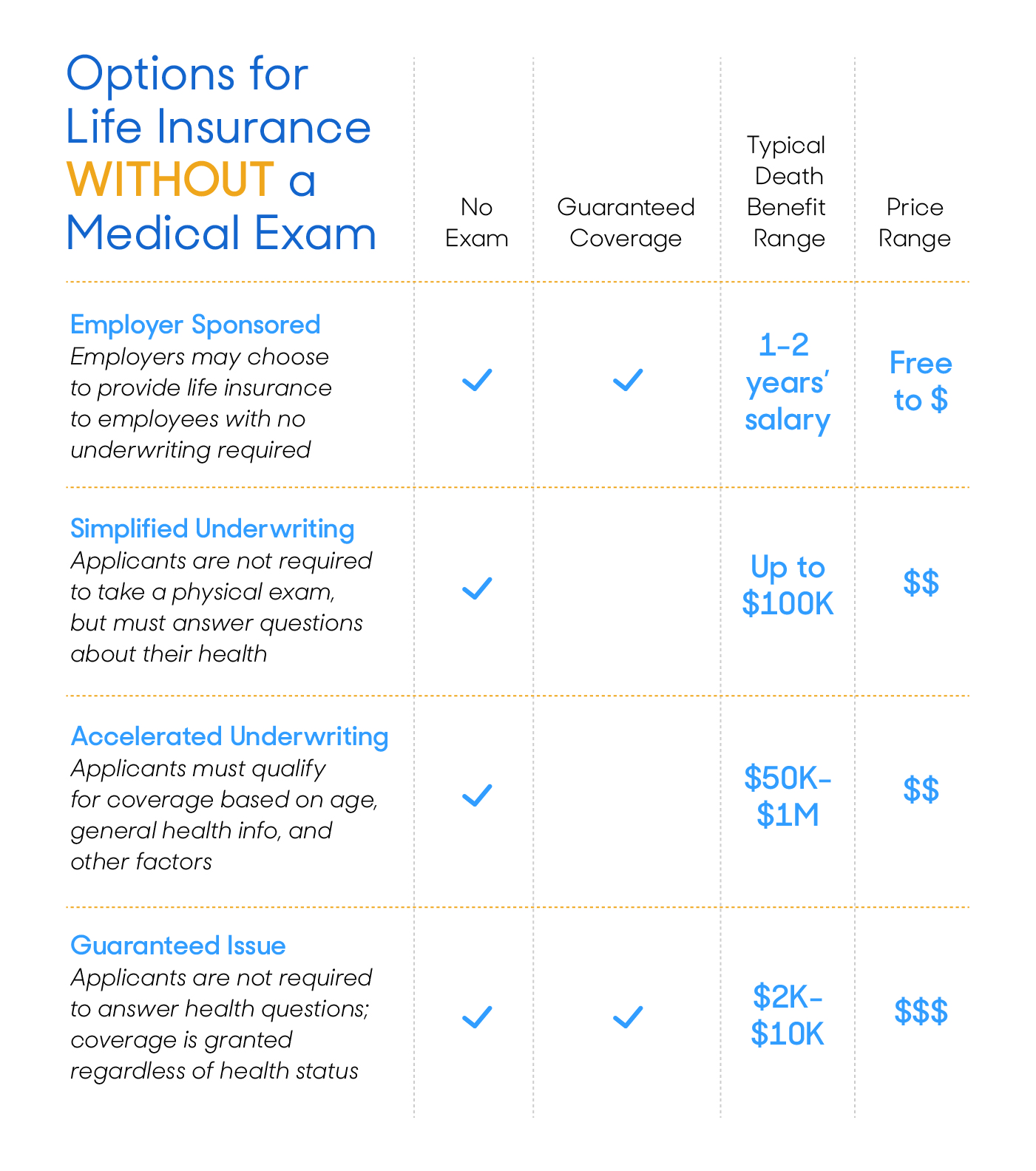
However, "no-exam life insurance" is not a single product. It is an umbrella term covering three distinct underwriting structures, each designed for different health profiles, coverage amounts, and budget limits.
Accelerated Underwriting
Accelerated underwriting uses algorithmic risk-scoring to evaluate applicants. Instead of scheduling a paramedical exam, the insurance carrier uses artificial intelligence and proprietary algorithms to cross-reference data from medical databases, prescription histories, motor vehicle records, and credit attributes.
If your data profile shows minimal health risk, the insurer waives the physical exam requirement while offering standard or preferred premium rates comparable to traditionally underwritten policies.
- Coverage Limits: Typically ranges from $100,000 to $3,000,000 or more.
- Target Audience: Younger, healthy individuals with clean medical histories and routine preventive care records.
- Underwriting Speed: Ranging from instant approval to a few business days.
Simplified Issue Life Insurance
Simplified issue life insurance removes the physical examination completely, replacing it with a detailed health questionnaire. You do not undergo fluid testing, but you must answer explicit questions about your personal medical history, past surgeries, chronic conditions, family medical history, and prescription use.
Because the carrier accepts higher risk by skipping physical measurements and blood work, premiums for simplified issue coverage are higher per dollar of coverage than accelerated or fully underwritten policies.
- Coverage Limits: Generally capped between $50,000 and $500,000.
- Target Audience: Individuals who need coverage quickly or those with moderate, well-managed health conditions (such as controlled hypertension) who might face higher rates or delays under standard underwriting.
- Underwriting Speed: Usually 24 to 48 hours.
Guaranteed Issue Life Insurance
Guaranteed issue life insurance requires no medical exam and no health questions. Eligibility is based entirely on age, provided you meet the carrier's minimum and maximum age criteria (typically between 50 and 85 years old).
Because the insurer collects no medical information, it assumes the applicant may have pre-existing or life-limiting health conditions. To offset this financial risk, carriers charge significantly higher premiums relative to the death benefit and incorporate mandatory waiting periods before the full death benefit becomes payable.
- Coverage Limits: Lower benefit amounts, usually between $2,000 and $25,000.
- Target Audience: Older adults with severe pre-existing conditions, terminal illnesses, or those previously declined for traditional coverage who require final expense funds for burial and legal expenses.
- Underwriting Speed: Instant to 24-hour approval.
How Insurers Evaluate Risk Without a Physical Exam
When an insurer waives a physical exam, they replace manual health testing with digital data verification. The underwriting process evaluates risk through several data sources:
- Applicant Data Inputs
- MIB Group Database
- Prescription Databases
- Motor Vehicle & Credit Data
- Automated Underwriting Engine / Risk Score
- Approved: Standard/Preferred
- Referred to Manual Review
The Medical Information Bureau (MIB) Database
The MIB Group operates a member-owned information exchange serving the life and health insurance industry. When you apply for insurance, the carrier queries the MIB database for coded records of previous insurance applications submitted within the past seven years.
If you previously applied for life coverage and disclosed conditions like diabetes or abnormal blood pressure—or if an underwriter noted adverse findings—the MIB report reflects those entries. Discrepancies between your current application answers and historical MIB data can trigger a manual review or application denial.
Prescription History Reports
Insurance underwriters review commercial prescription database services, such as Milliman IntelRx or LexisNexis Risk Solutions, to evaluate your drug histories. These databases aggregate national pharmacy records to reveal:
- The specific medications prescribed to you over the past 3 to 10 years.
- Dosages, refill frequency, and prescribing physician specialties.
- Unfilled prescriptions that may signal non-compliance with medical care.
Insurer algorithms analyze these prescriptions to identify underlying medical conditions. For example, regular refills for metformin signal diabetes management, while prescriptions for beta-blockers or statins point to cardiovascular monitoring.
Motor Vehicle and Public Records
Motor Vehicle Reports (MVR) provide carriers with a record of your driving behavior over the past three to five years. Underwriters flag major moving violations, such as driving under the influence (DUI/DWI) convictions, reckless driving charges, or excessive speed citations. Multiple infractions suggest high-risk lifestyle behavior, which directly impacts approval odds and premium pricing.
Credit-Based Insurance Scores
Many carriers use credit-based insurance scores derived from public records and consumer credit reports. These scores do not measure personal wealth; rather, financial data models link credit stability (such as payment history and bankruptcy filings) to mortality risk. Severe financial instability or recent bankruptcies can lead to higher premiums or automatic referral to traditional underwriting.
Comparing No-Exam Life Insurance Policy Types
Selecting the correct policy type depends on your health status, speed requirements, and required coverage amount. The table below outlines how these policy structures differ:
| Feature / Metric | Accelerated Underwriting | Simplified Issue | Guaranteed Issue |
|---|---|---|---|
| Medical Exam Required? | No (if qualified) | No | No |
| Health Questionnaire? | Yes (Comprehensive) | Yes (Basic/Short) | No |
| Maximum Coverage Amount | Up to $3,000,000+ | $50,000 – $500,000 | $2,000 – $25,000 |
| Approval Timeline | Instant to 3 Days | Instant to 48 Hours | Instant to 24 Hours |
| Relative Cost Level | Lowest (Standard rates) | Moderate to High | Highest per $1,000 of coverage |
| Death Benefit Structure | Full death benefit from Day 1 | Full death benefit from Day 1 | Graded (2–3 year waiting period) |
| Primary Risk Indicator | Algorithms & Third-Party Data | Self-reported health questions | Age & Residency criteria only |
| Ideal Applicant Profile | Healthy applicants wanting fast processing | Applicants with mild/controlled health issues | Applicants with severe health conditions |
Steps to Secure a No-Exam Policy
Securing a policy without a health exam requires clear documentation and accurate reporting. Follow these sequential steps to navigate the application process.
- Calculate Coverage Needs
- Determine total financial obligations and income replacement goals.
- Gather Medical & Personal Records
- Organize doctors' names, diagnoses, prescriptions, and dosage history.
- Compare Policy Types & Quotes
- Evaluate Accelerated vs. Simplified vs. Guaranteed coverage.
- Submit Application & Complete Data Checks
- Authorize third-party database checks (MIB, Rx, MVR).
- Review Policy Terms & Confirm Coverage
- Check contestability terms, graded death benefit rules, and premium locks.
Step 1: Calculate Your Actual Coverage Needs
Before applying, establish the exact financial obligation your policy must cover. Common targets include:
- Debt Coverage: Replacing outstanding mortgages, personal loans, or private student loans.
- Income Replacement: Multiplying your annual net income by a factor representing the remaining years until your planned retirement.
- Final Expenses: Allocating $10,000 to $25,000 specifically for burial, cremation, and estate administration costs.
Calculating your exact need prevents you from buying too little coverage through a limited guaranteed issue policy or overpaying for simplified issue limits you do not need.
Step 2: Review Your Personal and Medical Records
Gather accurate details about your personal medical background before opening an application. You will need:
- Primary care physician contact details and clinic addresses.
- Names, dosages, and prescribing doctors for all medications taken over the last five years.
- Dates and outcomes of major medical procedures, surgeries, or diagnostic tests.
- Details on past moving violations or major motor vehicle accidents.
Incomplete or inaccurate answers can slow down the automated underwriting process, triggering a manual review or a request for a traditional physical exam.
Step 3: Request Quotes Across Multiple Carriers
No-exam policy premiums vary substantially between insurance providers. Working with an independent broker or using transparent comparison platforms lets you evaluate quotes across multiple carriers simultaneously. Ensure that you are comparing identical term lengths (e.g., 10, 20, or 30-year term) or permanent coverage structures (such as whole life) across all prospective carriers.
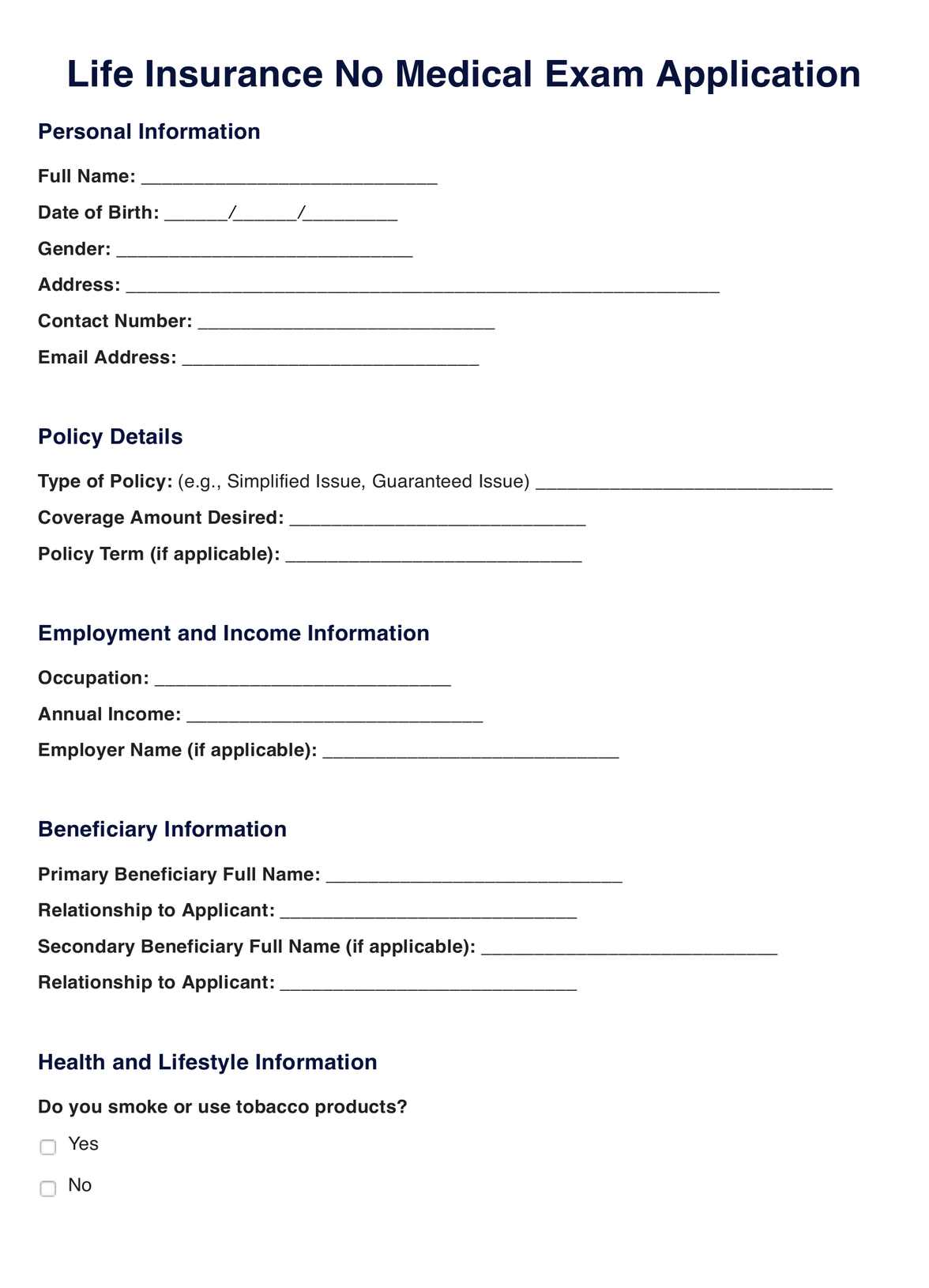
Step 4: Complete the Application and Questionnaire
Fill out the application completely. You will be asked to sign authorization forms granting the insurer permission to query third-party data networks, including MIB records, prescription history databases, and motor vehicle registers.
Answer all health questions truthfully. Concealing medical conditions, tobacco use, or dangerous hobbies to obtain approval can result in a denied claim or policy cancellation during the contestability period.
Step 5: Review Policy Terms and Waiting Periods
Once approved, review the policy contract before submitting your initial premium payment:
- Verify Premium Structure: Confirm whether your premium remains fixed for the life of the contract or increases at specified intervals.
- Identify Graded Death Benefits: If purchasing guaranteed issue coverage, confirm the length of the graded period (typically two to three years) and understand what percentage of premiums plus interest would be returned if death occurs from non-accidental causes during that window.
- Confirm the Free-Look Period: State laws provide a "free-look" period (usually 10 to 30 days depending on jurisdiction) during which you can review the policy and return it for a 100% refund if the terms are unsatisfactory.
Financial and Practical Trade-Offs to Consider
While bypassing a physical examination offers convenience and speed, applicants must weigh three key trade-offs against traditional underwritten policies.
- Financial & Practical Trade-Offs
- Premium Costs: Higher rates for simplified issue
- Death Benefits: Graded payout windows applied
- Contestability: 2-year window for misstatements
Premium Cost Disparity
Insurance carriers price policies based on risk uncertainty. When an underwriter lacks full laboratory data (blood chemistry, cholesterol ratios, kidney function markers, and urinalysis), they build a safety margin into the policy pricing.
For healthy applicants, accelerated underwriting provides competitive rates. However, for simplified or guaranteed issue policies, premiums can cost significantly more per dollar of coverage than a policy secured through a traditional paramedical exam.
Graded Death Benefits and Waiting Periods
Guaranteed issue policies usually feature a graded death benefit clause. If the insured person dies from natural causes (e.g., illness or chronic conditions) within the first two or three years of policy issuance:
- The beneficiary does not receive the full face value of the policy.
- Instead, the carrier refunds the total premiums paid to date, plus a specified interest rate (often between 5% and 10%).
Full death benefits are paid from Day 1 only if the cause of death is directly linked to an unexpected accident, as defined by the contract.
The Two-Year Contestability Clause
Under standard insurance regulations, including guidelines recognized by state insurance departments and the National Association of Insurance Commissioners (NAIC), life insurance contracts contain a two-year contestability clause.
If the insured passes away within the first two years of the policy effective date, the insurer reserves the legal right to audit the original application and medical records. If the carrier discovers material misrepresentations—such as undisclosed surgeries, unreported smoking habits, or omitted chronic diagnoses—they may rescind the policy and deny the death benefit claim, returning only the premiums paid.
Frequently Asked Questions
Can you get denied for a no-exam life insurance policy?
Yes. Accelerated underwriting and simplified issue policies can be denied based on third-party database records, adverse MIB reports, high-risk driving records, or prescription histories. Only guaranteed issue policies offer guaranteed acceptance without health-based denials, provided you meet the carrier's age requirements.
How long does approval take for a policy without a health exam?
Approval timelines vary by policy type. Accelerated underwriting can deliver instant approvals or take 24 to 72 hours. Simplified issue policies typically take between 24 hours and a few business days. Guaranteed issue coverage is usually approved instantly upon confirmation of payment and identity verification.
Is no-exam life insurance more expensive than traditional policies?
It depends on the underwriting method. Accelerated underwriting for healthy applicants offers rates comparable to traditional policies requiring exams. However, simplified issue and guaranteed issue policies carry higher premiums to compensate for the insurer's limited access to medical data.
What happens if you lie on a simplified issue health questionnaire?
Lying on a life insurance application constitutes insurance fraud. If the insured dies within the mandatory two-year contestability period, the insurance carrier will inspect past medical and pharmacy records. If deliberate misrepresentations or material omissions are discovered, the insurer can rescind the policy and deny the payout to your beneficiaries.
Can seniors over 70 get life insurance without a medical exam?
Yes. Seniors over 70 can qualify for simplified issue term or whole life policies if they pass basic health questions. Seniors with moderate to severe medical conditions can purchase guaranteed issue whole life insurance, though coverage limits are typically capped at $10,000 to $25,000, and premiums are significantly higher.
Recommended Next Actions
If you are considering a life insurance policy without a health exam:
- Assess Your Baseline Health: If you are generally healthy with no major chronic conditions, apply for an accelerated underwriting policy first. This preserves your ability to obtain higher coverage amounts at preferred rates without a paramedical exam.
- Run Standard Comparison Quotes: Compare no-exam quotes directly against fully underwritten policy rates. If the cost difference is substantial and you do not require immediate coverage, taking a routine paramedical exam may save you thousands of dollars over the policy term.
- Verify Carrier Financial Strength: Ensure any insurer you consider holds an "A-" (Excellent) rating or better from independent financial rating agencies such as A.M. Best.
- Consult an Independent Agent: Work with a licensed, non-captive insurance professional who can cross-reference your medical history against multiple underwriting guidelines to select the right carrier for your financial needs.
Disclaimer: This article is provided for informational purposes only and does not constitute formal legal, tax, or financial advice. Life insurance policy availability, underwriting rules, policy riders, and state regulations vary by carrier and jurisdiction. Consult a licensed insurance professional or estate planner to evaluate your specific situation.
EDITORIAL CATEGORY METADATA:
Image Gallery