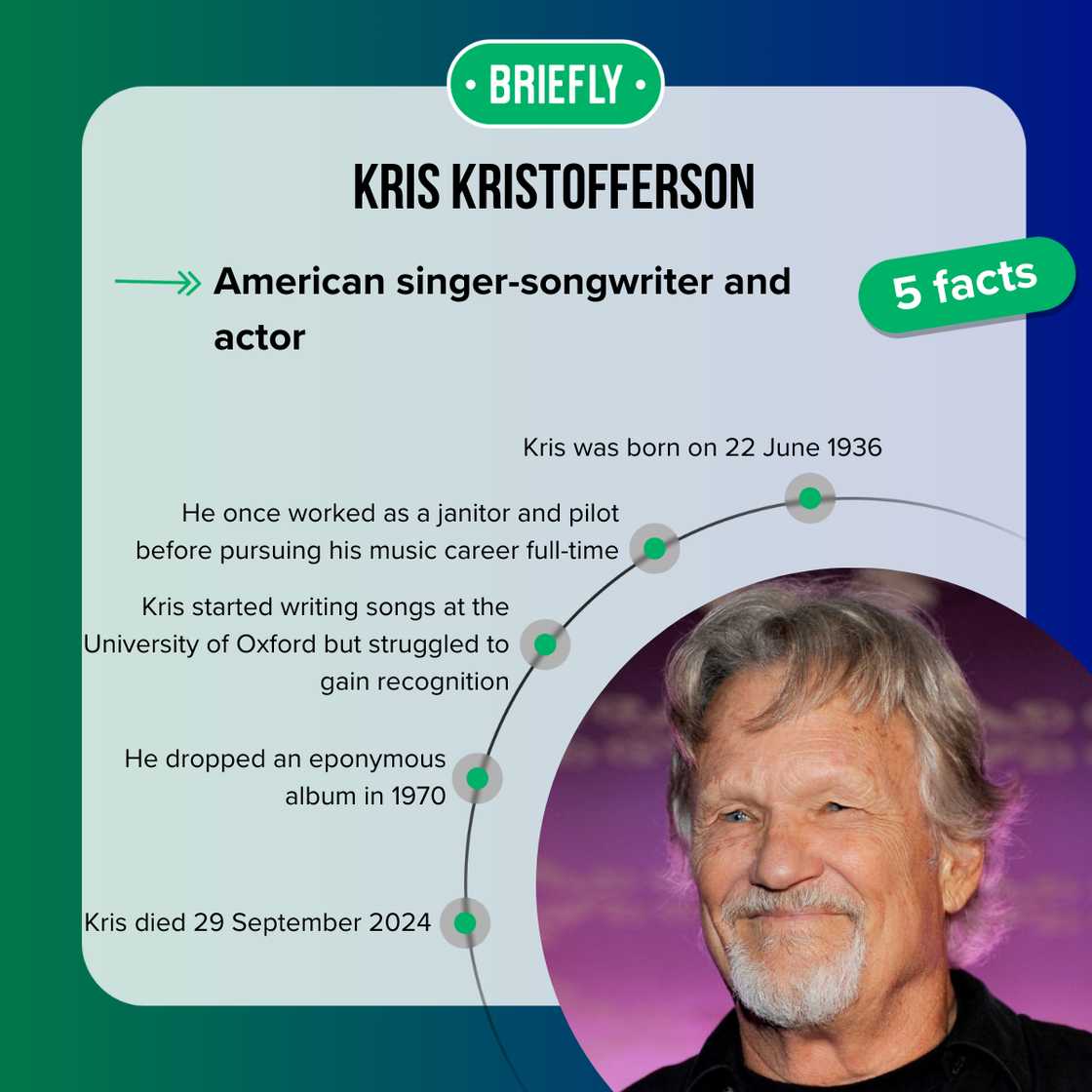
Kris Kristofferson Net Worth: The Financial Legacy of a Country Music Icon
Kris Kristofferson’s net worth is estimated at $50 million as of 2026. This valuation represents the enduring financial legacy of a man who transitioned from a Rhodes Scholar and military captain to a janitor and, eventually, one of th...
Kris Kristofferson’s net worth is estimated at $50 million as of 2026. This valuation represents the enduring financial legacy of a man who transitioned from a Rhodes Scholar and military captain to a janitor and, eventually, one of the most influential songwriters and actors in American history. Following his passing in September 2024, his estate continues to be managed through his significant 2021 catalog sale and ongoing royalties.
Contents
The Foundation of a Renaissance Man's Wealth
To understand how Kris Kristofferson (often searched as "Chris Kristoferson") amassed a $50 million fortune, one must look at the unconventional path he took toward professional success. Unlike many of his contemporaries who sought fame early, Kristofferson’s wealth was built on a foundation of intellectual and disciplined pursuits. He was a Rhodes Scholar at Oxford University and served as a Captain in the U.S. Army, where he became a helicopter pilot.
In the mid-1960s, Kristofferson famously walked away from a prestigious teaching position at West Point to move to Nashville. This gamble initially resulted in financial hardship; he worked as a janitor at Columbia Records to support his family while pitching songs. This period of his life, while characterized by low income, was when he authored the "intellectual property" that would later form the bulk of his net worth. His ability to blend literary depth with country music simplicity created a new market for "outlaw" country, which would prove to be immensely profitable over the subsequent five decades.
The 2021 Catalog Sale: A Strategic Financial Exit
One of the most significant events contributing to his $50 million valuation in 2026 was the strategic sale of his music publishing catalog. In 2021, Kristofferson followed the trend of legendary artists like Bob Dylan and Bruce Springsteen by selling his entire body of work to CTM Outlander Music LP.
This deal included his interest in his own songwriting catalog, which featured timeless classics such as "Me and Bobby McGee," "Help Me Make It Through the Night," and "Sunday Mornin' Comin' Down." While the exact purchase price was not publicly disclosed, industry experts and reports from Billboard suggested the deal was a multi-million dollar transaction that provided Kristofferson with immediate liquidity and simplified his estate planning.
By selling the catalog, Kristofferson ensured that his heirs would receive a lump sum rather than managing complex royalty streams across international jurisdictions. This move significantly stabilized his net worth against the volatility of the streaming market, locking in his financial legacy during his final years.
Songwriting Royalties and the "Outlaw" Goldmine
Before the 2021 sale, Kristofferson’s primary source of wealth was his songwriting. He was unique in that his songs often became bigger hits for other artists than for himself, creating a diversified stream of mechanical and performance royalties.
- "Me and Bobby McGee": While Kristofferson recorded it, Janis Joplin’s posthumous version topped the charts. As the sole writer, Kristofferson received the lion's share of royalties from one of the most played songs in rock history.
- "Sunday Mornin' Comin' Down": Johnny Cash’s rendition of this song won the CMA Song of the Year in 1970. This success cemented Kristofferson's status as a top-tier Nashville writer, leading to higher advances and better contractual terms for his future work.
- "For the Good Times": Ray Price’s version became a massive crossover hit, further expanding the reach of Kristofferson’s intellectual property into the pop and easy-listening markets.
Even after the sale of his catalog, the "Writer's Share" of royalties often remains with the creator or their estate depending on the specific contract, ensuring that his family continues to benefit from the ubiquitous presence of his music in films, commercials, and digital streaming platforms in 2026.
Hollywood Success and Film Earnings
Kristofferson was one of the few musicians who successfully transitioned into a legitimate "A-list" movie star, which significantly boosted his earnings beyond what music alone could provide. His acting career spanned over 50 years and included more than 100 credits.
The Leading Man Era
During the 1970s, Kristofferson was a major box-office draw. His role in the 1976 version of "A Star Is Born" alongside Barbra Streisand earned him a Golden Globe for Best Actor. This film was a massive commercial success, grossing over $80 million (equivalent to several hundred million in 2026 dollars), and Kristofferson reportedly received both a high salary and a percentage of the profits.
The Blade Trilogy and Franchise Income
In the late 1990s and early 2000s, Kristofferson found a new stream of income through the Blade franchise. Playing the character Abraham Whistler, the mentor to Wesley Snipes’ Blade, he appeared in three films. The franchise was a global success, grossing over $400 million worldwide. Participation in a major Marvel-adjacent franchise provided Kristofferson with modern-day blockbuster paydays and consistent residuals that bolstered his net worth in his later years.
The Highwaymen and Live Performance Revenue
Kristofferson’s financial portfolio was also bolstered by his participation in the country music supergroup The Highwaymen, alongside Johnny Cash, Waylon Jennings, and Willie Nelson.
The group was active from 1985 to 1995, a period when country music touring began to reach arena-sized scales. The Highwaymen released three major-label albums and embarked on massive world tours. These tours were highly lucrative, as the combined drawing power of four legends allowed for premium ticket pricing and high-volume merchandise sales. For Kristofferson, this era provided a significant mid-career financial surge, allowing him to invest in real estate and other private assets.
Real Estate and Personal Assets
A substantial portion of Kris Kristofferson's $50 million net worth is tied to his real estate holdings, particularly his long-term residence in Hawaii. For decades, Kristofferson lived on a sprawling estate in Hana, Maui.
| Property Type | Location | Estimated Value (2026) | Significance |
|---|---|---|---|
| Primary Estate | Hana, Maui, HI | $15,000,000 - $20,000,000 | A large coastal property held for decades, benefiting from massive appreciation. |
| Ranch Property | Northern California | $5,000,000 | Used as a retreat and for agricultural purposes. |
| Intellectual Property | Global Rights | $25,000,000+ (Valuation) | Residuals, likeness rights, and remaining royalty interests. |
The Maui property, in particular, represents a significant asset. Hana is one of the most secluded and expensive areas in Hawaii, and Kristofferson’s acreage there has appreciated significantly since he purchased it in the 1970s. In 2026, such properties are valued not just for their acreage but for their privacy and historical association with the legendary artist.
Managing the Kristofferson Estate in 2026
Since his passing in 2024, the management of Kristofferson’s wealth has shifted to his wife, Lisa Meyers, and his eight children. The estate is tasked with balancing the preservation of his artistic legacy with the commercial exploitation of his name, image, and likeness (NIL).
In 2026, the estate remains active in:
- Licensing for Film and TV: His songs continue to be high-demand items for period-piece soundtracks and documentaries.
- Posthumous Releases: Like many legends, there is a vault of unreleased demos and live recordings that provide periodic injections of revenue through "deluxe" reissues.
- Digital Presence: Managing his Spotify and YouTube presence, which generates millions of streams monthly from new generations discovering his work.
FAQs About Kris Kristofferson's Net Worth
Who inherited Kris Kristofferson's wealth?
His estate was primarily left to his third wife, Lisa Meyers, whom he married in 1983, and his eight children from his three marriages. Because of his proactive 2021 catalog sale, the inheritance process was likely more streamlined than many other music legends who die with tangled copyright interests.
Did the 2021 catalog sale include his acting residuals?
No. Music catalog sales typically involve publishing and/or master recording rights. Acting residuals are governed by Screen Actors Guild (SAG-AFTRA) contracts and usually remain as a separate stream of income for the actor's estate, paid out by film studios and television networks.
How much did he make from the movie "A Star Is Born"?
While the exact salary is not public, Kristofferson was at the height of his fame in 1976. Leading men of his caliber typically earned between $500,000 and $1,000,000 per film in that era, plus "points" (percentages) of the box office gross. Given the film's massive success, his total earnings from that single project likely exceeded $5 million in inflation-adjusted dollars.
Is Kris Kristofferson still earning money in 2026?
Technically, his estate is the recipient of the income. Through streaming, licensing, and the appreciation of his real estate assets, the financial value of "Kris Kristofferson" as a brand continues to grow, even after his physical passing.
Did he lose money on the film "Heaven's Gate"?
While the 1980 film Heaven's Gate was a notorious box-office disaster and a "career killer" for many involved, Kristofferson had already been paid his acting fee. While the film’s failure slowed his momentum as a Hollywood leading man, it did not significantly deplete his existing net worth, as he had already diversified into music and real estate.
Final Recommendation for Researchers
When evaluating the net worth of historical figures like Kris Kristofferson, it is essential to look beyond the "cash on hand" and consider the long-term value of Intellectual Property (IP). For those interested in the business of music, Kristofferson’s 2021 sale serves as a case study in "estate de-risking." Investors and fans alike can view his financial life as a successful transition from a high-risk creative career to a stabilized, multi-generational family office.
Image Gallery