Why Pluto in Your Birth Chart Matters More Than You Think
Pluto in your birth chart represents the "soul’s evolution," marking the specific area of life where you will experience profound transformation, power struggles, and eventual rebirth. While often feared for its intensity, Pluto reveal...
Pluto in your birth chart represents the "soul’s evolution," marking the specific area of life where you will experience profound transformation, power struggles, and eventual rebirth. While often feared for its intensity, Pluto reveals where you possess the greatest potential for psychological depth and the ability to rise, Phoenix-like, from your own challenges.
Contents
The Evolutionary Power of the Smallest Planet
In the realm of astrology, Pluto is often misunderstood as a purely malefic force. Named after the Roman god of the underworld, its influence is subtle, slow-moving, and incredibly dense. In your birth chart, Pluto serves as the "basement" of your psyche—the place where you store everything you have repressed, hidden, or inherited from your lineage. As of 2026, with Pluto firmly established in Aquarius, the collective focus has shifted toward technological and social revolution, but your personal Pluto placement remains the blueprint for your individual "shadow work."
Pluto’s role is to strip away what is no longer serving your highest good. This process is rarely comfortable. It involves the destruction of the ego's attachments to provide space for something more authentic. When people say Pluto "matters more than you think," they are referring to its ability to act as a permanent catalyst for change. Unlike the quick, erratic shocks of Uranus, Pluto’s transformations are slow, systemic, and final. Once Pluto has touched a part of your life, that area is never the same again.
Generational vs. Personal: The Two Faces of Pluto
Understanding Pluto requires a distinction between its sign and its house. Because Pluto takes roughly 248 years to orbit the Sun, it stays in a single zodiac sign for anywhere from 12 to 30 years. This makes its sign placement "generational." For example, the Millennials born with Pluto in Scorpio share a collective drive to transform intimacy and transparency, while the Gen Z cohort with Pluto in Sagittarius focuses on deconstructing belief systems and global structures.
However, the house placement and the aspects Pluto makes to your personal planets (Sun, Moon, Mercury, Venus, and Mars) are what make it intensely personal. While millions share your Pluto sign, only those born within a narrow timeframe and in a specific location share your exact Pluto house placement and degree. This is where the planet’s "volcanic" energy manifests in your daily life—whether through your career, your relationships, or your internal sense of self-worth.
Pluto Through the Houses: Where the Transformation Happens
The house occupied by Pluto in your natal chart indicates the specific arena where you are likely to experience "all or nothing" scenarios. It is where you feel the most intense desire for control, but also where you are most frequently required to surrender.
| House | Core Theme | The "Shadow" Struggle | The Ultimate Transformation |
|---|---|---|---|
| 1st | Identity & Self | Need for absolute control over image | Developing an unbreakable inner magnetism |
| 2nd | Values & Finance | Fear of poverty or obsessive hoarding | Realizing self-worth is independent of assets |
| 3rd | Communication | Fear of being misunderstood or silenced | Becoming a powerful, persuasive voice for truth |
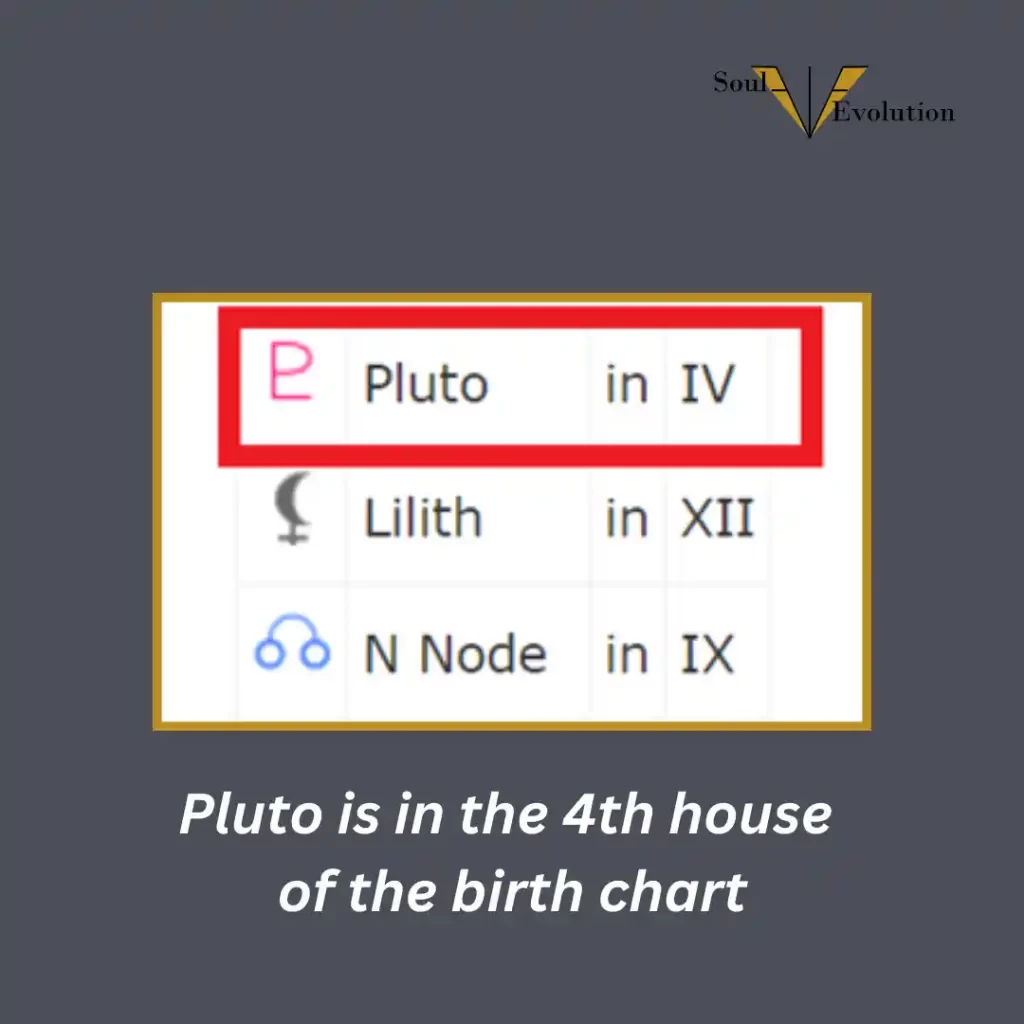
| 4th | Home & Roots | Family secrets or inherited trauma | Healing the lineage and creating a "soul" home |
| 5th | Creativity & Romance | Obsessive love or creative blocks | Expressing raw, uninhibited creative power |
| 6th | Health & Service | Workaholism or psychosomatic illness | Complete mastery of the body-mind connection |
| 7th | Partnerships | Power struggles and "fatal" attractions | Forming relationships based on mutual empowerment |
| 8th | Shared Resources | Control issues regarding sex or money | Deep psychological insight and spiritual rebirth |
| 9th | Higher Learning | Religious fanaticism or total cynicism | Discovering a personal, unshakable truth |
| 10th | Career & Status | Ruthless ambition or fear of failure | Becoming a transformative leader in society |
| 11th | Community | Manipulative social circles or isolation | Revolutionizing group dynamics for the greater good |
| 12th | The Unconscious | Hidden enemies or paralyzing fears | Dissolving the ego to access collective wisdom |
Pluto Aspects: The Alchemy of Personality
When Pluto forms an aspect (a specific angle) to a personal planet, it infuses that planet’s function with intensity, obsession, and a need for depth. These aspects often describe the "vibe" a person gives off, even if they aren't aware of it.
Sun-Pluto Aspects
If your Sun is in aspect to Pluto, your very identity is tied to the concept of transformation. You likely possess a "poker face" and a strong survival instinct. The challenge here is learning to use power without becoming a tyrant. The gift is a tireless resilience; no matter how many times you are knocked down, you have the internal resources to rebuild.
Moon-Pluto Aspects
This is one of the most intense placements in astrology. It suggests a deeply emotional nature where feelings are experienced with life-or-death urgency. There may have been a complex relationship with a primary caregiver (often the mother) involving control or emotional depth. The evolution here involves learning to navigate the depths of the unconscious without drowning in them.
Mercury-Pluto Aspects
This creates the "detective" mind. You are not interested in small talk or superficial answers. You want to get to the bottom of everything. While this can lead to obsessive thinking or paranoia, it also provides the ability to speak words that heal or cut through lies with surgical precision.
The Pluto Square: The Mid-Life Transformation
One reason Pluto matters so much is the "Pluto Square," a transit that everyone experiences between the ages of 36 and 60 (depending on the planet's speed in its orbit during your lifetime). This is the astrological "mid-life crisis."
During this period, the transiting Pluto moves into a 90-degree angle to your natal Pluto. This is a period of reckoning. Whatever you have built on a shaky foundation—whether a career, a marriage, or a false sense of self—will likely be tested. It is an invitation from the universe to shed your old skin. Those who resist this change often find the period much more difficult than those who lean into the process of shedding the unnecessary.
Power, Control, and the "Shadow"
At its most difficult, Pluto represents the urge to dominate or the fear of being dominated. In a birth chart, a prominent Pluto can indicate someone who has a hard time trusting others. This lack of trust often stems from a subconscious awareness of the "darker" side of human nature.
The "shadow" of Pluto includes manipulation, jealousy, and the "if I can't have it, no one can" mentality. However, the purpose of seeing Pluto in your chart isn't to judge these traits, but to integrate them. As Carl Jung famously noted, "Until you make the unconscious conscious, it will direct your life and you will call it fate." Pluto is the tool we use to make the unconscious conscious. By acknowledging your own capacity for darkness, you prevent that darkness from controlling you.
Professional Advice and Limitation
While birth chart analysis offers profound psychological insights, it should not be used as a substitute for professional mental health counseling or financial planning. Astrology serves as a symbolic language for self-reflection and personal growth. If you are experiencing acute distress related to "shadow work" or past trauma, please consult a licensed therapist or medical professional.
Frequently Asked Questions
Is Pluto a "bad" planet to have in a prominent position?
No, Pluto is not "bad." It is simply intense. A prominent Pluto (such as on the Ascendant or Midheaven) often indicates a person of great influence and resilience. While your life may involve more "upheavals" than others, it also involves more opportunities for profound renewal and self-mastery.
What does it mean if my Pluto is retrograde in my birth chart?
Approximately 40% of the population has Pluto retrograde, as it stays retrograde for about five months every year. In a natal chart, it suggests that the transformative energy is turned inward. You may be more private about your power struggles and more likely to do your "shadow work" in solitude rather than through external conflicts.
How does Pluto in Aquarius (2024–2043) affect my birth chart?
Pluto's transit through Aquarius will activate a specific house in your chart for nearly two decades. This house is where you will see major technological, social, or community-based shifts. If you have natal planets in the early degrees of Aquarius, Leo, Taurus, or Scorpio, you are currently feeling this "upgrade" most acutely.
Can Pluto influence my career?
Yes, particularly if it is in the 2nd, 6th, or 10th house, or aspecting your Midheaven. It often points to careers involving research, psychology, crisis management, investigation, or "reclaiming" resources (like recycling, archaeology, or high-stakes finance).
Why is Pluto called a "Higher Octave" of Mars?
In traditional astrology, Mars ruled Scorpio. Modern astrology assigns Pluto to Scorpio. Mars represents the raw, physical drive and immediate action. Pluto represents the deeper, more calculated, and "underground" version of that energy—the power of the will rather than just the power of the muscles.
Final Recommendation
To truly understand why Pluto matters in your chart, start by identifying the House it occupies. This is your "ground zero" for transformation. For the next month, observe how you handle power and control in that specific area of your life. Are you holding on too tight? Are you afraid of losing what you have? By consciously choosing to let go of the "old" in that house, you allow Pluto to work its magic of rebirth, turning your greatest vulnerabilities into your most enduring strengths.
Image Gallery