How Medi-Share Works for Families: A Complete Guide to Healthcare Sharing
Medi-Share works for families by pooling monthly financial contributions from a community of Christian members to pay for one another’s eligible medical expenses. Instead of insurance premiums, families pay a "Monthly Share" and respon...
Medi-Share works for families by pooling monthly financial contributions from a community of Christian members to pay for one another’s eligible medical expenses. Instead of insurance premiums, families pay a "Monthly Share" and responsible for an "Annual Household Portion" (AHP) before the community begins sharing their medical bills.
Contents
For many families in 2026, the rising costs of traditional health insurance premiums have made alternative models like healthcare sharing ministries (HCSMs) increasingly attractive. Medi-Share, managed by Christian Care Ministry, is one of the oldest and largest programs of its kind. It operates on the principle of "sharing" rather than "insuring," rooted in the biblical concept of carrying one another's burdens. Because it is not traditional insurance, the mechanics of how a family accesses care, pays for services, and receives reimbursement differ significantly from a standard PPO or HMO plan.
The Core Mechanics of Medi-Share for Families
To understand how Medi-Share functions for a household, it is essential to distinguish between its proprietary terminology and standard insurance language. While they may seem similar, the legal and operational frameworks are distinct.
The Annual Household Portion (AHP)
In a traditional insurance plan, you might have an individual deductible and a family deductible. Medi-Share simplifies this with the Annual Household Portion (AHP). This is the total amount a family must pay out-of-pocket for eligible medical expenses during a 12-month period before the community begins to share costs.
For families, the AHP is a "one-stop" threshold. Once the family as a unit meets this amount through eligible doctor visits, ER trips, or hospitalizations, 100% of future eligible bills are shared by the community for the remainder of the sharing year. In 2026, families can typically choose from several AHP levels—often ranging from $3,000 to $12,000—allowing them to balance their monthly budget against their potential out-of-pocket exposure.
The Monthly Share
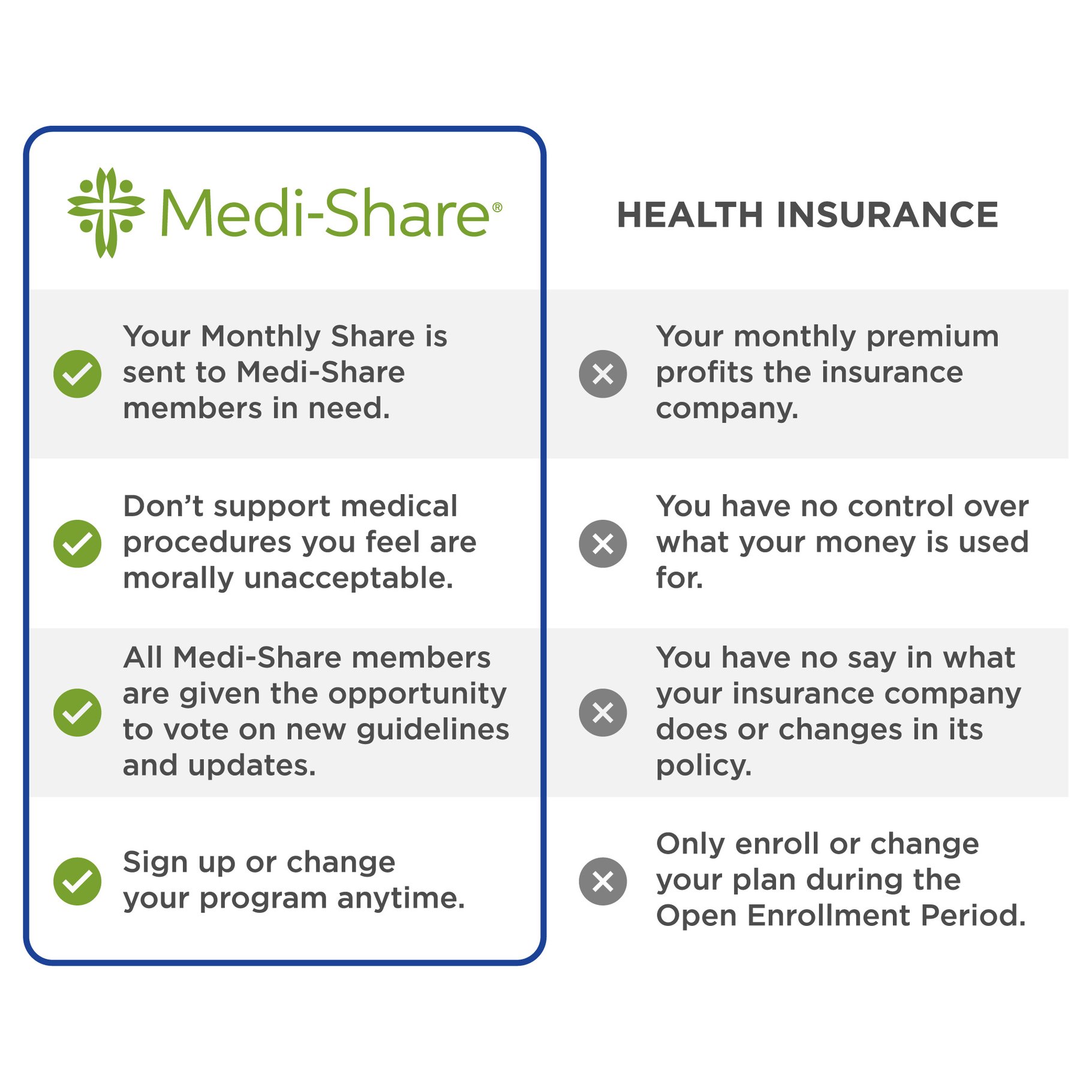
The "Monthly Share" is the amount a family contributes each month. This is not a premium, as it is not paid to an insurance company; rather, it is deposited into an individual sharing account. From there, the funds are transferred to the accounts of other members who have eligible medical needs.
The cost of the Monthly Share is determined by:
- The age of the oldest member in the household.
- The number of people in the family (broken down into tiers: Single, Couple, or Family of 3+).
- The chosen AHP level.
- Geography (certain regions may have different sharing impacts).
The Provider Network
Medi-Share utilizes the Private Healthcare Systems (PHCS) network, which is one of the largest PPO networks in the United States. When a family member visits a provider within this network, they receive pre-negotiated discounts on services. While members can visit providers outside the network, doing so often results in higher out-of-pocket costs because those providers have not agreed to the PHCS discount rates.
Eligibility and Member Requirements
Because Medi-Share is a religious ministry, it is not open to the general public in the same way an ACA-compliant insurance plan is. Families must meet specific lifestyle and faith-based criteria to join and remain in the program.
Statement of Faith and Lifestyle Standards
All adult members must attest to a Christian statement of faith. This includes a commitment to living according to biblical principles, which Medi-Share defines as:
- Abstaining from the use of tobacco or illegal drugs.
- Abstaining from the abuse of alcohol.
- Engaging in regular Christian fellowship and church attendance.
- Supporting the biblical definition of marriage.
If a medical need arises from an activity that violates these standards (for example, an injury sustained while driving under the influence or a condition resulting from illegal drug use), that need is generally not eligible for sharing.
Health Incentives: The Healthy Monthly Share
Medi-Share encourages families to maintain a healthy lifestyle through financial incentives. Families who meet specific health criteria—including targets for Blood Pressure, BMI (Body Mass Index), and waist circumference—can qualify for a Healthy Monthly Share discount of up to 15%. This health-conscious approach helps keep the overall costs for the community lower by reducing the frequency of chronic, lifestyle-related illnesses.
How the Sharing Process Works for a Medical Event
When a family member gets sick or injured, the process follows a specific sequence to ensure that discounts are applied and bills are processed correctly through the community.
- Presentation of Member ID: At the doctor's office or hospital, the member presents their Medi-Share ID card. The provider treats this similarly to a PPO card to verify the PHCS network status.
- Provider Processing: The provider sends the bill directly to Medi-Share. Medi-Share then reviews the bill to ensure the "allowed amount" (the discounted rate) is applied.
- Member Responsibility: Medi-Share notifies the member of the discounted amount. If the family has not yet met their AHP, they pay the provider directly at the discounted rate.
- Community Sharing: Once the AHP is met, the bill is "shared." This means funds from other members' monthly shares are moved into the member's account to pay the provider.
Managing Bills via the Member Portal
In 2026, the Medi-Share digital interface allows families to track their AHP progress in real-time. This transparency is crucial for families managing a budget, as it shows exactly how much has been applied toward their annual responsibility and which bills are currently in the sharing queue.
2026 Family Sharing Scenarios and Costs
The following table illustrates how different AHP levels affect the Monthly Share for a typical family of four (with the oldest parent being 40 years old). Note: These figures are representative of 2026 community guidelines and vary by specific household demographics.
| AHP Level | Monthly Share (Estimated) | Best For... |
|---|---|---|
| $3,000 | $850 - $1,100 | Families with young children or frequent medical needs. |
| $6,000 | $550 - $750 | Families seeking a balance between monthly cost and protection. |
| $9,000 | $400 - $550 | Healthy families who primarily want coverage for catastrophes. |
| $12,000 | $300 - $450 | Families with high savings who want the lowest possible monthly commitment. |
Maternity and Pediatric Care
For growing families, understanding how Medi-Share handles pregnancy and well-child visits is vital. Unlike traditional insurance, which is mandated by the Affordable Care Act to cover these "essential health benefits," Medi-Share has its own internal guidelines.
Maternity Sharing Guidelines
Maternity costs are eligible for sharing provided the mother was a member in good standing (under a "Family" or "Couple" membership) at the time of conception. If these criteria are met, the costs for prenatal care, delivery, and postnatal care are shared after the AHP is met.
It is important to note that there are sharing limits on maternity for those with very high AHPs, and certain complications may be subject to different rules. Families planning to conceive should review the Medi-Share Member Guidelines to ensure they are on the correct membership tier.
Well-Child and Routine Care
Medi-Share's approach to routine care differs from the "zero-copay" preventative care found in traditional insurance.
- Well-Child Visits: These are generally shared for children up to age six.
- Annual Physicals: Adult physicals and routine screenings (like mammograms or colonoscopies) are often eligible for sharing, but they may be subject to specific age requirements or frequency limits.
- Immunizations: These are typically not shared, as they are considered a routine expense that families are expected to budget for independently.
Potential Limitations and Risks for Families
While Medi-Share can offer significant savings, it is not without risks that a family must consider before resigning from a traditional insurance plan.
- No Legal Guarantee: Because Medi-Share is a ministry and not an insurance company, there is no legal contract that guarantees your bills will be paid. Sharing is voluntary. However, Medi-Share has a 30-year track record of meeting all eligible needs.
- Pre-existing Conditions: There are strict rules regarding pre-existing conditions. Most conditions that existed before joining have a "waiting period" (often 36 months) before they are eligible for sharing, and some may have lifetime sharing caps.
- No Tax Subsidies: Members are not eligible for federal premium tax credits (subsidies) through the ACA marketplace. For very low-income families, a subsidized marketplace plan might actually be cheaper than Medi-Share.
- Lifestyle Compliance: A family could theoretically lose their membership if they fail to uphold the lifestyle standards, which would leave them without medical cost-sharing.
Is Medi-Share Right for Your Family?
Deciding to join Medi-Share in 2026 requires a shift in how a family views their healthcare. It is most effective for families who:
- Identify as Christian and value a community-based approach to financial stewardship.
- Are generally healthy and do not have significant unmanaged pre-existing conditions.
- Are disciplined with budgeting, as routine costs (like minor prescriptions or school physicals) will likely be paid out-of-pocket until the AHP is met.
For large families, the "one AHP" model can be a massive financial advantage compared to traditional plans that have high per-person deductibles. For example, if three children in a family require medical attention in the same year, a traditional plan might require meeting three separate deductibles, whereas Medi-Share would only require meeting the single household AHP.
Frequently Asked Questions
1. Does Medi-Share cover prescriptions for my children?
Medi-Share provides a prescription discount card that can reduce the out-of-pocket cost of medications. However, routine prescriptions for chronic conditions are generally not shared. Sharing is typically reserved for prescriptions related to an acute, eligible medical event (like an infection or injury) for a limited duration (usually six months).
2. Can I use my Health Savings Account (HSA) with Medi-Share?
No. According to IRS Publication 969, to contribute to an HSA, you must be enrolled in a High Deductible Health Plan (HDHP). Because Medi-Share is not insurance, it does not qualify as an HDHP. However, families can still use a Health Reimbursement Arrangement (HRA) if provided by an employer in some specific circumstances.
3. What happens if our family has a catastrophic medical event?
Medi-Share is specifically designed for this scenario. Once the AHP is met, there is no annual or lifetime limit on the amount of eligible medical bills the community will share. This provides families with protection against the financial ruin often associated with major surgeries or long-term hospitalizations.
4. Are dental and vision included for families?
Medi-Share is primarily focused on medical sharing. While it often includes discounts for dental and vision providers through its network, the actual costs of cleanings, fillings, or eyeglasses are not shared by the community and must be paid for by the family.
5. How do I switch from traditional insurance to Medi-Share?
You can join Medi-Share at any time during the year; you do not have to wait for an Open Enrollment period. Most families coordinate their Medi-Share start date with the expiration of their previous coverage to avoid gaps. It is recommended to apply at least 15–30 days before you want your sharing to begin.
Final Recommendation: Families should begin by calculating their total healthcare spend over the last two years, including premiums and out-of-pocket costs. Compare this to the projected Monthly Share and AHP of a Medi-Share plan. If the math aligns and the family is comfortable with the faith-based lifestyle requirements, Medi-Share can serve as a robust, community-focused alternative to the traditional insurance market.
Image Gallery