Comprehensive VA Loan MPR Checklist: Requirements, Inspection Rules, and Repair Guidelines
The VA loan Minimum Property Requirements (MPR) checklist is a standardized set of property condition standards established by the U.S. Department of Veterans Affairs to ensure a residential property is safe, structurally sound, and sa...
The VA loan Minimum Property Requirements (MPR) checklist is a standardized set of property condition standards established by the U.S. Department of Veterans Affairs to ensure a residential property is safe, structurally sound, and sanitary before a VA-backed mortgage can be approved. Covered under VA Pamphlet 26-7, these criteria protect veteran buyers from purchasing homes with major latent defects, health risks, or structural hazards.
Contents
Understanding VA Minimum Property Requirements (MPRs)
When a military service member, veteran, or eligible surviving spouse uses a VA-backed home loan to purchase residential real estate, the property itself serves as the underlying collateral for the mortgage loan guarantee. To ensure that veterans receive full value for their investment and move into safe living quarters, the U.S. Department of Veterans Affairs requires an official appraisal that evaluates both market value and compliance with Minimum Property Requirements (MPRs).
The entire framework of VA MPRs is built upon three foundational core principles, often referred to as the "Three Ss":
- Safety: The home must be free from environmental hazards, structural defects, electrical hazards, or health risks that could injure occupants.
- Soundness: The physical structure—including the foundation, load-bearing walls, roof assembly, and framing—must be structurally durable and sound for the foreseeable future.
- Sanitation: The dwelling must offer clean, operable plumbing, a safe water supply, proper sewage treatment, and hygienic living conditions free of severe infestation or contamination.
It is important to understand that VA MPRs are set forth as administrative and operational standards in VA Pamphlet 26-7 (Lenders Handbook), Chapter 12. While the VA appraiser is tasked with checking for MPR compliance during their visual evaluation, the appraiser is assessing marketability and baseline habitability rather than performing a exhaustive code-compliance inspection. If a property fails to meet any single MPR standard, the appraisal report will list required repairs that must be completed before the loan can close, unless a formal exemption or waiver is granted by the Department of Veterans Affairs.
The Master VA Loan MPR Checklist
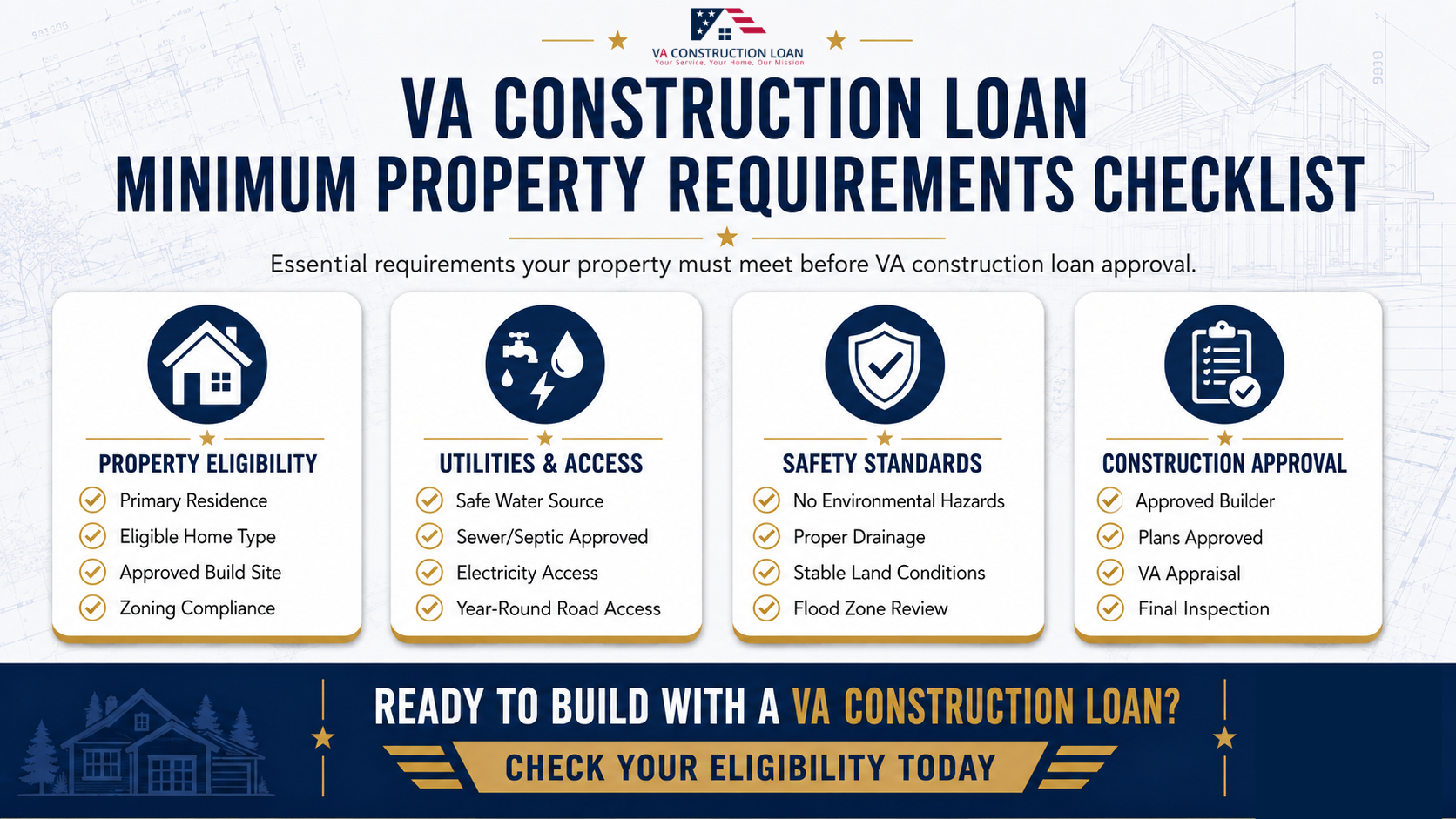
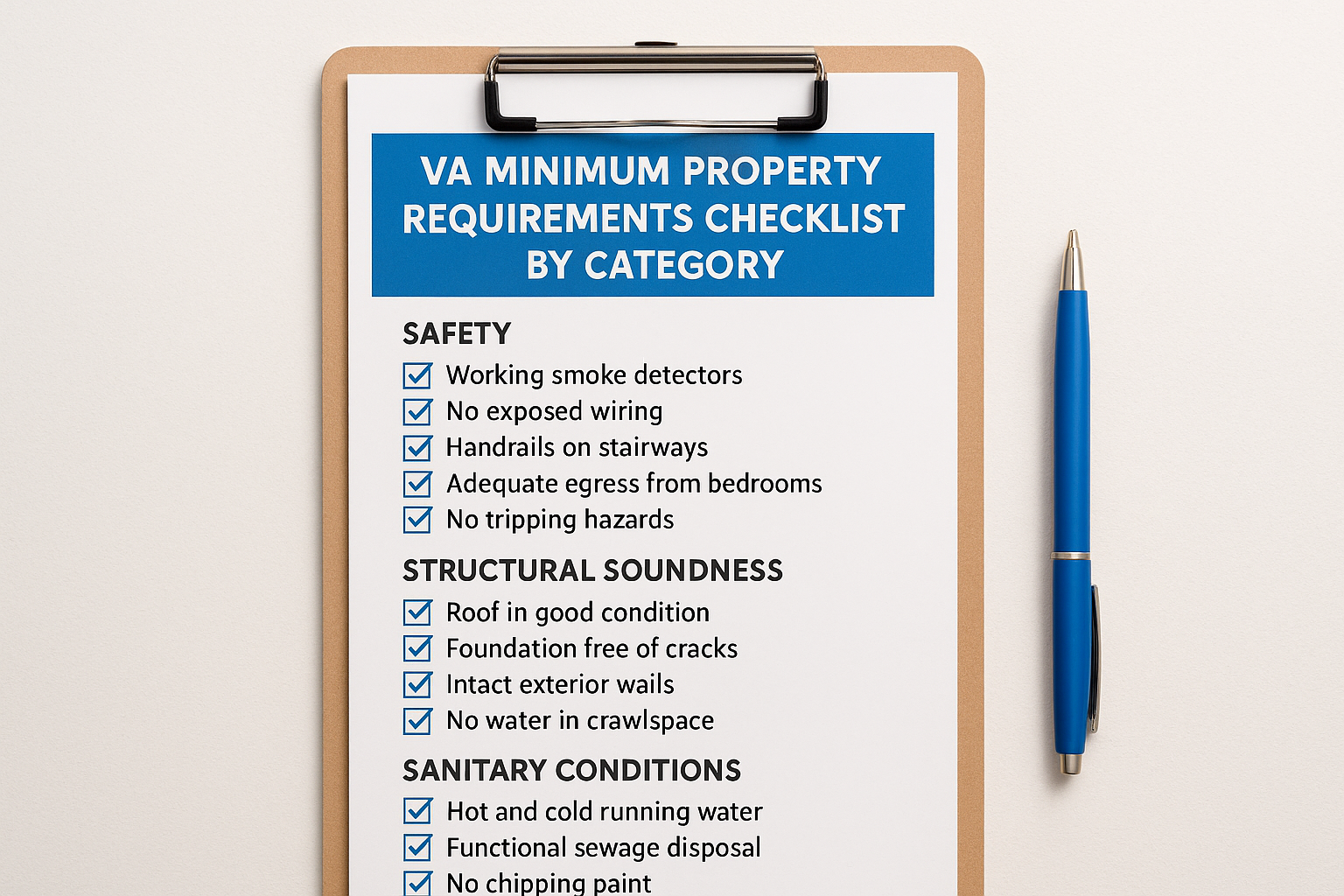
To help buyers, sellers, and real estate agents prepare for a VA appraisal, the following checklist breaks down every major category detailed in VA appraisal policy guidelines.
1. Structural Integrity and Foundation
- Foundation Stability: The foundation must show no signs of major structural settlement, severe cracking, bowing walls, or active shift. Minor hairline settlement cracks in concrete are typical, but vertical or horizontal structural fractures require structural engineering evaluation.
- Basements and Crawl Spaces: Crawl spaces must have adequate clearance (typically at least 18 inches of vertical space to allow for maintenance access), remain dry, be clear of standing water, and feature proper ventilation to prevent moisture accumulation.
- Framing and Floor Support: Floor joists, girders, wall studs, and support columns must be intact, uncompromised by dry rot or insect damage, and fully capable of carrying intended structural loads.
2. Roofing and Attic Space
- Roof Condition and Useful Life: The roof must prevent water intrusion and have a reasonable remaining useful life. While VA guidelines do not dictate a strict rigid remaining year minimum in every region, standard guidelines require the appraiser to confirm the roof is leak-free and generally retains at least 2 to 3 years of viable service life.
- Layer Count: A roof generally cannot have more than three layers of shingles applied over one another. If shingles are curling, missing, deteriorated, or leaking, repair or full replacement is mandatory.
- Attic Ventilation and Insulation: Attics must be properly vented to dissipate heat and moisture, and accessible for appraiser inspection (at least a head-and-shoulders examination).
3. Heating, Ventilation, and Air Conditioning (HVAC)
- Adequate Heat Source: The home must have a permanently installed, operational heating system capable of maintaining a healthy living temperature (typically at least 50 degrees Fahrenheit) in living spaces. Portable space heaters or unvented space heaters are not accepted as primary heat sources.
- Air Conditioning: Air conditioning is not universally required by the VA unless necessary for local health and comfort standards, but if installed, central AC units must function safely and operate correctly.
- Venting: All fuel-burning appliances (furnaces, water heaters, gas stoves) must be vented properly to the exterior of the home to eliminate carbon monoxide hazards.
4. Electrical and Plumbing Systems
- Electrical Safety: The electrical panel and branch circuits must safely handle modern electrical loads. Open junction boxes, exposed wiring, frayed service drops, knob-and-tube wiring in unsafe condition, or overloaded panels must be repaired by a licensed electrician.
- Plumbing Functionality: Plumbing systems must supply adequate water pressure, continuous hot and cold running water, and leak-free discharge lines throughout the house.
- Water Heaters: Water heaters must be functioning, equipped with a properly routed Temperature and Pressure Relief (TPR) valve and discharge pipe, and appropriately strapped where local seismic codes require.
5. Water Supply and Sewage Disposal
- Continuous Safe Drinking Water: The property must have a reliable supply of safe, drinkable water. If connected to a public utility, standard service verification is required.
- Private Well Standards: If the home relies on an individual private well, the water must be tested for lead, nitrate, nitrite, total coliform, and turbidity (plus local health authority requirements). Wells must also meet minimum separation distances from contamination sources (e.g., generally 50 feet from a septic tank and 100 feet from a septic drain field, subject to local health authority exceptions).
- Sewage Disposal: On-site septic systems must function properly without surfacing effluent. Community or municipal sewer connections must be clear and unobstructed.
6. Exterior Hazards, Paint, and Wood-Destroying Insects
- Lead-Based Paint (Pre-1978 Construction): For any residential structure constructed before January 1, 1978, all defective paint (chipping, peeling, cracking, or flaking paint on interior or exterior surfaces) poses a lead health risk. Defective paint surfaces must be scraped, washed, primed, and repainted according to approved lead-safe containment protocols.
- Termites and Wood-Destroying Insects (WDI): In regions designated by the VA as high-risk or moderate-risk for subterranean termites (as outlined on VA property guidelines maps), a wood-destroying insect inspection is mandatory. Any evidence of active infestation or unaddressed structural timber damage must be treated and repaired.
- Stair Safety: Handrails are required on stairways with three or more risers to eliminate fall hazards.
7. Access, Property Location, and Environmental Hazards
- Safe Access: The property must provide safe, direct, all-weather access from a public street or an approved private road maintained by an enforceable road maintenance agreement.
- Encroachments and Easements: Buildings, garages, or improvements must not encroach onto neighboring properties or dedicated utility easements in a manner that impairs property rights or marketability.
- High-Voltage Lines and Gas Pipelines: Residential structures must not be positioned directly within high-voltage electric transmission line easements or within specified safety buffer zones of high-pressure gas or liquid petroleum pipelines.
- Noise and Flood Hazards: Properties located in designated Special Flood Hazard Areas (SFHA) require mandatory flood insurance. Properties located near airport runways or heavy industrial noise corridors may face restrictions or require special disclosures.
Comparative Matrix: VA Appraisal MPR Checks vs. Independent Home Inspection
Many home buyers conflate the VA appraisal with a private, comprehensive home inspection. While both assess property conditions, their purposes, depths, and legal frameworks differ substantially.
| Feature / Criteria | VA Appraisal (MPR Evaluation) | Independent Home Inspection |
|---|---|---|
| Primary Objective | Determine market value and verify minimum habitability/safety criteria for lender guarantee. | Detailed diagnostic evaluation of property condition to inform the buyer's purchasing decision. |
| Mandatory Requirement | Yes (Required by VA-approved lender for loan funding). | Optional (Highly recommended by VA, but not legally mandatory for loan approval). |
| Scope of Property Evaluation | Visual surface examination of major accessible areas and observation of obvious safety/sanitary defects. | Comprehensive, deep-dive examination of every accessible system, component, mechanical unit, and structural detail. |
| Reporting Standard | Uniform Residential Appraisal Report (URAR) with VA Notice of Value (NOV) conditions. | Detailed narrative report (often 30–60 pages) with photographic evidence, maintenance advice, and repair estimates. |
| Impact on Loan Funding | Deficiencies identified as MPR non-compliant must be resolved, escrowed, or waived prior to loan closing. | Findings are informational negotiation points between buyer and seller; failure does not automatically block financing. |
| Key Authority Source | U.S. Department of Veterans Affairs (VA Pamphlet 26-7, Chapter 12). | State licensing boards and private professional associations (e.g., ASHI, InterNACHI). |
Resolving Failing MPR Items: Repairs, Waivers, and Escrows
When a VA appraiser notes that a property fails one or more Minimum Property Requirements, the appraisal report is marked "Subject to Completion of the Following Repairs." The lender subsequently issues a formal Notice of Value (NOV) specifying the exact property corrections required before loan documents can be finalized.
- VA Appraisal Completed
- Does the Property Meet All VA MPRs?
- YES: Notice of Value (NOV) Issued Unconditionally
- NO:
- NOV Issued with Required Repair Conditions
- Select Repair Resolution Pathway:
- Seller/Buyer Performs Repair
- Escrow Holdback (Completed)
- VA Regional Office Waiver
- Re-Inspection / Final Sign-Off
- Final VA Loan Approval Granted
Repair Execution and Re-Inspection
Once the repair conditions are listed, the buyer and seller negotiate who will complete the physical work:
- Work Completion: Repairs can be performed by licensed contractors or, in select non-structural cases, qualified property owners.
- Re-Inspection Verification: Once repairs are completed, the lender requests a re-inspection. The appraiser (or in certain approved cases, a qualified third party using VA Form 26-1839 / Compliance Inspection Report) visits the property to confirm the work was done in a workmanlike manner.
- Re-Inspection Fees: Re-inspection visits typically involve a modest fee (often $150 to $250), which is paid to the appraiser.
Requesting an MPR Waiver
In specific circumstances where a non-compliant MPR item is minor, non-hazardous, and expensive to fix relative to its impact, the buyer can request a formal VA MPR Waiver.
- The buyer must submit a written request expressing full knowledge of the defect and a desire to accept the property in its current condition.
- The lender forwards the request to the regional VA office (Regional Loan Center).
- The VA evaluates whether the item truly poses no risk to life, safety, or basic structural integrity. If approved, the loan can move forward without completing that specific repair.
Repair Escrow Holdbacks
If seasonal weather conditions (such as frozen ground preventing exterior painting or snow cover delaying roof repairs) prevent repairs prior to closing, lenders may allow an escrow holdback.
- The lender escrows funds (often 1.5 times the estimated repair cost) from seller proceeds or buyer funds.
- The loan closes, and the agreement requires repairs to be finished within a specified window (typically 30 to 90 days) once weather permits.
Common VA MPR Violations and Practical Quick Fixes
Property owners preparing to list a home for a VA buyer can streamline the closing process by proactively identifying and correcting common MPR pitfalls before the appraiser arrives:
1. Peeling, Chipping, or Flaking Paint (Pre-1978 Homes)
- The Violation: Any peeling paint inside or outside a pre-1978 dwelling violates federal lead safety guidelines.
- The Fix: Thoroughly scrape all loose paint, collect debris on drop cloths, apply primer, and apply top-coat exterior/interior paint to seal the surface completely.
2. Missing Staircase Handrails
- The Violation: Open stairways with three or more risers lack a sturdy protective handrail.
- The Fix: Securely install code-compliant wood or metal handrails anchored to wall studs or structural posts.
3. Missing Thermal Expansion Tanks or Unrouted Water Heater Relief Valves
- The Violation: The water heater TPR valve lacks a discharge line extending to within 6 inches of the floor, or local plumbing code requires an expansion tank.
- The Fix: Thread a heat-resistant discharge pipe onto the safety valve extending downward, and have a plumber install an expansion tank if required by local building standards.
4. Broken Window Glass or Defective Sash Locks
- The Violation: Cracked, broken, or non-locking window sashes present safety and weatherization issues.
- The Fix: Replace cracked panes, repair window latches, and ensure lower-floor windows open and lock properly for emergency egress.
5. Exposed Electrical Wiring
- The Violation: Open junction boxes, missing wall switch covers, or exposed wire splices in living spaces, basements, or attics.
- The Fix: Secure all loose wiring inside approved electrical junction boxes and fit them with blank cover plates.
Frequently Asked Questions
Can a property fail a VA appraisal for minor cosmetic issues?
No. The VA MPR checklist focuses strictly on structural soundness, safety hazards, and sanitary conditions. Cosmetic imperfections—such as outdated wallpaper, worn carpeting, scuffed trim, or aging countertops—do not violate VA MPRs unless they directly involve underlying rot, health risks, or structural failure.
Who is responsible for paying for required VA MPR repairs?
VA rules do not mandate whether the seller or the buyer must pay for MPR repairs. The cost allocation is negotiable. Sellers often handle repairs to salvage the sale, but buyers are permitted to pay for or complete required repairs if allowed by contract terms and property access rules.
Does the VA allow buyers to purchase a fixer-upper home?
Standard VA home purchase loans require the property to meet all MPRs before loan closing. A severely dilapidated home that fails multiple structural, roofing, or sanitary standards cannot close under a standard VA purchase loan. However, buyers interested in fixer-uppers may explore specialized programs such as the VA Renovation Loan, which allows eligible buyers to roll repair and alteration costs into a single mortgage package.
What happens if the seller refuses to fix MPR deficiencies?
If a seller refuses to address mandatory MPR items identified on the Notice of Value, the buyer has several options: pay for the repairs out of pocket (with seller permission to work on the property), request an official VA MPR waiver if the item qualifies as minor and non-hazardous, execute an escrow holdback if permitted by the lender, or terminate the purchase agreement under the VA financing contingency without forfeiting earnest money deposits.
How long does a VA appraisal re-inspection take?
Once required repairs are completed and documented, the lender requests a re-inspection from the assigned appraiser. The appraiser typically visits the property within 3 to 7 business days, depending on local appraiser workloads and scheduling. Final loan documents can proceed once the compliance report is signed off.
Strategic Recommendations for VA Buyers and Sellers
To navigate the VA loan property approval process efficiently, market participants should take concrete steps early in the transaction cycle:
- For Buyers: Always hire an independent home inspector prior to relying on the VA appraisal. While the VA appraiser checks basic MPR compliance, a licensed inspector conducts a diagnostic evaluation of HVAC mechanical life, sewer pipe condition, electrical load capacities, and subtle moisture issues that standard appraisals will miss.
- For Sellers: Prior to listing your home, conduct a pre-listing walk-through focused on pre-1978 exterior paint condition, missing handrails, functional plumbing leaks, clear attic access, and electrical junction covers. Fixing minor maintenance issues upfront prevents appraisal delays and protects purchase timelines.
- For Real Estate Agents: Ensure purchase contracts incorporate clear language stating how MPR repair expenses will be handled and specifying reasonable timelines for appraiser re-inspections.
EDITORIAL CATEGORY METADATA:
Image Gallery