You Can Receive Both Life and Accidental Death Insurance Payouts: How Coverage Stacking Works
Beneficiaries can receive both life insurance and accidental death insurance payouts if the deceased held both policies or a specific "double indemnity" rider. When a death is ruled accidental under policy terms, the standard death ben...
Beneficiaries can receive both life insurance and accidental death insurance payouts if the deceased held both policies or a specific "double indemnity" rider. When a death is ruled accidental under policy terms, the standard death benefit and the supplemental accidental benefit trigger simultaneously, providing a combined total payout to the designated beneficiaries.
Contents
Understanding the Dual Payout Mechanism
The intersection of life insurance and accidental death and dismemberment (AD&D) insurance often creates confusion regarding whether one cancels out the other. In the insurance landscape of 2026, these products remain contractually independent. If a policyholder pays premiums for a term life insurance policy and maintains a separate AD&D policy—or an accidental death rider attached to their primary life coverage—the insurance carriers are legally obligated to pay out on both, provided the cause of death meets the specific criteria for "accidental."
This "stacking" of benefits is a strategic financial move for many families, particularly those where the primary earner works in a high-risk industry or commutes frequently. While life insurance is designed to provide a financial safety net regardless of how the individual passes away (with few exceptions like the suicide clause in the first two years), AD&D serves as a low-cost supplement that provides an additional "layer" of protection specifically for unforeseen tragedies.
The Role of the Accidental Death Rider
Most modern life insurance policies offer an "Accidental Death Rider," historically known as a double indemnity clause. If this rider is active, the insurer pays a multiple of the face value—often double—if the death results from a covered accident. For example, a $500,000 life insurance policy with a 100% accidental death rider would result in a $1,000,000 total payout if the insured dies in a multi-car collision.
Standalone AD&D Policies
In addition to riders, many individuals hold standalone AD&D policies, often provided as a fringe benefit through an employer or purchased independently. These are separate contracts. If you have a private life insurance policy with Company A and an employer-sponsored AD&D policy through Company B, both companies will process claims independently. There is no "coordination of benefits" in life insurance like there is in health insurance; the full face value of every valid policy is due upon proof of death.
What Qualifies as an Accidental Death in 2026?
To receive both payouts, the cause of death must satisfy the stringent definitions of an "accident" set forth in the policy language. Insurance companies distinguish between "natural" deaths and "accidental" deaths through a rigorous claims adjustment process. In 2026, forensic reporting and medical examiner certifications play a pivotal role in these determinations.
Covered Accidental Events
Generally, an accidental death is one caused by external, violent, and visible means. Common scenarios that trigger both payouts include:
- Motor Vehicle Accidents: This remains the leading cause of accidental death claims. It includes passengers, drivers, and pedestrians.
- Falls and Equipment Malfunctions: Sudden falls from heights or workplace accidents involving heavy machinery.
- Drowning: Provided it was not the result of a medical event (like a heart attack) occurring while in the water.
- Fires and Natural Disasters: Death resulting from smoke inhalation, burns, or structural collapse during a fire or earthquake.
- Homicide: Unless the beneficiary was involved or the insured was participating in a criminal act.
The "Accidental Means" vs. "Accidental Results" Distinction
Some older or more restrictive policies use the "accidental means" test. This requires that both the result (death) and the cause (the action leading to death) were unexpected. For example, if someone jumps off a bridge for fun and dies, the result was accidental, but the "means" (the jump) was intentional. Most modern policies in 2026 have moved toward "accidental results" language, which is more favorable to the beneficiary, but it is essential to verify the specific wording in the policy document.
Limitations and Exclusions to Dual Payouts
While the prospect of a double payout provides significant financial security, insurance companies include specific exclusions to limit their liability. If a death occurs under any of the following circumstances, the life insurance policy might pay out, but the accidental death portion likely will not.
Medical and Health-Related Exclusions
If an accident is secondary to a medical event, the AD&D payout is usually denied. For instance, if an individual suffers a massive heart attack while driving and subsequently crashes into a tree, the primary cause of death is the heart attack (natural causes). In this case, the life insurance pays the standard benefit, but the accidental death benefit is withheld because the "accident" was a consequence of a physical illness.
High-Risk Activities and Lifestyle
Many AD&D policies exclude "hazardous occupations" or "dangerous hobbies" unless specifically disclosed and covered by a higher premium. Common exclusions include:
- General Aviation: Death while piloting a private aircraft or acting as a crew member.
- Professional Sports: Fatalities during high-impact professional athletic competitions.
- Substance Involvement: If the insured was under the influence of non-prescribed drugs or over the legal limit for alcohol at the time of the accident, the accidental death claim is almost universally denied.
- Illegal Acts: If the death occurred while the insured was committing a felony.
Comparison of Coverage Types
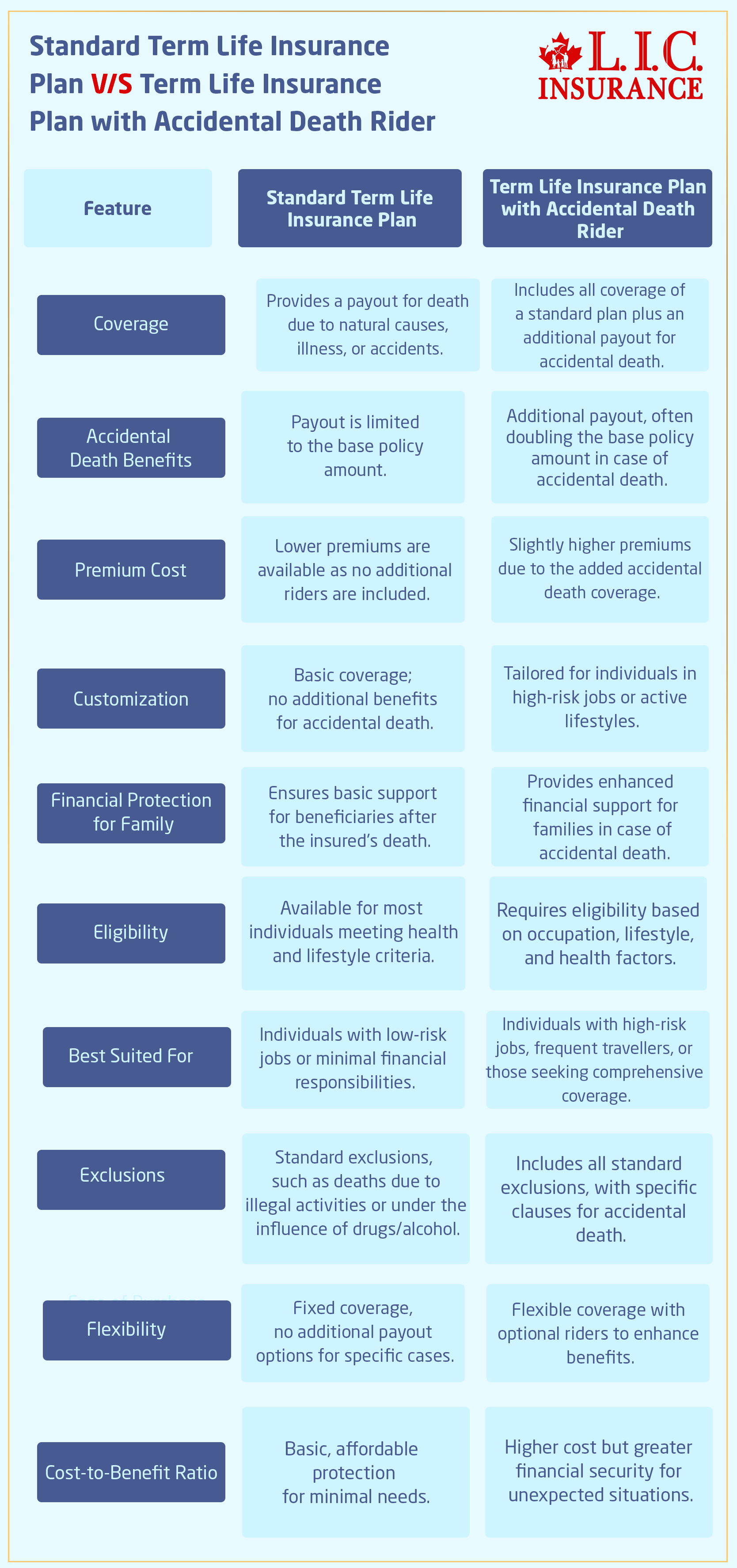
The following table outlines the key differences between standard life insurance and the accidental death component to help clarify how they interact during a claim.
| Feature | Term Life Insurance | Accidental Death (AD&D) |
|---|---|---|
| Primary Trigger | Death by any cause (except suicide in early years) | Death by external, accidental event only |
| Medical Underwriting | Usually required (exams, health history) | Minimal to none |
| Cost per $1,000 Coverage | Moderate (based on age and health) | Very Low |
| Typical Exclusions | War, suicide (within 2 years), fraud | Illness, surgery, overdose, high-risk hobbies |
| Payout Structure | Lump sum face value | Lump sum; often "stacks" on life insurance |
| Dismemberment Benefit | No (unless a separate rider is added) | Yes (payouts for loss of limbs, sight, etc.) |
The Claims Process for Multiple Policies
Filing for both life and accidental death payouts requires more documentation than a standard life insurance claim. Beneficiaries must be prepared to provide evidence that satisfies two different sets of criteria.
1. Initial Notification
Notify all relevant insurance companies immediately. In 2026, most carriers offer digital portals for claim initiation. You will need the policy numbers, the social security number of the deceased, and basic details regarding the location and date of death.
2. Required Documentation
For a standard life insurance claim, a certified death certificate is often sufficient. However, for an accidental death payout, the insurer will likely require:
- The Medical Examiner’s Report: This confirms whether the death was accidental or natural.
- Police Reports: Necessary for motor vehicle accidents or homicides to rule out foul play or criminal activity by the insured.
- Toxicology Reports: Used by the insurer to ensure no exclusions (like intoxication) apply.
- Autopsy Report: Often mandatory for AD&D claims to rule out underlying medical conditions as the primary cause.
3. Review and Contestability
If the policy was purchased recently (usually within the last two years), the insurer will conduct a "contestability" review. They will verify that the insured did not misrepresent their health or lifestyle on the initial application. While this applies more to the life insurance side, any discovered fraud can void both the life and accidental death components.
Strategic Planning: When to Rely on Dual Coverage
Relying on both life and accidental death insurance is a common strategy for families who want high coverage limits without the high premiums of a massive whole life or term life policy. Because AD&D is significantly cheaper, it allows an individual to "boost" their coverage specifically for the most unexpected scenarios.
However, financial experts warn against using AD&D as a replacement for life insurance. Since AD&D only pays out in a small percentage of total deaths—most people eventually die from illness or age-related causes—it should always be viewed as a secondary supplement. The goal of "receiving both" is a worst-case scenario contingency, not a primary retirement or estate planning tool.
For more information on insurance regulations and consumer protections, you can refer to the National Association of Insurance Commissioners (NAIC).
Frequently Asked Questions
Can I have accidental death insurance with multiple companies?
Yes. You can hold multiple AD&D policies through different providers. Unlike disability insurance, which limits your total benefit based on your income, life and accidental death insurance generally allow you to collect the full face value from every policy you own, provided you can afford the premiums and the insurers accept the risk.
Does accidental death insurance pay out if the person dies during surgery?
Typically, no. Deaths resulting from medical treatments, surgeries, or complications of an illness are categorized as medical/natural deaths, even if the death was unexpected. Most AD&D policies specifically exclude medical mishaps unless the mishap was a direct result of an underlying covered accident (e.g., dying on the table while being treated for injuries from a car crash).
Is the payout from both policies tax-free?
In most jurisdictions, including the United States under current 2026 tax codes, life insurance and accidental death payouts are received by beneficiaries tax-free. The lump sum is not considered "earned income." However, if the payout is delayed and the insurance company pays interest on the death benefit, that interest portion may be taxable.
What happens if the cause of death is "undetermined"?
If the medical examiner lists the cause of death as "undetermined," the accidental death payout is likely to be denied or delayed. Life insurance policies will generally still pay out (as long as suicide and foul play by the beneficiary are ruled out), but the burden of proof for an "accidental" claim rests on proving the event was truly an accident.
Can an accidental death payout be denied if the insured wasn't wearing a seatbelt?
This depends on the specific policy language. Some AD&D policies in 2026 include "seatbelt riders" that actually increase the payout if the insured was wearing one, while others may have exclusions for "reckless endangerment" or "illegal acts" if not wearing a seatbelt violates local laws. Generally, a standard accidental death claim is not denied solely for a seatbelt violation unless specifically stated in the exclusions.
Practical Recommendation
If you are a beneficiary seeking to maximize a claim, or a policyholder looking to protect your family, ensure that your life insurance and AD&D policies are clearly documented in one place. Verify that the beneficiary designations match across all policies to avoid legal disputes during the payout process. If a death occurs that seems accidental, obtain the police and toxicology reports as early as possible, as these are the primary documents used to trigger the second payout. For complex cases where an insurer denies the accidental portion of a claim, consulting with a specialized insurance attorney is often necessary to challenge the medical examiner's findings or the insurer's interpretation of "accidental means."
Image Gallery