Navigating Wake County Real Estate Tax Records: Comprehensive Search Guide, Tax Rates, and Assessment Lookup
Wake County real estate tax records are official public documents managed by the Wake County Tax Administration in North Carolina. Property owners, buyers, and legal professionals can access, inspect, and pay real property tax records...
Wake County real estate tax records are official public documents managed by the Wake County Tax Administration in North Carolina. Property owners, buyers, and legal professionals can access, inspect, and pay real property tax records online through the Wake County Tax Administration Portal or the iMAPS GIS system using a property owner's name, physical street address, or 10-digit Parcel Identification Number (PIN).
Contents
Understanding Wake County Real Estate Tax Records: Core Definitions and Systems
Wake County real property tax records maintain detailed historical, spatial, and financial data for every real estate parcel across all thirteen municipalities—including Raleigh, Cary, Apex, Wake Forest, Garner, and Holly Springs—as well as unincorporated county areas. Under North Carolina state law (specifically the North Carolina Machinery Act, codified in NC General Statutes Chapter 105), real property taxes are levied annually against land, buildings, and permanent improvements.
When you access a Wake County real estate tax record, the document functions as both a valuation assessment history and a tax compliance ledger. Tax administration is split functionally into two primary divisions: the Tax Assessor, who determines real property market values and administers exemptions, and the Tax Collector, who issues annual billing statements, accepts payments, and executes tax lien collections on delinquent accounts.
Key Data Elements Found in a Property Tax Record
- Parcel Identification Number (PIN): A unique 10-digit spatial identification code assigned by the county GIS registry (e.g.,
1701234567) that locates the precise centroid of the real estate parcel. - Account Real ID / Real Estate Account Number: The primary internal account ledger number used by the Tax Collector for billing, payment tracing, and escrow reporting.
- Assessed Real Property Value: The combined appraised market value established during the county’s general revaluation, divided specifically into Land Value and Building Value (or Improvement Value).
- Deed Book and Page Reference: The legal recording reference at the Wake County Register of Deeds establishing current ownership and land transfer history.
- Taxing Districts: The specific overlapping tax jurisdictions governing the parcel, which may include Wake County base tax, municipal taxes (e.g., City of Raleigh), and special service districts (e.g., Fire Protection Districts or Downtown Improvement Districts).
- Tax Billing and Payment Ledger: A multi-year historical record reflecting annual tax principal, accrued interest, applied payments, outstanding balances, and active tax liens.
Step-by-Step Guide: How to Search Wake County Tax Records Online
The Wake County Tax Administration provides two primary digital portals for searching real estate tax records without requiring a physical visit to the county office in downtown Raleigh.
- Tax Portal Search: Search by PIN, Owner Name, or Property Street Address
- iMAPS GIS Search: Spatial Map Navigation, Parcel Overlay, & Boundary Data
- Register of Deeds: Search Legal Conveyance Deeds, Liens, & Maps
Method 1: Searching via the Wake County Real Estate Tax Portal
The official real estate tax lookup tool allows direct query access to tax assessment bills, parcel details, and payment statuses.
- Navigate to the official Wake County Tax Portal Search Page.
- Select your preferred search criterion from the primary lookup options:
- Owner Name: Enter last name followed by first name (e.g.,
Smith John). - Property Address: Input the street number and street name. Omit directional suffixes like "Street" or "Avenue" for broader results.
- Parcel Identification Number (PIN): Enter the full 10-digit PIN without spaces or hyphens.
- Account Real ID: Input the specific real estate account number if referencing a tax notice.
- Owner Name: Enter last name followed by first name (e.g.,
- Click Search to view the match list. Click on the corresponding parcel account number to open the detailed tax summary.
- Review the appraisal breakdown, tax district assignment, and total tax owed. Click Print Tax Bill to download an official PDF statement for mortgage underwriting or tax reporting.
Method 2: Searching via the iMAPS Interactive GIS Portal
For spatial queries, boundary lines, aerial views, and neighborhood tax comparables, the joint City of Raleigh and Wake County GIS system (iMAPS) offers complete map-based tax records integration.
- Access the iMAPS mapping application via web browser.
- Enter the property address or PIN into the top search bar.
- Once the map zooms to the selected property boundary, click inside the parcel overlay.
- Expand the Property Info tab on the side panel to view owner details, assessed land/building values, sales history, and a direct link to the corresponding Wake County tax account record.
Decoding Your Tax Assessment and Local Rates
Property tax calculations in Wake County follow a standardized mathematical formula dictated by state law. Real estate taxes are assessed based on the property’s appraised value per $100 of valuation.
Property Tax Calculation Formula
$$\text{Total Annual Tax} = \left( \frac{\text{Assessed Property Value}}{100} \right) \times (\text{County Rate} + \text{Municipal Rate} + \text{Special District Rate})$$
For example, if a home located within the City of Raleigh carries an assessed value of $450,000, the tax liability is computed by taking 4,500 units of $100 assessment and multiplying that by the combined tax rate (Wake County base rate + City of Raleigh rate + any applicable county fire or special service district tax).
Wake County Tax Rate and Assessment Structure
Tax rates are adopted annually by the Wake County Board of Commissioners and municipal city councils prior to July 1 for each fiscal year.
| Taxing Jurisdiction | Tax Structure Type | Scope of Assessment | Primary Purpose |
|---|---|---|---|
| Wake County Base Tax | Countywide Mandatory | Applied to 100% of assessed real property value across all parcels | Public schools (WCPSS), community colleges, emergency services, county operations |
| Municipal District Tax | City/Town Specific | Applied to properties within incorporated municipal boundaries (e.g., Raleigh, Cary, Apex) | Local road maintenance, public safety (police/fire), parks, municipal infrastructure |
| County Fire District Tax | Unincorporated Service Tax | Applied to parcels located outside municipal fire protection zones | Funding rural and volunteer fire response departments |
| Special Service District (SSD) | Targeted District Tax | Applied to specific economic zones (e.g., Downtown Raleigh SSD) | Municipal enhancements, economic development, specialized urban maintenance |
Wake County Revaluation Cycles
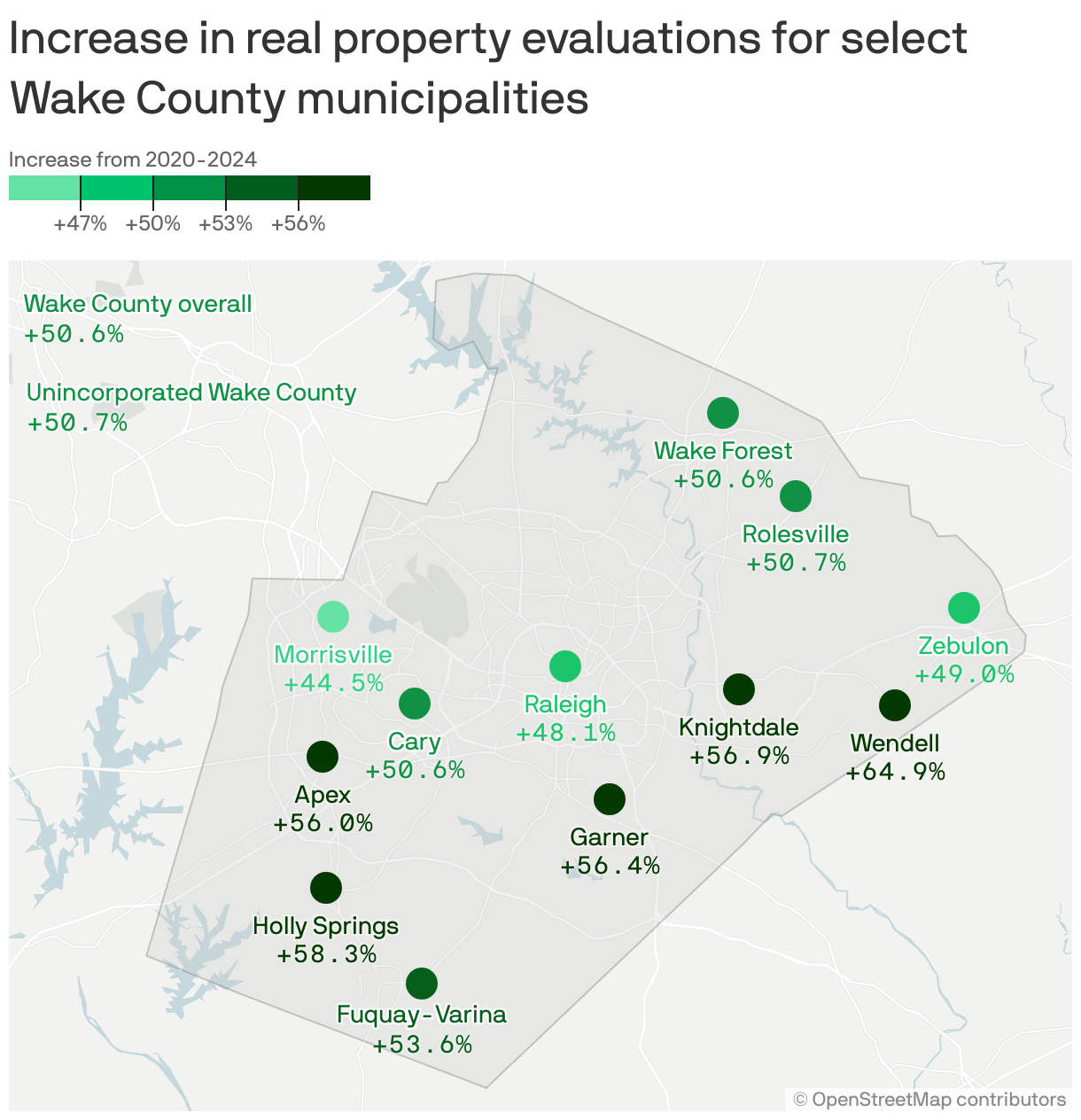
Under NC General Statute § 105-286, counties are mandated to conduct real property general revaluations at least once every eight years, though Wake County operates on a four-year revaluation cycle to keep pace with rapid regional real estate growth.
- 2024 Revaluation: Wake County conducted a comprehensive property revaluation effective January 1, 2024, updating real estate values across all commercial and residential parcels to reflect current fair market values.
- Interim Tax Years: Between revaluation years, real estate tax values remain static unless physical changes occur to the property (such as new building construction, room additions, demolition, or land subdivision).
- Next Scheduled Revaluation: The next countywide general property revaluation is scheduled for implementation effective January 1, 2028.
Tax Relief Programs, Exemptions, and Assessment Appeals
North Carolina provides statutory tax relief programs for qualified homeowners, veterans, and agricultural landowners. Applications for all property tax exemptions must be filed with the Wake County Tax Administration office between January 1 and June 1 of the tax year.
Statutory Tax Relief Exemption Summary
Elderly or Disabled Homestead Exclusion: Authorized under NCGS § 105-277.1. Excludes the greater of $25,000 or 50% of the appraised value of the primary residence for qualifying seniors (65+) or permanently disabled individuals meeting annual income caps.
Disabled Veteran Exclusion: Authorized under NCGS § 105-277.1C. Excludes up to $45,000 of assessed value for honorably discharged veterans with a 100% permanent and total service-connected disability (or surviving spouses).
Circuit Breaker Tax Relief: Authorized under NCGS § 105-277.1B. Limits annual tax payments to a percentage of income for qualifying senior homeowners, deferring the balance as a lien on the property.
Present-Use Value (PUV) Program: Authorized under NCGS § 105-277.2 through 277.7. Allows qualifying agricultural, horticultural, and forestry lands to be taxed based on current production capacity rather than commercial market value.
- Informal Review: File application with Tax Assessor (Jan - April)
- Formal Board Appeal: File appeal to Board of Equalization and Review (BER)
- State Property Commission: Appeal BER decision to NC Property Tax Commission
Appealing Your Real Estate Assessment
If you believe your property's assessed value significantly exceeds its fair market value, you have the statutory right to appeal.
- Informal Review: Submit an informal appeal request form to the Wake County Tax Assessor upon receiving a Notice of Real Estate Appraisal Value. You must submit market evidence, such as recent comparable property sales, professional appraisals, or photos of structural defects.
- Formal Appeal to Board of Equalization and Review (BER): If the informal review does not resolve the issue, file a formal appeal to the Wake County Board of Equalization and Review. Appeals must be submitted prior to the formal adjournment of the BER (typically late spring).
- State-Level Appeal: If satisfied with the BER ruling, further appeals may be escalated to the North Carolina Property Tax Commission in Raleigh within 30 days of the BER decision notice.
Important Billing Timelines and Payment Protocols
Wake County property taxes are billed on a fiscal calendar basis. Understanding the billing schedule prevents interest penalties and tax lien enforcement.
- July 1: Official Tax Bills Mailed to Property Owners
- September 1: Property Taxes Become Due and Payable
- January 5: Last Day to Pay Without Interest Penalty
- January 6: Taxes Become Delinquent; 2% Interest Accrues Instantly
- March / April: Delinquent Tax Liens Advertised in Local Newspapers
Payment Options and Processing Details
- Online Tax Payment: Paid directly via electronic funds transfer (e-Check) or major credit cards through the Wake County Tax Collector portal. Processing fees apply for credit card transactions.
- Mortgage Escrow Disbursement: If your property taxes are escrowed, the lender receives billing files electronically from Wake County. However, the property owner remains legally responsible for ensuring taxes are disbursed prior to the January 5 delinquency threshold.
- In-Person or Mail Payments: Mailed payments must be postmarked by the U.S. Postal Service on or before January 5 to avoid late interest charges. In-person payments can be tendered at the Wake County Office Building in downtown Raleigh.
Frequently Asked Questions (FAQs)
How can I find out who owns a property in Wake County?
You can search the owner name directly on the Wake County Real Estate Tax Search portal or locate the property visually using the iMAPS GIS map tool. Both portals list the recorded owner of record, property address, and deed book page numbers.
When are Wake County property taxes due?
Wake County real estate taxes are due on September 1 of each calendar year. However, property owners have a interest-free grace period allowing payment until January 5 of the following year before interest charges accumulate.
What happens if Wake County real property taxes go unpaid?
Taxes unpaid by January 6 become delinquent, immediately incurring a 2% initial interest fee, plus an additional 3/4% per month thereafter. North Carolina law grants counties strong collection remedies, including tax lien foreclosures, wage garnishment, and bank account attachment.
How is real estate land value calculated versus building value?
The Wake County Tax Assessor determines land value based on location, parcel size, zoning, and neighborhood land sales. Building value is assessed separately using standardized mass-appraisal cost tables, structural quality schedules, total square footage, and physical depreciation formulas.
Are Wake County property tax records public information?
Yes, under North Carolina Public Records Law (NCGS Chapter 132), all county property assessment values, payment histories, mapping boundaries, and ownership details are public records accessible online to anyone.
Navigating Real Estate Records Efficiently
Managing property ownership, conducting title due diligence, or preparing for tax season requires accurate access to local government records. By using the Wake County Real Estate Search Portal alongside iMAPS GIS software, property owners, investors, and legal researchers can verify assessed property values, confirm municipal tax boundaries, check payment statuses, and ensure full compliance with North Carolina real property tax statutes. For specific inquiries regarding assessment appeals or exemption applications, contact the Wake County Tax Administration office directly.
Image Gallery