SSL Offloading Explained: Optimizing Performance and Security in 2026
SSL offloading is a technique used to relieve a web server of the processing-intensive burden of encrypting and decrypting traffic sent via Secure Sockets Layer (SSL) or Transport Layer Security (TLS). By moving these cryptographic tas...
SSL offloading is a technique used to relieve a web server of the processing-intensive burden of encrypting and decrypting traffic sent via Secure Sockets Layer (SSL) or Transport Layer Security (TLS). By moving these cryptographic tasks to a dedicated device, such as a load balancer or Application Delivery Controller (ADC), servers can focus exclusively on processing application logic and delivering content.
Contents
In the modern landscape of 2026, where encrypted traffic accounts for nearly 99% of all web requests, the computational overhead of managing handshakes and data encryption can significantly degrade server performance. SSL offloading addresses this bottleneck by centralizing the decryption process at the edge of the network. This not only speeds up the user experience by reducing latency but also simplifies the management of digital certificates. To understand why this process is essential for enterprise-grade infrastructure, we must examine the mechanics of cryptographic handshakes, the different methods of offloading, and the security implications of moving decryption away from the origin server.
The Mechanics of SSL/TLS and the Processing Burden
To appreciate the value of SSL offloading, one must first understand the "tax" that encryption imposes on hardware. Every time a user connects to a secure website, a complex series of exchanges known as the SSL/TLS handshake occurs. During this process, the server must use its private key to verify its identity and negotiate a symmetric session key with the client.
As of 2026, the industry has almost entirely transitioned to TLS 1.3, which is more efficient than its predecessors. However, even with these improvements, the initial asymmetric encryption—often using RSA or Elliptic Curve Cryptography (ECC)—requires significant CPU cycles. For a high-traffic server handling thousands of simultaneous connections, these cryptographic operations can consume up to 30% or more of the available processing power. This "computational tax" directly impacts the Time to First Byte (TTFB) and the overall throughput of the application.
When a dedicated device handles this workload, it typically uses specialized hardware acceleration—such as Application-Specific Integrated Circuits (ASICs)—designed specifically for high-speed mathematical computations. This specialized hardware can perform decryptions thousands of times faster than a general-purpose server CPU, effectively neutralizing the performance penalty of a secure web.
SSL Termination vs. SSL Bridging: Two Core Approaches
There are two primary ways to implement SSL offloading, and the choice between them depends on the organization's internal security posture and regulatory requirements.
1. SSL Termination
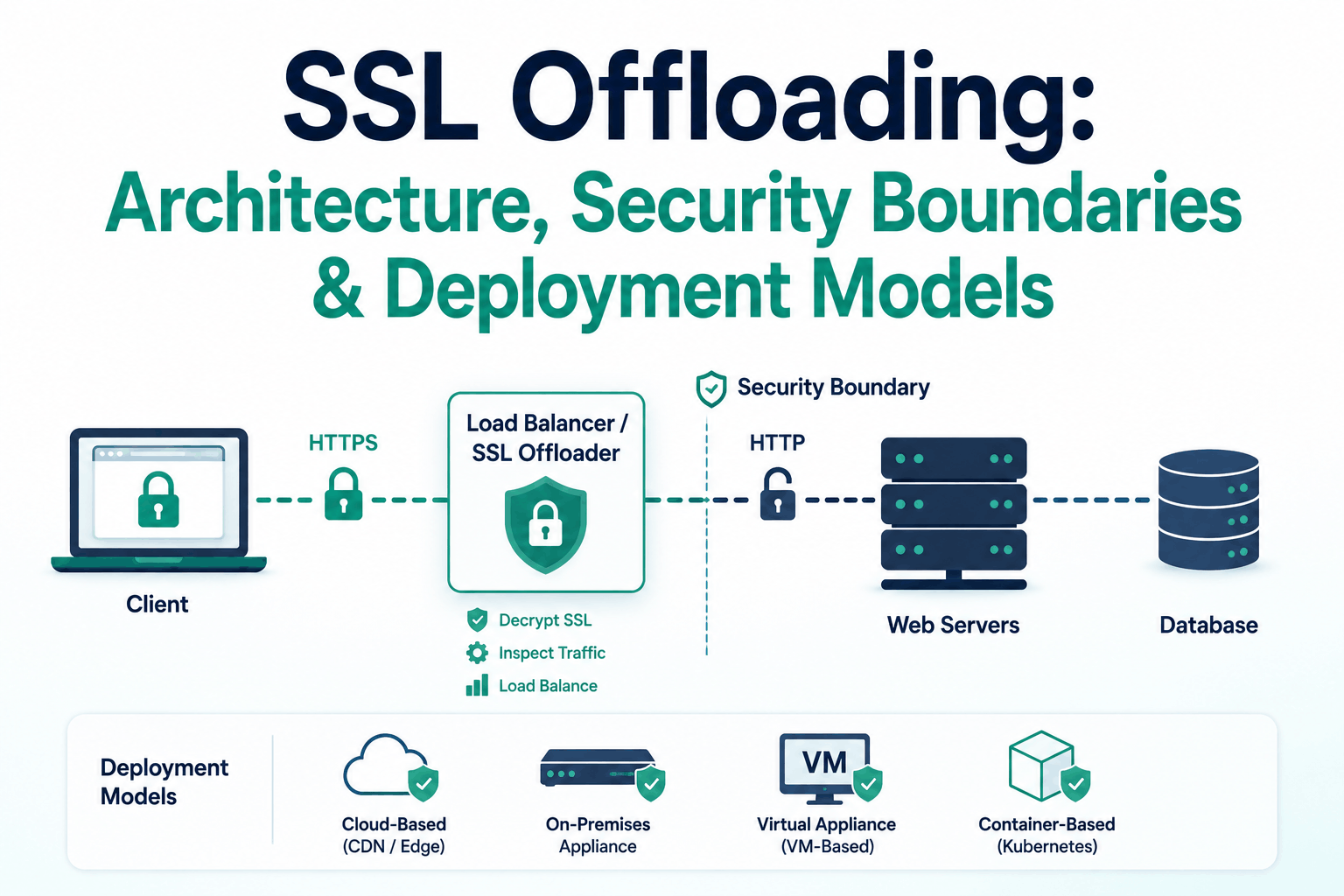
In an SSL termination setup, the encrypted connection from the user's browser ends (terminates) at the load balancer or ADC. The traffic is decrypted at this edge device and sent to the backend web servers as unencrypted (cleartext) HTTP.
This is the most efficient form of offloading because the backend servers perform no cryptographic work at all. It also allows for sophisticated traffic inspection. Since the load balancer sees the raw data, it can perform deep packet inspection (DPI), look for malicious payloads, and apply Web Application Firewall (WAF) rules before the data ever touches the server. The primary risk here is that traffic travels unencrypted within the internal data center network, which may be a concern for organizations with strict "Zero Trust" internal policies.
2. SSL Bridging (Re-encryption)
SSL bridging is a middle-ground approach. The traffic is decrypted at the edge device for inspection (to check for viruses or SQL injection), but it is then re-encrypted before being sent to the backend server.
While this still requires the backend server to perform some decryption, the edge device can use a less computationally expensive cipher suite for the internal leg of the journey. This method ensures that data is never in cleartext while in transit, even within the private network. This is often required for compliance with standards such as PCI DSS or HIPAA, which mandate end-to-end encryption for sensitive personal data.
Comparing Offloading Methods
| Feature | SSL Termination | SSL Bridging |
|---|---|---|
| Server CPU Usage | Minimal (Zero encryption work) | Moderate (Needs internal decryption) |
| Internal Security | Unencrypted (Cleartext) | Encrypted (Re-encrypted) |
| Inspection Capabilities | High (WAF/IDS can see all traffic) | High (WAF/IDS can see all traffic) |
| Latency | Lowest possible | Slightly higher due to re-encryption |
| Complexity | Simple configuration | Complex certificate management |
| Regulatory Compliance | May not meet strict end-to-end rules | Generally meets high security standards |
The Strategic Benefits of Centralized SSL Management
Beyond pure performance, SSL offloading offers a major operational advantage: centralized certificate management. In a traditional setup without offloading, an administrator must install and renew SSL/TLS certificates on every individual web server in a cluster. In a large environment with dozens or hundreds of servers, this becomes a logistical nightmare prone to human error.
By offloading, the digital certificate and its associated private key are stored only on the load balancer. When it is time to renew a certificate, the administrator updates it in one place, and the change is immediately effective for all backend traffic. This significantly reduces the risk of service outages caused by expired certificates. Furthermore, storing private keys in a centralized, hardened ADC—often equipped with a Hardware Security Module (HSM)—is inherently more secure than scattering keys across multiple web servers that might have broader attack surfaces.
Performance Optimization and Connection Multiplexing
SSL offloading also enables a secondary performance benefit known as connection multiplexing or "Keep-Alives." Setting up a new TCP connection along with an SSL handshake is time-consuming. When an ADC handles the SSL termination, it can maintain a persistent "pool" of open connections to the backend servers.
Instead of opening and closing a new connection for every single user request, the ADC can funnel multiple user requests through a single pre-established backend connection. This minimizes the "three-way handshake" overhead at the server level, further reducing latency and resource consumption. This synergy between SSL offloading and connection pooling is why ADCs are considered the cornerstone of high-availability web architecture in 2026.
Security Considerations and Potential Risks
While SSL offloading is a powerful tool, it is not without its risks. The most prominent concern is the "Cleartext Window." In an SSL termination scenario, if a malicious actor manages to breach the internal network, they could potentially use a packet sniffer to capture sensitive data as it travels from the load balancer to the server.
To mitigate this in 2026, many enterprises utilize internal network segmentation or Virtual Private Clouds (VPCs) with strict access control lists (ACLs). If the internal network is deemed "untrusted," SSL bridging is the mandatory alternative. Additionally, the offloading device itself becomes a high-value target. Because it holds the private keys and sees decrypted traffic, its security must be prioritized with multi-factor authentication (MFA), regular auditing, and physical security measures if it is an on-premises appliance.
Implementing SSL Offloading: Best Practices
For organizations looking to implement or optimize SSL offloading, several best practices should be followed to ensure both speed and security:
- Prioritize TLS 1.3: Ensure your offloading device supports TLS 1.3, which reduces the handshake to a single round trip and eliminates obsolete, vulnerable ciphers.
- Use ECC Certificates: Elliptic Curve Cryptography (ECC) keys provide the same level of security as RSA but with much smaller key sizes, leading to faster handshakes and lower CPU usage.
- Automate with ACME: Use the Automated Certificate Management Environment (ACME) protocol to automate certificate issuance and renewal on your load balancer, preventing manual errors.
- Enable Perfect Forward Secrecy (PFS): Ensure the offloading device is configured for PFS. This ensures that even if a private key is compromised in the future, past session data remains encrypted and secure.
- Monitor Cipher Strength: Regularly audit the cipher suites enabled on the offloader. Disable older protocols like TLS 1.0, 1.1, and even 1.2 if your user base supports the latest standards.
Frequently Asked Questions
Does SSL offloading make a website less secure?
No, it does not inherently lower security. In many cases, it enhances security by allowing specialized security appliances (like WAFs) to inspect traffic for threats that would otherwise be hidden inside encryption. However, if using SSL termination, you must ensure your internal network is physically and logically secured to prevent eavesdropping on cleartext data.
Is there a difference between SSL offloading and TLS offloading?
In 2026, the terms are used interchangeably. "SSL" is the older term that became the industry standard name, but the actual protocol used today is TLS (Transport Layer Security). When someone says "SSL offloading," they are almost certainly referring to the offloading of TLS traffic.
Can I perform SSL offloading in the cloud?
Yes. Major cloud providers offer this through their native Load Balancing services (e.g., AWS ELB/ALB, Azure Application Gateway). These services allow you to upload your certificates directly to the cloud provider's infrastructure, which then handles the decryption before passing traffic to your virtual machines or containers.
When should I choose SSL bridging over termination?
Choose SSL bridging if you operate in a highly regulated industry (finance, healthcare, government) where data must be encrypted at every step of its journey, even within your own data center. Also, choose bridging if you do not have complete control over the security of the network segments between your load balancer and your servers.
How does SSL offloading affect SEO?
SSL offloading has a positive indirect effect on SEO. Search engines like Google prioritize page speed as a ranking factor. By reducing the CPU load on your servers and lowering the Time to First Byte (TTFB), SSL offloading helps your pages load faster, which can improve your search engine rankings.
Practical Recommendation
For most medium-to-large enterprises, SSL termination is the recommended path for non-sensitive public-facing content due to the significant performance gains and the ability to perform deep security inspections. However, if your application handles PII (Personally Identifiable Information) or financial data, you should implement SSL bridging. Ensure that your load balancer or ADC is configured to use modern ciphers and that you have a robust, automated process for certificate renewal to avoid costly downtime.
Image Gallery