What Are Accounting Processes? Definition, Types, and Core Cycles
Accounting processes are standardized, repeatable sequences of operational steps used to capture, measure, record, classify, and report a business's financial transactions. These processes transform raw financial transactions—such as s...
Accounting processes are standardized, repeatable sequences of operational steps used to capture, measure, record, classify, and report a business's financial transactions. These processes transform raw financial transactions—such as sales orders, vendor invoices, payroll records, and expense reports—into verified financial statements that management, investors, tax authorities, and regulators rely on for decision-making and compliance.
Contents
Without robust accounting processes, organizations risk severe operational inefficiencies, compliance penalties, inaccurate financial reporting, and increased vulnerability to fraud. Establishing clear accounting workflows ensures that financial data remains accurate, audit-ready, and consistent across accounting periods.
Disclaimer: This article provides general educational information regarding accounting operations and enterprise internal controls. It does not constitute formal accounting, legal, or financial advice. Organizations should consult a Certified Public Accountant (CPA) or qualified financial consultant for specific regulatory compliance and system design.
Accounting Processes vs. The Accounting Cycle
While often used interchangeably, an accounting process and the accounting cycle refer to distinct concepts within corporate finance and operational management.
- Accounting Processes represent the broader end-to-end operational workflows designed to manage specific business activities. Examples include processing vendor bills, collecting payments from customers, or running monthly payroll. These sub-processes operate continuously throughout the fiscal year.
- The Accounting Cycle is a specific eight- or nine-step sequential procedure that accounting teams execute during a defined accounting period (such as a month, quarter, or year) to close the financial books and generate financial statements.
Together, operational accounting processes feed real-time financial data into the overarching accounting cycle. This integration ensures that ledger balances reflect true operational activity before financial statements are published.
The 5 Core Sub-Processes in Business Accounting
Most enterprise accounting departments organize their daily operations into five key functional sub-processes. Each sub-process governs a specific transaction type and requires tailored internal controls.
- Core Accounting Sub-Processes
- P2P
- O2C
- R2R
- Payroll & WIP
- General Ledger & Close
1. Procure-to-Pay (P2P)
The Procure-to-Pay process covers the entire purchasing workflow, from identifying an operational need to executing final payment to a vendor.
The standard P2P workflow includes:
- Purchase Requisition & Approval: An employee requests goods or services, subject to management approval based on pre-set spending limits.
- Purchase Order (PO) Creation: The procurement team issues a formal PO to the supplier, establishing a legally binding purchase agreement.
- Goods/Services Receipt: The receiving department logs incoming items against the PO, issuing a receiving report.
- Three-Way Matching: The accounts payable team compares the PO, the receiving report, and the vendor invoice to ensure prices, quantities, and terms match before scheduling payment.
- Disbursement: Payment is released via ACH, check, or wire transfer, and the transaction is credited to cash and debited to accounts payable.
2. Order-to-Cash (O2C)
The Order-to-Cash process handles sales transactions from initial customer order entry to final revenue collection and cash application.
The core O2C steps include:
- Credit Evaluation & Order Management: Customer orders are checked against pre-approved credit limits.
- Fulfillment & Shipping: Goods are picked, packed, and shipped, creating a bill of lading or delivery confirmation.
- Invoicing: The billing engine generates a customer invoice matching the terms of shipment.
- Accounts Receivable Management: Outstanding balances are tracked using aging reports to ensure prompt collection.
- Cash Application: Payments received via bank transfer, check, or credit card are matched against outstanding customer invoices in the general ledger.
3. Record-to-Report (R2R)
Record-to-Report is the financial management sub-process responsible for collecting, processing, and presenting financial performance metrics. It acts as the operational bridge between transaction-level sub-processes and corporate financial management.
Key R2R components include:
- Posting manual and automated journal entries.
- Performing intercompany transaction eliminations for consolidated corporate structures.
- Managing fixed asset depreciation schedules and capitalization policies.
- Executing bank, sub-ledger, and balance sheet reconciliations.
- Drafting regulatory compliance reports and management accounts.
4. Payroll Processing
Payroll handles wage calculations, statutory tax withholdings, and employee benefit distributions. Because payroll represents one of the largest operating expenses for service-oriented businesses, maintaining tight control over this workflow is critical.
The payroll sequence requires:
- Collecting and verifying timekeeping data.
- Calculating gross earnings, gross-to-net deductions, voluntary benefit payments, and employer tax liabilities.
- Disbursing funds to employees via direct deposit or check.
- Filing quarterly and annual statutory payroll tax returns with national and regional tax authorities.
5. Inventory and Cost Accounting
For manufacturing, retail, and distribution enterprises, inventory accounting tracks raw materials, work-in-process (WIP), and finished goods. It assigns appropriate cost values to inventory assets using accepted valuation methods such as FIFO (First-In, First-Out), LIFO (Last-In, First-Out), or Weighted Average Cost.
This process ensures that the Cost of Goods Sold (COGS) is accurately matched against revenue generated in the same reporting period, adhering to the matching principle of accounting.
Steps of the Financial Accounting Cycle
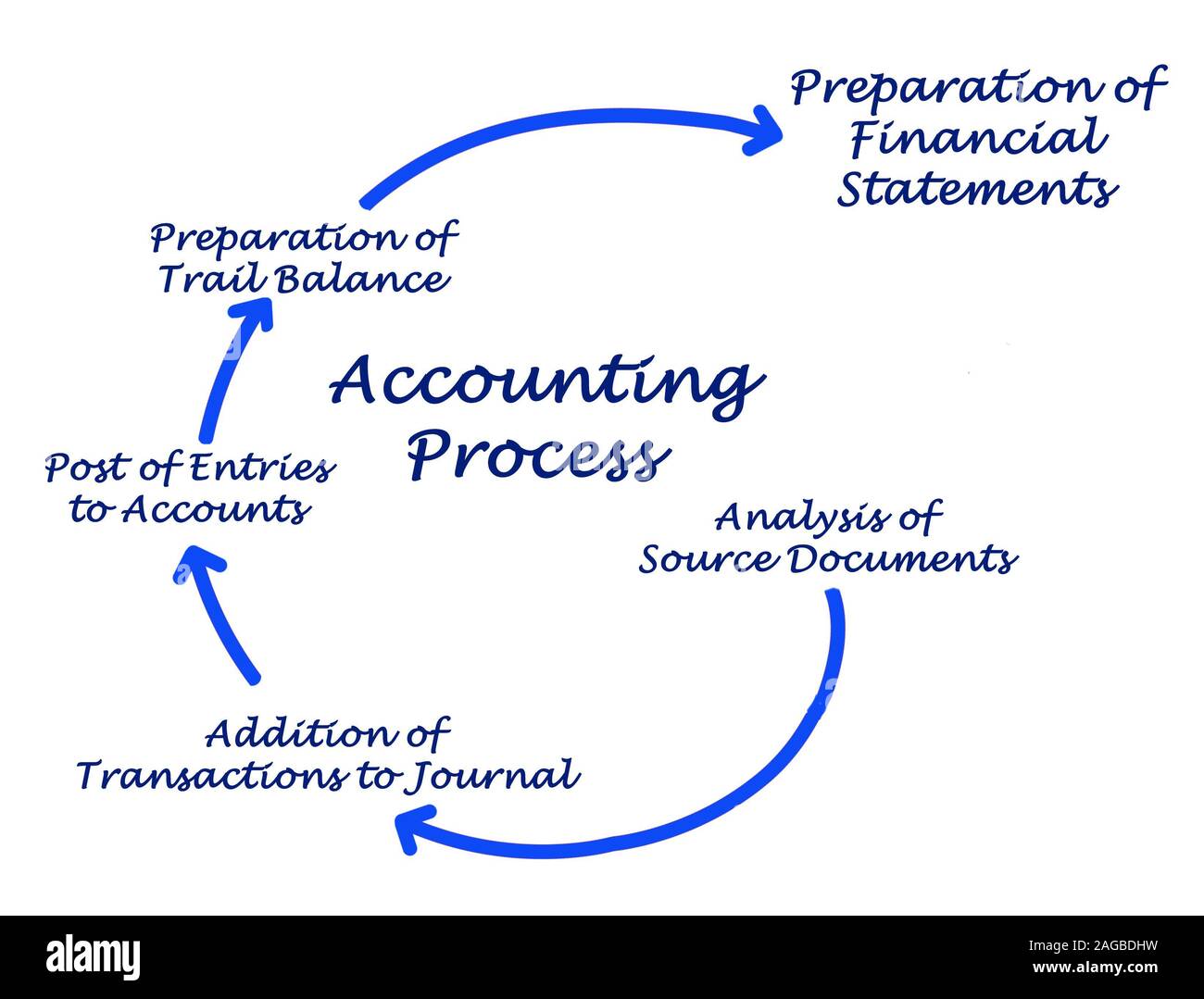
While sub-processes handle day-to-day operations, the accounting cycle structures periodic financial reporting. The standardized steps of the accounting cycle include:
Source Document Analysis
Journal Entry Creation
General Ledger Posting
Unadjusted Trial Balance
Adjusting Entries
Adjusted Trial Balance
Financial Statements
Closing Entries
Post-Closing Trial Balance
Identify and Analyze Transactions: Source documents (invoices, receipts, bank statements, contracts) are gathered and analyzed to determine their accounting impact.
Record Journal Entries: Transactions are recorded chronologically in the general journal using double-entry bookkeeping (equal debit and credit entries).
Post to General Ledger: Journal entries are transferred to individual T-accounts or ledger accounts to update running balances.
Prepare an Unadjusted Trial Balance: At the end of the reporting period, balances from all ledger accounts are compiled to verify that total debits equal total credits.
Draft Adjusting Entries: Accrual-basis accounting requires adjustments for accrued revenues, accrued expenses, deferred revenues, prepaid expenses, and non-cash expenses like depreciation and amortization.
Run an Adjusted Trial Balance: A new balance check is run after incorporating adjusting entries to confirm ledger balance equality before generating formal reports.
Generate Financial Statements: The income statement, balance sheet, statement of cash flows, and statement of equity are compiled using the adjusted trial balance numbers.
Record Closing Entries: Revenue and expense accounts (temporary accounts) are zeroed out to the Retained Earnings account to prepare the system for the next accounting period.
Prepare a Post-Closing Trial Balance: A final audit check ensures that only balance sheet accounts (permanent accounts) carry open balances into the next fiscal period.
Process Comparison Matrix
The following table summarizes the scope, inputs, deliverables, and primary operational risks associated with core accounting sub-processes:
| Accounting Sub-Process | Primary Operational Inputs | Core Deliverables & Outputs | Key Risk Focus & Internal Controls |
|---|---|---|---|
| Procure-to-Pay (P2P) | Purchase requisitions, vendor quotes, receiving notes, invoices | Payment remittances, accounts payable sub-ledger, expense registers | Unauthorized spending, duplicate payments; controlled via 3-way matching. |
| Order-to-Cash (O2C) | Customer orders, shipping manifests, credit checks | Customer invoices, cash receipt journals, aging AR reports | Bad debt exposure, uncollected revenue; controlled via credit approvals and collections workflows. |
| Record-to-Report (R2R) | Sub-ledger feeds, journal entries, bank statements | Income statement, balance sheet, cash flow statement, SEC/regulatory filings | Material misstatement, manual posting errors; controlled via account reconciliations. |
| Payroll Processing | Employee timesheets, tax withholding forms (W-4/W-2), benefit elections | Paychecks, payroll registers, tax filings, benefit remittances | Wage calculation errors, non-compliance with labor laws; controlled via dual authorization. |
| Cost & Inventory | Bill of materials (BOM), production logs, scrap reports | Inventory asset valuation, Cost of Goods Sold (COGS) reports | Inventory shrinkage, valuation inaccuracies; controlled via physical counts and variance analysis. |
Internal Controls and Governance
To maintain financial integrity, accounting processes must operate within a structured internal control framework. Frameworks such as the Committee of Sponsoring Organizations of the Treadway Commission (COSO) guidance and Sarbanes-Oxley Act (SOX) Section 404 standards provide benchmarks for evaluating accounting operations.
Key control mechanisms include:
- Segregation of Duties (SoD): No single individual should control all stages of a financial transaction. The person who approves a purchase order must not be the individual who disburses payments or reconciles bank accounts. Separating authorization, custody, and recording roles significantly reduces fraud risk.
- Authorization Controls: Financial software must enforce system permissions based on designated approval thresholds. For example, operational managers may approve expenses up to $5,000, while expenditures over $50,000 require executive signatory approval.
- Reconciliation Protocols: Monthly independent reconciliations must be conducted between sub-ledgers (e.g., Accounts Receivable, Accounts Payable) and the General Ledger, as well as between internal ledgers and third-party bank statements.
- Audit Trails: Modern enterprise accounting applications maintain immutable system logs tracking every user interaction, entry creation, adjustment, and approval timestamp to ensure complete traceability.
The Role of ERP Systems and Automation
Enterprise Resource Planning (ERP) systems—such as SAP S/4HANA, Oracle NetSuite, Workday, and Microsoft Dynamics 365—have updated traditional accounting workflows. Rather than manually tracking entries across isolated spreadsheets, enterprise software integrates data across sales, human resources, procurement, and warehouse operations.
Key areas where technology changes accounting processes include:
- Automated Data Extraction: Optical Character Recognition (OCR) tools read incoming digital invoices, capture vendor metadata, and automatically generate proposed journal entries.
- Robotic Process Automation (RPA): RPA software executes repetitive tasks, such as cross-checking shipping documents against vendor bills or performing high-volume bank statement matching.
- Continuous Close Execution: Advanced enterprise setups use automated sub-ledger reconciliations throughout the month. This reduces the workload standardly concentrated at month-end and allows teams to achieve a faster financial close.
Common Accounting Process Bottlenecks and Solutions
Organizations frequently face operational drag in their financial departments due to poor process design. Identifying these pain points allows accounting leadership to streamline workflows effectively.
Delayed Month-End Close
- Root Cause: Heavy reliance on manual journal entries, un-reconciled intercompany balances, and decentralized balance sheet reconciliations performed late in the closing cycle.
- Solution: Standardize a post-close checklist with clear ownership dates. Implement automated account reconciliation tools that sync continuously rather than exclusively at month-end.
High Error Rates in Accounts Payable
- Root Cause: Manual invoice data entry, missing purchase orders, and lack of standardized vendor onboarding procedures.
- Solution: Mandate strict PO-required policies for non-payroll expenditures and deploy vendor portals that allow suppliers to upload invoices directly into an automated matching engine.
Inaccurate Revenue Recognition
- Root Cause: Disconnects between sales contracts and accounting teams, leading to non-compliance with complex accounting standards such as ASC 606 / IFRS 15.
- Solution: Integrate CRM systems directly with billing and revenue engines, ensuring that contractual performance obligations automatically dictate revenue schedule generation.
Best Practices for Improving Accounting Processes
To keep accounting operations scalable, transparent, and accurate, financial leadership should prioritize systematic updates to internal controls and documentation:
- Develop Detailed Standard Operating Procedures (SOPs): Document every operational workflow step-by-step. SOPs serve as training material for new hires, preserve institutional knowledge, and establish clear operational expectations.
- Track Key Process Metrics: Monitor quantitative indicators such as Days Sales Outstanding (DSO), Days Payable Outstanding (DPO), Cost per Invoice Processed, and Total Days to Close. Metrics point directly to workflow bottlenecks.
- Conduct Periodic Internal Audits: Regularly test compliance with documented internal controls. Auditing sample transactions verifies that authorization matrices, segregation of duties, and matching procedures are operating as intended.
- Enforce Master Data Management (MDM): Maintain strict controls over who can edit customer registers, vendor payment terms, and chart of accounts configurations to prevent data corruption and fraudulent entries.
Frequently Asked Questions
What is the primary difference between bookkeeping and accounting processes?
Bookkeeping focuses on the administrative, transactional recording of financial data—such as logging invoices and tracking daily sales receipts. Accounting processes encompass bookkeeping within a broader framework that includes financial analysis, adjusting entries, regulatory tax filings, internal controls, and preparing verified financial reports for stakeholders.
What is the most critical accounting process for risk mitigation?
The Record-to-Report (R2R) process, combined with rigorous account reconciliations and Segregation of Duties (SoD), is critical for risk mitigation. Weaknesses in R2R directly increase the risk of material financial misstatements, regulatory fines, internal fraud, and failed external audits.
How does ASC 606 / IFRS 15 impact customer accounting processes?
ASC 606 and IFRS 15 govern revenue recognition from customer contracts. They require businesses to identify performance obligations within customer contracts and recognize revenue only when those obligations are satisfied, rather than simply when cash is received or an invoice is issued. This requires tight integration between order entry, billing, and general ledger workflows.
What causes a trial balance to be out of balance?
A trial balance fails to balance when total debits do not equal total credits. This typically happens due to manual posting errors (e.g., entering a debit without a corresponding credit), transposition errors (e.g., writing $540 as $450), posting an entry to the wrong side of an account, or partial system sync failures between sub-ledgers and the main general ledger.
How often should an organization review and update its accounting processes?
Organizations should conduct a comprehensive review of their accounting operating procedures at least once a year. Additionally, immediate process updates are warranted whenever the business implements new enterprise software, undergoes structural mergers or acquisitions, adopts updated statutory accounting principles, or expands into new regulatory jurisdictions.
Strategic Recommendations
Optimizing accounting operations requires treating financial workflows as continuous business processes rather than administrative chores. Organizations seeking to strengthen financial governance should begin by mapping out their existing Order-to-Cash, Procure-to-Pay, and Record-to-Report workflows to identify manual intervention points, duplicate efforts, and control vulnerabilities.
Once baseline workflows are documented, finance leadership should implement automated reconciliation software, establish rigid access controls to maintain segregation of duties, and enforce standard operating procedures across all business units. Refining accounting processes elevates the role of the corporate finance department—shifting focus away from manual data entry toward strategic analysis, financial modeling, and corporate risk mitigation.
Image Gallery