Understanding Treasury Bills: Practical Examples and Investment Mechanics
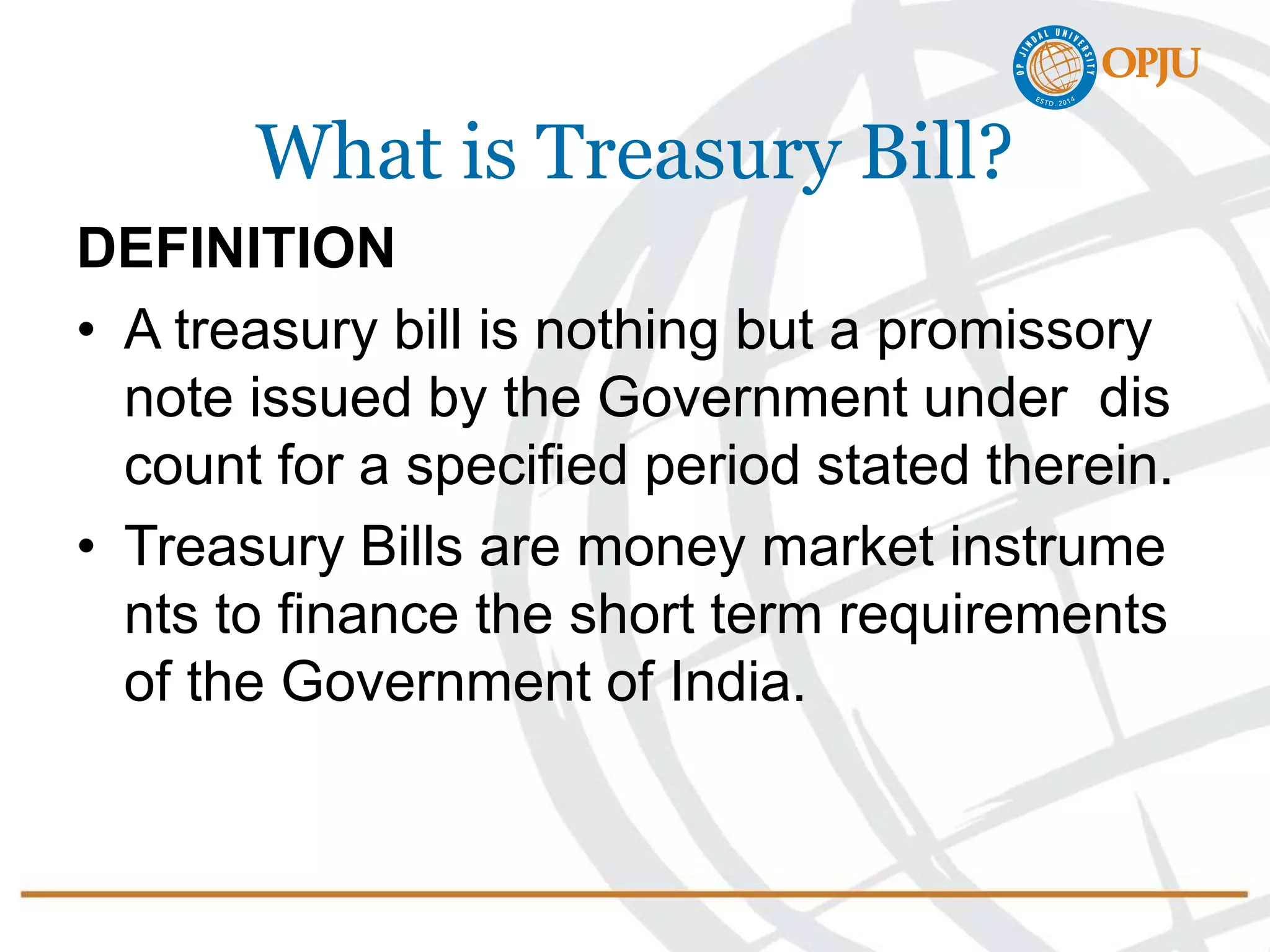
A treasury bill (T-Bill) is a short-term debt obligation issued by the U.S. Treasury Department with a maturity of one year or less. In practice, an example of a T-Bill is an investor purchasing a $10,000 26-week bill at a discounted p...
A treasury bill (T-Bill) is a short-term debt obligation issued by the U.S. Treasury Department with a maturity of one year or less. In practice, an example of a T-Bill is an investor purchasing a $10,000 26-week bill at a discounted price of $9,750; upon maturity, the government pays the investor the full $10,000 face value, resulting in $250 of interest income.
Contents
Treasury bills are considered one of the safest investments globally because they are backed by the "full faith and credit" of the United States government. Unlike traditional bonds, they do not pay periodic interest (coupons). Instead, they are sold at a discount to their face value (par value), and the investor's return is the difference between the purchase price and the amount received at maturity. As of 2026, T-Bills remain a cornerstone of conservative portfolios, providing liquidity and capital preservation in volatile market environments.
The Fundamental Concept of Discounting
To understand T-Bills in practice, one must first grasp the concept of "zero-coupon" or "discount" pricing. Most fixed-income securities, like corporate bonds or Treasury Notes, provide regular interest payments. T-Bills do not.
When the Treasury issues these bills, they set a par value (usually in increments of $100). However, the market determines the current value through an auction process. If the prevailing interest rates are high, the discount will be deeper (meaning you pay less today for the promise of $100 in the future). If rates are low, the discount is shallower.
The "interest" you earn is technically the capital appreciation of the bill as it moves toward its maturity date. In financial terms, this is known as an "accreted" return. Because you know the purchase price and the maturity value upfront, the yield is predictable, provided you hold the security until it expires.
A Practical Example: The $10,000 26-Week T-Bill
Let’s look at a concrete example of how a T-Bill transaction functions for an individual investor in 2026.
Imagine an investor named Sarah who has $10,000 sitting in a low-interest checking account. She decides to move this capital into a 26-week (6-month) Treasury Bill to earn a higher yield while maintaining near-perfect safety.
- The Auction: Sarah places a "non-competitive bid" for a $10,000 par value T-Bill through the TreasuryDirect portal or her brokerage.
- The Price: The auction results determine that the bill will sell at a discount rate of 5%. This results in a purchase price of $9,750.
- The Transaction: On the issue date, $9,750 is deducted from Sarah’s linked bank account. She now holds a digital certificate for a $10,000 Treasury Bill.
- The Holding Period: Sarah holds the bill for exactly 182 days (26 weeks). During this time, the value of the bill on the secondary market may fluctuate based on interest rate changes, but Sarah’s eventual payout remains fixed.
- Maturity: At the end of the 26 weeks, the U.S. Treasury automatically deposits $10,000 into Sarah’s account.
- The Profit: Sarah’s profit is $250 ($10,000 minus $9,750). This $250 is her interest income for the six-month period.
Calculating the Yield
While the discount is 2.5% of the face value ($250 is 2.5% of $10,000), the actual annualized yield is higher because Sarah only invested $9,750, not the full $10,000, and she earned that return in half a year. To calculate the Bond Equivalent Yield (BEY), which allows for comparison with other investments, the formula accounts for the 365-day year and the actual amount of capital at risk.
The Mechanics of Purchase: Competitive vs. Non-Competitive Bidding
In practice, T-Bills are issued through weekly auctions managed by the Bureau of the Fiscal Service. There are two primary ways to participate in these auctions:
Non-Competitive Bidding
This is the method used by the vast majority of individual investors and small entities. In a non-competitive bid, you agree to accept whatever discount rate is determined by the auction. This guarantees that your bid will be filled and you will receive the requested amount of bills. You do not need to be a financial expert to use this method; you simply specify the dollar amount you wish to purchase.
Competitive Bidding
Competitive bids are typically reserved for institutional investors, such as banks, hedge funds, and primary dealers. In this scenario, the bidder specifies the exact yield they are willing to accept. If the auction's "stop-out" yield (the highest yield accepted to sell all available bills) is lower than the bidder's request, the bid is rejected. If the bidder’s yield is lower than the stop-out yield, they receive the full amount. This process ensures the government borrows at the lowest possible cost.
Comparing Short-Term Cash Management Tools
Investors often weigh T-Bills against other "cash-equivalent" instruments. Below is a comparison based on the financial landscape of 2026.
| Feature | Treasury Bills (T-Bills) | Certificates of Deposit (CDs) | High-Yield Savings Accounts |
|---|---|---|---|
| Issuer | U.S. Federal Government | Private Banks | Private Banks |
| Maturity | 4, 8, 13, 17, 26, or 52 weeks | 3 months to 5+ years | None (Liquid) |
| Risk Level | Lowest (Sovereign Backing) | Low (FDIC Insured up to limits) | Low (FDIC Insured up to limits) |
| State/Local Tax | Exempt | Fully Taxable | Fully Taxable |
| Minimum Purchase | $100 | Varies (often $500–$1,000) | Varies ($0–$100) |
| Liquidity | High (Secondary Market) | Low (Early Withdrawal Penalty) | High (Immediate Access) |
The Math Behind the Yield: Technical Specifications
For those managing larger portfolios, understanding the two ways T-Bill returns are quoted is essential. In 2026, financial terminals usually display both the Discount Basis and the Investment Rate.
1. Bank Discount Basis
This is the standard way T-Bills are quoted in the news. It uses a 360-day year and calculates the return as a percentage of the face value.
- Formula:
[(Face Value - Purchase Price) / Face Value] * (360 / Days to Maturity) - Using our example:
(250 / 10,000) * (360 / 182) = 4.95%
2. Investment Rate (Bond Equivalent Yield)
This is a more accurate reflection of your actual return because it uses a 365-day year and calculates the return based on the purchase price (the money you actually spent).
- Formula:
[(Face Value - Purchase Price) / Purchase Price] * (365 / Days to Maturity) - Using our example:
(250 / 9,750) * (365 / 182) = 5.14%
The Investment Rate will always be higher than the Discount Basis. When comparing a T-Bill to a traditional savings account or a CD, you should always look at the Investment Rate/BEY.
Tax Advantages and Practical Benefits in 2026
One of the most significant "in practice" reasons investors choose T-Bills over other short-term options is their tax treatment. While the interest earned on T-Bills is subject to federal income tax, it is exempt from state and local income taxes.
In high-tax states such as New York, California, or Massachusetts, this exemption can significantly increase the "after-tax yield" of the investment. For example, a T-Bill yielding 5.14% may actually provide more take-home pay than a bank CD yielding 5.30% once state taxes are factored in.
Furthermore, T-Bills are highly liquid. Unlike a CD, where your money is "locked" unless you pay a penalty, T-Bills can be sold on the secondary market at any time. If you hold your bills in a brokerage account (like Fidelity, Schwab, or Vanguard), you can sell them during market hours and have the cash available for withdrawal within one or two business days.
Practical Considerations for 2026 Investors
If you are looking to implement T-Bills into your financial strategy this year, consider the following operational steps:
- TreasuryDirect vs. Brokerage: Buying through TreasuryDirect.gov allows you to purchase in increments of $100 and set up automatic reinvestments (rolling the principal into a new bill upon maturity). However, the interface is dated, and selling before maturity is cumbersome. Buying through a brokerage allows for easier selling and a consolidated view of your assets, though some brokerages require $1,000 minimums for certain auctions.
- Laddering Strategy: To maintain constant liquidity, many investors use a "T-Bill Ladder." This involves buying bills with staggered maturities (e.g., buying 4-week, 8-week, 13-week, and 26-week bills). As each bill matures, a portion of your cash becomes available, or you can reinvest it at the then-current rates.
- The "Risk-Free" Benchmark: In practice, the yield on the 13-week T-Bill is often used by economists and investors as the "risk-free rate of return." This serves as a benchmark for all other investments. If a risky stock isn't projected to return significantly more than a guaranteed T-Bill, the T-Bill is often the more logical choice.
Frequently Asked Questions
Can I lose money on a Treasury Bill? If you hold a T-Bill until it reaches maturity, it is impossible to lose money on your nominal investment, as the U.S. government has never defaulted on its debt. However, if you sell a T-Bill on the secondary market before it matures, and interest rates have risen since you bought it, you might receive less than you paid. This is known as interest rate risk.
What is the minimum and maximum amount I can buy? In 2026, the minimum purchase for a T-Bill is $100. For non-competitive bids, the maximum purchase per auction is $10 million. For competitive bids, the limit is 35% of the total offering amount, which is typically in the billions, making it practical only for institutional players.
How do I pay taxes on the interest? The interest is reported to the IRS in the year the bill matures. If you buy a 52-week bill in late 2026 that matures in 2027, you will not owe taxes on that interest until you file your 2027 tax return. You will receive a Form 1099-INT from either TreasuryDirect or your brokerage detailing the interest earned.
Is there a difference between T-Bills, T-Notes, and T-Bonds? Yes, the primary difference is the maturity length. T-Bills are short-term (1 year or less). Treasury Notes (T-Notes) have maturities ranging from 2 to 10 years and pay interest every six months. Treasury Bonds (T-Bonds) have maturities of 20 to 30 years and also pay semi-annual interest.
What happens if I die while holding T-Bills? If held in a brokerage account, T-Bills are treated like any other security and pass to your designated beneficiaries or through your estate. If held in TreasuryDirect, you can name a secondary owner or a beneficiary directly on the account to ensure a seamless transfer of ownership without the need for probate.
Final Recommendation: For those seeking a safe haven for cash in 2026, Treasury Bills offer a compelling mix of government-backed security, federal tax efficiency, and state tax exemptions. If you reside in a state with high income tax, prioritize T-Bills over high-yield savings accounts or CDs to maximize your after-tax return. Start by opening a TreasuryDirect account or checking the "Fixed Income" section of your existing brokerage to view upcoming auction dates.
Image Gallery