How to Access Your Health Records: A Complete Guide to Your Rights and Process
You have a legal right to review and obtain copies of your medical information under the Health Insurance Portability and Accountability Act (HIPAA). To access your health records in 2026, you typically submit a written request or use...
You have a legal right to review and obtain copies of your medical information under the Health Insurance Portability and Accountability Act (HIPAA). To access your health records in 2026, you typically submit a written request or use a digital patient portal provided by your healthcare provider. Providers must fulfill these requests within 30 days, although many now offer near-instant electronic access.
Contents
The landscape of healthcare data has shifted significantly over the last decade. While patients once navigated a labyrinth of paper forms and mailing delays, the current standard in 2026 emphasizes "Information Interoperability." This means your data is increasingly mobile, digital, and under your direct control. Understanding how to exercise these rights is essential for coordinating care, verifying accuracy, and managing long-term health outcomes.
The Legal Framework of Health Record Access
In the United States, the primary authority governing your medical data is the HIPAA Privacy Rule. Established to protect sensitive patient information, the rule also guarantees that individuals have the right to inspect and receive a copy of their "designated record set." This set includes medical records, billing records, and any other data used by healthcare providers to make decisions about your care.
The Impact of the 21st Century Cures Act
By 2026, the full implementation of the 21st Century Cures Act has fundamentally altered the speed of access. The Act introduced "Information Blocking" regulations, which prohibit healthcare providers, certified health IT developers, and health information exchanges from engaging in practices that interfere with the access, exchange, or use of electronic health information (EHI).
Under these rules, providers are required to provide patients with access to their electronic health records without delay. This has led to the "Open Notes" movement, where clinician notes—once hidden from patients—are now standard components of the accessible record. Unless a specific exception applies (such as a risk of physical harm to the patient), your provider cannot withhold this data.
Jurisdictional Nuances
While HIPAA provides a federal floor for privacy and access rights, many states have enacted laws that offer even greater protections or shorter timelines for fulfillment. For instance, some states require providers to supply records within 15 days rather than the federal 30-day limit. When requesting records, it is helpful to know if your state has specific mandates that supersede federal minimums.
What Information is Included in Your Health Record?
A "health record" is not a single document but a collection of various data points generated throughout your medical history. When you request access to health records, you can generally expect to receive the following:
- Clinical Summaries: Notes from office visits, physical exams, and consultations.
- Diagnostic Results: Laboratory reports, pathology results, and diagnostic imaging reports (e.g., X-rays, MRIs, CT scans).
- Medication History: A list of currently prescribed medications, past prescriptions, and known allergies.
- Immunization Records: Comprehensive histories of vaccinations.
- Procedure Reports: Details regarding surgeries, biopsies, or other invasive treatments.
- Billing and Insurance Data: Information regarding claims, payments, and cost-of-care estimates.
It is important to distinguish between the medical record (clinical data) and the billing record. If you need to verify charges for an insurance dispute, you must specifically request the billing records, as they are often maintained in a different department than clinical notes.
Step-by-Step Guide to Requesting Your Records
The process for obtaining records has become more streamlined as of 2026, but specific administrative steps remain necessary to ensure security and HIPAA compliance.
1. Identify the Record Holder
Health records are decentralized. Your primary care physician, the local hospital, and specialized clinics (like an imaging center or a physical therapist) all maintain their own sets of data. You must contact the Health Information Management (HIM) or "Medical Records" department of each specific facility.
2. Choose Your Method of Access
Most modern healthcare systems offer three primary ways to access data:
- Patient Portals: The fastest method. Most systems (such as Epic’s MyChart or Cerner’s HealtheLife) allow you to download your entire history as a PDF or XML file.
- Digital APIs: In 2026, many patients use third-party apps (like Apple Health or specialized health management tools) that connect directly to provider databases via secure APIs.
- Formal Written Request: Necessary for older records that have not been digitized or for comprehensive legal "certified" copies.
3. Complete the Authorization Form
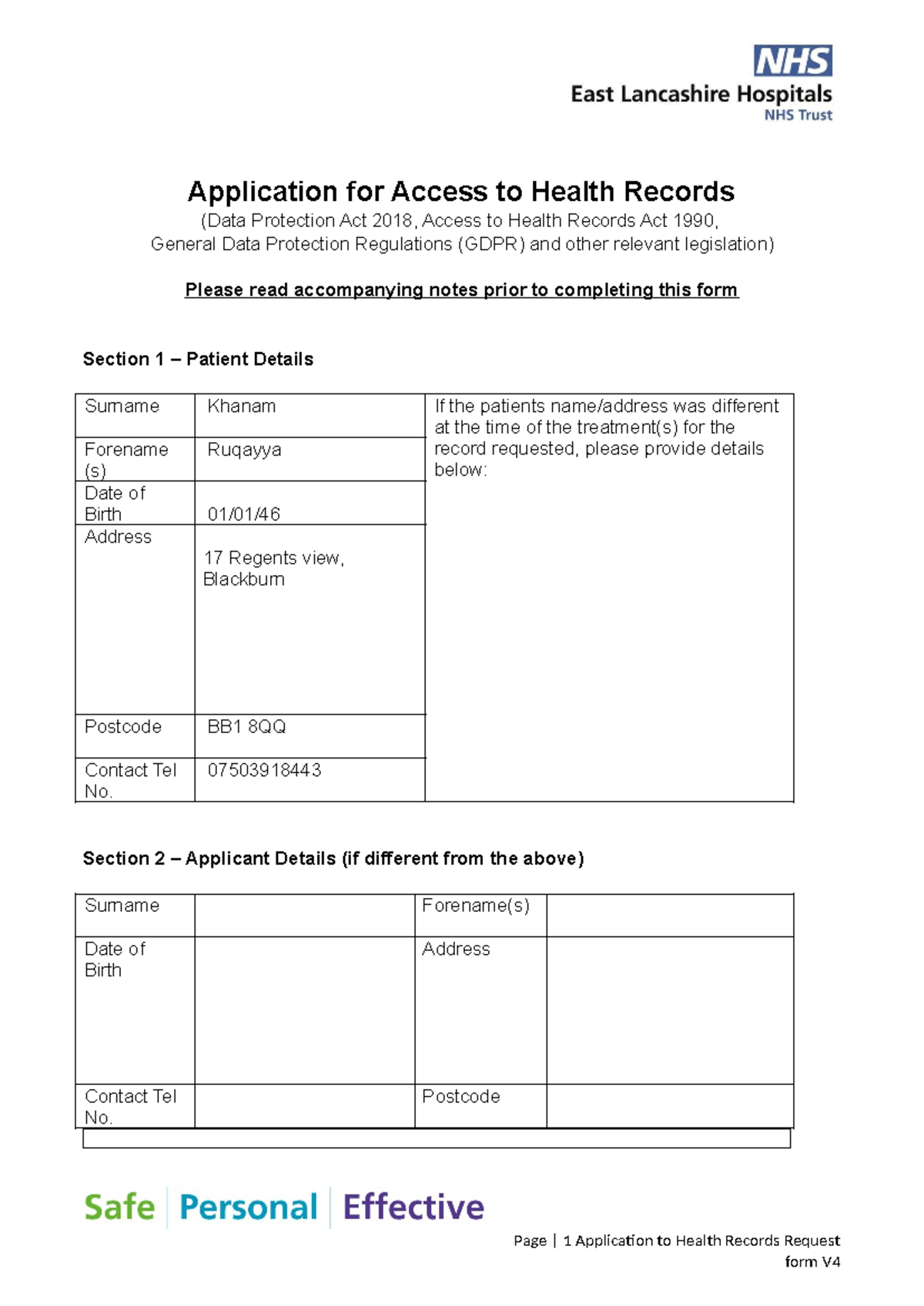
If you are not using a portal, you will likely need to sign a Release of Information (ROI) form. This document must specify:
- Your full name and date of birth.
- The specific records requested (e.g., "All records from Jan 2024 to Dec 2025").
- The format you prefer (Electronic vs. Paper).
- Where the records should be sent (to you, a lawyer, or another doctor).
4. Verify Identity
To prevent medical identity theft, providers must verify your identity. This usually involves providing a copy of a government-issued ID or, in the case of digital portals, multi-factor authentication (MFA).
Comparison of Record Access Methods
| Method | Typical Turnaround | Primary Benefit | Potential Drawback |
|---|---|---|---|
| Patient Portal | Instant to 24 Hours | No cost; immediate access to notes and labs. | May not contain "legacy" paper records from years ago. |
| Third-Party Apps (API) | Real-time | Aggregates data from multiple doctors in one view. | Requires technical setup; app-specific privacy risks. |
| Direct Email/Secure Link | 3–10 Days | Secure; easy to forward to other providers. | Links may expire; files may be password-protected. |
| Physical Mail (Paper) | 15–30 Days | Necessary for those without digital access. | Slowest method; often involves per-page printing fees. |
Costs and Fees Associated with Requests
A common point of confusion is whether a doctor can charge you for your own information. Under HIPAA, a provider cannot charge you a "retrieval fee" for the labor of finding your records. However, they are permitted to charge a reasonable, cost-based fee for:
- Labor for copying the protected health information (PHI) in paper or electronic form.
- Supplies for creating the paper copy or the electronic media (like a USB drive) if requested.
- Postage if you ask for the records to be mailed.
As of 2026, the trend has shifted heavily toward free access. Most providers waive fees for electronic delivery via portals or email. However, if you request a 500-page paper file, you should expect to pay a per-page fee, which is often regulated by state law. If you are requesting records to be sent directly to another healthcare provider for "continuity of care," these fees are almost always waived.
When Can Access Be Denied?
While your right to access is broad, it is not absolute. There are specific, narrow circumstances where a provider may legally deny your request:
- Psychotherapy Notes: These are handled differently than general medical records. Notes taken by a mental health professional during a conversation are often excluded from the "designated record set" to protect the therapeutic process.
- Legal Proceedings: Information compiled in reasonable anticipation of, or for use in, a civil, criminal, or administrative action may be withheld.
- Safety Concerns: If a licensed healthcare professional determines that access is "reasonably likely to endanger the life or physical safety of the individual or another person," they may deny the request. This is most common in cases of domestic violence or certain mental health crises.
If your request is denied, the provider must give you a written explanation and, in many cases, provide a process for the denial to be reviewed by a different healthcare professional.
Third-Party Access: Caregivers and Legal Representatives
In 2026, managing the health records of a family member—such as an aging parent or a child—is a common task. To do this legally, you must have the proper authorization:
- Personal Representatives: If you have Power of Attorney (POA) for healthcare or are the legal guardian, you stand in the shoes of the patient and have the same access rights.
- Minors: Generally, parents have access to their children's records. However, in many states, minors have "protected" categories of care (like reproductive health or substance abuse counseling) that parents may not be able to access without the minor's consent.
- Deceased Individuals: The administrator or executor of a deceased person's estate has the right to access the decedent's health records.
Troubleshooting Common Issues
If you encounter resistance while trying to access your health records, follow these steps to resolve the issue:
- Reference the 30-Day Rule: Remind the HIM department that under 45 CFR § 164.524, they are required to provide access within 30 days.
- Request an Electronic Copy: If they claim paper records will take too long, ask for the digital version. Under the HITECH Act, if the provider uses electronic records, they must provide them in an electronic format if you request it.
- Escalate to the Privacy Officer: Every healthcare organization is required to have a Privacy Officer. If the administrative staff is unhelpful, ask to speak with this official.
- File a Complaint: If you believe your rights are being violated or if the provider is engaged in "Information Blocking," you can file a formal complaint with the U.S. Department of Health and Human Services Office for Civil Rights (OCR).
FAQs About Health Record Access
Can a doctor withhold my records because I have an unpaid bill?
No. Under HIPAA, a healthcare provider cannot deny you access to your medical records because you have not paid for the services you received. While they can charge a fee for the cost of copying the records, they cannot hold the records "hostage" to force payment of a medical debt.
How long do providers have to keep my records?
Retention periods vary by state and the type of record, but most states require providers to keep adult medical records for 5 to 10 years after the last date of treatment. For minors, records are often kept until the patient reaches the age of majority plus a set number of years. In 2026, many systems have moved toward permanent digital archiving.
What should I do if I find an error in my records?
You have the right to request an amendment to your record if you believe information is inaccurate or incomplete. The provider must respond to your request, usually within 60 days. If they agree the info is wrong, they will update it. If they disagree, they must allow you to submit a "Statement of Disagreement" that becomes a permanent part of your file.
Does "access to health records" include the images themselves or just the reports?
It includes both. You are entitled to the diagnostic images (the actual "pictures" from an X-ray or MRI) and the radiologist’s interpretation (the report). In 2026, these images are typically shared via a secure cloud-based image viewer or a digital download rather than a physical CD.
Can I access my records through a smartphone app?
Yes. Under the 21st Century Cures Act, healthcare systems must provide patients with the ability to access their data through the "app of their choice." This is facilitated through standardized APIs. If your hospital uses a major EMR system, you can likely link your data to apps like Apple Health or CommonHealth.
Summary of Actionable Steps
To secure your health records efficiently in 2026, begin by logging into your provider's patient portal. This remains the most cost-effective and rapid method for data retrieval. If you require a more comprehensive history—including narrative clinician notes or imaging—submit a formal written request specifically citing your rights under the HIPAA Privacy Rule. Always specify your preferred format (digital PDF is recommended) and keep a record of your request date to ensure the provider adheres to the 30-day legal deadline.
Image Gallery