Understanding Buddha Avalokiteshvara: The Embodiment of Universal Compassion
Avalokiteshvara is the principal Mahayana Buddhist Bodhisattva who embodies the ultimate, unconditional compassion (karuna) of all Buddhas. Revering Avalokiteshvara bridges the path between aspiring practitioners and full enlightenment...
Avalokiteshvara is the principal Mahayana Buddhist Bodhisattva who embodies the ultimate, unconditional compassion (karuna) of all Buddhas. Revering Avalokiteshvara bridges the path between aspiring practitioners and full enlightenment, offering an accessible manifestation of infinite mercy, protective grace, and profound wisdom across global Buddhist traditions.
Contents
Origins, Etymology, and Canonical Identity
The name Avalokiteshvara is derived from classical Sanskrit, combining avalokita ("observed" or "looking down") and ishvara ("lord" or "master"). It is commonly translated as "The Lord Who Looks Down with Compassion" or "The Sovereign Who Hears the Cries of the World." Early Sanskrit manuscripts, such as those discovered in Central Asia, also reveal an alternate spelling: Avalokitasvara, where svara means "sound" or "voice," emphasizing the deity's responsiveness to the vocalized suffering of sentient beings.
In classical Theravada historical contexts, Avalokiteshvara is recognized primarily as a celestial Bodhisattva within Mahayana literature. However, within Mahayana and Vajrayana (Tantric) Buddhism, Avalokiteshvara occupies a central position. While technically categorized as a tenth-stage (dasabhumi) Bodhisattva—a being who has deliberately deferred final entry into Nirvana to assist all suffering beings—Vajrayana traditions often treat Avalokiteshvara as an enlightened Buddha operating in the form of a Bodhisattva to carry out non-referential compassion.
- Primordial Enlightenment / Amitabha Buddha
- Buddha Avalokiteshvara (Active Universal Compassion)
- Emanations & Forms
- Padmapani (Lotus Bearer)
- Chaturbhuja (Four-Armed)
- Sahasrabhuja (1,000-Armed)
- Cultural Traditions
- Chenrezig (Tibet)
- Guanyin (China)
- Kannon (Japan)
- Emanations & Forms
- Buddha Avalokiteshvara (Active Universal Compassion)
The canonical roots of Avalokiteshvara trace back to early Mahayana texts composed between the 1st century BCE and the 2nd century CE. Texts such as the Lotus Sutra (Saddharmapundarika Sutra) and the Karandavyuha Sutra established Avalokiteshvara not merely as an abstract principle, but as an active protector capable of assuming any form necessary to liberate beings from physical danger, mental afflictions, and lower realms of rebirth.
Iconography and Manifestations Across Traditions
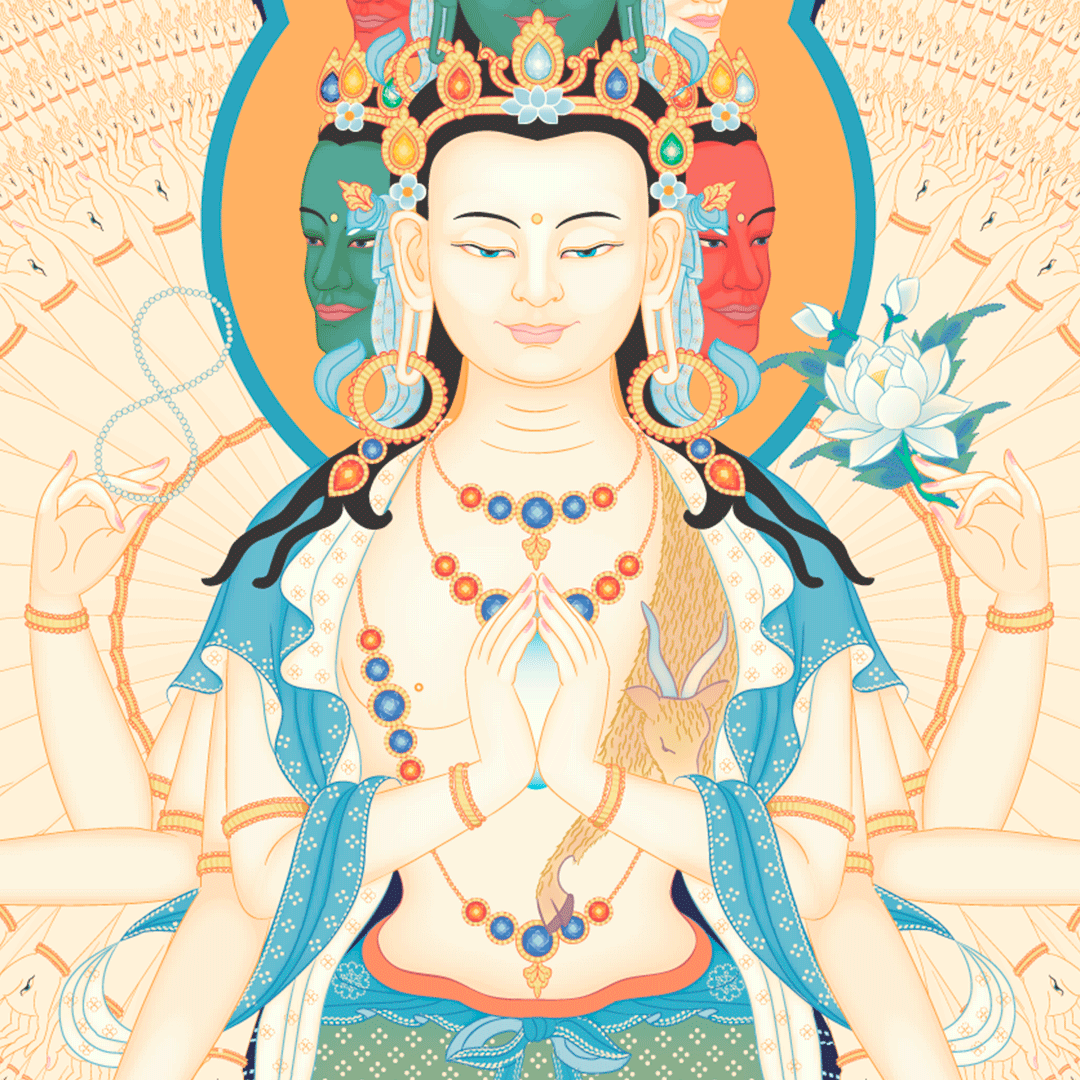
Avalokiteshvara is represented across a vast iconographic spectrum, reflecting the deity's ability to adapt to the spiritual capacity of different practitioners (upaya, or skillful means). Iconographic variations range from serene two-armed human forms to complex multi-limbed tantric structures.
1. Padmapani (The Lotus Holder)
The earliest Indian iconographic form depicts Avalokiteshvara as Padmapani, a graceful standing or seated prince holding a fully blossomed pink or blue lotus (padma) in his left hand. The lotus symbolizes primordial purity rising unpolluted out of the mud of worldly existence (samsara). In his crown, a small figure of Amitabha Buddha—the Buddha of Infinite Light—is seated, signifying Avalokiteshvara’s spiritual lineage within the Lotus Family (Padma Kula).
2. Chaturbhuja Avalokiteshvara (Four-Armed Chenrezig)
Dominant in Tibetan Buddhism, where he is known as Chenrezig, the four-armed form represents the realization of the Four Immeasurables:
- Immeasurable Loving-Kindness (metta)
- Immeasurable Compassion (karuna)
- Immeasurable Joy (mudita)
- Immeasurable Equanimity (upekkha)
In this form, his main two hands are joined at the heart in the anjali mudra, holding a wish-fulfilling jewel (chintamani) that represents the enlightened mind (bodhicitta). His upper right hand holds a crystal rosary (mala) for counting mantras, while his upper left hand holds a lotus stem.
3. Sahasrabhuja Ekadasamukha (1,000-Armed, 11-Headed Avalokiteshvara)
According to Mahayana tradition, Avalokiteshvara once vowed never to rest until all sentient beings were freed from suffering. Upon looking down into the hell realms and realizing the infinite extent of sentient misery, his head split into eleven pieces from grief.
His spiritual master, Amitabha Buddha, repaired his head by transforming the fragments into eleven distinct heads—ten depicting peaceful and wrathful expressions to subdue different temperaments, topped by the head of Amitabha himself. To aid these beings, Avalokiteshvara was granted one thousand arms, each equipped with an eye in the palm, symbolizing the unity of wisdom (eyes) and compassionate action (hands).
4. Gender Transformation: Guanyin and Kannon
As Mahayana Buddhism spread along the Silk Road into East Asia, the iconography of Avalokiteshvara underwent a significant transformation:
- China (Guanyin): By the Tang and Song Dynasties (8th–12th centuries), Avalokiteshvara merged with local female compassionate figures and maternal deities, transforming into Guanyin (the "Goddess of Mercy"). This feminine portrayal emphasized accessible, maternal protection and maternal grace.
- Japan (Kannon / Kanzeon): In Japanese Buddhism, Kannon is revered in 33 canonical forms, ranging from the feminine Nyoirin Kannon (holding the wish-fulfilling jewel) to wrathful forms such as Bato Kannon (Horse-Headed Kannon).
Primary Sacred Texts and Philosophical Foundations
The spiritual framework surrounding Buddha Avalokiteshvara is preserved across three primary scriptures, each highlighting a distinct dimension of the deity's identity.
The Heart Sutra (Prajnaparamita Hridaya)
In the Heart Sutra, Avalokiteshvara serves as the central voice explaining the ultimate nature of reality to the disciple Shariputra. Avalokiteshvara articulates that all five aggregates (skandhas) of human existence are empty of intrinsic, independent existence (svabhava):
"Form is emptiness, emptiness is form; form does not differ from emptiness, emptiness does not differ from form."
This text demonstrates that true compassion cannot exist without the realization of wisdom (prajna). Without understanding emptiness, compassion risks devolving into attached pity; with wisdom, compassion becomes a spontaneous manifestation of non-duality.
- HEART SUTRA (Avalokiteshvara reveals the unity of Compassion & Emptiness)
- Emptiness (Shunyata): Form is Emptiness; No inherent existence.
- Compassion (Karuna): Active engagement to relieve suffering without attachment.
The Lotus Sutra (Chapter 25: The Universal Gateway)
Chapter 25 of the Lotus Sutra, titled Samantamukha Parivarta, details the practical protective powers of Avalokiteshvara. The text asserts that calling upon Avalokiteshvara's name instantly protects devotees from:
- Physical dangers (fire, floods, execution, bandits, and imprisonment).
- Mental poisons (attachment, hatred, and ignorance).
- Existential fears, providing transformed births and spiritual progress.
It introduces the concept of Upaya-kaushalya (Skillful Means), describing how Avalokiteshvara manifests as a monk, a king, a woman, a child, or a non-human entity based on what form best communicates the Dharma to a suffering individual.
The Karandavyuha Sutra
This Vajrayana text introduces the cosmic nature of Avalokiteshvara, describing how suns and moons emerge from his eyes, Shiva from his forehead, and Brahma from his shoulders. Crucially, the Karandavyuha Sutra is the historical source for the famous six-syllable mantra: Om Mani Padme Hum.
Comparative Breakdown of Major Forms
The following table summarizes the primary iconography, regional names, and symbolic functions of Avalokiteshvara's prominent manifestations:
| Form / Name | Regional Tradition | Primary Visual Attributes | Core Symbolic Focus |
|---|---|---|---|
| Padmapani | India, Nepal, Early Central Asia | Standing posture, holding a lotus blossom, Amitabha in crown | Purity of the awakened mind remaining unsullied by Samsara |
| Chaturbhuja Chenrezig | Tibet, Bhutan, Mongolia | Seated in lotus pose, four arms, holding jewel, rosary, and lotus | Perfection of the Four Immeasurables and Bodhicitta |
| Sahasrabhuja Ekadasamukha | Tibet, East Asia, Nepal | 11 heads, 1,000 arms with eyes in palms, holding various implements | Omnipresent vision and unlimited capacity for active rescue |
| Guanyin (Goddess of Mercy) | China, Vietnam, East Asia | Soft feminine robes, holding a vase of nectar (amrita) and willow branch | Universal maternal grace, healing, and vocal responsiveness to distress |
| Kannon (Kanzeon) | Japan | Varied (33 traditional manifestations including Juichimen and Fukukenjaku) | Adaptive protection and subduing spiritual obstacles across 33 realms |
| Amoghapasha | Nepal, Tibet, East Asia | Multiple arms holding the lasso (pasha) and trident | Snaring delinquent beings and bringing them onto the path of liberation |
The Interdependence of Compassion (Karuna) and Wisdom (Prajna)
Within Mahayana philosophy, Buddha Avalokiteshvara represents the resolution of a fundamental spiritual dilemma: the relationship between personal liberation and the salvation of others.
In Mahayana doctrine, compassion and wisdom are described as the two wings of a bird. One cannot fly without the other:
- Compassion without Wisdom: Results in misguided sentimentality. A practitioner may desire to help others but lacks the deep insight into karma and cause-and-effect required to provide genuine, long-term help.
- Wisdom without Compassion: Results in cold, intellectual abstraction. A practitioner may understand emptiness theoretically but remain isolated from the living reality of sentient suffering.
Avalokiteshvara synthesizes these two qualities. By realizing that all phenomena are interdependent and empty of separate selfhood (shunyata), Avalokiteshvara recognizes that the suffering of others is non-different from one's own. Consequently, compassionate action becomes an automatic, unconditioned response rather than a forced moral duty.
Practical Contemplation and Devotional Practices
Devotion to Avalokiteshvara involves specific meditative, vocal, and physical practices designed to transform the practitioner's mind into the compassionate nature of the Bodhisattva.
- Mind / Visualization (Visualization of White Light & Form)
- Enlightened Mind (Bodhicitta)
- Speech / Mantra Recitation (Recitation of Om Mani Padme Hum)
- Enlightened Mind (Bodhicitta)
1. The Recitation of Om Mani Padme Hum
The six-syllable Sanskrit mantra associated with Avalokiteshvara is the most widely recited mantra in Mahayana and Vajrayana Buddhism.
- OM: Pride
- MA: Envy
- NI: Desire
- PAD: Ignorance
- ME: Greed
- HUM: Hatred
Each syllable corresponds to the purification of a specific negative emotion and the closing of the door to rebirth in one of the six samsaric realms:
- OM (ॐ): Purifies pride and ego; closes the door to the deva (god) realm.
- MA (णि): Purifies jealousy and lust for entertainment; closes the door to the asura (demigod) realm.
- NI (णि): Purifies passion and desire; closes the door to the human realm.
- PAD (प): Purifies ignorance and prejudice; closes the door to the animal realm.
- ME (द्मे): Purifies greed and possessiveness; closes the door to the hungry ghost (preta) realm.
- HUM (हूँ): Purifies hatred and anger; closes the door to the hell realm.
Practitioners recite this mantra aloud or mentally, contemplating that the sound itself carries the transformative resonance of Avalokiteshvara’s mind.
2. The Nyungne Fasting Ritual
In Tibetan tradition, the Nyungne practice is an intensive two-day retreat centered on the 1,000-Armed Avalokiteshvara, originally created by the 11th-century Indian nun Gelongma Palmo. The practice combines:
- Strict vegetarianism and complete fasting on the second day.
- Vows of total silence.
- Prostrations accompanied by visualization of Avalokiteshvara.
- Recitation of the Long Compassion Mantra (Nilakantha Dharani).
The physical hardship of the retreat is deliberately undertaken to experience a fraction of the suffering endured by beings in lower realms, cultivating genuine, unshakeable empathy.
Frequently Asked Questions
Is Avalokiteshvara considered a Buddha or a Bodhisattva?
Avalokiteshvara occupies both roles depending on the doctrinal perspective. In classic Mahayana sutras, Avalokiteshvara is a tenth-stage (dasabhumi) Bodhisattva who deliberately postpones complete Buddhahood to rescue sentient beings. In Vajrayana Buddhism, Avalokiteshvara is recognized as an eternally enlightened Buddha who appears in the form of a Bodhisattva to perform enlightened activities across the universe.
What is the spiritual meaning of the mantra Om Mani Padme Hum?
The mantra literally translates to "The Jewel in the Lotus." Symbolically, "Mani" (Jewel) represents the altruistic method—compassion, love, and the intention to achieve awakening for others. "Padme" (Lotus) represents wisdom—the insight into the empty nature of reality. The combination indicates that through the unification of compassionate method and wisdom, one can transform an impure body, speech, and mind into the pure body, speech, and mind of a Buddha.
Why did Avalokiteshvara transform into the female form Guanyin in East Asia?
The gender transition occurred gradually between the 8th and 12th centuries in China. In the Lotus Sutra, Avalokiteshvara is explicitly described as having no fixed gender, capable of taking female or male forms to help practitioners. Because East Asian cultures strongly associated ultimate mercy, tenderness, and maternal protection with female energy, popular iconography shifted toward the feminine form of Guanyin, which resonated deeply with lay devotees seeking compassionate comfort.
What is the relationship between the Dalai Lama and Avalokiteshvara?
In Tibetan Gelugpa tradition, the lineage of Dalai Lamas is recognized as successive earthly emanations (tulku) of Avalokiteshvara (Chenrezig). The Dalai Lama is understood not to be a reincarnation of a past human personality, but a purposeful manifestation of Avalokiteshvara’s enlightened compassion, taking human form to guide and protect living beings.
What do the 1,000 arms of Avalokiteshvara symbolize?
The 1,000 arms represent the infinite capacity for compassionate action (upaya). The eye embedded in the palm of each hand signifies that action must always be guided by wisdom and clear perception. According to scripture, when Avalokiteshvara’s head shattered from grief over the suffering of Samsara, Amitabha Buddha granted him 1,000 arms so he could reach out and save beings in every direction simultaneously.
Summary and Practical Application
Buddha Avalokiteshvara remains the primary archetype of active, wisdom-based mercy in the Eastern philosophical tradition. Whether approached through scholarly study, iconographic contemplation, or liturgical recitation, the spiritual framework of Avalokiteshvara provides concrete tools for developing emotional resilience, reducing self-cherishing, and cultivating deep empathy.
To integrate the principles of Avalokiteshvara into daily life:
- Establish a Daily Contemplation: Set aside dedicated time each day to cultivate Bodhicitta—the resolution to awaken for the benefit of all living beings.
- Engage in Mantra Recitation: Recite Om Mani Padme Hum while focusing on purifying personal negative habits such as anger, greed, and pride.
- Unify Wisdom with Action: Practice active service and kindness while maintaining the contemplative understanding that all beings are fundamentally interconnected.
Image Gallery