Understanding "At Least" in Math Inequalities: Symbols, Rules, and Applications
In mathematics, the phrase at least indicates that a quantity is greater than or equal to a specific value. It is represented by the symbol $\ge$. This means the value in question serves as a minimum threshold; the actual number can be...
In mathematics, the phrase at least indicates that a quantity is greater than or equal to a specific value. It is represented by the symbol $\ge$. This means the value in question serves as a minimum threshold; the actual number can be exactly that value or any number larger than it.
Contents
Mathematical language is often more precise than everyday speech, but "at least" is one of the few phrases that translates directly from common English into a specific algebraic constraint. When you see "at least" in a word problem or a technical specification, you are being given a lower boundary. In the current 2026 academic standards, mastering the translation of these verbal cues into symbolic logic remains a foundational skill for algebra, calculus, and data science.
Defining "At Least" in Mathematical Terms
The concept of "at least" belongs to the study of inequalities. Unlike an equation, which states that two expressions are exactly equal ($x = y$), an inequality describes a relationship where one value may be larger, smaller, or equal to another.
When we say a variable $x$ is at least 10, we are stating two things simultaneously:
- $x$ could be 10.
- $x$ could be any number greater than 10 (such as 11, 15, or 1,000,000).
Mathematically, this is written as: $$x \ge 10$$
This is a non-strict inequality because it includes the possibility of equality. This contrasts with "greater than" ($x > 10$), which is a strict inequality because it excludes the number 10 itself. In the context of 2026 technical requirements, whether in software engineering or structural design, failing to distinguish between strict and non-strict inequalities can lead to significant "off-by-one" errors.
The Inequality Symbol: $\ge$ (Greater Than or Equal To)
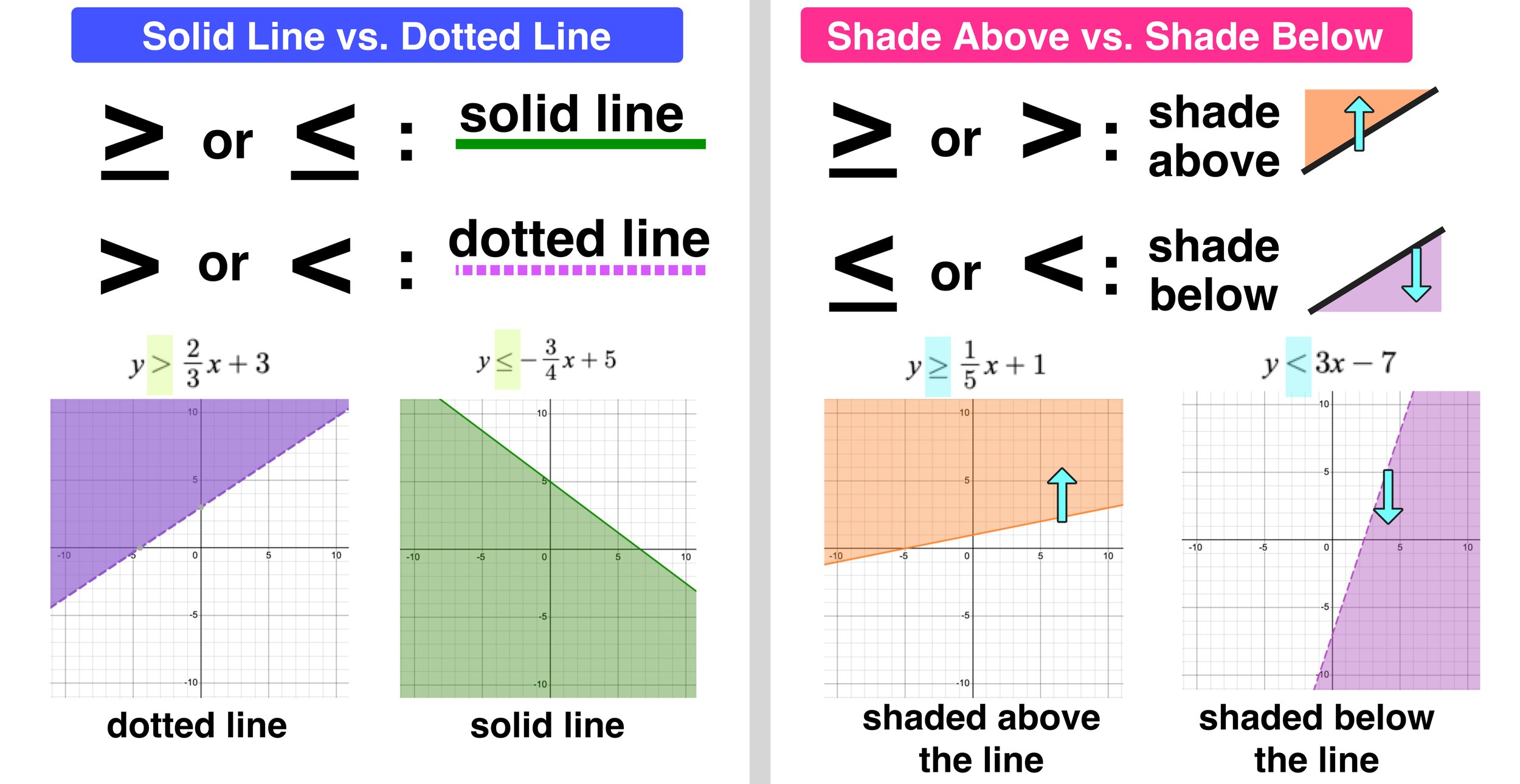
The symbol for "at least" is a combination of two other symbols: the "greater than" sign (>) and a horizontal line representing the "equal to" sign (=).
- The Component Part (>): Indicates that the value on the left is larger than the value on the right.
- The Component Part (_): Indicates that the value on the left can also be identical to the value on the right.
In computer programming and digital documentation, you will often see this written as >=. This "greater than or equal to" operator is essential in coding loops and conditional logic. For instance, if a 2026 security protocol requires at least eight characters for a password, the code checks if password_length >= 8. If the length is 8, the condition is met (true). If it is 9, it is met. If it is 7, it fails.
Translating Real-World Phrases into Inequalities
Identifying "at least" is simple when the phrase is used explicitly, but word problems often use synonyms. To solve these effectively, you must recognize the various ways a "minimum" requirement can be expressed.
Common Synonyms for "At Least"
- A minimum of: "You must carry a minimum of $25 in cash." ($c \ge 25$)
- No less than: "The temperature must be no less than 70 degrees." ($t \ge 70$)
- Not fewer than: "There must be not fewer than 5 witnesses." ($w \ge 5$)
- The bottom limit is: "The bottom limit for the scholarship is a 3.5 GPA." ($g \ge 3.5$)
Understanding these nuances is vital for translating narrative problems into solvable equations. If a 2026 logistical contract states that a shipping container must hold "no less than 500 units," you immediately translate that to $u \ge 500$.
"At Least" vs. "At Most": Clearing the Confusion
A common point of confusion for students is the difference between "at least" and "at most." While they sound similar, they represent opposite directions on the number line.
| Phrase | Meaning | Symbol | Boundary Type |
|---|---|---|---|
| At Least | Greater than or equal to | $\ge$ | Lower Bound (Minimum) |
| At Most | Less than or equal to | $\le$ | Upper Bound (Maximum) |
If you have at least 3 apples, you have 3, 4, 5... (3 is the smallest possible number). If you have at most 3 apples, you have 3, 2, 1, or 0 (3 is the largest possible number).
How to Solve Inequalities Involving "At Least"
Solving an inequality where a variable must be at least a certain value follows most of the same rules as solving basic equations, with one critical exception involving negative numbers.
Step-by-Step Algebraic Manipulation
Consider the problem: "Twice a number plus five is at least 15."
- Translate to an inequality: $2x + 5 \ge 15$
- Isolate the variable term: Subtract 5 from both sides. $$2x \ge 10$$
- Solve for $x$: Divide both sides by 2. $$x \ge 5$$
The solution $x \ge 5$ tells us that any number 5 or higher satisfies the original condition.
The Negative Flip Rule
The most important rule to remember when working with "at least" (or any inequality) is that if you multiply or divide both sides by a negative number, you must flip the inequality sign.
Example: $-3x \ge 12$ To solve for $x$, you divide by -3. Because you are dividing by a negative, the "at least" sign ($\ge$) flips to an "at most" sign ($\le$). $$x \le -4$$
Failure to flip the sign results in a solution set that is exactly the opposite of the truth. This is a common error in financial modeling and 2026 data analytics examinations. You can verify this logic by picking a number. If we didn't flip the sign, we might think $x = 0$ is a solution (since 0 is "at least" -4). But plugging 0 into the original $-3(0) \ge 12$ gives $0 \ge 12$, which is false.
Graphing "At Least" Inequalities on a Number Line
Visualizing "at least" is helpful for understanding the range of possible solutions. On a standard number line, graphing an "at least" inequality involves two specific steps:
- The Circle: Place a closed (solid) circle on the number mentioned. The solid circle indicates that the number itself is included in the solution set. (An open circle is used for "greater than" but not "equal to").
- The Direction: Draw an arrow pointing to the right. This indicates that all values larger than the starting point are also valid solutions.
For the inequality $x \ge -2$, you would place a solid dot on -2 and shade everything to the right. This visual representation is standard across Khan Academy and other major educational platforms.
Comparison Table: Inequality Phrases and Their Symbols
This table serves as a quick reference for translating common English phrases into mathematical notation, which is essential for 2026 standardized testing and technical writing.
| English Phrase | Mathematical Symbol | Inclusion of Endpoint | Example |
|---|---|---|---|
| At least | $\ge$ | Yes (Closed circle) | $x \ge 10$ |
| Minimum of | $\ge$ | Yes (Closed circle) | $m \ge 5$ |
| No less than | $\ge$ | Yes (Closed circle) | $y \ge 100$ |
| Greater than | $>$ | No (Open circle) | $x > 10$ |
| More than | $>$ | No (Open circle) | $z > 15$ |
| At most | $\le$ | Yes (Closed circle) | $x \le 20$ |
| Maximum of | $\le$ | Yes (Closed circle) | $w \le 50$ |
Practical Examples and Word Problems (2026 Scenarios)
To see how "at least" functions in practice, consider these scenarios relevant to modern academic and professional life.
Example 1: Budgeting and Finance
An entrepreneur in 2026 is launching a startup. To cover their overhead costs, they determine they need to make at least $12,000 in monthly revenue. If they sell a service for $150 per client, how many clients do they need?
- Let $c$ be the number of clients.
- Inequality: $150c \ge 12,000$
- Calculation: Divide both sides by 150.
- Solution: $c \ge 80$
- Interpretation: The entrepreneur needs 80 clients or more to meet their goal. 79 clients would be insufficient.
Example 2: Academic Requirements
A university's 2026 graduation policy states that a student must complete at least 120 credit hours to receive a degree. If a student has already completed 85 hours, how many more do they need?
- Let $h$ be the remaining hours.
- Inequality: $85 + h \ge 120$
- Calculation: Subtract 85 from both sides.
- Solution: $h \ge 35$
- Interpretation: The student must take 35 or more additional credits to graduate.
Common Mistakes to Avoid
- Using an Open Circle: When graphing $x \ge 5$, students often use an open circle. Remember: "At least" includes the number itself, so the circle must be filled in.
- Misinterpreting the Direction: Some people see "least" and think "smaller," leading them to point the arrow to the left or use the "less than" symbol. Always remember that "at least" means the value is at the bottom of the list and everything else is above it.
- Forgetting the Negative Flip: As mentioned earlier, multiplying or dividing an inequality by a negative number reverses the direction of the sign. This is the most common error in multi-step inequality problems.
- Confusing "At Least" with "More Than": "More than 10" ($x > 10$) does not include 10. "At least 10" ($x \ge 10$) does include 10. This distinction is critical in discrete mathematics where integers are the only allowed values.
Frequently Asked Questions
Does "at least" include the number itself?
Yes. In mathematics, "at least" is inclusive. If a rule says you must be at least 18 years old to vote, an 18-year-old is eligible. The inequality symbol $\ge$ specifically includes the "equal to" component.
Is "at least" the same as "greater than"?
Not exactly. "Greater than" ($>$) is a strict inequality that excludes the starting value. "At least" ($\ge$) is a non-strict inequality that includes the starting value. For example, if $x > 5$, $x$ cannot be 5. If $x \ge 5$, $x$ can be 5.
How do I type the "at least" symbol on a keyboard?
On most computers, there is no single key for $\ge$. In programming and standard text, you can type >= (the greater than sign followed immediately by the equals sign). In specialized software like Microsoft Word, you can use the "Insert Symbol" menu or type 2265 followed by Alt+X to create the mathematical $\ge$ character.
What is the opposite of "at least"?
The logical opposite of "at least" ($\ge$) is "less than" ($<$). If something is not "at least 10," it must be "less than 10." Note that the opposite of "at least" is not "at most," because both "at least 10" and "at most 10" include the number 10.
Can "at least" be used with negative numbers?
Absolutely. If $x$ is at least -5, then $x \ge -5$. This means $x$ could be -5, -4, 0, or any positive number. On a number line, you would still shade to the right.
Final Recommendation for Students and Professionals
When dealing with inequalities in 2026, the best practice is to always perform a "sanity check" after solving. If your solution is $x \ge 5$, pick a number larger than 5 (like 10) and the number 5 itself, then plug them back into the original word problem or equation. If both make sense, your translation of "at least" was successful. For those pursuing fields in data science or engineering, consistent use of the $\ge$ notation ensures that your logic remains robust across different platforms and programming languages.
For further technical exploration of inequality properties, resources like Wolfram MathWorld provide deep dives into the axiomatic foundations of these relationships.
Image Gallery