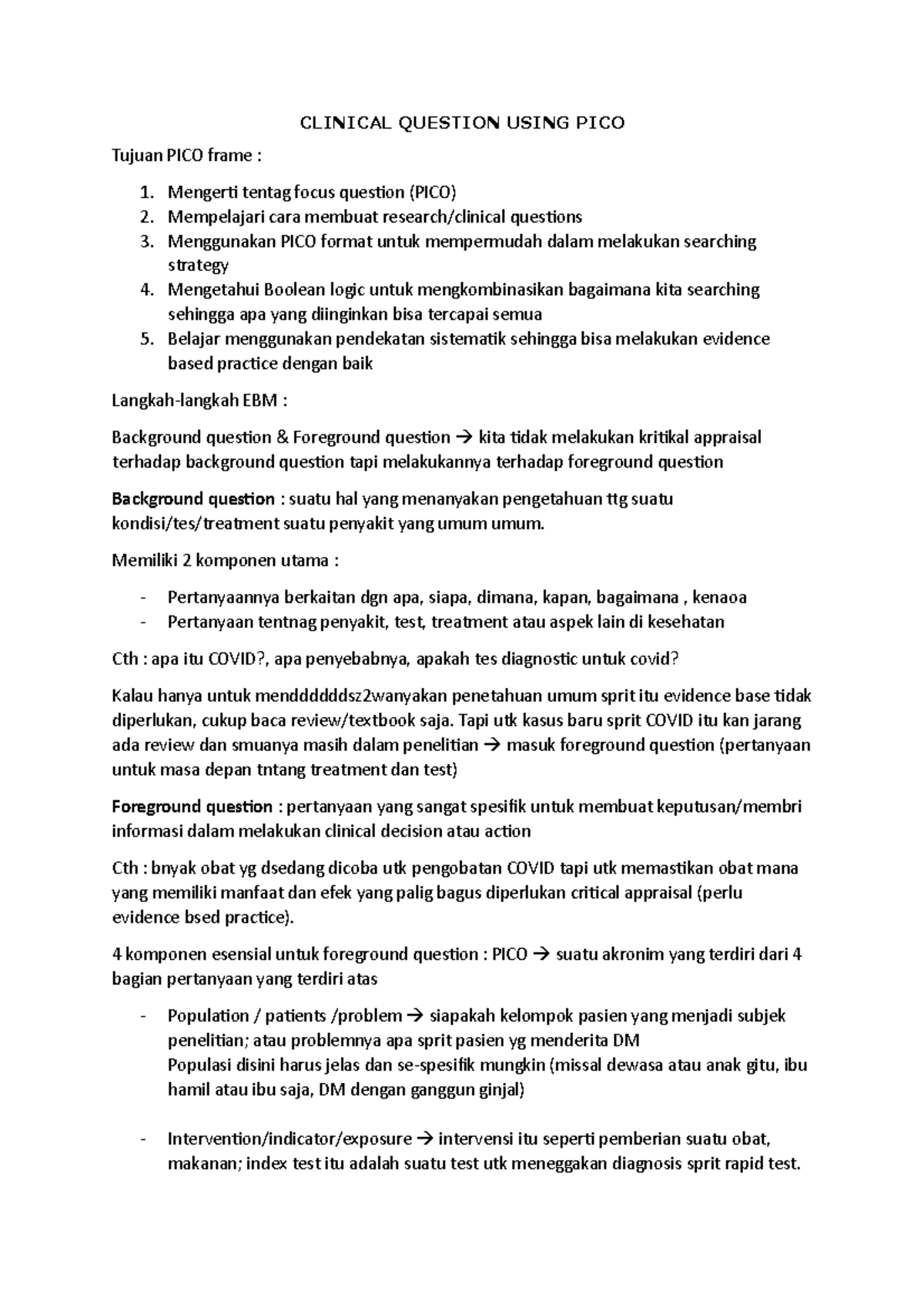
PICO Formula: A Structured Approach to Clinical Questions
The PICO formula is a mnemonic-based framework used in evidence-based practice (EBP) to construct well-defined, searchable clinical questions. By breaking a scenario into Patient/Population, Intervention, Comparison, and Outcome, healt...
The PICO formula is a mnemonic-based framework used in evidence-based practice (EBP) to construct well-defined, searchable clinical questions. By breaking a scenario into Patient/Population, Intervention, Comparison, and Outcome, healthcare professionals can streamline literature searches, improve the quality of evidence retrieved, and enhance clinical decision-making in diverse medical environments.
Contents
As of 2026, the volume of biomedical literature continues to expand at an exponential rate. For clinicians, researchers, and students, the primary challenge is no longer finding information, but filtering through the noise to find high-quality, actionable evidence. The PICO framework remains the gold standard for bridging the gap between a complex clinical observation and a precise research query. This structured approach ensures that all essential components of a clinical problem are addressed, preventing the "vague question, vague answer" trap that often leads to inefficient practice.
The Anatomy of the PICO Formula
To effectively utilize the PICO formula, one must understand the specific requirements of each of its four components. While the acronym is straightforward, the depth of detail provided within each letter determines the success of the subsequent literature search.
P: Patient, Population, or Problem
This element defines who the question is about. A well-constructed "P" component avoids overly broad terms like "adults" or "patients" and instead focuses on specific characteristics that might influence the effectiveness of an intervention.
Relevant descriptors often include:
- Primary Complaint or Disease: For example, Type 2 Diabetes or Acute Respiratory Distress Syndrome (ARDS).
- Demographics: Age groups (neonates, geriatrics), gender, or socioeconomic status if relevant to the health outcome.
- Setting: Is the patient in an Intensive Care Unit (ICU), a primary care clinic, or a long-term care facility?
- Co-morbidities: Does the patient have secondary conditions like hypertension or chronic kidney disease that might alter the response to treatment?
I: Intervention
The intervention is the action, treatment, or exposure being considered. This is not limited to pharmaceutical drugs or surgical procedures. In the modern 2026 healthcare landscape, interventions frequently include:
- Diagnostic Tests: Using a specific imaging modality or a new blood biomarker.
- Therapeutic Actions: Physical therapy protocols, dietary changes, or psychological counseling.
- Preventative Measures: Vaccines, lifestyle modifications, or workplace safety protocols.
- Management Strategies: Implementing a new nurse-led triage system or a digital health monitoring tool.
C: Comparison or Control
The comparison is often the most overlooked part of the formula, yet it is vital for establishing the relative value of an intervention. A question without a comparison is descriptive rather than analytical. The comparison may be:
- The Current Standard of Care: What is normally done in the clinical setting today?
- A Placebo: Common in randomized controlled trials to determine the baseline effect of an intervention.
- An Alternative Intervention: Comparing Drug A to Drug B to see which has fewer side effects.
- No Intervention: Monitoring the "natural history" of a condition without active treatment.
O: Outcome
The outcome defines what the clinician hopes to achieve, measure, or avoid. Outcomes must be specific and measurable to be useful in a search. Rather than using a general term like "feeling better," a structured outcome might focus on:
- Clinical Endpoints: Reduction in mortality rates, lower HbA1c levels, or decreased incidence of stroke.
- Functional Status: Improved mobility scores or the ability to return to work.
- Patient-Reported Outcomes (PROs): Quality of life scales, pain intensity (VAS score), or patient satisfaction.
- Economic Impact: Length of hospital stay or total cost of care.
Why the Structured Approach is Essential in 2026
The transition from "traditional" medicine to evidence-based practice requires a shift in how questions are asked. In the past, a clinician might ask, "How do we treat sepsis?" This is a "background question" that provides general knowledge but does not help with a specific patient. PICO is designed for "foreground questions," which are specific and lead directly to clinical decisions.
By using PICO, clinicians achieve several critical objectives:
- Search Efficiency: Using PICO elements as search terms in databases like PubMed or the Cochrane Library dramatically reduces the number of irrelevant results. It allows for the use of Boolean operators (AND, OR) to link specific population traits with specific interventions.
- Clarity of Thought: Forcing a clinician to define the "Comparison" and "Outcome" helps clarify exactly what they are looking for. It prevents the pursuit of evidence that does not actually address the patient's primary concern.
- Standardization: When a multidisciplinary team (doctors, nurses, pharmacists) uses the same framework, communication becomes more precise. Referrals and consultations are clearer when the clinical question is presented in a structured format.
Variations of the PICO Framework
While the standard PICO model is sufficient for many therapy-based questions, several variations have emerged to address specific types of research and clinical scenarios.
- PICOT (Time): Adds a "T" for the time frame. This is crucial for conditions where the duration of treatment or the timing of an outcome is significant. Example: "How does the intervention affect recovery over a 6-month period?"
- PICOS (Study Design): Adds an "S" to specify the type of study sought, such as Systematic Reviews or Randomized Controlled Trials (RCTs). This helps researchers filter for the highest levels of evidence.
- PECO (Exposure): Used primarily in public health and environmental studies. The "I" (Intervention) is replaced by "E" (Exposure). Instead of asking what treatment works, researchers ask how exposure to a certain factor (like air pollution) impacts a population.
- SPICE (Setting, Perspective, Intervention, Comparison, Evaluation): Often used in qualitative research and social sciences to capture the context and subjective experience of the patient or caregiver.
Steps to Formulating a PICO Question
Formulating a PICO question is a skill that improves with practice. Follow these steps to ensure the question is robust enough for a high-quality literature search.
Step 1: Identify the Clinical Scenario
Start with a real-world case. For example: A 65-year-old male with chronic osteoarthritis is asking if glucosamine supplements will help reduce his knee pain as effectively as the ibuprofen he currently takes.
Step 2: Extract the Key Elements
Map the scenario onto the PICO components:
- P: 65-year-old male with chronic osteoarthritis of the knee.
- I: Glucosamine supplements.
- C: Ibuprofen (NSAID).
- O: Reduction in knee pain and improved mobility.
Step 3: Write the Formally Structured Question
Combine the elements into a single, cohesive sentence.
- Structure: "In [P], how does [I] compared to [C] affect [O]?"
- Refined Question: "In older adults with chronic knee osteoarthritis, are glucosamine supplements more effective than ibuprofen in reducing joint pain and improving physical mobility?"
Step 4: Translate into Search Terms
The PICO components become your primary keywords. To expand the search, identify synonyms for each component (e.g., "osteoarthritis" OR "degenerative joint disease").
Comparison of Clinical Question Types and PICO Applications
The way you emphasize PICO components depends on the nature of the clinical problem. The following table illustrates how PICO adapts to different domains of evidence-based practice.
| Question Type | Primary Focus | Example Intervention (I) | Preferred Study Design |
|---|---|---|---|
| Therapy | Effectiveness of a treatment | New medication, surgical technique | Randomized Controlled Trial (RCT) |
| Diagnosis | Accuracy of a test | New imaging modality, biomarker | Prospective, blind comparison to gold standard |
| Prognosis | Future outcome of a disease | Time since diagnosis, age | Cohort Study, Case-Control |
| Etiology | Cause or risk factors | Environmental exposure, habit | Cohort Study, Case-Control |
| Prevention | Reducing risk of disease | Vaccine, lifestyle change | RCT, Prospective Cohort |
| Meaning | Patient experience | Qualitative interview, survey | Phenomenological Study, Ethnography |
Common Pitfalls and How to Avoid Them
Even experienced researchers can struggle with PICO if the initial clinical scenario is poorly defined.
Being Too Broad: A common mistake is defining the population as "hospitalized patients." This is too vague because the interventions for a maternity patient differ vastly from those for a trauma patient.
- Solution: Always add at least one specific descriptor (age, condition, or setting).
Ignoring the Comparison: Many clinicians search for "the benefits of Vitamin D." This is not a PICO question; it is a general interest search. Without a comparison (e.g., "compared to Vitamin D plus Calcium" or "compared to no supplement"), the evidence found will be difficult to apply to a specific choice.
- Solution: If no active alternative exists, use "standard care" or "placebo" as the comparison.
Conflating Outcomes with Interventions: Sometimes, the desired outcome is mistakenly placed in the "Intervention" slot. For example, "Does weight loss improve heart health?" Weight loss is the outcome; the intervention is the method used to achieve it (e.g., ketogenic diet or bariatric surgery).
- Solution: Always ask, "What am I doing (Intervention)?" versus "What am I measuring (Outcome)?"
Troubleshooting the PICO Process
What happens when you follow the formula but find zero results? This is a frequent issue in rare disease research or cutting-edge 2026 medical developments.
- Broaden the Population: If your search for "65-year-old males with Stage IV rare lung cancer" yields nothing, broaden the "P" to "Adults with advanced lung cancer."
- Generalize the Intervention: Instead of searching for a specific brand-name drug that may be too new, search for the drug class (e.g., "SGLT2 inhibitors" instead of a specific product name).
- Remove the Comparison: While C is vital for the formula, some databases index articles by intervention and population only. Removing the comparison from the initial search string can increase the volume of hits, which you can then manually screen for comparative data.
- Change the Database: Not all evidence is in PubMed. For nursing-specific PICO questions, CINAHL is often more productive. For systematic reviews, the Cochrane Database of Systematic Reviews is the primary source.
Frequently Asked Questions
Can PICO be used for qualitative research?
Yes, though some researchers prefer the SPIDER (Sample, Phenomenon of Interest, Design, Evaluation, Research type) or SPICE frameworks for qualitative queries. When using PICO for qualitative questions, the "Intervention" is often replaced by an "Experience" or "Phenomenon," and the "Comparison" is often omitted as qualitative work focuses on deep understanding rather than comparative effectiveness.
Is the "Comparison" always necessary?
In a formal research or systematic review context, the "Comparison" is almost always required. In daily clinical practice, if you are simply looking for the efficacy of a single new drug and there is no known alternative, you may search using only PIO. However, for true evidence-based decision-making, comparing the new option to the current status quo is essential.
How does PICO help with "Information Overload"?
By 2026, thousands of papers are published daily. PICO acts as a filter. By entering "Diabetics AND Metformin AND Weight Loss," you bypass millions of papers on diabetes that do not involve Metformin or do not measure weight. This precision saves hours of manual screening.
What is the difference between a background and a foreground question?
A background question asks for general knowledge about a condition (e.g., "What causes heart failure?"). These are best answered by textbooks. A foreground question is a PICO question that asks for specific knowledge to inform a clinical decision (e.g., "In patients with heart failure, does Entresto compared to Lisinopril reduce hospital readmission rates?"). These are best answered by primary research and systematic reviews.
Can PICO be used by non-medical professionals?
Absolutely. The PICO framework is increasingly used in evidence-based management, education, and policy-making. Any field that requires comparing one course of action against another to achieve a measurable result can benefit from the structure PICO provides.
Practical Recommendation
For clinicians and students looking to master the PICO formula in 2026, the best next action is to integrate the framework into your daily documentation or study habits. Before opening a search engine, take sixty seconds to write down the P, I, C, and O on a notepad. Use this structure to guide your interaction with medical databases. For institutional leaders, incorporating PICO templates into Electronic Health Records (EHR) can foster a culture of evidence-based practice by prompting clinicians to frame their clinical uncertainties as searchable questions during the point of care.
Image Gallery