What Is Düsseldorf Known For? A Guide to Germany’s Fashion and Business Capital
Düsseldorf is a global hub for fashion, international trade fairs, and corporate business, famous for the luxury shopping boulevard Königsallee and its historic Altstadt, often called the "longest bar in the world." As the capital of N...
Düsseldorf is a global hub for fashion, international trade fairs, and corporate business, famous for the luxury shopping boulevard Königsallee and its historic Altstadt, often called the "longest bar in the world." As the capital of North Rhine-Westphalia, it seamlessly blends avant-garde architecture in the MedienHafen with a world-renowned art scene and the largest Japanese community in Germany.
Contents
Düsseldorf often flies under the radar compared to Berlin’s grit or Munich’s alpine charm, yet it consistently ranks as one of the cities with the highest quality of life globally. In 2026, it remains a vital node in the European economy, serving as a gateway for international investors while maintaining a distinct Rhenish culture characterized by conviviality, sharp wit, and a legendary rivalry with neighboring Cologne. To understand what Düsseldorf is known for, one must look at the intersection of its high-fashion veneer and its deep-rooted industrial and artistic history.
The Global Capital of Fashion and Luxury Retail
Düsseldorf is widely recognized as the fashion capital of Germany. This reputation is anchored by the Königsallee, affectionately known as the "Kö." This landscaped boulevard, divided by a scenic canal lined with chestnut trees, is one of Europe’s most prestigious shopping streets. It serves as the primary stage for flagship stores from luxury houses such as Prada, Gucci, Chanel, and Louis Vuitton.
The city's influence on fashion extends far beyond retail. Düsseldorf is a critical center for the garment industry's wholesale and design sectors. It hosts numerous showrooms and trade fairs, such as the Fashion Net Düsseldorf, which coordinates the city's various fashion activities. Historically, the "Collection Premiere Düsseldorf" (CPD) established the city as a must-visit destination for buyers worldwide. Even as digital shifts have changed how fashion is consumed, the physical presence of over 600 showrooms in districts like Stockum and the city center ensures that the business of style remains a pillar of the local economy in 2026.
The Altstadt: The "Longest Bar in the World"
One of the most famous monikers associated with the city is the "longest bar in the world" (Längste Theke der Welt). This refers to the Altstadt (Old Town), a compact square kilometer containing over 300 bars, pubs, breweries, and restaurants. Unlike the sprawling nightlife of other cities, Düsseldorf’s scene is concentrated, creating an electric atmosphere where the boundaries between one establishment and the next often blur into the cobblestone streets.
The Legend of Altbier
Düsseldorf is the birthplace of Altbier, a top-fermented beer that is dark, copper-colored, and notably hoppy. The name "Alt" (old) refers to the traditional brewing method used before bottom-fermentation became common. In the Altstadt, four historic "house breweries" (Hausbrauereien) continue to produce their own specific versions of the brew:
- Brauerei im Füchschen: Known for its lively atmosphere and traditional pork knuckles.
- Brauerei zum Uerige: Famous for its uncompromisingly bitter, high-quality Alt and the "stickum" (secret) seasonal brews.
- Brauerei Kürzer: A more modern take on the tradition, popular with the younger crowd.
- Brauerei Schumacher: Located just outside the immediate Altstadt, it is the oldest Altbier brewery in the city.
The drinking culture here is governed by specific traditions. The waiters, known as Köbes, are famous for their brusque, no-nonsense service. They will continue to bring small glasses (0.2L) of Altbier until you place a coaster over your glass to signal that you have finished.
A Hub for Art, Culture, and Electronic Music
Düsseldorf’s contribution to global culture is profound, particularly in the realms of visual art and music. The Düsseldorf Art Academy (Kunstakademie Düsseldorf) is one of the most influential institutions of its kind. In the post-war era, it became a focal point for the international avant-garde, housing figures like Joseph Beuys, Gerhard Richter, and Andreas Gursky.
The city’s commitment to the arts is visible in the Kunstsammlung Nordrhein-Westfalen, which is divided into three main venues:
- K20: Focuses on 20th-century masterpieces, including works by Paul Klee, Henri Matisse, and Pablo Picasso.
- K21: Located in the former parliament building (Ständehaus), it focuses on contemporary art and large-scale installations.
- Schmela Haus: Used for experimental exhibitions and lectures.
The Birthplace of Electronic Music
Music historians recognize Düsseldorf as the cradle of electronic music. The band Kraftwerk formed here in 1970, establishing their Kling Klang Studio in the city center. Their pioneering use of synthesizers and drum machines laid the groundwork for synth-pop, techno, and hip-hop. Other influential bands like Neu! and La Düsseldorf also emerged from the city's vibrant 1970s experimental scene, creating a sound often referred to as "Krautrock" or the "Düsseldorf School."
Economic Powerhouse and Global Trade Fairs
Düsseldorf is a powerhouse of the German "Mittelstand" and home to numerous multinational corporations. It is a major center for telecommunications (Vodafone Germany), chemicals (Henkel), and advertising. The city's economic stability is bolstered by the Messe Düsseldorf, one of the world's most successful trade fair organizers.
The fairgrounds host several "world number one" trade fairs, including:
- Boot Düsseldorf: The world’s largest yacht and watersports show.
- Drupa: The leading international trade fair for printing technologies.
- Medica: The world's largest medical trade fair.
- K Fair: The premier event for the plastics and rubber industry.
These events bring millions of visitors to the city, driving the hospitality sector and ensuring Düsseldorf remains a globally connected business hub.
Little Tokyo: Germany’s Unique Japanese Influence
Düsseldorf is home to the third-largest Japanese community in Europe, after London and Paris. Centered around Immermannstraße, the "Little Tokyo" district offers an authentic slice of Japanese culture. This is not merely a tourist attraction but a functional community with Japanese supermarkets, bookstores, doctors, and some of the best ramen shops and sushi restaurants in Europe.
This cultural fusion culminates annually in Japan Day (Japan-Tag), a massive festival that attracts hundreds of thousands of visitors. The event features traditional music, martial arts demonstrations, and a spectacular Japanese fireworks display over the Rhine. The presence of over 600 Japanese companies in the region underscores the deep economic and cultural ties between Düsseldorf and Japan.
Modern Architecture and the Rhine Riverfront
The city's skyline is a testament to its forward-looking nature. The MedienHafen (Media Harbor) is a prime example of successful urban regeneration. Once a derelict port, it has been transformed into a district for media, fashion, and design companies. The architectural highlight is the Neuer Zollhof, a trio of organic, deconstructivist buildings designed by Frank Gehry.
The Rheinturm (Rhine Tower) stands as the city's tallest landmark. At 240 meters, it offers panoramic views of the Rhine valley. A unique feature of the tower is its "light clock," which is the world's largest digital clock, integrated into the tower’s shaft using a series of LED lights.
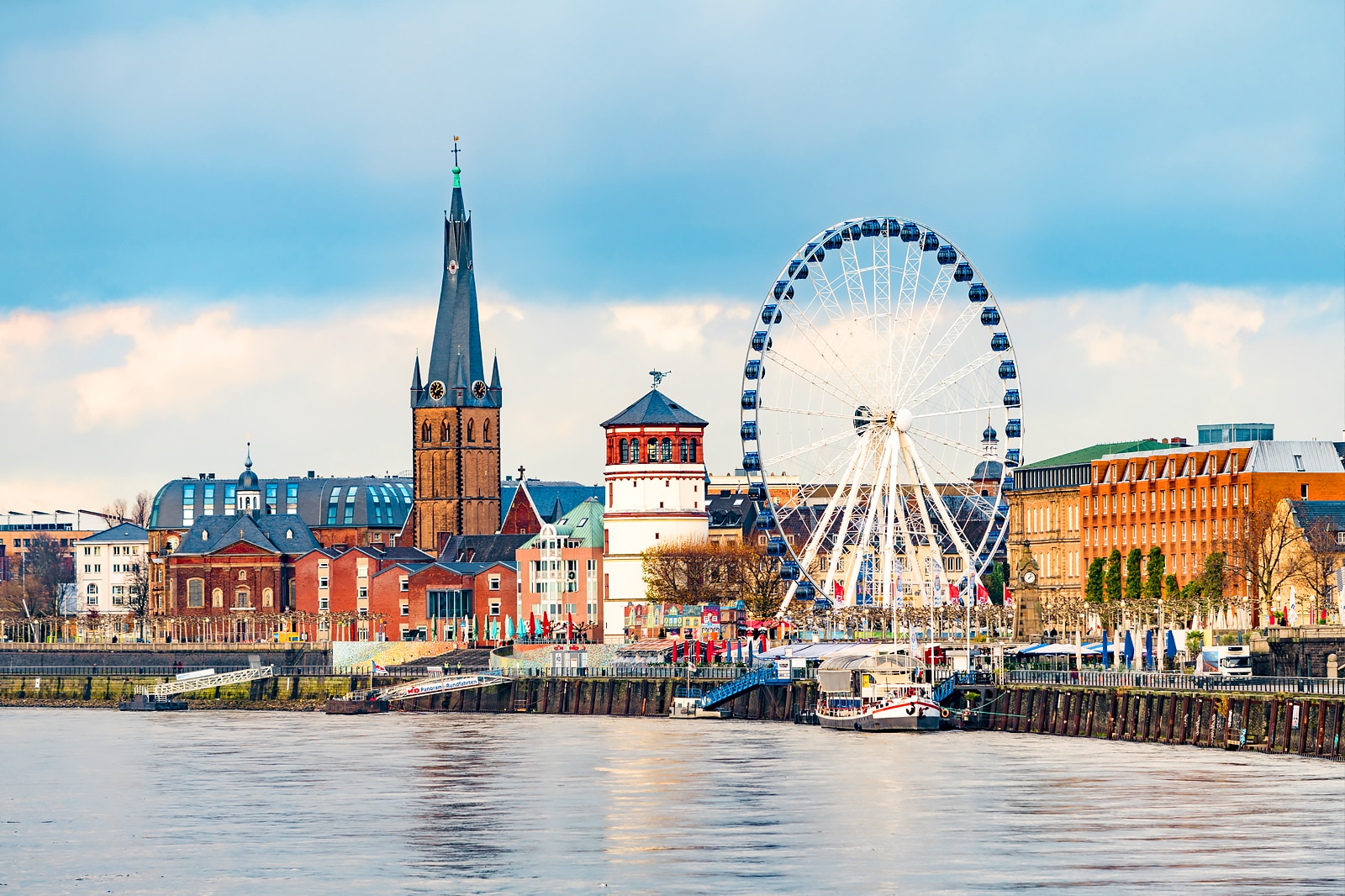
Connecting the Old Town to the Media Harbor is the Rheinuferpromenade. This pedestrian walkway along the river is the city’s social heart during the warmer months, where locals and tourists alike gather to walk, cycle, and enjoy the sunset.
Comparing Düsseldorf’s Key Districts
To better understand the city's layout and what each area offers, the following table summarizes the primary characteristics of the most significant districts.
| District | Primary Identity | Top Landmarks | Best For |
|---|---|---|---|
| Altstadt | Historic Heart | Town Hall (Rathaus), St. Lambertus | Nightlife, traditional food, beer culture |
| Stadtmitte | Business & Shopping | Königsallee, Immermannstraße | Luxury shopping, Japanese cuisine, commerce |
| MedienHafen | Modern Innovation | Gehry Buildings, Rheinturm | Architecture, fine dining, media offices |
| Pempelfort | Residential/Bohemian | Nordstraße, Ehrenhof | Local cafes, boutique shopping, art museums |
| Carlstadt | Artistic/Antique | Carlsplatz Market, City Museum | Galleries, fresh produce, antiques |
Essential Events in the Düsseldorf Calendar
Düsseldorf’s cultural identity is also defined by its seasonal events, which are deeply ingrained in the local lifestyle.
- Rhenish Carnival: Known locally as "The Fifth Season," it kicks off on November 11th but peaks in February. The Rosenmontag (Rose Monday) parade is famous for its satirical floats that often poke fun at global politicians. The local battle cry is "Helau!"
- Biggest Fair on the Rhine: Every July, the meadows across from the Altstadt host a massive funfair (Größte Kirmes am Rhein). It combines high-tech amusement rides with traditional beer tents.
- Christmas Markets: Spread across several squares (Marktplatz, Heinrich-Heine-Platz, etc.), Düsseldorf’s markets are praised for their distinct themes and high-quality crafts.
Frequently Asked Questions
How many days are needed to see Düsseldorf?
For most travelers, two to three days are sufficient to experience the primary highlights. This allows for one day exploring the Altstadt and Königsallee, a second day for the museums and MedienHafen, and a third day to explore Little Tokyo or take a boat trip on the Rhine.
Is Düsseldorf expensive to visit?
As a center for fashion and finance, Düsseldorf can be more expensive than cities like Leipzig or Berlin. However, it is generally more affordable than Munich or Zurich. Visitors can save money by utilizing the excellent public transport system and enjoying the "Büdchen" (small kiosks) culture for drinks and snacks.
What is the rivalry between Düsseldorf and Cologne?
The rivalry is legendary and mostly friendly. It stems from historical economic competition and differences in beer (Düsseldorf’s Altbier vs. Cologne’s Kölsch). During Carnival, the rivalry is most visible, as the two cities use different greetings ("Helau" in Düsseldorf and "Alaaf" in Cologne).
What is the best way to get around the city?
Düsseldorf has an integrated public transport network operated by Rheinbahn, consisting of trams, buses, and the U-Bahn (subway). The city is also very bike-friendly, with extensive paths along the Rhine. Most central attractions are within walking distance of each other.
When is the best time to visit?
Late spring (May/June) and early autumn (September) offer the best weather for outdoor activities and the Rhine promenade. December is also highly popular for the Christmas markets, while February is the time for those wishing to experience the intensity of the Rhenish Carnival.
Practical Recommendation for Visitors
To truly experience what Düsseldorf is known for, start your day with a walk through the Hofgarten, Germany's first public park, then head to the Königsallee for window shopping. For lunch, explore the authentic Japanese eateries around Immermannstraße. Spend your afternoon at the K20 Art Collection before heading to the MedienHafen to see the Gehry buildings at sunset. End your evening in the Altstadt with a glass of Altbier at Uerige or Füchschen, ensuring you experience the city’s unique blend of high-end sophistication and down-to-earth tradition.
Image Gallery