Movies in the Gun Barrel: History, Evolution, and Complete Guide to Cinema's Iconic Opening Motif
The gun barrel sequence is cinema's most recognizable opening logo motif, introduced in the 1962 James Bond film Dr. No. Created by graphic designer Maurice Binder, this signature visual feature appears in all 25 official EON Productio...
The gun barrel sequence is cinema's most recognizable opening logo motif, introduced in the 1962 James Bond film Dr. No. Created by graphic designer Maurice Binder, this signature visual feature appears in all 25 official EON Productions James Bond movies, as well as numerous feature film parodies, animated movies, and action homages.
Contents
The Cinematic Origin of the Gun Barrel Opening Sequence
The gun barrel sequence was conceived in 1962 by title designer Maurice Binder during the pre-production of Dr. No. Tasked with designing a striking opening title sequence for an unfamiliar British secret agent character, Binder created a minimalist, highly graphic visual signature that established the tone for the entire spy thriller genre.
(No code blocks, ASCII drawings, or pre tags allowed)
Note check: Ensure no backticks or code tags are used anywhere in the rendered text.
To capture the genuine depth and spiral rifling of a firearm, Binder did not rely on traditional animation techniques. Instead, he used a pinhole camera mounted inside the actual barrel of a .38 caliber Austin Freeman gun. The camera photographed the natural light passing through the rifled spiral grooves, establishing an authentic, high-contrast black-and-white graphic image that became the visual baseline for the franchise.
The original sequence shot in 1962 did not feature lead actor Sean Connery. Due to scheduling constraints and stunt coordination, stuntman Bob Simmons performed the walk, turn, and shoot maneuver. Connery did not shoot his own gun barrel footage until Thunderball in 1965, when the sequence was re-filmed to accommodate the wider Panavision anamorphic aspect ratio.
Chronological Guide to James Bond Movies with the Gun Barrel Sequence
Every main-line James Bond film produced by EON Productions incorporates a version of the gun barrel graphic. Across six decades, the sequence evolved through distinct cinematic eras, reflecting changes in lead actors, aspect ratios, color timing, and visual effects technologies.
The Classic Era: Connery, Lazenby, and Moore (1962–1985)
- Dr. No (1962): Features Bob Simmons walking across a stark white field. The sequence opens with a flickering white dot moving horizontally across the frame before resolving into the gun barrel view.
- From Russia with Love (1963): Reuses the original Bob Simmons black-and-white footage, ending with the signature red blood wipe covering the frame down to a black void.
- Goldfinger (1964): The final use of the original 1.37:1 spherical aperture Bob Simmons footage, optically cropped for theatrical projection.
- Thunderball (1965): The first gun barrel shot featuring Sean Connery himself. Filmed in anamorphic widescreen, Connery wears a dark suit and wobbles slightly during the gun recoil.
- You Only Live Twice (1967): Reuses Connery's Thunderball performance with subtle color grading adjustments.
- On Her Majesty's Secret Service (1969): Introduces George Lazenby. Lazenby drops to a single knee while firing, a unique posture among Bond actors. The sequence features a distinct dynamic shadow within the barrel grooves.
- Diamonds Are Forever (1971): Returns to Sean Connery in a revised tailored suit, establishing a brighter white matte background.
- Live and Let Die (1973): Introduces Roger Moore, wearing a flare-bottomed suit without a hat, marking the permanent elimination of the traditional trilby hat from the motif.
- The Man with the Golden Gun (1974) to A View to a Kill (1985): Spanning six films, Roger Moore's sequence features a double-handed stance in certain optical prints and subtle shifts in gun barrel metallic reflection hues.
The Modern Optical and Digital Era: Dalton, Brosnan, and Craig (1987–2021)
- The Living Daylights (1987) & Licence to Kill (1989): Timothy Dalton brings a sharp, aggressive, single-handed firing motion. The camera motion stabilizes with improved optical printing composition.
- GoldenEye (1995): Introduces Pierce Brosnan along with the franchise's first fully Computer-Generated (CG) gun barrel designed by Daniel Kleinman. The interior barrel features realistic light reflections and dynamic 3D rendering.
- Tomorrow Never Dies (1997) to Die Another Day (2002): Enhances the CGI bullet hole effect, incorporating dynamic motion-tracked blood wipes and digital shine highlights across the internal spiraling lands and grooves.
- Casino Royale (2006): Subverts the trope by embedding the gun barrel into the narrative. Daniel Craig's Bond shoots a villain in a monochromatic bathroom, transitioning into an organic blood spray that forms the barrel graphic.
- Quantum of Solace (2008): Relocates the traditional sequence to the final frame of the movie immediately preceding the end credits, featuring an accelerated walk by Craig.
- Skyfall (2012): Placed at the end of the film to commemorate the 50th anniversary, concluding with the classic 50-year logo overlay.
- Spectre (2015): Restores the gun barrel sequence to its traditional position at the absolute start of the movie for the first time in the Craig era.
- No Time to Die (2021): Integrates a soft digital focus pull where the barrel dots fade into a snowbound landscape, serving as a transitional device into the opening prologue.
Technical Evolution of the Gun Barrel Visual Effects
| Film Era | Primary Actor(s) | Production Technique | Aspect Ratio | Key Visual Characteristic |
|---|---|---|---|---|
| Early Classic (1962–1964) | Bob Simmons (Stuntman) | Pinhole camera inside .38 barrel | 1.37:1 Academy | Black-and-white high contrast, off-center white dot entry |
| Widescreen Classic (1965–1971) | Sean Connery, George Lazenby | Optical printer animation composite | 2.35:1 Anamorphic | Anamorphic stretch, deep shadow gradients, hat removal (Lazenby) |
| Analog Color (1973–1989) | Roger Moore, Timothy Dalton | Multi-plane optical rostrum film | 2.39:1 Panavision | Brightened white field, metallic sheen inside rifling |
| CGI Transition (1995–2002) | Pierce Brosnan | 3D Computer Graphics (Maya/Softimage) | 2.39:1 Super 35 | Dynamic light reflections, CGI blood, bullet path alignment |
| Modern Integrated (2006–2021) | Daniel Craig | CGI hybrid & practical plate blend | 2.39:1 / IMAX | Contextual narrative insertion, variable placement (head/tail) |
Non-Bond Movies Featuring the Gun Barrel Sequence: Parodies and Homages
The cultural ubiquity of the gun barrel opening has led dozens of non-Bond films to parody, honor, or reinterpret the visual framework.
Design Innovation in Cinema History Maurice Binder's choice to shoot down a real barrel created an immediate sense of danger. By placing the audience inside the perspective of the hidden assassin's gun looking out at Secret Agent 007, the graphic frame creates instant narrative tension before a single line of dialogue is spoken.
Direct Parodies and Comedy Films
- Austin Powers: International Man of Mystery (1997): Replaces James Bond with Mike Myers' character, who shoots the camera, causing the frame to leak blood before dancing off-screen.
- Johnny English (2003) & Johnny English Reborn (2011): Features Rowan Atkinson in physical comedy variations of the classic stance, often misfiring or stumbling during the turn.
- Spy Hard (1996): Features Leslie Nielsen performing a clumsy gun barrel entry, shooting directly into the lens until water shoots out to douse the viewer.
- The Simpsons Movie (2007): Features Homer Simpson walking into frame within a gun barrel graphic, turning, and shooting the screen, only to realize he forgot to load the weapon.
Feature Animation and Action Homages
- Spies in Disguise (2019): Uses a stylized digital graphic opening that mimics the pinhole spiral optics to introduce Will Smith's super-spy character, Lance Sterling.
- Deadpool & Wolverine (2024): Features breaking-the-fourth-wall structural nods to iconic studio opening motifs, including high-contrast aperture frames referencing classic 1960s spy aesthetics.
- The Lego Batman Movie (2017): Employs block-built animated aperture transitions during hero entrances, taking visual cues directly from Binder's graphic framing.
Technical Mechanics: How the Gun Barrel Effect Works
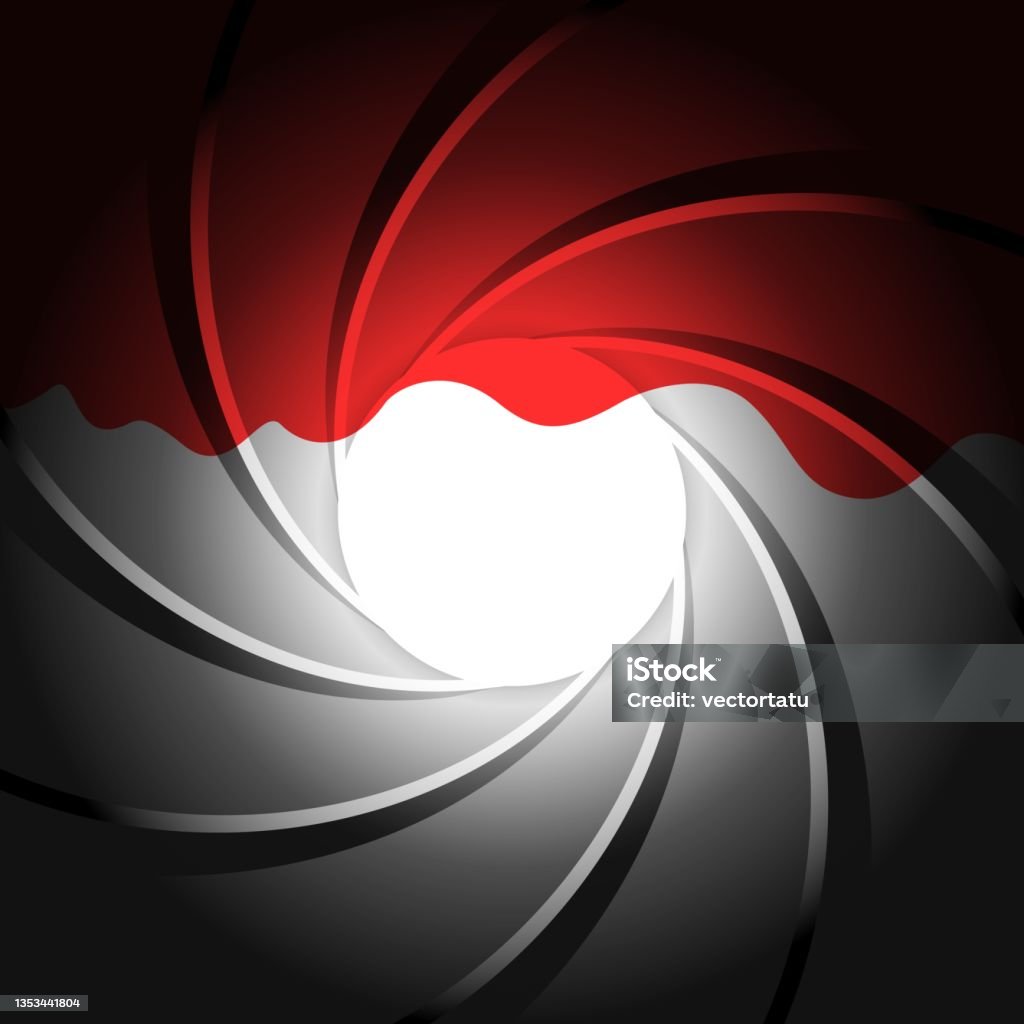
Understanding how the gun barrel motif functions requires analyzing its four key visual components: the dot pass, the tracking turn, the muzzle flash effect, and the blood curtain drop.
1. The White Dot Pass
The sequence opens across a blank black screen. A series of bright white circular dots travel horizontally from left to right across the frame. Historically achieved via animated rostrum camera cutouts, modern digital versions use procedural particle emitters. Once the final dot reaches the right margin, it sweeps back to the center and expands rapidly to reveal the interior of the rifled gun barrel.
2. The Tracking Shot and Turn
The camera remains stationary from the perspective of an invisible assailant looking down the barrel. The secret agent walks left-to-right in mid-profile across a pure white void background. As the actor reaches the exact center of the spiral iris, he swiftly pivots 90 degrees to face the camera, draws his sidearm (traditionally a Walther PPK or P99), and fires directly down the line of sight.
3. The Muzzle Flash and Frame Shake
Upon firing, an optical flash overlay covers the center aperture. In early optical prints, this was created by exposing two to three frames of high-intensity white light onto the master print. In post-1995 digital releases, a directional lens flare and micro-camera shake are applied to simulate the kinetic shockwave of the bullet passing the camera lens.
4. The Blood Curtain Drop
Immediately following the muzzle flash, deep red translucent color dissolves over the image, wiping downward from the top of the aperture to the bottom. In early films, this effect was created by filming liquid dye falling down a sheet of vertical glass on an optical printer table. The sequence concludes as the red wash turns the frame black, leaving a shrinking white dot that opens directly into the film's pre-title cold open scene.
Modern Archival Restorations and Technical Standards
In modern 4K HDR remastering workflows, preserving the visual fidelity of the original optical gun barrel prints presents unique digital cleanup challenges.
- Grain Preservation vs. Noise Reduction: Because the early gun barrel sequences were created using optical printers—layering multiple film elements together—they naturally contain higher levels of film grain than the main feature footage. Remastering engineers must avoid over-applying Digital Noise Reduction (DNR), which strips away the authentic texture of Binder's original high-contrast camera plates.
- Color Space Conversion: The signature red blood curtain requires exact Rec.2020 color gamut mapping during High Dynamic Range (HDR10 / Dolby Vision) mastering. Incorrect color space mapping can cause the red dye gradient to clip, resulting in an unnatural magenta hue instead of the deep crimson shade seen on original 35mm prints.
- Aspect Ratio Uniformity: Early releases like Goldfinger featured subtle shifts in matting frame sizes. Restoration guidelines require strict adherence to the original theatrical release aperture specs (1.85:1 or 2.39:1 depending on the production year) to prevent stretching the circular geometry of the gun barrel into an ellipse.
Frequently Asked Questions
Which movie first introduced the gun barrel sequence?
The gun barrel sequence debuted in the 1962 James Bond film Dr. No. It was designed by graphic designer Maurice Binder and performed by stuntman Bob Simmons rather than lead actor Sean Connery.
Is Sean Connery in the gun barrel sequence of Dr. No?
No, Sean Connery is not in the gun barrel sequence of Dr. No. Stuntman Bob Simmons performed the walk, turn, and shoot sequence for the first three Bond films (Dr. No, From Russia with Love, and Goldfinger). Sean Connery first filmed the shot himself for 1965's Thunderball.
How did Maurice Binder create the original gun barrel shot?
Maurice Binder created the original shot by mounting a pinhole camera inside the real barrel of a .38 caliber Austin Freeman gun. The camera captured natural light reflecting off the internal spiral rifling, forming the high-contrast graphic circle used in the title sequence.
Which non-James Bond movies use the gun barrel sequence?
Numerous non-Bond movies parody or pay homage to the sequence, including Austin Powers: International Man of Mystery, Johnny English, Spy Hard, The Simpsons Movie, and Spies in Disguise.
Why was the gun barrel moved to the end of Quantum of Solace and Skyfall?
Directors Marc Forster (Quantum of Solace) and Sam Mendes (Skyfall) felt that placing the traditional gun barrel at the opening disrupted the immediate dramatic momentum of their pre-credit action sequences. For Skyfall, moving it to the end also allowed EON Productions to use the sequence as a celebratory bridge into the 50th-anniversary credits.
Exploring Cinematic Title Design
The gun barrel sequence remains a masterclass in visual branding, demonstrating how simple geometric framing and high-contrast cinematography can define an entire genre. Film historians, graphic designers, and cinephiles studying visual effects evolution can analyze how this 60-year-old motif successfully adapted from analog pinhole photography to cutting-edge digital rendering without losing its cultural identity.
Image Gallery