Gorilla Forearm Anatomy and Functional Significance
Gorilla forearm anatomy is characterized by massive muscle bellies, high bone mineral density, and specialized tendon insertions that facilitate both knuckle-walking and powerful arboreal climbing. These adaptations prioritize extreme...
Gorilla forearm anatomy is characterized by massive muscle bellies, high bone mineral density, and specialized tendon insertions that facilitate both knuckle-walking and powerful arboreal climbing. These adaptations prioritize extreme grip strength and weight-bearing stability over the fine motor precision found in humans, allowing a silverback to exert force exceeding several thousand newtons.
Contents
The Osteological Foundation: Radius and Ulna Robusticity
The skeletal framework of the gorilla forearm consists of the radius and the ulna, but their morphology differs significantly from other hominoids. In gorillas (Gorilla gorilla and Gorilla beringei), these bones are characterized by exceptional cortical thickness and a distinct curvature.
The radius is particularly robust, featuring a distal expansion that provides a broad surface area for the carpal bones. This is a critical adaptation for knuckle-walking, as the radius must transmit a significant portion of the animal's body weight—which can exceed 400 pounds in adult males—through the wrist and into the ground. Unlike the relatively straight human radius, the gorilla's radius often exhibits a pronounced lateral bowing. This curvature increases the space for the massive flexor muscle mass, allowing for larger muscle bellies and, consequently, greater force production.
The ulna in gorillas features a prominent olecranon process. While technically part of the elbow joint, the length of this process is functionally significant for the forearm because it provides a powerful lever arm for the triceps brachii. However, within the forearm itself, the ulna acts as a stable strut. The distal end of the ulna in gorillas does not directly articulate with the carpal bones (a trait shared with humans and chimps), which allows for a greater degree of wrist rotation (supination and pronation) compared to monkeys, though this mobility is somewhat restricted in gorillas to favor stability during terrestrial travel.
Myology: The Powerhouse Flexor Groups
The functional significance of the gorilla forearm is most evident in its musculature. The "forearm" is divided into the anterior (flexor) and posterior (extensor) compartments. In gorillas, the flexor compartment is disproportionately developed.
The Flexor Digitorum Profundus and Superficialis
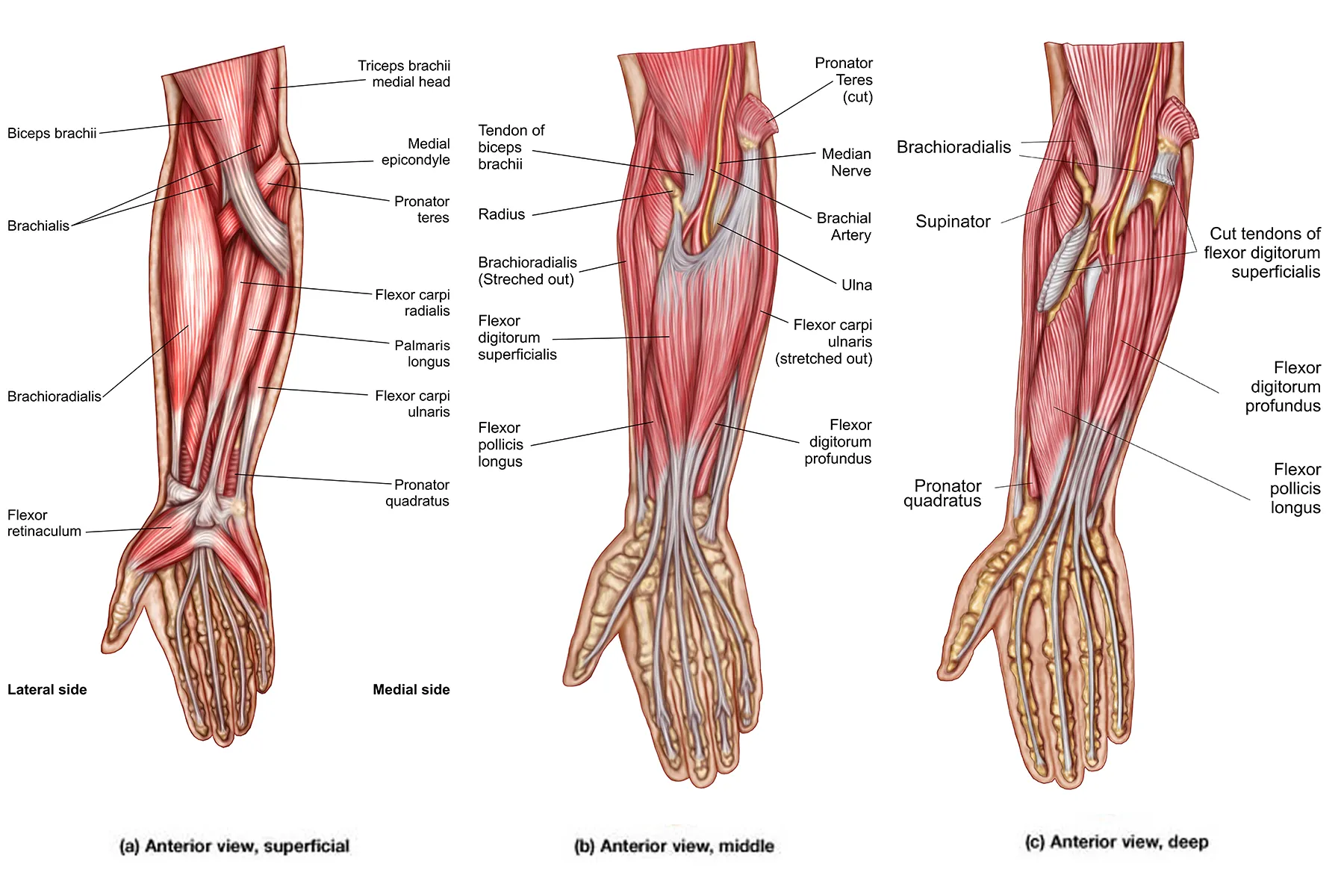
The Flexor Digitorum Profundus (FDP) and Flexor Digitorum Superficialis (FDS) are the primary drivers of the gorilla’s legendary grip strength. In humans, these muscles allow for independent finger movement. In gorillas, these muscles are much more integrated. The FDP in gorillas is massive, often possessing a physiological cross-sectional area (PCSA) several times larger than that of a human. This high PCSA allows the gorilla to maintain a "power grip" for extended periods, which is vital for hauling its massive weight up tree trunks or through dense canopy.
The Brachioradialis and Pronator Teres
The brachioradialis is a muscle of the forearm that acts as a powerful flexor of the elbow, especially when the forearm is in a neutral position (neither palm up nor palm down). In gorillas, this muscle is exceptionally thick. Its functional significance lies in climbing; when a gorilla reaches upward and pulls its body toward a branch, the brachioradialis works in tandem with the biceps and brachialis to provide the necessary vertical lift.
The pronator teres is also highly developed. While its primary role is to rotate the forearm, in gorillas, it also acts as a stabilizer for the elbow joint during knuckle-walking, preventing the joint from buckling under the animal's weight.
Functional Significance in Knuckle-Walking
As of 2026, primatological consensus continues to emphasize the forearm as the mechanical bridge of the knuckle-walking gait. Gorillas are "stiff-wristed" knuckle-walkers compared to chimpanzees. This stability is provided by both the bone structure and the ligamentous support within the forearm and wrist.
During the stance phase of knuckle-walking, the forearm is held in a near-vertical position. The muscles of the forearm must engage in "isometric contraction"—meaning they exert force without changing length—to lock the wrist in place. This prevents the wrist from over-extending (hyperextension), which could lead to ligamentous damage or fractures given the gorilla's mass.
The Extensor Carpi Radialis muscles, located on the back of the forearm, play a surprising role here. While they are technically extensors, they act as dynamic stabilizers, firing simultaneously with the flexors to "clamp" the carpal bones into a rigid block. This co-contraction is a hallmark of gorilla forearm function, prioritizing structural integrity over the fluid, variable movements required for tool manipulation.
Comparative Biometrics: Gorilla vs. Human Forearms
To understand the scale of gorilla forearm anatomy, it is helpful to compare specific metrics against human anatomy. These differences are not merely about size; they are about mechanical advantage and the distribution of muscle fibers.
| Feature | Gorilla Forearm | Human Forearm |
|---|---|---|
| Muscle Mass Ratio | High (Primary mass in Flexors) | Moderate (Balanced Flexors/Extensors) |
| Bone Cortical Density | Extremely High (Weight-bearing) | Moderate (Mobility-focused) |
| Brachial Index | Lower (Relatively shorter forearms) | Higher (Relatively longer forearms) |
| Primary Nerve Focus | High-force motor units | High-precision motor units |
| Wrist Mobility | Restricted (Stability priority) | High (Dexterity priority) |
| Grip Capability | Power Grip (Cylindrical/Crushing) | Precision Grip (Pincer/Fine Motor) |
Evolutionary Trade-offs: Strength vs. Dexterity
The functional significance of the gorilla's forearm anatomy reveals a clear evolutionary trade-off. While humans evolved forearms that facilitate the use of complex tools, throwing, and fine-tuned manipulation, gorillas evolved for "mechanical economy" and raw power.
The gorilla's forearm has a lower density of sensory receptors compared to humans. Furthermore, the neural innervation of the forearm muscles in gorillas involves larger motor units. A single motor neuron in a gorilla might trigger hundreds of muscle fibers simultaneously, leading to massive, synchronized contractions. In contrast, human motor units are smaller, allowing us to fire only a few fibers at a time for delicate tasks like threading a needle or typing.
This anatomy makes the gorilla an "obligate power-user." The forearm's functional significance is rooted in its ability to resist the forces of gravity during locomotion and to generate the explosive force required for breaking through vegetation or defending against predators. Research published in the Journal of Anatomy has indicated that even young gorillas possess forearm strength-to-weight ratios that far exceed those of adult human athletes, largely due to the distal insertion points of the tendons which provide better mechanical leverage.
Tendon Morphology and Force Transmission
The tendons in a gorilla's forearm are significantly thicker and less elastic than those in humans. This is a vital adaptation for transmitting the massive forces generated by the flexor muscles to the phalanges (finger bones).
In the gorilla forearm, the tendon sheaths are highly reinforced to prevent "bowstringing." Bowstringing occurs when a tendon pulls away from the bone during heavy loading. Because gorillas exert such high forces, their forearm anatomy includes thick fibrous pulleys that keep the tendons pinned close to the bone. This ensures that the force generated by the muscle is translated directly into grip strength without energy loss.
Frequently Asked Questions
How much stronger is a gorilla's grip than a human's?
While exact measurements vary, estimates suggest a silverback gorilla’s grip strength can exceed 500 kg (1,100 lbs) under extreme exertion. This is roughly five to nine times the strength of an average adult male human. This strength is a direct result of the high physiological cross-sectional area (PCSA) of the forearm flexor muscles.
Does the gorilla forearm anatomy allow for tool use?
Yes, gorillas use tools, such as using sticks to gauge water depth or as walking aids. However, their forearm anatomy limits them to "power-grip" tool use. They lack the fine-tuned control of the Extensor Pollicis Longus (a thumb muscle) that humans use for precision tasks, making their tool use more functional and less dexterous.
Why are gorilla forearms so much hairier than their upper arms?
The hair density on a gorilla's forearm serves as protection. Since gorillas spend much of their time knuckle-walking through dense, abrasive undergrowth and thorny vegetation, the thick hair and underlying thick skin on the forearm act as a protective barrier against lacerations and insect bites.
Do gorillas experience forearm injuries like "tennis elbow"?
In the wild, gorillas rarely suffer from chronic tendonitis like "tennis elbow" because their musculoskeletal system is built for these loads. However, in captive settings with aging populations, zookeepers in 2026 have noted occurrences of osteoarthritis in the radio-carpal joint, likely due to the long-term stress of weight-bearing locomotion on hard surfaces.
Can a gorilla rotate its forearm like a human?
Gorillas can supinate and pronate (rotate) their forearms, but they have a reduced range of motion compared to humans. This reduction is a functional necessity; too much mobility in the forearm bones would compromise the stability needed to support their heavy frames during knuckle-walking.
Practical Implications for Evolutionary Biology
Understanding gorilla forearm anatomy is essential for paleoanthropologists who study the fossil record of human ancestors. By analyzing the "robusticity" and muscle attachment scars on fossilized radius and ulna fragments, researchers can determine whether an extinct hominid was primarily arboreal, a knuckle-walker, or an upright biped.
For those interested in primatology or biomechanics, the gorilla forearm stands as the ultimate example of biological engineering for power. It represents a specialized evolutionary path where the forearm ceased to be a tool for exploration and became a specialized pillar for locomotion and a vice-grip for survival.
Image Gallery