How Commercial Auto Insurance in Melbourne, AR Is Changing
Commercial auto insurance in Melbourne, Arkansas is undergoing a significant transformation driven by rising vehicle replacement costs, local telematics adoption, stricter carrier underwriting standards, and regional litigation trends...
Commercial auto insurance in Melbourne, Arkansas is undergoing a significant transformation driven by rising vehicle replacement costs, local telematics adoption, stricter carrier underwriting standards, and regional litigation trends across North-Central Arkansas. Business owners in Izard County face higher mandatory liability thresholds, dynamic usage-based pricing, and stricter safety protocols tailored to rural highway corridors.
Contents
| Traditional Model | Evolving Model (2026) |
|---|---|
| Static annual policy ratings | Real-time telematics tracking |
| Basic state liability minimums | $1M+ Combined Single Limits |
| Standard vehicle repair estimates | ADAS sensor calibration costs |
| Generalized driver risk profiles | Continuous MVR monitoring |
Key Drivers Behind Melbourne's Shifting Commercial Insurance Landscape
The commercial auto insurance market across Izard County and the surrounding Ozark region reflects national economic shifts while responding to distinct local risk factors. Small trade contractors, agricultural haulers, logging outfits, and retail delivery operators in Melbourne encounter an insurance environment that demands greater operational transparency and proactive risk management.
Several macro and microeconomic forces drive this evolution:
- Repair Inflation and Advanced Vehicle Technology: Modern work trucks, vans, and heavy-duty vehicles come equipped with Advanced Driver Assistance Systems (ADAS), including lane-departure sensors, automated emergency braking, and blind-spot radar. While these systems reduce collision frequency, they drastically increase physical damage repair costs. A simple bumper replacement on a commercial pickup now requires specialized electronic recalibration, driving up comprehensive and collision loss ratios for carriers operating in Arkansas.
- Regional Litigation and Social Inflation: Arkansas courts have seen elevated settlement values for commercial vehicle accidents. High-dollar jury awards and legal expenses across the state force commercial insurers to increase premium pools and raise base rate schedules for commercial fleets, even in lower-density areas like Melbourne.
- Severe Weather Patterns: North-Central Arkansas experiences seasonal severe storms, hail, windstorms, and winter ice along rural state routes such as Highway 9 and Highway 56. High claims volume from comprehensive weather losses directly impacts local underwriting profitability.
Technical Trends Impacting Business Fleets in Izard County
1. Widespread Integration of Telematics and Usage-Based Insurance (UBI)
Historically, underwriters calculated commercial auto premiums using static data points: business ZIP code, vehicle weight class, broad usage categories, and annual historical mileage estimates. Carriers serving Melbourne now mandate or heavily incentivize telematics devices and mobile application tracking.
Telematics systems capture real-time driving metrics:
- Hard Braking and Rapid Acceleration: Indicating aggressive driving or inadequate trailing distance on rural routes.
- Cornering Force: Measuring vehicle stability around tight Ozark foothill curves.
- Time-of-Day Routing: Tracking late-night or early-morning transport when visibility is compromised.
- Speeding Relative to Posted Limits: Monitoring compliance along secondary highways and local municipal zones.
For small businesses in Melbourne, telematics presents a dual reality. Fleets that enforce strict driver safety programs earn substantial policy discounts—often between 10% and 25%. Conversely, businesses that fail to monitor driver behavior face steep surcharge adjustments or non-renewal notices during policy anniversaries.
2. Escalating Mandatory Liability Limits
While Arkansas statutory requirements for personal vehicles remain at baseline minimums ($25,000 per person for bodily injury, $50,000 per accident for bodily injury, and $25,000 for property damage), these figures are entirely inadequate for commercial operations.
- Arkansas Legal Minimum ($25k/$50k/$25k)
- vs. Standard Commercial Contract Benchmark ($1,000,000 Combined Single Limit)
Carriers writing commercial policies in Melbourne increasingly require a minimum $1,000,000 Combined Single Limit (CSL) for standard commercial vehicles. For heavy haulers, logging trucks, and hazardous material transporters, primary policy requirements frequently start at $2,000,000, with commercial general liability or excess umbrella policies becoming mandatory prerequisites for commercial contract eligibility.
3. Continuous Motor Vehicle Record (MVR) Screening
The traditional practice of running a driver's Motor Vehicle Record once per year at policy renewal is fading. Underwriters now leverage continuous MVR monitoring software that alerts insurers to violations, suspensions, or DUI charges in near real-time. A single major violation by an employee operating a company vehicle can result in immediate driver exclusion mandates from the insurer.
Regulatory and Statutory Requirements in Arkansas
Commercial motor vehicles (CMVs) operating in Melbourne must comply with both federal mandates and regulations enforced by the Arkansas Insurance Department (AID) and the Arkansas Department of Finance and Administration (DFA).
- Commercial Fleet Regulatory Framework
- State / Local Jurisdiction (AID / DFA Rules)
- Form E Financial Proof
- Intra-State Weight Ratings
- Mandatory Local Coverage
- Federal / Interstate (FMCSA Rules)
- MCS-90 Endorsements
- Interstate CSL Requirements
- DOT Driver Qualification
- State / Local Jurisdiction (AID / DFA Rules)
Key regulatory touchpoints shaping current commercial coverage include:
- Form E Filings: Intrastate motor carriers regulated by the state must submit filings proving continuous liability insurance coverage to maintain legitimate authority.
- Federal Motor Carrier Safety Administration (FMCSA) Oversight: Local carriers in Melbourne that cross state lines—such as hauling freight or agricultural products north into Missouri—fall under FMCSA jurisdiction. Federal law mandates liability insurance ranging from $750,000 to $5,000,000 depending on the cargo classification and gross vehicle weight rating (GVWR).
- Hired and Non-Owned Auto (HNOA) Compliance: Businesses in Melbourne whose employees use personal vehicles for work tasks (e.g., runs to the bank, local supply houses, or client site visits) are subject to significant third-party liability exposure. Insurers are modifying HNOA endorsements to require strict employer verification of personal auto insurance limits for all participating staff.
Traditional vs. Modern Commercial Auto Coverage in Melbourne, AR
The table below highlights how core commercial auto policy structures, underwriting evaluations, and operational requirements have evolved for local fleet operators:
| Feature / Rating Factor | Historical Standard | Current Market Standard | Operational Impact on Melbourne Businesses |
|---|---|---|---|
| Driver Evaluation | Annual MVR checks at renewal | Continuous MVR tracking & automated alerts | Immediate removal of high-risk drivers required to maintain coverage. |
| Primary Liability Limit | $300,000 – $500,000 CSL | $1,000,000 CSL baseline ($2M+ for heavy haul) | Higher premium floors; greater financial protection against catastrophic claims. |
| Data Collection | Self-reported mileage & radius | Mandatory telematics / GPS tracking | Rates directly tied to actual driver performance on local highways. |
| Physical Damage Claims | Traditional body shop repairs | ADAS sensor calibration & specialized tech | Longer downtime for repairs and higher comprehensive/collision deductibles. |
| Employee Vehicle Use | Unmonitored informal errands | Mandatory Hired & Non-Owned Auto (HNOA) rules | Proof of personal underlying insurance ($100k/$300k) required for staff. |
| Weather Risk Assessment | Standard regional underwriting | Micro-zone severe weather risk pricing | Higher hail/storm deductibles or required sheltered vehicle storage. |
Sector-Specific Impacts Across Local Melbourne Industries
Changes in commercial auto underwriting do not affect all local businesses equally. Specialized industries in Melbourne and Izard County experience distinct policy adjustments:
Construction, Electrical, and Plumbing Contractors
Tradespeople operating service vans and utility trucks face rising physical damage rates due to expensive tools and installed equipment mounted to vehicles. Insurers now require tailored Inland Marine (Tool and Equipment Transit Riders) alongside standard commercial auto coverage, explicitly excluding unattached tools from base collision policies.
Agricultural Transport and Timber Hauling
Logging and farming routes across rural North-Central Arkansas present heightened rollover and off-road accident risks. Insurers writing timber and agricultural fleets are reducing maximum available policy limits unless operators implement strict weight monitoring, routine brake testing, and mandatory dashcam installation.
Local Services and Sales Fleets
Small businesses utilizing lighter passenger vehicles or SUVs for local client meetings or delivery services are shifting toward hybrid policy models. Insurers demand clear separation between personal commuting and commercial usage, penalizing businesses that fail to declare regular business routes.
Strategies for Local Businesses to Manage Insurance Costs
Navigating the changing commercial auto market requires a proactive risk mitigation framework. Business owners in Melbourne can control rising insurance costs through several concrete steps:
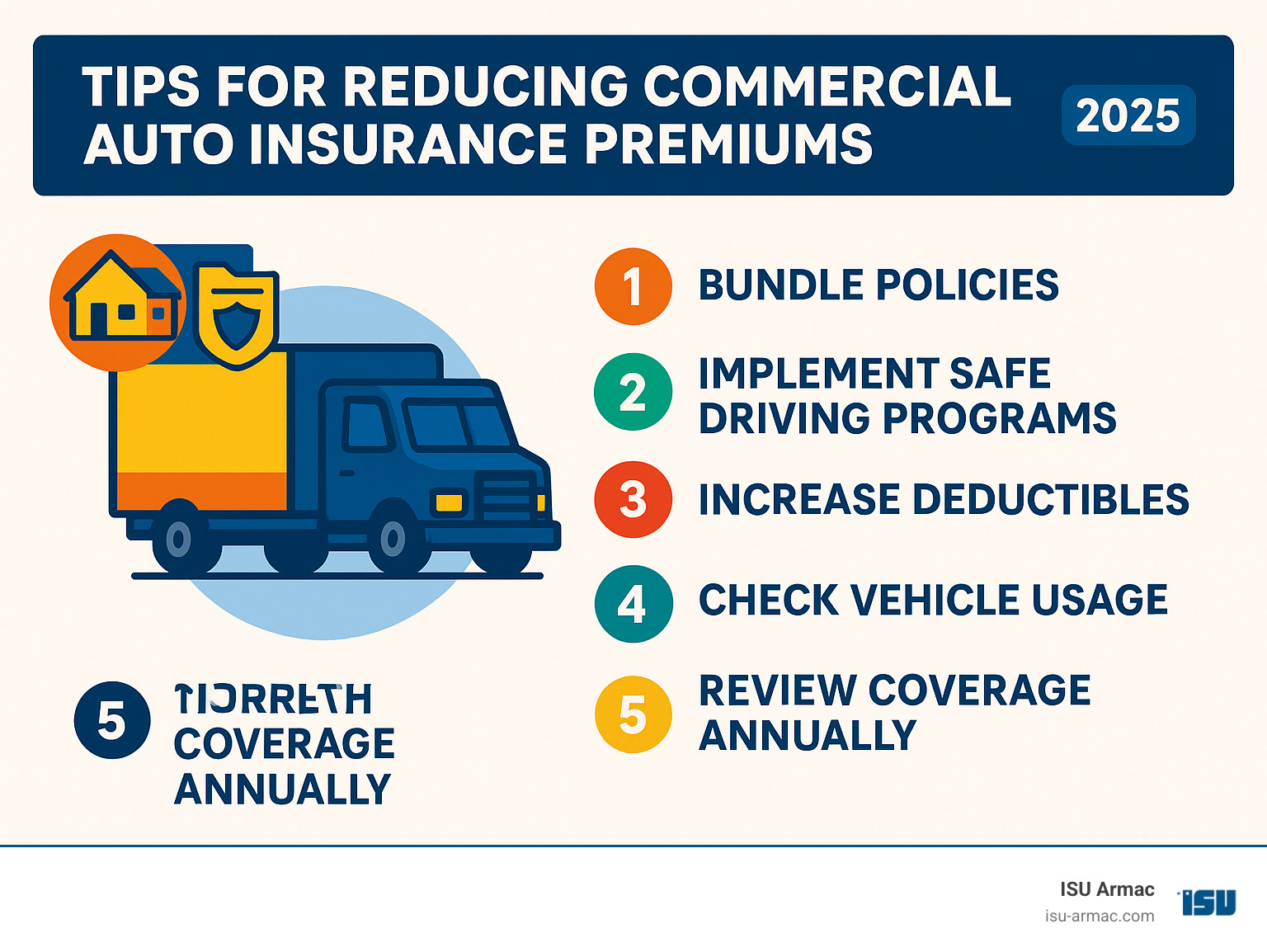
- Implement a Written Fleet Safety Program: Formalize rules regarding mobile phone use, seatbelt compliance, defensive driving expectations, and post-accident procedures. Insurers require documented fleet safety guidelines before offering preferred underwriting tiers.
- Deploy Dual-Facing Dashcams and Telematics: Installing dashcams provides objective evidence in staged or disputed accidents along rural routes, protecting local fleets from fraudulent claims and fraudulent liability assignments.
- Optimize Deductible Structures: Adjusting physical damage deductibles from $500 to $1,000 or $2,500 can significantly reduce annual comprehensive and collision premiums, provided the business maintains adequate cash reserves for minor repairs.
- Enforce Strict Driver Eligibility Criteria: Establish minimum hiring standards—such as requiring three full years of clean driving experience and zero major violations within 36 months—before authorizing employees to operate company vehicles.
- Audit Vehicle Classifications and Radii Annually: Ensure vehicles are registered accurately regarding usage radius. If trucks operate strictly within a 50-mile radius of Melbourne, ensure they are categorized as "local" rather than "intermediate" or "long-haul," which carry higher premium tariffs.
Frequently Asked Questions
What are the statutory minimum commercial auto insurance limits in Arkansas?
Arkansas law requires minimum personal liability limits of 25/50/25 ($25,000 bodily injury per person, $50,000 bodily injury per accident, and $25,000 property damage). However, commercial auto policies rarely use these state minimums. Lenders, brokers, and industry standards typically mandate a Combined Single Limit (CSL) of at least $1,000,000 for standard business vehicles.
Why are commercial auto rates rising even if my business has no claims?
Commercial auto rates reflect broader systemic factors, including severe repair cost inflation due to advanced vehicle technology (ADAS calibration), rising medical expenses, severe regional weather events in North-Central Arkansas, and overall commercial litigation costs across the state. These macro factors force carriers to raise base rate tables across entire geographic zones.
How does telematics lower commercial auto premiums for rural fleets?
Telematics devices track actual driving metrics such as speed, braking force, cornering, time of day, and mileage. When drivers consistently demonstrate safe operations on rural roads around Izard County, insurers apply usage-based safety discounts that lower base premiums by 10% to 25%.
What is Hired and Non-Owned Auto (HNOA) coverage, and do small businesses in Melbourne need it?
HNOA coverage protects a business if an employee causes an accident while driving a non-company vehicle—such as a personal car or rented vehicle—on business errands. Standard commercial auto policies do not cover personal vehicles unless an HNOA endorsement is explicitly added to the policy.
Are physical damage claims handled differently due to modern vehicle features?
Yes. Modern commercial vehicles feature sensors, cameras, and radar units integrated into bumpers, windshields, and side mirrors. Repairing physical damage now involves both bodywork and computerized electronic recalibration, leading to longer repair turnaround times, higher labor charges, and increased comprehensive/collision deductibles from insurance carriers.
Actionable Next Steps for Melbourne Business Owners
To stabilize commercial auto insurance costs and maintain policy compliance:
- Review Existing Schedules: Conduct an internal review of all insured vehicles, listed drivers, and designated primary radius categories. Remove inactive drivers or out-of-service vehicles immediately.
- Request a Loss Run Report: Obtain 3-to-5-year claims histories (loss runs) from your current agent. Identify recurring claim patterns—such as backing accidents or windshield chips—and implement targeted employee driver safety modules.
- Evaluate Telematics Options: Consult with an independent commercial insurance agent specializing in North-Central Arkansas to evaluate telematics-integrated policy structures that reward safe rural driving profiles.
Disclaimer: Insurance rules, regulatory requirements, and underwriting guidelines vary by policy type, carrier, and business classification. Consult a licensed Arkansas commercial insurance professional and review specific carrier documentation for detailed policy terms and legal compliance requirements.
Image Gallery