Celebrity Teeth So White Explained: The Treatments, Science, and Staging Behind Hollywood Smiles
Celebrities achieve impossibly bright, perfectly uniform white teeth through a combination of high-end cosmetic dentistry, customized restorative materials, and visual staging. While over-the-counter whitening products are heavily adve...
Celebrities achieve impossibly bright, perfectly uniform white teeth through a combination of high-end cosmetic dentistry, customized restorative materials, and visual staging. While over-the-counter whitening products are heavily advertised, Hollywood smiles are primarily created using custom porcelain veneers, professional-grade peroxide bleaching, high-contrast makeup, studio lighting, and digital post-production enhancement.
Contents
Beyond Whitening Toothpaste: The Primary Driver of the "Hollywood Smile"
The stark, glowing brightness seen on red carpets and movie screens is rarely the product of exceptional natural hygiene or commercial whitening toothpastes. Human enamel is naturally semi-translucent, revealing the underlying dentin, which inherently possesses a yellowish tint. As people age, enamel gradually wears thin while dentin thickens, causing teeth to naturally darken over time.
To overcome these biological limitations, public figures rely on advanced cosmetic dental interventions that alter the color, shape, alignment, and light reflectance of their teeth. The key distinction between natural teeth and the classic "Hollywood smile" lies in the material composition of the outer dental layer. Cosmetic dentists utilize ceramic materials that do not absorb stains in the same manner as natural enamel and reflect studio light with extreme intensity.
| Natural Enamel | Porcelain Veneers |
|---|---|
| Porous microstructure absorbs organic pigments (coffee, wine). | Non-porous glass-ceramic resists extrinsic staining. |
| Translucent structure reflects yellow dentin core beneath. | Opaque masking blocks underlying dark dentin completely. |
The Unnatural "Hollywood White" Shade Scale
Standard dental color grading relies on shade guides such as the VITA Classical Shade Guide, which ranges from A1 (the brightest natural shade) to D4 (dark reddish-grey). Natural, healthy adult teeth typically fall within the A2 to A3 range.
However, cosmetic dentistry established a specialized extended range known as the Bleach Shades (often labeled BL1 through BL4, or OM1 through OM3 in specialized ceramic systems):
- BL4 / OM3: A bright, cleaned-up natural shade that mimics exceptionally white natural enamel.
- BL3 / OM2: Visibly whiter than natural human teeth, providing a clean aesthetic under standard lighting.
- BL1 / OM1: The bright white shade widely favored in celebrity restorations. It contains high opacity and value, reflecting maximum light and appearing pure white even under intense camera flashes.
Achieving a BL1 or OM1 shade on natural teeth using chemical bleaching alone is virtually impossible for most individuals due to intrinsic genetic limitations of natural dentin. Consequently, when a celebrity exhibits a high-value, pure-white smile across all visible teeth, it almost universally indicates the presence of indirect ceramic restorations.
The Spectrum of Cosmetic Dental Procedures Celebrities Use
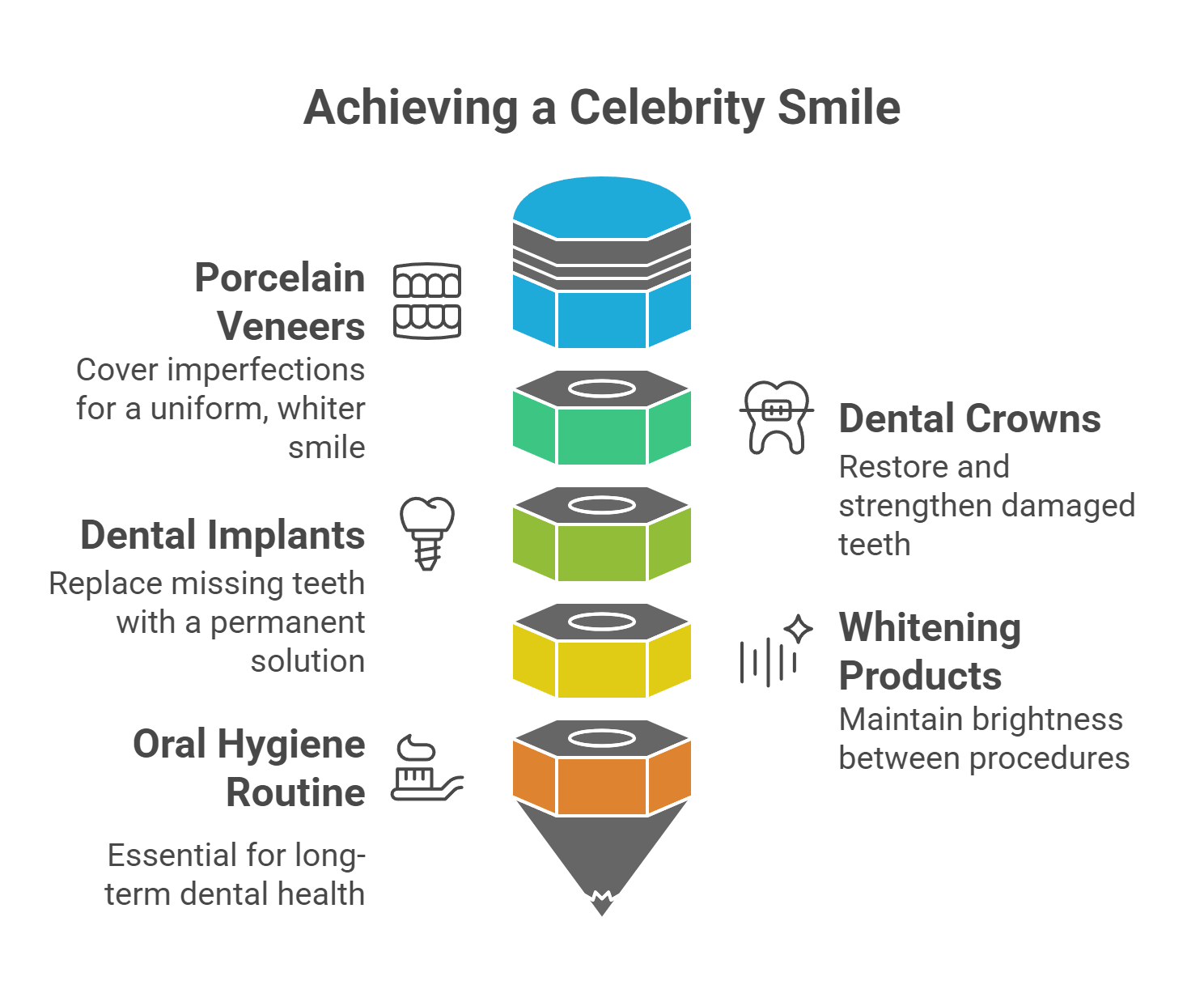
Celebrities select specific treatments based on their baseline dental health, available downtime, budget, and desired speed of results. The most frequent clinical interventions range from chemical oxidation to full structural replacement.
- Initial Evaluation
- Natural Dentition
- In-Office Bleaching (35-40% Hydrogen Peroxide)
- Maintenance Traps & LED Activation
- Structural Issues
- Porcelain Veneers or Full Crowns
- Minimal-Prep Ceramics (0.3mm - 0.7mm Reduction)
- Natural Dentition
1. Porcelain Veneers and Laminates
Porcelain veneers represent the gold standard for high-profile smile transformations. A veneer is a ultra-thin shell of medical-grade ceramic—typically lithium disilicate (such as IPS e.max) or feldspathic porcelain—bonded directly to the facial surface of the tooth.
- Preparation: Traditional veneers require the removal of approximately 0.3 mm to 0.7 mm of natural enamel to create room for the ceramic shell and ensure proper alignment along the gumline.
- Minimal-Prep / No-Prep Alternatives: Ultra-thin veneers (such as Lumineers or custom feldspathic laminates) can sometimes be applied with minimal enamel reduction, though they require specific structural prerequisites to prevent an unnatural, bulky appearance.
- Stain Resistance: Ceramic glass surfaces are non-porous. Unlike natural enamel, high-quality porcelain does not absorb chromogens from coffee, tea, red wine, or tobacco, allowing the restoration to maintain its initial shade indefinitely.
2. Full-Coverage Porcelain Crowns
When teeth have suffered significant decay, existing structural damage, or extensive previous fillings, full-coverage ceramic crowns are utilized rather than surface veneers. Crowns encompass the entire 360-degree circumference of the tooth, requiring more extensive reduction of natural tooth structure. Modern full-zirconia or layered zirconia crowns offer high flexural strength while matching the high-luminance bleach shades requested by performers.
3. In-Office High-Concentration Bleaching
For performers who possess structurally straight teeth and wish to preserve their natural enamel, professional in-office whitening provides rapid shade improvement:
- Chemical Chemistry: Dentists apply high-concentration hydrogen peroxide gels (typically 35% to 40% active concentration). By comparison, over-the-counter whitening strips usually contain 6% to 14% hydrogen peroxide or lower concentrations of carbamide peroxide.
- Mechanism of Action: Peroxide molecules penetrate the porous enamel rods to break down long-chain organic chromogen molecules into smaller, uncolored double-bond structures via an oxidation reaction.
- Light Activation: Phototherapy devices (often colloquially referred to as "laser whitening" or LED activation lamps) are used to warm the peroxide gel, accelerating the rate of chemical decomposition and oxidizing deep intrinsic stains in a single 60- to 90-minute session.
4. Composite Resin Bonding
Composite bonding involves applying a tooth-colored photo-cured resin directly to the tooth surface. The dentist manually sculpts, shapes, and polishes the resin to correct minor gaps, chips, or discoloration. While significantly less expensive and faster to execute than porcelain veneers, composite resin is porous. Over time, it is susceptible to edge staining and surface wear, making it a temporary or intermediate solution for mainstream public figures.
5. Clear Aligner Therapy and Lingual Orthodontics
Bright white color can emphasize misalignment or uneven light reflection. Celebrities frequently undergo invisible orthodontic alignment using clear removable aligners or lingual braces (mounted behind the teeth) prior to shade enhancement. Aligning the dental arches ensures uniform light distribution across the tooth surfaces, preventing isolated shadows that make teeth look darker.
Comparison Matrix of Celebrity Dental Enhancements
| Procedure Type | Primary Material / Agent | Average Shade Improvement | Average Lifespan | Enamel Alteration Required | Relative Cost per Tooth (USD) |
|---|---|---|---|---|---|
| Porcelain Veneers | Lithium Disilicate / Feldspathic Ceramic | Unrestricted (e.g., BL1/OM1) | 10 – 20 Years | Moderate (0.3mm – 0.7mm) | $1,500 – $3,500 |
| Composite Bonding | Hybrid Micro-filled Resin | 2 – 4 Shades | 3 – 7 Years | Minimal to None | $300 – $1,000 |
| In-Office Bleaching | 35%–40% Hydrogen Peroxide Gel | 4 – 8 Shades (Natural Limit) | 6 – 18 Months | None (Reversible Hydration Loss) | $500 – $1,500 (Full Arch) |
| Porcelain Crowns | Zirconia / Layered Ceramic | Unrestricted (e.g., BL1/OM1) | 15 – 25 Years | High (1.0mm – 2.0mm) | $1,800 – $4,000 |
| At-Home Custom Trays | 10%–22% Carbamide Peroxide | 2 – 6 Shades | 3 – 12 Months | None | $300 – $600 (Full Kit) |
The Illusion Factor: Studio Lighting, Makeup, and Digital Post-Production
The perceived whiteness of a celebrity's smile on camera is rarely determined by dentistry alone. Visual media production employs specific techniques that artificially magnify brightness and contrast.
- Lighting Environment
- Three-Point Studio Rig
- Softboxes & Fill Lights
- Makeup Contrast
- Blue-Undertone Lipsticks
- Deep Skin Bronzers
- Camera & Post
- Custom Color Curves
- Airbrush Retouching
- High-Luminance Visual
Lighting Engineering and Camera Exposure
High-budget film sets, broadcast studios, and red-carpet photography setups utilize high-intensity lighting configurations:
- Direct Ring Lights and Softboxes: These light sources flood the facial plane with soft, diffuse illumination, casting light directly into the oral cavity. This minimizes natural intraoral shadows that typically obscure side teeth (bicuspids and molars).
- Specular Reflection: Porcelain veneers are finished with a polished glaze. When hit by focused studio strobes, the glaze creates a brilliant specular highlight, projecting an ultra-bright reflection back toward the camera sensor.
- Color Temperature Settings: Professional video cameras are color-balanced to daylight standards (5600K). High color-rendering index (CRI) lights eliminate warm yellow cast, instantly making natural teeth look cooler and whiter.
Strategic Contrast: Makeup and Skin Tones
Cosmetic artists use color theory to maximize smile brightness:
- Lipstick Undertones: Lip products formulated with cool blue or purple undertones counteract yellow intrinsic tones in natural teeth. Conversely, warm, orange-based lipsticks accentuate warm yellow shades in enamel.
- Skin Tanning and Bronzing: Darkening the surrounding facial frame through spray tans, deep foundation shades, or contouring bronzers increases the relative brightness contrast between the skin and the teeth. Under visual perception laws (simultaneous contrast), the same shade of white appears brighter when bordered by darker values.
Digital Editing and Real-Time Video Filters
In modern media, digital post-production plays a major role in smile appearance:
- Still Photography: Commercial photo retouching applications employ selective adjustment layers. Retouchers isolate the tooth region, lower the yellow and red color saturation channels, and boost the luminosity or exposure channel.
- Video Post-Production: Automated skin-smoothing and feature-tracking software can dynamically track a subject's mouth across thousands of video frames, applying real-time color corrections that desaturate yellow tones and increase specular highlight brightness.
Biological Costs, Risks, and Maintenance Requirements
Achieving extreme dental whiteness through invasive procedures involves distinct physiological trade-offs and mandatory long-term maintenance.
Medical Disclaimer: This article is provided for educational and informational purposes only and does not constitute professional medical or dental advice. Individual suitability for cosmetic procedures must be evaluated by a licensed dentist or prosthodontist.
Irreversible Structural Changes and Tooth Sensitivity
The mechanical preparation of teeth for porcelain veneers or crowns requires permanent reduction of healthy enamel:
- Loss of Hydroxyapatite Layer: Once enamel is removed, it cannot naturally regenerate. The procedure commits the patient to wearing artificial restorations for the remainder of their life.
- Dentin Exposure: Preparing teeth brings restorations closer to the internal dental pulp, which houses nerves and blood vessels. Patients frequently experience transient or long-term thermal sensitivity to hot and cold substances.
- Pulpal Complications: In a small percentage of cases, aggressive tooth preparation can lead to irreversible pulpitis, necessitating root canal therapy to clear inflamed or necrotic nerve tissue.
Ongoing Maintenance Protocols
Maintaining high-end cosmetic dentistry requires strict compliance with oral health regimes:
- Night Guards (Occlusal Splints): Porcelain is strong under compressive forces but brittle under shear forces. Celebrities and patients with veneers routinely wear custom-molded bruxism guards during sleep to prevent chipping or debonding caused by nocturnal jaw clenching.
- Non-Abrasive Dentifrices: Standard whitening toothpastes often contain coarse abrasives (such as silica or calcium carbonate) designed to mechanically scour surface stains off natural enamel. However, abrasive pastes can scratch the outer glaze of porcelain or composite resin, destroying their luster and making them dull over time. Neutral sodium fluoride pastes with low Relative Dentin Abrasivity (RDA) ratings (below 70) are recommended.
- Cyclic Replacement Requirements: No dental restoration lasts indefinitely. Porcelain veneers typically require full removal and replacement every 10 to 20 years due to micro-leakage at margin boundaries, gum recession exposing underlying tooth roots, or ceramic fracture.
How Everyday Patients Can Achieve Similar Results Safely
Achieving a healthy, attractive smile does not require replicating the ultra-opaque BL1 shades popular in entertainment circles. Patients looking to improve their smile can approach the process methodically.
1. Differentiate Between Whitening Needs and Structural Corrections
- If teeth are straight and undamaged: Professional in-office peroxide bleaching combined with custom-fitted gel trays for at-home maintenance offers the safest, non-invasive route to bright natural enamel.
- If teeth are chipped, worn, severely discolored, or unevenly spaced: Indirect restorations such as porcelain veneers or direct composite bonding are the appropriate clinical pathways for modifying both structural geometry and shade.
2. Choose Natural Shade Matching Over Maximum Opacity
Prosthodontists generally advise selecting a shade that matches the brightness of the sclera (the white portion) of the patient's eyes. Choosing a dental shade brighter than the sclera can create an unnaturally artificial appearance that draws attention away from other facial features.
- Evaluate Sclera (Eye White) Color
- Match to Sclera
- Yields natural harmony
- Fits facial features naturally
- Exceed Sclera
- Creates high visual contrast
- Risk of artificial "chicle-strip" look
- Match to Sclera
3. Key Questions to Ask During a Cosmetic Consultation
When evaluating cosmetic dental treatments, patients should review procedural specifics with their treating clinician:
- What specific shade guide value are we targeting, and is it realistic for my natural dentition?
- How much natural enamel reduction will be required for this restoration?
- Can I view a wax-up model or digital smile design simulation before tooth preparation begins?
- What are the ongoing replacement costs and maintenance requirements for the materials selected?
Frequently Asked Questions
Do celebrities use standard whitening toothpaste to get their teeth so white?
No. Standard whitening toothpastes only remove surface stains (extrinsic discoloration) through mild abrasives. They cannot change the intrinsic color of the enamel or dentin, nor can they alter structural shape or alignment. The bright white smiles seen on celebrities are almost always the result of porcelain veneers, professional in-office bleaching, or full ceramic crowns.
Why do celebrity veneers sometimes look fake or overly opaque?
Veneers appear artificial when they lack translucency and characterization. Natural human teeth have delicate variations, micro-textures, and slight translucency at the biting edge. If a restoration is fabricated using a high-value, highly opaque bleach shade (like BL1) without natural gradations, it reflects light uniformly, creating a solid, monochromatic "chiclet" appearance.
How much do celebrity-style porcelain veneers cost?
In North America, high-end cosmetic dentists charge between $1,500 and $3,500 per tooth for porcelain veneers. A complete upper arch transformation (typically 8 to 10 visible teeth) can range from $12,000 to over $35,000, excluding preliminary treatments like orthodontics, gum contouring, or temporary restorations.
Is professional teeth whitening safe for natural enamel?
Yes, when performed or supervised by a licensed dental professional, chemical teeth whitening using hydrogen peroxide or carbamide peroxide is clinically proven to be safe. It does not permanently erode enamel. However, it can cause temporary tooth sensitivity and transient gingival irritation, which resolve shortly after treatment ends.
Can veneers stain from coffee, red wine, or smoking?
High-quality porcelain veneers are made from non-porous ceramic materials that resist staining from dark foods, beverages, and smoking. However, the composite resin cement used to bond the veneer to the tooth can absorb stains along the margins over time. Additionally, natural teeth surrounding the veneers can still stain, leading to a shade mismatch if hygiene is neglected.
Practical Next Steps for Smile Enhancement
- Schedule a Comprehensive Oral Health Exam: Prior to undergoing any cosmetic treatment, ensure all active dental disease, such as periodontal inflammation or tooth decay, is fully resolved. Cosmetic restorations placed over compromised teeth will fail prematurely.
- Begin with Conservative Treatments: Attempt high-concentration professional bleaching before choosing irreversible structural options like veneers. If whitening achieves your desired shade, simple alignment using clear aligners or edge bonding may provide your ideal outcome with minimal biological cost.
- Request a Mock-Up or Digital Smile Design: If proceeding with porcelain veneers, ask your cosmetic dentist for a temporary diagnostic mock-up placed directly over your teeth. This allows you to evaluate the proposed shade, length, and shape in real-world lighting before any permanent enamel removal occurs.
Image Gallery