How We Can Reduce Methane Emissions: Technologies, Sector Strategies, and Policy Actions
Reducing methane emissions requires targeted technical interventions across three primary anthropogenic sectors: fossil fuel energy production, agriculture, and waste management. Key strategies include deploying advanced leak detection...
Reducing methane emissions requires targeted technical interventions across three primary anthropogenic sectors: fossil fuel energy production, agriculture, and waste management. Key strategies include deploying advanced leak detection and repair (LDAR) networks in oil and gas infrastructure, altering livestock diets and capping manure storage in agriculture, and capturing landfill gas while diverting organic waste from municipal waste systems.
Contents
Understanding Methane’s Atmospheric Impact and Mitigation Priority
Methane ($\text{CH}_4$) is a potent greenhouse gas responsible for approximately 30 percent of the rise in global temperatures since the Industrial Revolution. While carbon dioxide ($\text{CO}_2$) remains the primary driver of long-term climate warming due to its persistence in the atmosphere for centuries, methane exerts a significantly stronger warming effect over a shorter timeframe. Over a 20-year timescale, methane has a Global Warming Potential (GWP) more than 80 times greater than $\text{CO}_2$; over a 100-year timescale, its GWP is roughly 28 to 36 times higher, according to the Intergovernmental Panel on Climate Change (IPCC).
Because methane has an atmospheric lifetime of only about 12 years, reducing methane emissions yields rapid cooling benefits. Lowering atmospheric concentrations of methane immediately slows the rate of near-term global warming, buying critical time for long-term decarbonization of global energy systems. Additionally, methane is a direct precursor to ground-level tropospheric ozone, a hazardous air pollutant. Curbing methane emissions simultaneously improves public health outcome by preventing respiratory illnesses and agricultural yield loss.
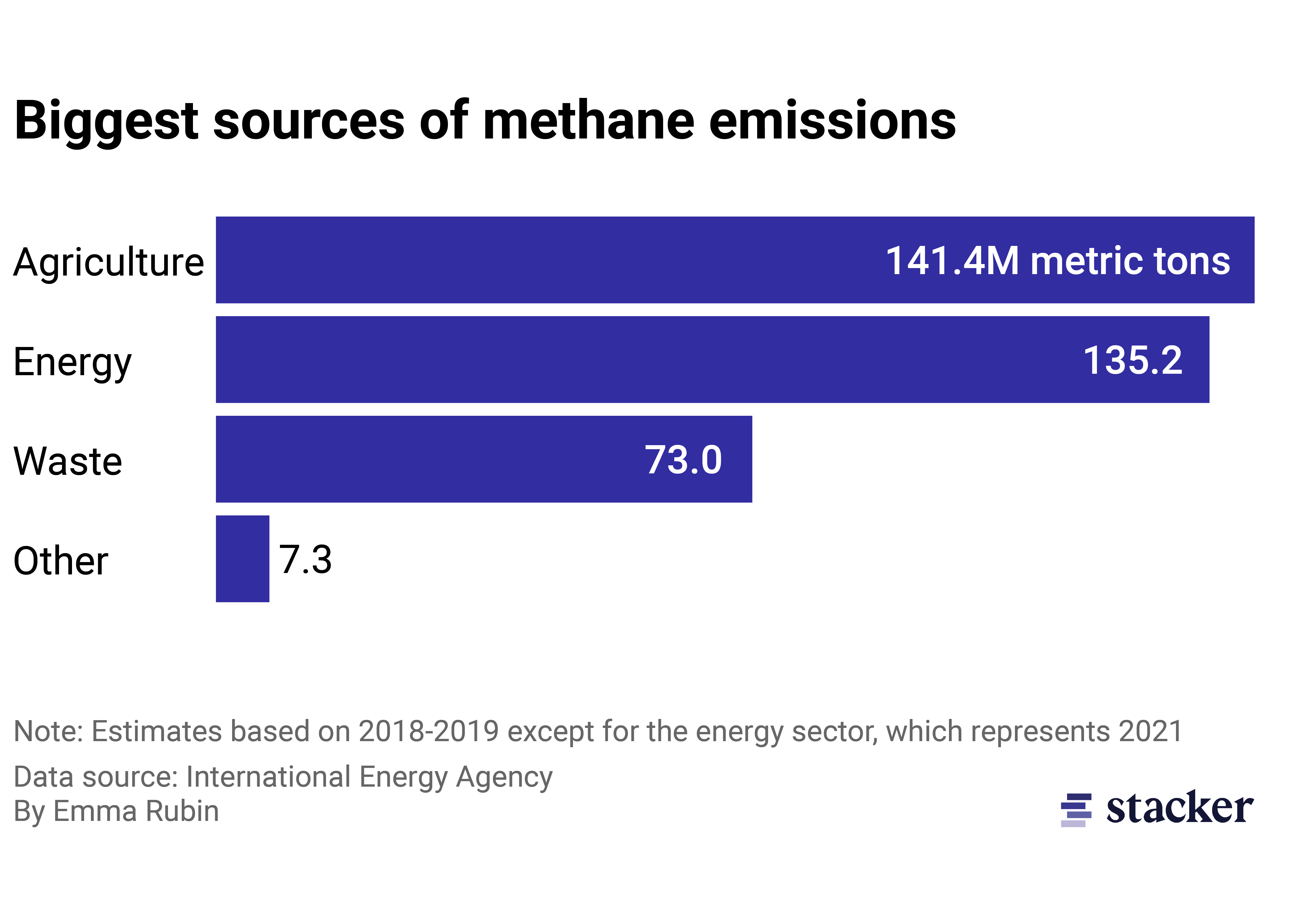
The global baseline for human-caused methane emissions is concentrated across three primary sectors:
- Fossil Fuel Energy Production: Oil, natural gas, and coal systems emit methane during extraction, processing, transportation, and distribution.
- Agriculture: Enteric fermentation in ruminant animals, manure management, and flooded rice paddies represent the single largest source of anthropogenic methane.
- Waste Management: Solid waste landfills, open dumps, and municipal wastewater treatment facilities generate methane as organic matter decomposes anaerobically.
Mitigating Methane Emissions in the Energy Sector
The fossil fuel sector offers the most technically straightforward and cost-effective opportunities for rapid methane reduction. Because natural gas consists primarily of methane, captured emissions represent a valuable energy commodity that can often offset the capital expenditure required for mitigation technology.
- Fossil Fuel Sector Emissions
- Upstream (Extraction & Wellheads): Automated Shut-off Valves, Vapor Recovery Units
- Midstream (Processing & Pipelines): Optical Gas Imaging (OGI), Pneumatic Controller Upgrades
- Downstream (Distribution Networks): Continuous Acoustic/Infrared Monitoring, Main Replacement
Leak Detection and Repair (LDAR) Infrastructure
Fugitive emissions—unintended leaks from valves, flanges, pumps, compressors, and aging pipeline infrastructure—account for a major portion of oil and gas methane releases. Implementing comprehensive Leak Detection and Repair (LDAR) programs allows operators to identify and fix leaks rapidly.
Modern LDAR strategies rely on a multi-tiered monitoring framework:
- Optical Gas Imaging (OGI): Handheld infrared cameras allow technicians to visualize invisible methane plumes at facilities in real time, pinpointing exact leak locations.
- Continuous Monitoring Sensors: Ground-based sensor arrays deployed around facility perimeters detect concentration spikes immediately, replacing periodic manual inspections with continuous surveillance.
- Aerial and Satellite Remote Sensing: High-resolution satellites (such as MethaneSAT and commercial satellite constellations) and drone-mounted sensors detect major leaks ("super-emitters") across remote basins and pipeline corridors.
According to data compiled by the International Energy Agency (IEA), deploying existing LDAR technologies and replacing leaking components could eliminate more than 70 percent of current fossil fuel methane emissions, with a substantial fraction achievable at net-zero net cost due to the market value of the recovered gas.
Eliminating Venting and Flaring
Venting (the intentional release of unburned natural gas into the atmosphere) and inefficient flaring (the burning of associated natural gas) are major emission sources. To eliminate routine venting and flaring, energy producers deploy specific engineering controls:
- Installing Vapor Recovery Units (VRUs): VRUs capture low-pressure gas from storage tanks and compress it for injection into sales pipelines or on-site power generation.
- Replacing High-Bleed Pneumatic Controllers: Traditional pneumatic control devices use pressurized natural gas to actuate valves, releasing small amounts of methane during normal operation. Upgrading to zero-emission instrument air systems or solar-powered electric actuators eliminates these operational releases.
- Mandating Green Completions: During hydraulic fracturing and well completions, operators use reduced-emissions completions ("green completions") to route gas to separation equipment rather than venting or flaring it during well cleanup.
Coal Mine Methane (CMM) Capture
Coal mining releases trapped methane from underground seams during degasification and ventilation. Mitigation involves two core approaches:
- Pre-mining Degasification: Drilling directional boreholes into coal seams prior to excavation allows high-purity methane to be extracted and piped for commercial use or power generation.
- Ventilation Air Methane (VAM) Oxidation: Underground mines rely on massive ventilation systems to dilute methane to safe operating levels for miners. Because VAM contains very low concentrations of methane (typically under 1 percent), standard combustion is impossible. Thermal and Catalytic Flow-Reversal Reactors (TFRRs/CFRRs) oxidize this dilute methane into $\text{CO}_2$ and water, generating usable thermal energy while neutralizing the gas's high warming potential.
Reducing Agricultural Methane Emissions
Agriculture accounts for roughly 40 percent of anthropogenic methane emissions globally. Reducing emissions from agricultural systems requires a combination of nutritional science, manure management engineering, and precise water management in field crops.
Enteric Fermentation Interventions in Livestock
Ruminant livestock—including cattle, sheep, and goats—produce methane as a natural byproduct of enteric fermentation, a digestive process where microbes in the rumen break down complex plant fibers. Interventions focus on altering rumen chemistry and improving livestock production efficiency:
- Feed Additives and Inhibitors: Chemical compounds such as 3-nitrooxypropanol (3-NOP) directly inhibit the specific enzyme (methyl-coenzyme M reductase) involved in methanogenesis within the rumen, reducing methane output by 20 to 40 percent without compromising milk or meat production.
- Dietary Supplements: Incorporating small percentages of specific red seaweeds (Asparagopsis taxiformis) or lipid-rich dietary supplements (such as oilseeds and fats) alters rumen fermentation pathways, shifting hydrogen balance away from methane production.
- Improved Forage Quality and Digestibility: Feeding livestock higher-quality, easily digestible forage reduces the retention time of feed in the rumen, decreasing methane generated per unit of animal product (milk or meat).
Advanced Manure Management Systems
Manure stored in liquid form within lagoons or pits breaks down anaerobically, generating substantial methane volumes. Mitigation strategies transform this waste stream into renewable energy:
- Anaerobic Digesters: Enclosing manure storage facilities with anaerobic digesters traps methane gas released during microbial decomposition. The captured biogas is conditioned into biomethane (renewable natural gas) for grid injection, vehicle fuel, or on-site electricity generation.
- Covered Storage and Acidification: Installing impermeable covers over manure lagoons prevents gas escape while allowing biogas collection. Alternatively, acidifying manure by lowering its pH below 6.0 inhibits methanogenic archaea, cutting methane generation during storage by up to 80 percent.
- Solid-Liquid Separation: Separating solid organic matter from liquid slurry before storage reduces the organic load available for anaerobic digestion in lagoons, lowering baseline methane formation.
Optimized Water Management in Rice Cultivation
Flooded rice paddies create anoxic (oxygen-depleted) soil conditions ideal for methanogenic bacteria. Shifting water management techniques disrupts these anaerobic conditions:
- Alternate Wetting and Drying (AWD): Instead of keeping paddies continuously flooded throughout the growing season, farmers allow the field water level to drop to 15 centimeters below the soil surface before re-flooding. Periodically exposing soil to oxygen arrests methane production without reducing crop yields, cutting methane emissions from rice fields by 30 to 50 percent while conserving irrigation water.
- Direct-Seeded Rice (DSR): Planting seeds directly into dry soil rather than transplanting seedlings into flooded fields shortens the duration of soil submergence, reducing overall methane accumulation.
Transforming Waste Management Systems
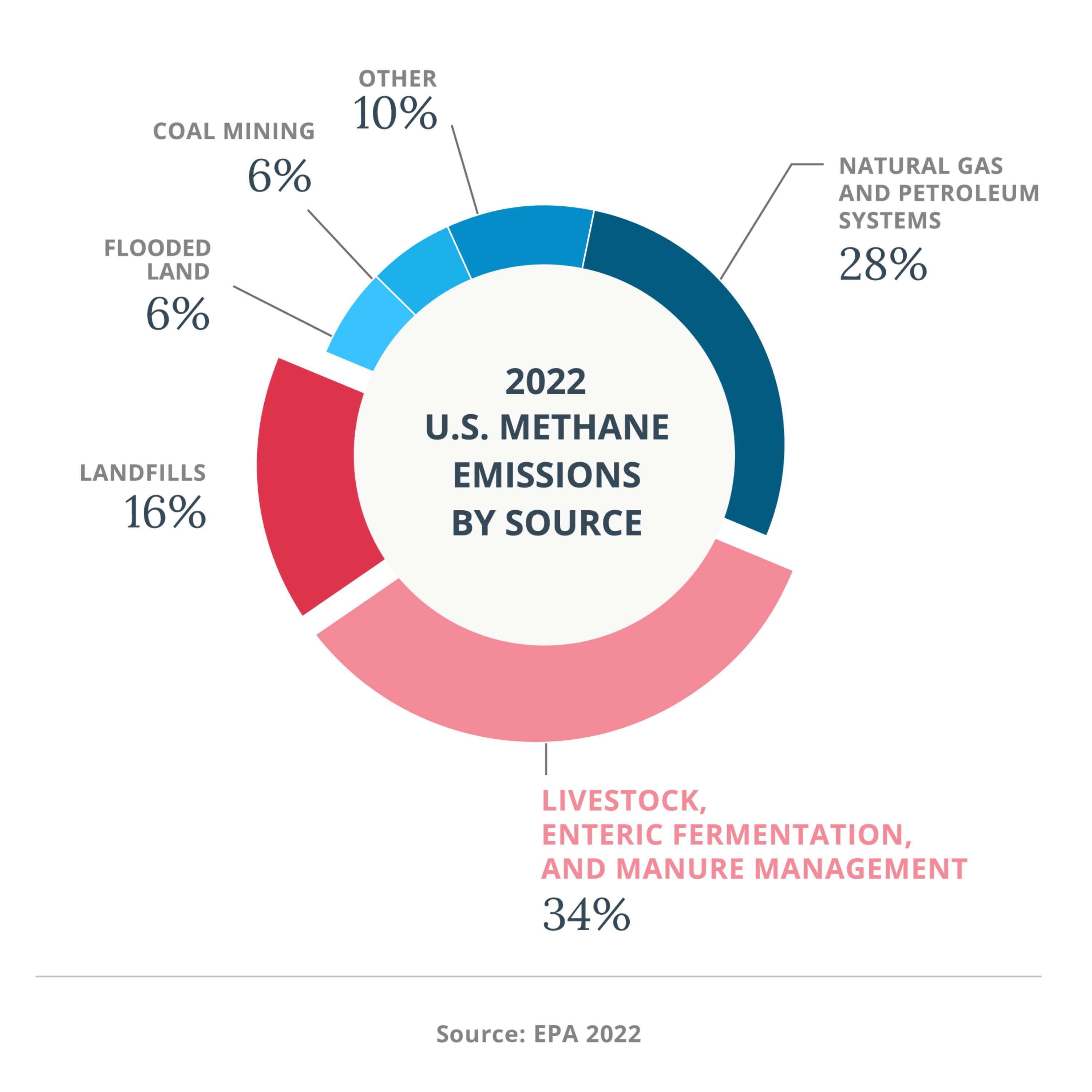
Organic waste decomposing in oxygen-depleted landfill environments accounts for approximately 20 percent of global human-caused methane. Addressing waste emissions requires upstream diversion of organic materials and downstream gas capture infrastructure.
- Municipal Waste Management Strategy
- Upstream Reduction: Source Separation & Food Waste Prevention Programs
- Midstream Diversion: Industrial Composting & Commercial Anaerobic Digestion
- Downstream Capture: Landfill Gas (LFG) Wells, Flare Stacks & Biomethane Upgrading
Landfill Gas (LFG) Capture and Energy Recovery
Modern engineered landfills generate landfill gas—a mix of roughly 50 percent methane and 50 percent carbon dioxide—as organic waste decays. To prevent methane migration:
- Gas Collection Well Networks: Operators drill vertical extraction wells and horizontal trenches into the waste mass, placing the landfill under negative pressure to pull gas into a central manifold system.
- Flaring and Utilization: Collected LFG is either destroyed through high-efficiency enclosed flares (converting methane to $\text{CO}_2$) or processed for use in combustion turbines, reciprocating engines, or upgraded to pipeline-quality biomethane.
- Biocovers and Biofilters: For smaller or inactive landfills where mechanical gas capture is economically unfeasible, applying soil biocovers amended with compost or methanotroph-rich media encourages natural biological oxidation of methane as it migrates through the surface layer.
Organic Waste Diversion and Composting
The most effective long-term solution to landfill methane is preventing organic matter from reaching landfills initially. Guidelines established by the U.S. Environmental Protection Agency (EPA) emphasize diverting food scraps, yard trimmings, and paper products through municipal collection mandates:
- Aerobic Composting: Processing organic waste in open windrows or in-vessel composting systems maintains high oxygen levels through mechanical turning or forced aeration. Aerobic decomposition produces $\text{CO}_2$ and nutrient-rich soil amendments rather than methane.
- Municipal Source Separation Mandates: Enacting local regulations that require residential and commercial sectors to separate organic waste at the point of generation provides clean feedstocks for composting and industrial anaerobic digestion facilities.
Sector-by-Sector Mitigation Strategies Compared
The following matrix compares primary methane reduction strategies across sectors, detailing key implementation mechanisms, expected reduction efficiencies, and secondary operational considerations.
| Sector | Mitigation Strategy | Primary Mechanism | Estimated Methane Reduction Potential | Key Implementation Considerations |
|---|---|---|---|---|
| Oil & Gas | Advanced LDAR Programs | Satellite, drone, and OGI camera detection of leaks | 60% – 80% of fugitive emissions | Low net cost; captured natural gas yields revenue offset. |
| Oil & Gas | Pneumatic Controller Replacement | Switching from gas-bleed to instrument-air or electric actuators | Up to 98% of pneumatic releases | Requires reliable site power or solar-battery installations. |
| Coal Mining | VAM Thermal Oxidation | Flow-reversal reactors oxidise low-concentration ventilation gas | 70% – 90% of ventilation emissions | High upfront capital expenditure; generates usable heat energy. |
| Livestock | Dietary Additives (e.g., 3-NOP) | Chemical inhibition of methanogenic enzymes in the rumen | 20% – 40% per animal | Requires consistent daily dosing; ideal for feedlots and intensive dairies. |
| Livestock | Anaerobic Manure Digesters | Capturing biogas from covered manure storage | 60% – 80% of manure emissions | Requires substantial organic load; high capital cost offset by energy sales. |
| Agriculture | Alternate Wetting & Drying (AWD) | Periodic aeration of flooded rice paddies | 30% – 50% of paddy emissions | Saves water; requires controlled irrigation and drainage infrastructure. |
| Waste | Landfill Gas (LFG) Recovery | Extraction wells with active vacuum systems | 60% – 85% of generated LFG | Operational efficiency depends on landfill capping integrity. |
| Waste | Organics Diversion & Composting | Diverting food waste to aerobic composting facilities | Up to 95% of diverted organic emissions potential | Requires municipal logistics, public participation, and sorting infrastructure. |
Regulatory Frameworks and International Initiatives
Policy mechanisms play a decisive role in driving methane abatement technologies into commercial deployment. Key international policy instruments include:
The Global Methane Pledge
Launched at COP26, the Global Methane Pledge commits signatory nations to collectively reduce global anthropogenic methane emissions by at least 30 percent below 2020 levels by 2030. Participants represent over half of global methane emissions and encompass major industrial and agricultural economies working to standardize emissions reporting and technology transfer.
Sector-Specific Regulations
- United States EPA Clean Air Act Standards: EPA performance standards require oil and natural gas operators to perform regular LDAR inspections, phase out high-bleed pneumatic controllers, and capture gas from completions and storage tanks. Federal rules also impose waste emissions charges on large facilities exceeding specific emission thresholds.
- European Union Methane Regulation: The EU framework imposes strict monitoring, reporting, and verification (MRV) standards on domestic energy production and introduces import regulations that require fossil fuels imported into the EU market to meet equivalent methane tracking standards.
Frequently Asked Questions
Why is reducing methane considered the fastest way to slow near-term global warming?
Methane has a short atmospheric lifetime of roughly 12 years but a global warming potential more than 80 times that of carbon dioxide over a 20-year period. Because methane decays rapidly compared to persistent carbon dioxide, cutting methane emissions immediately reduces radiative forcing in the atmosphere, producing a rapid cooling effect on global temperature trajectories.
Can livestock methane emissions be completely eliminated?
Complete elimination of enteric methane is unlikely due to the nature of ruminant digestion, which relies on microbial fermentation to break down fibrous plant material. However, combining feed additives (such as 3-NOP or specialized seaweeds), improved pasture forage, selective breeding, and manure digesters can reduce total livestock emissions by 40 to 60 percent.
How do satellites detect invisible methane leaks from space?
Satellites use imaging spectrometers to measure how sunlight reflects off the Earth's surface and passes through the atmosphere. Methane molecules absorb specific wavelengths of light in the shortwave infrared spectrum. By analyzing these absorption signatures, satellite data algorithms pinpoint the location and measure the flow rate of methane plumes emitted by industrial sites.
Is capturing landfill gas economically viable for smaller landfills?
For smaller landfills, installing full-scale energy conversion equipment (such as gas turbines) may not be economically viable due to capital costs. However, smaller facilities can cost-effectively utilize passive soil biocovers to biologically oxidize methane, or install simpler flare systems to convert methane to carbon dioxide, significantly lowering atmospheric impact at low operational expenditure.
How does Alternate Wetting and Drying (AWD) affect rice crop yields?
When implemented correctly according to agricultural guidelines—allowing field water levels to drop no lower than 15 centimeters below the soil surface before re-flooding—AWD does not reduce rice yields. In many trial environments, AWD strengthens root systems, reduces fungal diseases, lowers arsenic accumulation in the grain, and decreases farm water costs.
Practical Implementation Steps for Enterprises and Municipalities
Organizations seeking to implement verified methane reduction programs should execute actionable protocols tailored to their operational footprints:
- Conduct a Rigorous Methane Baseline Audit: Deploy quantitative measurement tools—such as optical gas imaging, drone overflights, or organic waste mass-balance calculations—to identify and quantify primary methane sources rather than relying solely on desktop emission factors.
- Prioritize Zero- and Low-Cost Engineering Upgrades: In energy and industrial operations, prioritize low-cost capital projects with short payback periods, such as retrofitting high-bleed pneumatic valves, installing vapor recovery systems, and repairing localized flange leaks.
- Deploy Closed-Loop Waste Infrastructure: Municipalities should institute mandatory organic waste separation, establishing industrial composting networks or regional anaerobic digester facilities to divert organics from landfills.
- Establish Continuous Verification and Reporting: Implement continuous leak detection sensors and integrate emissions data into standardized monitoring frameworks aligned with international standards (such as the Oil & Gas Methane Partnership 2.0).
Image Gallery