Absolute Liability in Workers Compensation: Understanding Employer Obligations
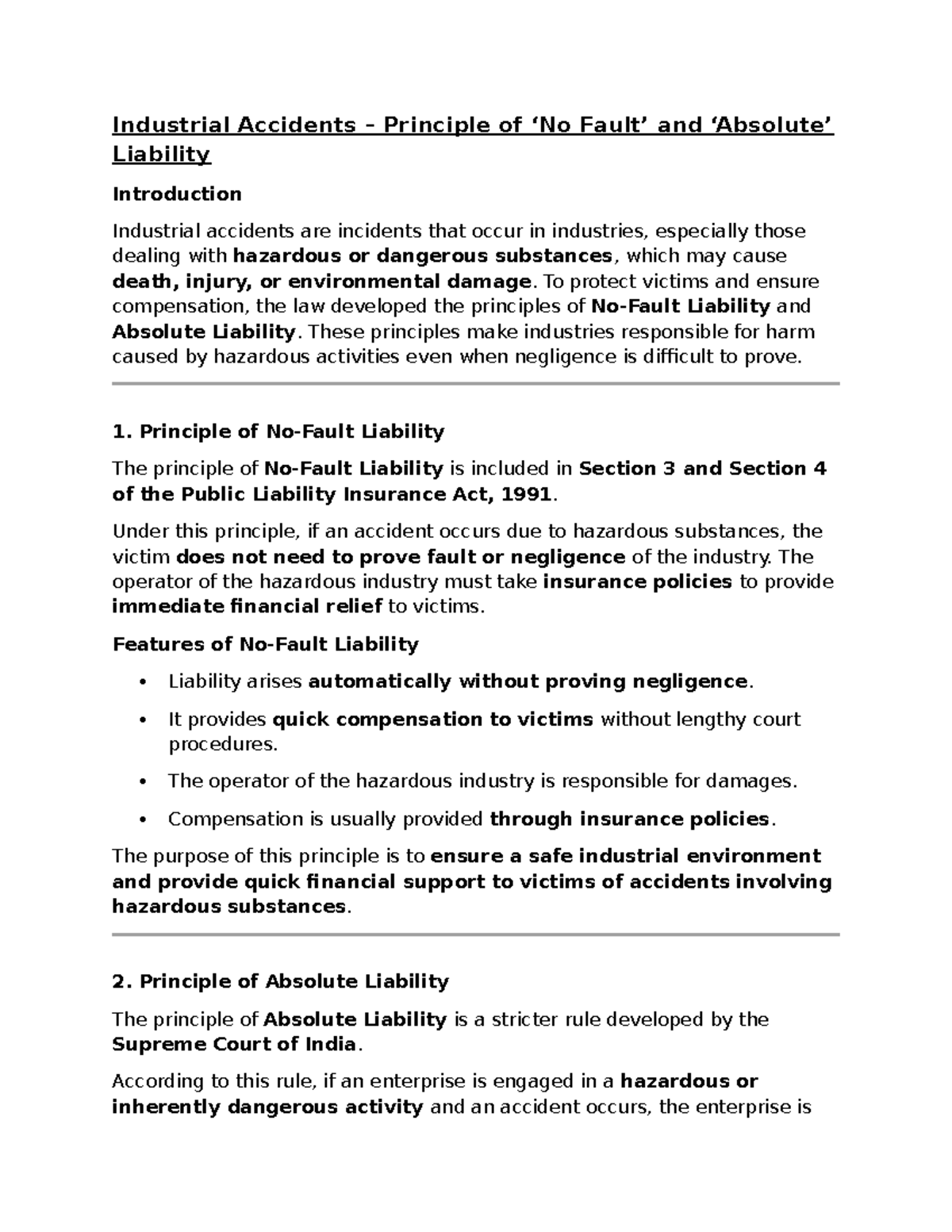
Absolute liability in workers compensation refers to the "no-fault" principle where an employer is held legally responsible for an employee’s work-related injury or occupational disease regardless of who was at fault. Under this system...
Absolute liability in workers compensation refers to the "no-fault" principle where an employer is held legally responsible for an employee’s work-related injury or occupational disease regardless of who was at fault. Under this system, the injured worker does not need to prove the employer was negligent, and conversely, the employer generally receives immunity from most civil lawsuits related to the incident, provided the injury occurred within the scope of employment.
Contents
The Foundation of No-Fault Systems
The concept of "absolute" or "strict" liability within the workers compensation framework is the cornerstone of modern labor protection laws. Historically, injured workers faced significant hurdles in obtaining compensation, often having to prove in court that their employer’s negligence directly caused their injury. Employers, in turn, utilized common-law defenses—such as the "assumption of risk" or the "fellow servant rule"—to avoid paying damages.
The shift toward absolute liability represented a fundamental "grand bargain" between labor and management. By establishing a system where liability is absolute and automatic upon the occurrence of a work-related injury, the law ensures that employees receive medical care and wage replacement promptly. In exchange, the employer is granted protection against the uncertainty and high costs of personal injury litigation. This means that if an employee is injured while performing their professional duties, the employer’s liability is triggered by the fact of the injury itself, not by a determination of fault.
Determining Liability: Scope and Causality
While liability is absolute in the sense that fault is irrelevant, it is not infinite. For a claim to qualify under this system, it must meet specific criteria regarding the nature of the employment relationship and the circumstances of the incident.
The Scope of Employment Test
To trigger workers compensation coverage, an injury must typically "arise out of and in the course of employment." This two-pronged test ensures that the employer is not responsible for injuries sustained during purely personal activities.
- Arising out of employment: There must be a causal link between the job requirements and the injury. If the work environment created the risk, the requirement is met.
- In the course of employment: This refers to the time, place, and activity. Injuries must occur during work hours, on the employer’s premises (or at a location where the employee is required to be), and while performing job-related tasks.
Exclusions and Limitations
Absolute liability does not extend to every mishap that occurs on the job. Jurisdictions often exclude injuries that result from:
- Intoxication: Injuries sustained while under the influence of drugs or alcohol.
- Intentional Self-Harm: Injuries that were purposefully self-inflicted.
- Willful Misconduct: Deliberate violations of safety protocols or horseplay that fall outside the reasonable expectations of job performance.
- Commuting: Injuries sustained during a standard commute between home and work are generally not covered, as they are not considered part of the "course of employment."
Comparison: Absolute Liability vs. Negligence
It is crucial to distinguish between workers compensation liability and standard tort liability. Understanding this distinction clarifies why employers maintain separate insurance policies for different types of risk.
| Feature | Workers Compensation (Absolute Liability) | Tort/Personal Injury (Negligence) |
|---|---|---|
| Proof of Fault | Not required; purely no-fault | Required (must prove breach of duty) |
| Primary Goal | Medical care and wage replacement | Compensatory damages for pain/suffering |
| Defenses | Limited (e.g., horseplay, intoxication) | Contributory negligence, assumption of risk |
| Remedy | Fixed statutory benefit schedules | Flexible, jury-determined awards |
| Immunity | Employer typically shielded from lawsuits | Employer fully exposed to litigation |
Practical Implications for Employers
For business owners and managers in 2026, the reality of absolute liability means that risk management must shift from defending against accusations to preventing the underlying risks. Because the cost of an injury—in the form of increased premiums and lost productivity—is realized regardless of fault, safety becomes a primary financial driver.
Verification and Documentation
Employers are required to maintain accurate records of all workplace incidents. Because liability is triggered automatically, failure to report an injury or to provide access to medical evaluation can lead to regulatory penalties. Employers should implement:
- Standardized Incident Reporting: Documenting the "who, what, where, and when" of every injury immediately.
- Medical Management: Partnering with healthcare providers who understand occupational medicine to ensure employees receive appropriate care, which can minimize long-term recovery times and costs.
- Return-to-Work Programs: Developing structured plans to bring injured employees back to light-duty roles, which reduces wage-replacement obligations and supports employee retention.
Addressing Common Misconceptions
A frequent misunderstanding among employees and employers alike is that "absolute liability" means an employer must pay even if the injury had nothing to do with the work. This is incorrect. If an employee suffers a heart attack while sitting at their desk, the injury is not automatically compensable unless the employee can demonstrate that the job-related stress or activity was a significant contributing factor. The liability is absolute regarding fault, but the causation between the workplace and the injury must still be medically and legally established.
Frequently Asked Questions
1. Does absolute liability mean my employer is always responsible for my injury? No. It means that if your injury occurred in the scope of employment, the employer cannot use your own carelessness (unless it constitutes willful misconduct) to deny your claim. You must still prove the injury was related to your work duties.
2. Can I sue my employer for negligence if they have absolute liability? In most cases, no. Workers compensation is the "exclusive remedy" for workplace injuries. By providing no-fault coverage, employers are granted immunity from civil lawsuits, except in rare instances involving gross negligence or intentional harm.
3. What happens if I am injured due to my own mistake? Under the no-fault system, you are generally still eligible for benefits. The primary focus of workers compensation is to ensure you receive medical treatment and wage replacement, not to assess blame.
4. Does this liability apply to independent contractors? Generally, no. Workers compensation laws typically apply to individuals classified as "employees." Independent contractors are responsible for their own insurance coverage unless a specific jurisdictional statute reclassifies the relationship.
5. How are benefit amounts determined? Benefits are defined by state or jurisdictional statutes rather than individual negotiation. They are usually based on a percentage of your average weekly wage, subject to minimums and maximums, alongside provisions for necessary medical expenses.
Next Actions for Employers and Workers
If you are an employer, the most effective way to navigate absolute liability is to perform a comprehensive safety audit. Ensure that all workstations are ergonomic, safety training is documented, and your workers compensation insurance policy is active and sufficient for your current payroll size.
If you are an employee, ensure that you report every workplace injury to your supervisor immediately. Delayed reporting can lead to the denial of your claim or the loss of eligibility for specific benefits. If you believe your rights have been violated or a legitimate claim was improperly denied, consult with a legal professional specializing in your local jurisdiction’s labor laws to discuss the appeals process.
Image Gallery