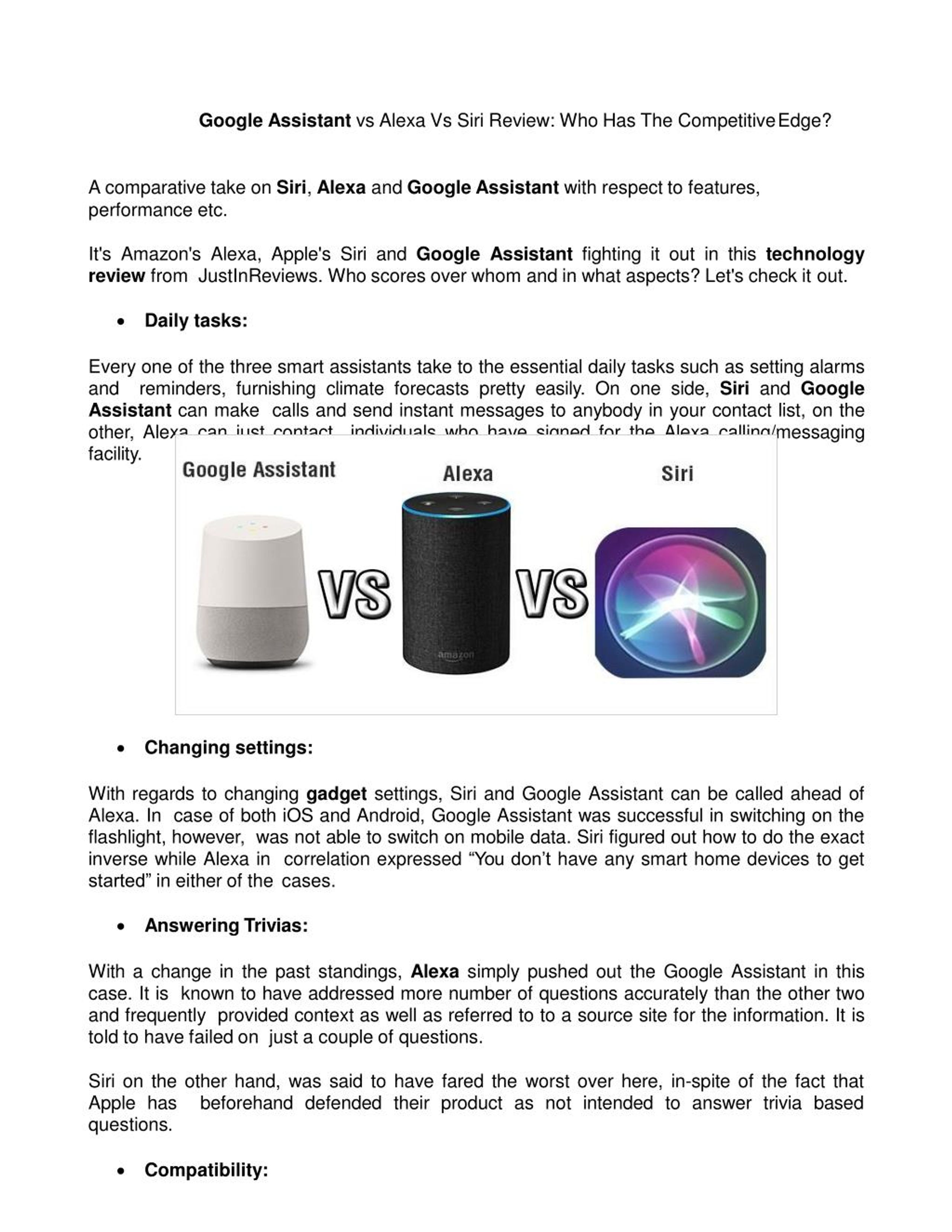
Google Assistant vs. Alexa vs. Siri: Choosing the Best Smart Assistant in 2026
Choosing the best voice assistant depends primarily on your existing device ecosystem and your priorities for smart home control, information retrieval, or privacy. Google Assistant leads in search accuracy, Amazon Alexa dominates smar...
Choosing the best voice assistant depends primarily on your existing device ecosystem and your priorities for smart home control, information retrieval, or privacy. Google Assistant leads in search accuracy, Amazon Alexa dominates smart home compatibility and shopping, while Apple Siri offers the most seamless integration and privacy for dedicated Apple users.
Contents
The landscape of voice assistants has undergone a radical transformation by 2026. What were once rigid, command-based tools have evolved into sophisticated generative AI agents. The integration of Large Language Models (LLMs)—such as Google’s Gemini, Amazon’s upgraded Alexa LLM, and Apple Intelligence—has shifted the focus from simple "if-this-then-that" commands to complex, multi-step reasoning and natural conversation. Selecting the right one is no longer just about which smart speaker looks better on your shelf; it is about which AI brain you want managing your digital life.
Google Assistant: The Information and Knowledge Leader
Google Assistant, now deeply integrated with Gemini, remains the gold standard for users who prioritize information retrieval and the vast Google ecosystem. Because it taps into the world’s most comprehensive search index, it handles complex questions with far greater nuance than its competitors.
In 2026, Google Assistant serves as a proactive personal secretary. For users of Google Workspace (Gmail, Calendar, Drive), the assistant can perform cross-app tasks such as "Find the flight details from my email and add a reminder to pack my passport two hours before I need to leave for the airport." This level of interoperability is a significant advantage for professionals and students.
Hardware and Ecosystem
The Google Nest line—including the Nest Audio, Nest Hub Max, and the latest Pixel Tablet—serves as the primary hardware foundation. However, Google’s greatest strength is its presence on billions of Android devices. This mobile-first approach ensures that your assistant travels with you, maintaining context from your smart display in the kitchen to your phone in the car via Android Auto.
Key Strengths in 2026
- Conversational Accuracy: Thanks to Gemini, Google Assistant excels at understanding "intent" even when your phrasing is vague.
- Multilingual Support: Google continues to lead in real-time translation and the ability to understand and respond in multiple languages simultaneously within a single household.
- Visual Integration: On Nest Hub devices, the assistant provides the most detailed visual feedback, utilizing Google Maps and YouTube for rich, informative responses.
Amazon Alexa: The Smart Home and Commerce Giant
Amazon Alexa remains the most popular choice for dedicated smart home enthusiasts. As of 2026, Alexa’s primary advantage is its massive "Skills" library and the sheer variety of third-party hardware that supports it. While Google and Apple have narrowed the gap, Alexa still supports the widest range of budget-friendly smart plugs, lights, and sensors.
The 2026 version of Alexa has moved toward "Ambient Intelligence." This means the assistant uses sensors and historical data to anticipate needs without a wake word. For example, Alexa can detect when you’ve left the kitchen and automatically turn off the lights or alert you if the refrigerator door was left ajar.
The Shopping Powerhouse
Unsurprisingly, Alexa is the only assistant that offers a frictionless shopping experience. For Amazon Prime members, the ability to reorder household essentials or track packages through an Echo device is a core utility. In 2026, Alexa’s AI can even suggest products based on your previous consumption rates, acting as an automated inventory manager for the home.
Key Strengths in 2026
- Ecosystem Breadth: From the Echo Pop to high-end Echo Studio speakers and even smart rings or glasses, Alexa is everywhere.
- Matter and Thread Support: Amazon was a primary driver of the Matter standard, ensuring that almost any modern smart device will work flawlessly with an Alexa-enabled hub.
- Customization: The "Blueprints" and "Skills" features allow users to create custom routines and responses more easily than on other platforms.
Apple Siri: The Privacy and Ecosystem Specialist
For a long time, Siri was criticized for being less "smart" than its rivals. However, the rollout of Apple Intelligence and advanced on-device processing has redefined Siri’s value proposition in 2026. Siri is now the premier choice for users who are already "all-in" on Apple hardware and prioritize data privacy above all else.
Siri’s primary differentiator is Personal Context. Because Siri has access to your on-device data across iPhone, iPad, Mac, and Apple Watch—all while keeping that data encrypted and local—it can perform tasks like "Play that podcast my brother sent me in Messages yesterday" without the data ever leaving your personal cloud.
Privacy as a Feature
Unlike Google or Amazon, which have historically relied on cloud processing for voice commands, Apple performs the vast majority of Siri’s logic on the device's silicon. In 2026, this not only makes Siri faster for basic tasks like setting timers or controlling lights but also ensures that your voice recordings are not being stored on a server for advertising profiles.
Key Strengths in 2026
- Deep Hardware Integration: Siri provides the best experience for controlling an Apple TV or finding a misplaced iPhone using "Find My."
- HomeKit Security: Apple’s Home app and the HomeKit framework offer some of the most stringent security requirements for smart home manufacturers, reducing the risk of camera or lock hacks.
- Onscreen Awareness: Siri can now see what you are looking at on your iPhone screen and take action based on that context, such as "Add this address to my contact card."
Technical Comparison of Voice Assistants (2026)
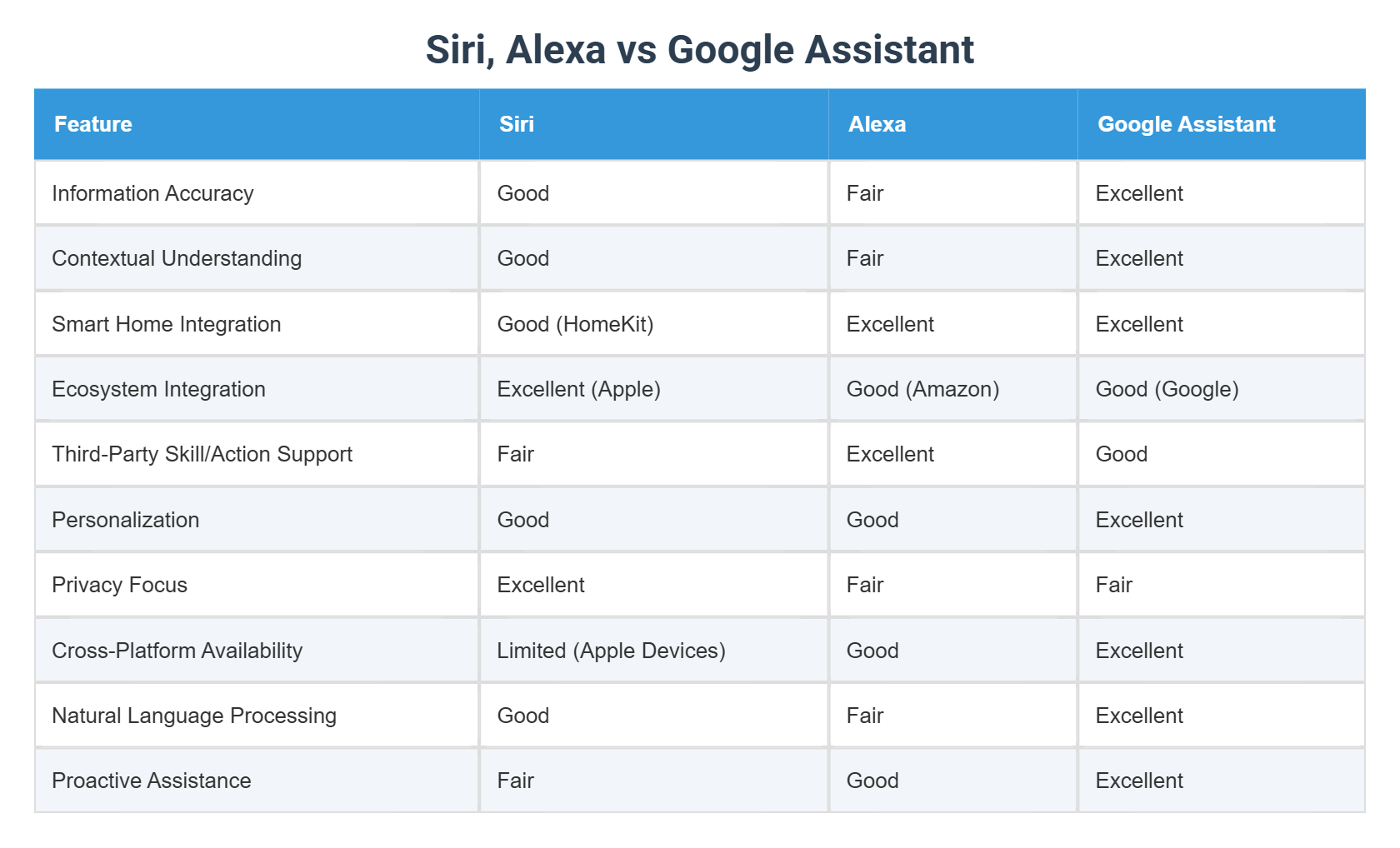
The following table compares the core specifications and functional capabilities of the three leading assistants as of the current year.
| Feature | Google Assistant (Gemini) | Amazon Alexa (LLM) | Apple Siri (Apple Intelligence) |
|---|---|---|---|
| Primary Strength | Search & Knowledge | Smart Home & Shopping | Privacy & Ecosystem |
| Core AI Engine | Gemini Pro/Ultra | Alexa Plus LLM | Apple Intelligence |
| Smart Home Standard | Matter, Thread, Google Home | Matter, Thread, Zigbee | Matter, Thread, HomeKit |
| Mobile Integration | Excellent (Android/iOS) | Moderate (App-based) | Superior (iOS/macOS Only) |
| Privacy Model | Cloud-based (Opt-out) | Cloud-based (Opt-out) | On-device / Private Cloud |
| Wake Word | "Hey Google" | "Alexa," "Ziggy," "Echo" | "Siri" or "Hey Siri" |
| Third-Party Devices | High | Highest | Moderate (Strict Certification) |
The Impact of Matter and Thread Protocols
By 2026, the technical barriers between these three assistants have largely dissolved thanks to the universal adoption of Matter and Thread. Matter is a communication standard that allows smart devices from different brands to talk to each other, while Thread is a low-power mesh networking protocol that makes those connections faster and more reliable.
Previously, you had to check for a "Works with Alexa" or "Works with Apple Home" sticker. Now, as long as a device is Matter-certified, it can be controlled by Google, Alexa, and Siri simultaneously. This "Multi-Admin" feature allows one family member to use an iPhone to turn on the lights via Siri, while another uses a Nest Hub to dim them via Google.
However, the "experience" layer still differs. While any assistant can turn on a Matter-enabled light, Alexa might offer better automation routines, while Google might integrate that light into a "Good Morning" routine that also reads your Google Calendar.
Privacy and Security Considerations
Data handling remains the most significant point of contention between these services.
- Apple: Continues to lead with a "Privacy by Design" philosophy. Most Siri requests are processed locally on the iPhone or HomePod. When cloud processing is required, Apple uses Private Cloud Compute, ensuring that data is never stored or accessible to Apple employees.
- Google: While Google has moved more processing on-device with its Tensor chips, its business model is still built on data. In 2026, Google provides robust "Auto-delete" options, but the default state is often cloud-stored to improve the Gemini AI model.
- Amazon: Alexa relies heavily on the cloud. While Amazon has introduced "Privacy Hubs" to make it easier to delete voice recordings, Alexa remains a tool designed to understand your habits to facilitate commerce.
Users should regularly audit their privacy settings in the respective apps (Google Home, Amazon Alexa, or Apple Settings) to ensure they are comfortable with the level of data sharing.
Frequently Asked Questions
Which assistant is best for a smart home in 2026?
Amazon Alexa remains the strongest choice for smart homes due to its vast compatibility and the maturity of its "Routines" engine. However, if your home is exclusively populated by Apple users, Siri (via HomeKit/Matter) offers a more secure and integrated experience.
Can I use more than one assistant in the same house?
Yes. Thanks to the Matter protocol, you can have a Google Nest Hub in the kitchen and an Amazon Echo in the bedroom, both controlling the same set of smart lights and thermostats. This allows you to leverage the specific strengths of each assistant where they are most needed.
Does Siri work on Android devices?
No. Siri remains exclusive to the Apple ecosystem (iPhone, iPad, Mac, Apple Watch, HomePod, and CarPlay). If you use an Android phone, Google Assistant is the most natural fit, though the Alexa app can be installed as a secondary option.
Which assistant is best for elderly users or accessibility?
Google Assistant is often cited as the best for accessibility because of its superior natural language processing. It is more forgiving of stammers, pauses, or non-standard syntax, making it easier for users with speech impairments or those who find technology intimidating.
Do these assistants require a monthly subscription?
By 2026, all three providers have introduced "Premium" tiers. Google offers advanced Gemini features through Google One AI Premium, Amazon has Alexa Plus for more conversational AI, and Apple includes advanced Siri features as part of the Apple Intelligence suite, often tied to newer hardware requirements or iCloud+ subscriptions.
Final Recommendation: Which Should You Choose?
The decision in 2026 is less about the "smartest" assistant and more about your "digital anchor."
- Choose Google Assistant if your life runs on Google Calendar, Gmail, and Android. It is the best tool for those who ask a lot of questions and need a proactive AI that understands the world's information.
- Choose Amazon Alexa if you want the most versatile smart home and a seamless shopping experience. It is the best "utility" assistant for managing a complex household of diverse smart devices.
- Choose Apple Siri if you value privacy above all else and are already invested in the Apple hardware ecosystem. It provides the most refined, secure, and cohesive experience for iPhone and Mac users.
To get started, evaluate your most-used device. If you spend eight hours a day on an iPhone, a HomePod Mini is the logical first step. If you are an Android user who loves DIY home automation, start with a Nest Hub or an Echo Show and expand using Matter-certified devices to keep your options open for the future.
Image Gallery