Exploring The Lottery by Shirley Jackson: Accessing and Understanding the PDF Text
To access a PDF version of Shirley Jackson's "The Lottery," readers should look toward legitimate digital repositories such as the Internet Archive, JSTOR, or university-hosted academic servers. While the story remains under copyright,...
To access a PDF version of Shirley Jackson's "The Lottery," readers should look toward legitimate digital repositories such as the Internet Archive, JSTOR, or university-hosted academic servers. While the story remains under copyright, it is frequently available through library loan systems like Libby or institutional access points for students and educators seeking the full text for scholarly analysis.
Contents
"The Lottery," first published in the June 26, 1948, issue of The New Yorker, remains one of the most famous and controversial short stories in American literature. Decades after its debut, and now in 2026, the narrative continues to be a staple of high school and university curricula. Its enduring relevance stems from its chilling exploration of tradition, social conformity, and the inherent capacity for violence within organized communities.
For those searching for "The Lottery Shirley Jackson PDF," the goal is typically more than just finding a file; it is about engaging with a work that redefined the mid-century Gothic tradition. This guide examines how to locate the text legally, the historical weight behind its publication, and a deep thematic analysis that explains why this story remains a required reading in 2026.
Legitimate Sources for "The Lottery" Digital Text
When seeking a PDF of Shirley Jackson’s work, it is important to distinguish between authorized educational distributions and unauthorized mirrors. Because Shirley Jackson passed away in 1965, her work is still protected under United States copyright law, which generally extends for 70 years after the author's death. Consequently, "The Lottery" will not enter the public domain in the U.S. until the mid-2030s.
Academic and Institutional Repositories
Most readers looking for a PDF are students or educators. Educational institutions often provide access through gated portals. If you have a university or library login, you can find the story in:
- JSTOR: Often included in literary anthologies or journals discussing Jackson's impact.
- The New Yorker Archive: Subscribers can access the original 1948 layout, which provides a unique historical context for how readers first encountered the story.
- The Internet Archive (Open Library): This platform allows users to "borrow" digital copies of anthologies like The Lottery and Other Stories, ensuring the author's estate is respected through controlled digital lending.
Public Library Digital Loans
Using applications like Libby or Hoopla, readers can check out digital versions of Jackson's collections. These platforms often provide the text in EPUB or PDF formats that are compatible with e-readers and tablets. This is the most reliable way to secure a high-quality, proofread version of the text without navigating the risks associated with unverified PDF hosting sites.
Historical Impact and Initial Reception
To understand why the search for this story remains so high in 2026, one must look at the unprecedented reaction to its 1948 debut. The New Yorker received more mail for "The Lottery" than for any other piece of fiction it had ever published. The majority of the letters were negative, ranging from confusion and bewilderment to outright hostility.
Jackson’s narrative arrived in a post-WWII world that was just beginning to grapple with the "banality of evil"—a concept later popularized by Hannah Arendt. Readers in 1948 were horrified by the idea that a "normal" American town could participate in a ritualistic murder. Many readers wrote to the magazine asking where such lotteries were held, or if the story was a report on a real event. This confusion speaks to Jackson’s mastery of the realistic, matter-of-fact tone that masks the impending horror.
Comprehensive Summary of the Narrative
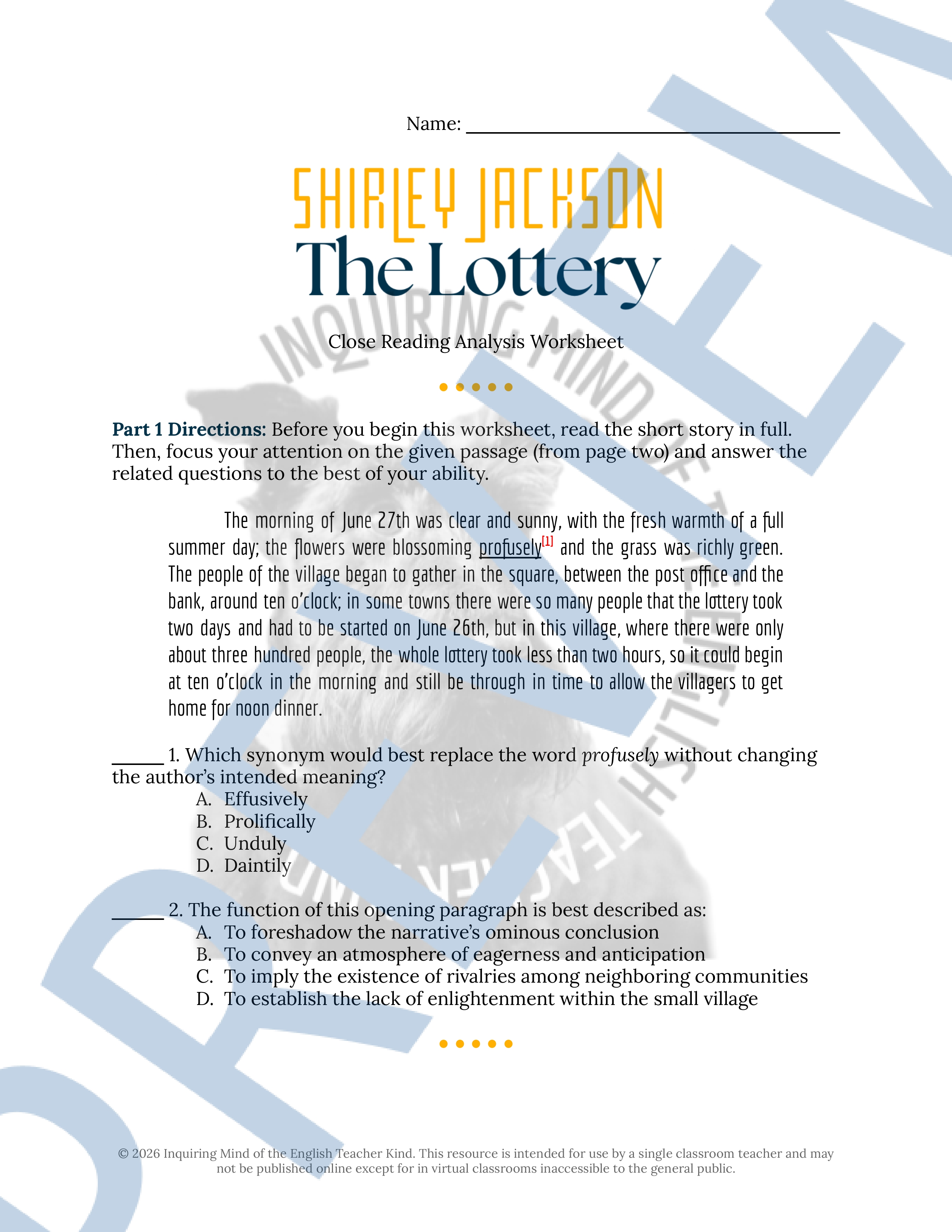
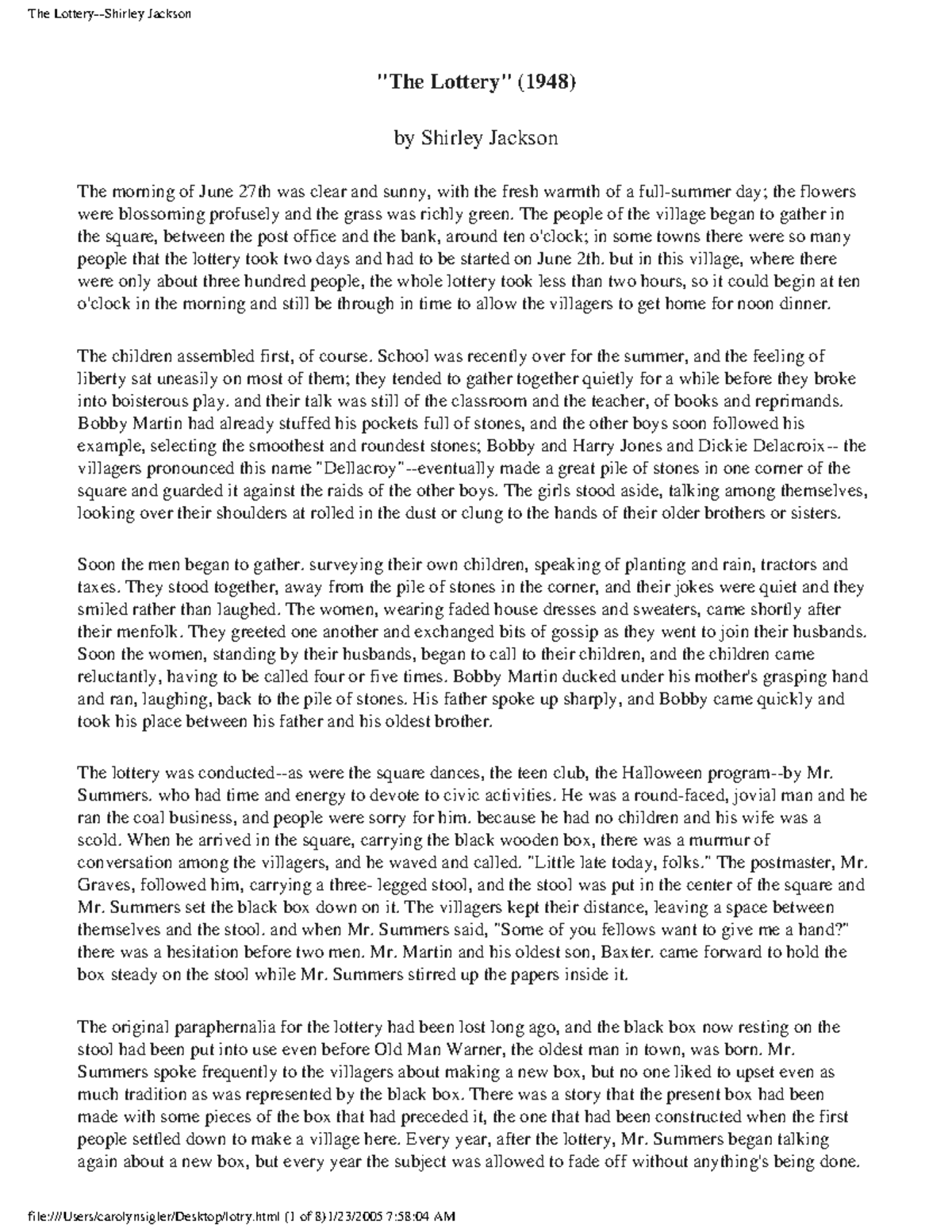
The story is set on the morning of June 27th, a day described as clear and sunny, with the "fresh warmth of a full-summer day." This pastoral opening is a deliberate choice by Jackson to disarm the reader. The setting is a small village of about 300 people, where the atmosphere initially feels like a typical community gathering.
The Preparation
The village children are the first to gather, and they begin collecting stones. This detail, seemingly innocuous at first, is the first subtle hint of the story's violent conclusion. The men and women follow, discussing mundane topics like taxes and farming. Mr. Summers, who runs the coal business, and Mr. Graves, the postmaster, conduct the lottery. They bring out a "shabby" black box, which represents the age and decay of the tradition itself.
The Procedure
The lottery is conducted in two stages. In the first stage, the head of each household draws a slip of paper from the black box. During this phase, the tension begins to mount. One of the older residents, Old Man Warner, defends the lottery against rumors that other towns are giving it up, famously remarking, "Lottery in June, corn be heavy soon." This highlights the ritual's origin as a primitive fertility sacrifice.
The Selection
Bill Hutchinson draws the marked paper—a slip with a black spot. His wife, Tessie, who had arrived late because she "forgot what day it was," immediately begins to protest, claiming the drawing wasn't fair. This shift in her character, from a joking participant to a frantic victim, underscores the theme that people only question oppressive systems once they are directly affected by them. In the second stage, each member of the Hutchinson family must draw. Tessie draws the slip with the black spot.
The Conclusion
The story ends abruptly and violently. The villagers, including Tessie’s own young son, pick up the stones they gathered earlier. The narrative maintains its detached, journalistic tone even as the villagers descend upon her. The final line, "And then they were upon her," leaves the physical violence to the reader's imagination, which often proves more impactful than a graphic description.
Thematic Analysis: Why We Still Study "The Lottery"
The longevity of "The Lottery" in the 2026 academic landscape is due to its multi-layered themes. It serves as a psychological and sociological mirror.
The Danger of Blind Tradition
The black box is the primary symbol of tradition. It is splintered, faded, and stained, yet the villagers resist replacing it. This mirrors how societies cling to outdated or harmful practices simply because "that's the way it's always been done." Jackson suggests that tradition is not a justification for morality.
Scapegoating and Mob Mentality
The story illustrates how easily a community can turn an individual into a "scapegoat." By selecting one person to die, the community believes it is ensuring its own survival or prosperity (the "corn be heavy soon" logic). The fact that the villagers move so quickly from chatting with Tessie to stoning her demonstrates how social pressure can override individual conscience.
The Banality of Evil
Unlike traditional horror that features monsters or supernatural entities, Jackson places horror in the mundane. The characters are not "evil" in the traditional sense; they are neighbors, friends, and family members. This suggests that the capacity for horrific violence is present in every society, waiting for a "system" or "ritual" to authorize its release.
Comparative Framework: "The Lottery" vs. Similar Literary Works
In many 2026 literature courses, "The Lottery" is compared to other works of social commentary and dystopian fiction. The following table illustrates how it sits alongside other major texts.
| Feature | "The Lottery" (Jackson) | "The Ones Who Walk Away from Omelas" (Le Guin) | The Hunger Games (Collins) |
|---|---|---|---|
| Type of Sacrifice | Random individual (Stoning) | One specific child (Neglect/Suffering) | Youth participants (Gladiatorial) |
| Social Justification | Agricultural prosperity/Tradition | Utilitarian happiness for the majority | Political control/Punishment |
| Participant Reaction | Active participation by all | Passive acceptance or departure | Spectacle and forced participation |
| Tone | Realistic and detached | Philosophical and allegorical | Action-oriented and dystopian |
| Primary Theme | Blind adherence to tradition | The moral cost of utopia | Institutionalized systemic cruelty |
Technical and Symbolic Elements
Jackson uses specific names and items to reinforce her message. Analyzing these is essential for anyone using the PDF for a literary essay.
- The Names:
- Mr. Summers: Suggests a light, pleasant season, contrasting with the dark nature of his role.
- Mr. Graves: A clear omen of the death that follows the lottery.
- Delacroix: In French, this means "of the cross," hinting at a perverted religious or sacrificial ritual. Interestingly, the villagers pronounce it "Dellacroy," showing a corruption of the original meaning.
- The Black Box: It represents the persistence of the lottery itself. Even though the original ritual has been lost or changed over time, the box—and the violence it represents—remains.
- The Stones: They are the oldest tools of execution. By having the villagers use stones, Jackson connects the modern 1948 (and by extension 2026) setting to a primitive, barbaric past.
Frequently Asked Questions
Is "The Lottery" based on a true story?
No, "The Lottery" is a work of fiction. However, Shirley Jackson was inspired by the social dynamics of the small town in Vermont where she lived. She wanted to comment on the latent cruelty and gossip she observed in community life, as well as the global atrocities witnessed during World War II.
Why do the villagers keep doing the lottery?
The story suggests they continue out of a sense of duty to a tradition they no longer fully understand. While some mentions are made of other villages giving it up, the residents of this town are led by figures like Old Man Warner, who views any change to the ritual as a path back to "living in caves."
What does the ending mean?
The ending is a critique of how easily people can participate in state-sanctioned or community-sanctioned violence. When the group acts together, individual responsibility is diffused. The horror lies in the fact that it is a collective action; no single person is "to blame," yet everyone is complicit.
Why is the PDF often used in schools?
The story is ideal for educational settings because of its brevity, its clear use of symbolism, and the intense debate it sparks. It serves as a perfect introduction to the concept of irony—specifically the contrast between the pleasant summer day and the brutal execution.
Is the PDF available for free?
While many educational sites host the text for study, Shirley Jackson's work is not in the public domain. Readers should look for "The Lottery Shirley Jackson PDF" through library services or academic databases to ensure they are accessing a legal and accurate version.
Next Steps for Readers
If you have downloaded or are reading "The Lottery" for the first time, your next action should be to read Jackson’s follow-up essay, "Biography of a Story." In it, she details the hundreds of letters she received and provides her own insights into why the story provoked such a visceral reaction. Additionally, comparing the text to its famous 1969 short film adaptation can provide a visual perspective on the "banality" Jackson worked so hard to establish in her prose. For those using the text for research, ensure you cite the original 1948 New Yorker publication date to maintain historical accuracy in your analysis.
Image Gallery