City of God: A Comprehensive Overview of Fernando Meirelles’ Cinematic Masterpiece
City of God (2002), directed by Fernando Meirelles and co-directed by Kátia Lund, stands as a seminal work in contemporary world cinema. Based on the 1997 novel by Paulo Lins, the film depicts the brutal rise of organized crime in the...
City of God (2002), directed by Fernando Meirelles and co-directed by Kátia Lund, stands as a seminal work in contemporary world cinema. Based on the 1997 novel by Paulo Lins, the film depicts the brutal rise of organized crime in the Cidade de Deus suburb of Rio de Janeiro, spanning the late 1960s to the early 1980s. Its innovative visual style, non-linear narrative, and raw portrayal of socioeconomic conflict have solidified its status as a landmark production in Brazilian filmmaking history.
Contents
The Historical and Socioeconomic Foundation
To understand the gravity of City of God, one must recognize that the Cidade de Deus was a real-life public housing project established in the 1960s. The government relocated residents from the central favelas of Rio to this remote area, promising a better life while effectively isolating the poor from the city’s urban center.
Fernando Meirelles utilized this historical backdrop not merely as a setting but as a character in itself. The lack of infrastructure, the abandonment by state authorities, and the encroaching influence of the drug trade turned the housing project into a crucible of violence. The film’s narrative arc is structured through the eyes of Rocket (Buscapé), an aspiring photographer who acts as an observer of the shifting power dynamics, providing a rare lens into the lives of those caught between systemic poverty and the lure of criminal enterprise.
Directional Style and Cinematographic Innovation
Fernando Meirelles brought a highly energetic, fast-paced aesthetic to the film, characterized by frantic editing and a restless camera. This was a departure from the "cinema of misery" often associated with Latin American dramas, which frequently leaned toward slow, static, and somber imagery.
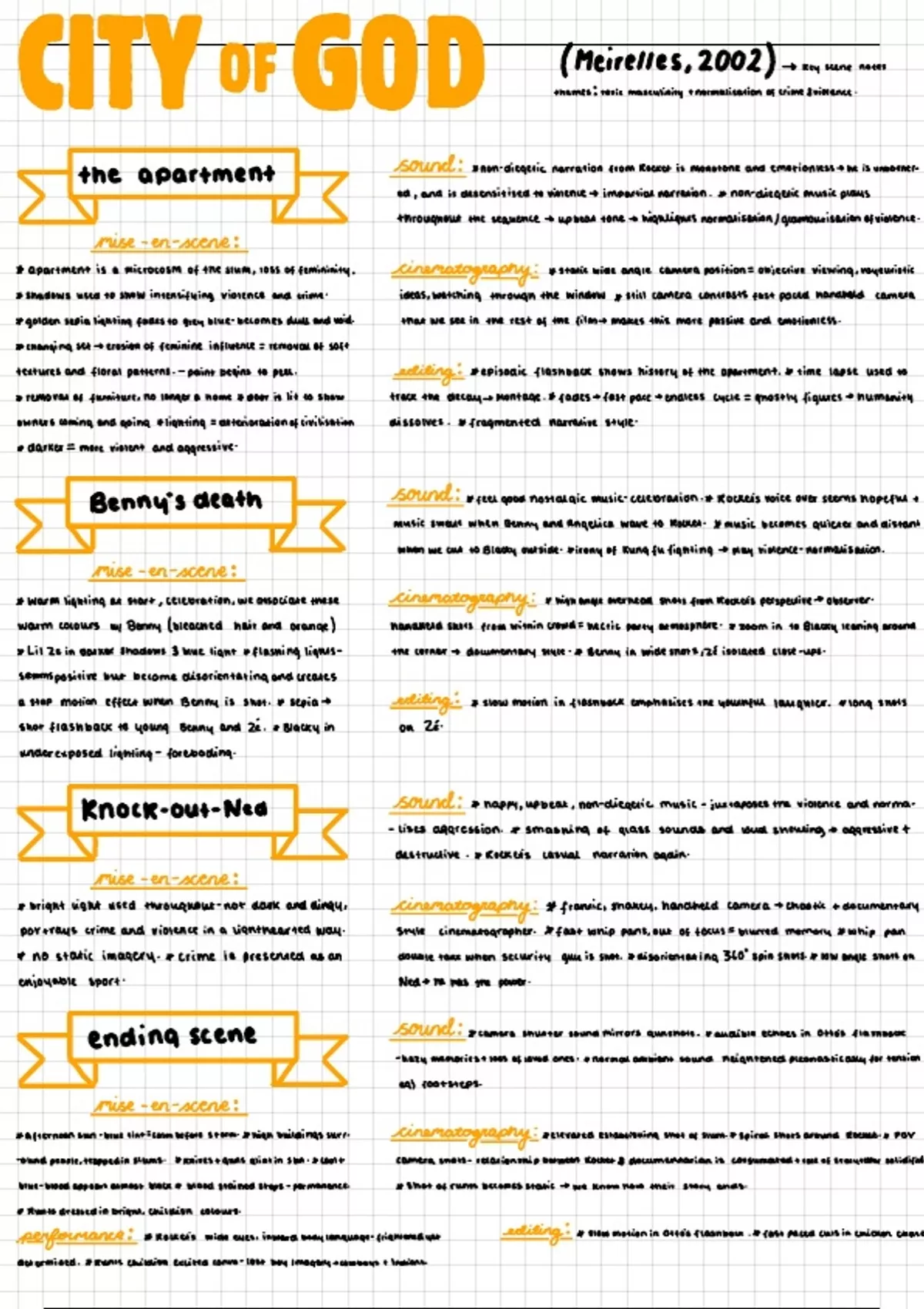
Instead, City of God employs a palette that shifts according to the era depicted. The 1960s sequences are bathed in warm, golden tones, reflecting a sense of nostalgic, albeit flawed, optimism. As the film progresses into the 1970s and 1980s, the visual tone shifts toward cold blues and jarring, high-contrast greens, emphasizing the desensitization and mechanical nature of the gang warfare that consumes the community.
César Charlone, the film's cinematographer, utilized handheld cameras and non-traditional mounting rigs to keep the viewer in constant motion. This immersion creates a sense of proximity to the danger, ensuring that the audience is not just observing the conflict but is positioned within its visceral orbit.
Narrative Structure and Character Dynamics
The screenplay, adapted by Bráulio Mantovani, rejects a traditional chronological approach. By using Rocket’s perspective, the film serves as an episodic chronicle. It avoids the trope of a single protagonist fighting a single antagonist, choosing instead to focus on the institutionalization of violence.
The primary conflict involves the power struggle between Li’l Zé (Zé Pequeno), a psychopathic crime lord, and Knockout Ned (Mané Galinha), an honest man forced into violence by circumstances. This juxtaposition highlights the central theme of the film: in a landscape devoid of legal recourse or institutional safety, violence becomes the only currency for survival and respect. The ensemble cast, many of whom were actual residents of Rio’s favelas rather than professional actors, provided an authenticity that brought a documentary-like weight to the dramatized screenplay.
Comparing Stylistic Eras in the Film
The film’s evolution in tone and pacing is central to the audience's experience. The following table delineates the intentional shift in atmospheric direction:
| Era | Primary Visual Tone | Thematic Focus | Pacing |
|---|---|---|---|
| Late 1960s | Warm, golden hues | Youth, transition, innocence | Controlled, observant |
| Early 1970s | Transition to harsh light | The emergence of the drug trade | Accelerating, rhythmic |
| Late 1970s | Cold, saturated blues | Escalation and cyclical violence | Kinetic, jarring |
| Early 1980s | High-contrast grit | Inevitability and total war | Staccato, unrelenting |
Critical Reception and Cultural Legacy
Upon its release, City of God transcended its status as a Brazilian domestic product to become a global phenomenon. It received four Academy Award nominations in 2004, including Best Director and Best Adapted Screenplay. For many international critics, the film served as a gateway to modern Brazilian cinema, encouraging further exploration of the Cinema Novo movement and its descendants.
The film’s legacy is complex. While it brought international attention to the plight of favela residents, it also drew criticism from some who argued that its stylistic brilliance threatened to aestheticize real-world violence. However, the film remains a core study in film schools worldwide due to its technical proficiency in editing and its ability to weave a complex, multi-layered story without relying on conventional exposition.
Practical Considerations for Viewers and Scholars
For those engaging with City of God in 2026, it is important to note that the film is widely available on most major global streaming platforms. When viewing, consider the following elements to gain the most value:
- Audio track: If possible, view the film in the original Portuguese with subtitles. The linguistic nuances and regional slang are essential components of the character development that are often lost in dubbed versions.
- Contextual research: Familiarize yourself with the Estado Novo and the later military dictatorship in Brazil, as these political structures influenced the creation of the housing projects depicted in the film.
- The "Observer" role: Pay attention to Rocket’s camera. The act of photographing the violence is a meta-commentary on the role of journalism in marginalized communities. Ask yourself: does Rocket change the reality he documents, or is he merely a vessel for the viewer's consumption of that reality?
Frequently Asked Questions
Is the story of City of God based on real people? Yes. While the characters of Rocket, Li’l Zé, and Benny are composites or fictionalized versions of individuals, they are based on the lives of real people living in Cidade de Deus during the decades the film portrays. Paulo Lins, the author of the source novel, grew up in the area and conducted extensive research to capture the authentic sociopolitical environment.
Why is the editing style considered so revolutionary? The editing, led by Daniel Rezende, broke with traditional continuity rules. It utilized rapid-fire cuts and non-linear jumps that matched the frantic, unpredictable nature of life in the favela. This influenced a generation of action and crime cinema, pushing directors to abandon standard coverage for more impressionistic styles.
Does the film accurately represent life in Rio de Janeiro? The film captures a specific historical moment and a specific location. While it is grounded in reality, it is a dramatization. Life in Rio today is highly diverse, and while the issues of social inequality and violence persist, the film should be viewed as a historical narrative rather than a holistic representation of modern Brazil.
What is the role of music in the film’s narrative? The soundtrack, featuring a mix of 1970s samba and funk, acts as a temporal marker. Music serves as a bridge between the changing decades, grounding the narrative in the specific cultural landscape of the time while providing a rhythmic counterpoint to the violence on screen.
Is it necessary to read the book before watching the film? While the book provides extensive detail regarding the history and social dynamics of the community, it is not required for a full appreciation of the film. Meirelles’ work stands on its own as a self-contained cinematic experience, though reading the novel can offer a deeper understanding of the peripheral characters.
Final Recommendation
To fully appreciate the impact of City of God, approach the film as an intersection of historical documentation and narrative art. Start by viewing the film in its original language, and follow up by reading essays on the Cinema da Retomada movement. This will provide the necessary context to understand why Meirelles’ direction was so pivotal in moving Brazilian cinema toward international recognition. Whether for academic study or personal interest, this film remains an essential touchstone for understanding the power of perspective in storytelling.
Image Gallery