What the Washington State Auto Insurance Requirement Means for You
Washington State law requires all motor vehicle drivers to maintain proof of financial responsibility before operating a vehicle on public roads. For most motorists, this requirement is met by carrying a compliant auto insurance policy...
Washington State law requires all motor vehicle drivers to maintain proof of financial responsibility before operating a vehicle on public roads. For most motorists, this requirement is met by carrying a compliant auto insurance policy that includes specific statutory liability limits, though alternative financial options exist.
Contents
| Washington State Auto Insurance: At a Glance | Details |
|---|---|
| Statutory Liability Minimums | • $25,000 Bodily Injury (Per Person)• $50,000 Bodily Injury (Per Accident)• $10,000 Property Damage (Per Accident) |
| Mandatory In-Writing Offers (Rejectable in Writing) | • Personal Injury Protection (PIP)• Uninsured / Underinsured Motorist (UM/UIM) |
| Legal Alternatives to Policies | • $60,000 Cash/Securities Deposit (WA State Treasurer)• $60,000 Surety Bond (Filed with Washington DOL)• Self-Insurance Certificate (Fleets of 26+ Vehicles) |
Disclaimer: This guide provides educational information regarding Washington State motor vehicle financial responsibility laws. It does not constitute formal legal or insurance counseling. Statutory rules and administrative codes are subject to legislative amendment. Drivers should consult the Washington State Office of the Insurance Commissioner or a licensed insurance professional for specific policy evaluation.
Mandatory Minimum Auto Insurance Limits in Washington State
Under the Revised Code of Washington (RCW 46.30.020), operating a motor vehicle registered in or driven throughout the state without adequate financial responsibility is illegal. The standard method for fulfilling this obligation is purchasing third-party auto liability insurance. Liability insurance does not pay for your own injuries or vehicle damage; rather, it pays for bodily injury and property damage you negligently cause to others in a motor vehicle collision.
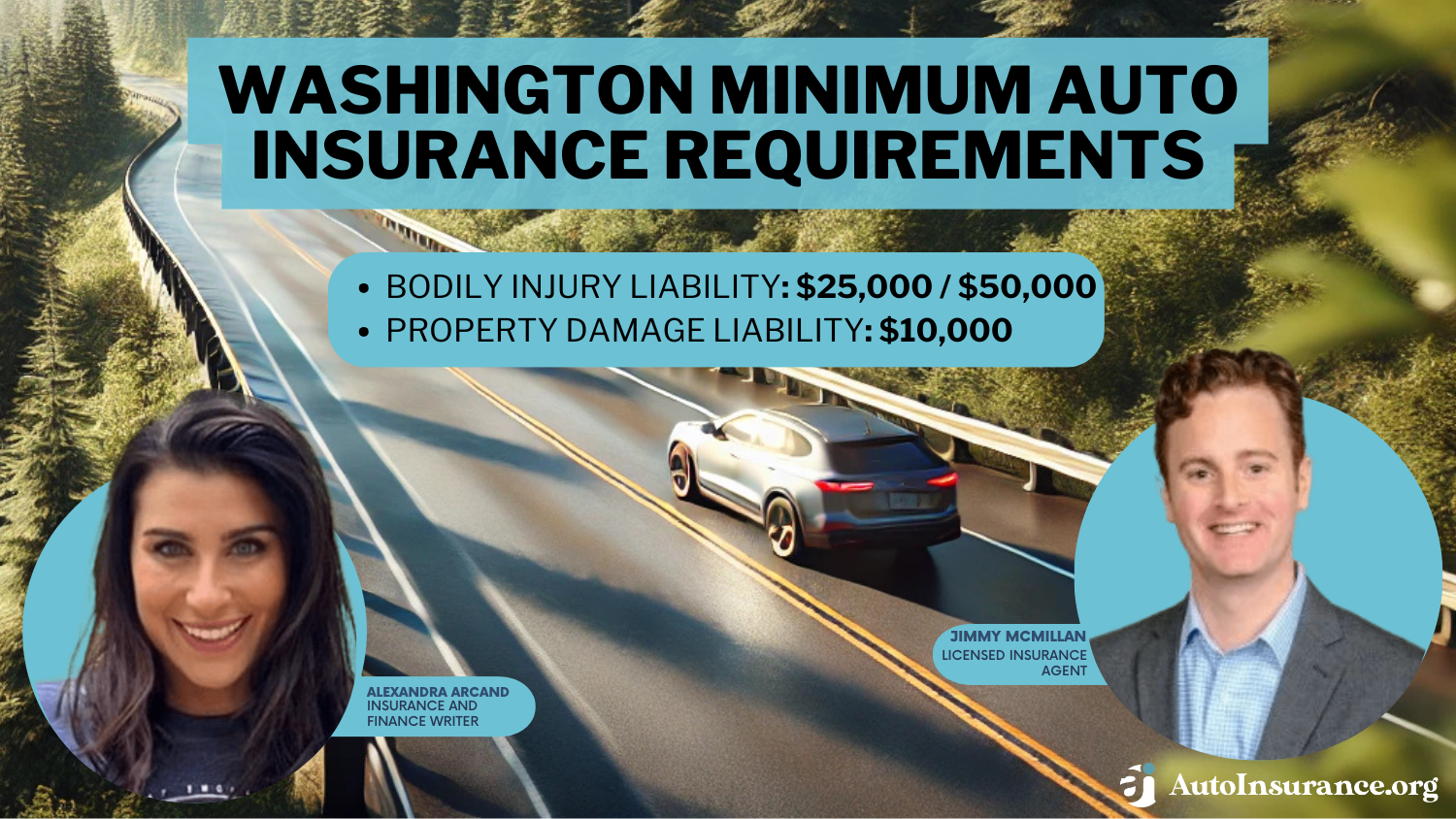
Washington mandates three distinct liability thresholds, commonly summarized in shorthand as 25/50/10 coverage:
$25,000 Bodily Injury Liability per person: The maximum amount your insurance carrier will pay for medical bills, lost wages, and related damages for a single individual injured in an accident you caused.
$50,000 Bodily Injury Liability per accident: The total aggregate limit your insurer will pay for all combined injuries sustained by two or more people in a single accident caused by your vehicle.
$10,000 Property Damage Liability per accident: The maximum benefit paid for destruction of property belonging to others—including damaged vehicles, municipal structures, utility poles, fences, or guardrails.
Accident Event (You are at fault):
- $50,000 Aggregate Bodily Injury Cap:
- Person A Injury: $25,000 Max
- Person B Injury: $25,000 Max
- Property Damage: $10,000 Max
- $50,000 Aggregate Bodily Injury Cap:
If damages caused by an at-fault driver exceed these threshold limits, the driver remains personally liable for the remaining financial balance out of pocket.
Approved Alternatives to Standard Auto Insurance
While purchasing an auto insurance policy from an admitted carrier is the primary route to compliance, Washington law provides three statutory alternatives under RCW 46.29 for individuals and business entities seeking to establish financial responsibility without standard insurance policies.
1. Cash or Securities Deposit with the State Treasurer
A driver may satisfy the legal requirement by executing a cash or security deposit of $60,000 directly with the Washington State Treasurer. Upon receipt and verification, the State Treasurer issues a certificate confirming financial responsibility. This certificate must be kept inside the vehicle as legal proof. If an at-fault accident occurs, court judgments or claims are satisfied out of this deposited funds pool.
2. Surety Bond
Motorists can purchase and file a $60,000 surety bond issued by a licensed surety company authorized to conduct business in Washington State. The bond must be filed directly with the Washington Department of Licensing (DOL). The surety company agrees to pay up to $60,000 to injured third parties if you cause an accident, but unlike insurance, the surety company will actively seek full reimbursement from you for any money paid out.
3. Certificate of Self-Insurance
Businesses, organizations, or individuals that hold legal title to 26 or more motor vehicles can apply for a Certificate of Self-Insurance through the Washington Department of Licensing. To qualify, the applicant must demonstrate ongoing financial solvency and establish a dedicated reserve fund capable of paying liability claims at or above the statutory 25/50/10 minimums for every vehicle in the commercial fleet.
Mandatory Coverage Offers: PIP and Uninsured Motorist Protection
Washington insurance regulations place specific duties on insurance companies regarding additional coverage types. While liability insurance protects third parties, state laws under RCW 48.22 mandate that insurance carriers include two important protections in every auto liability policy sold in the state, unless the policyholder explicitly rejects them in writing.
- Policy Issuance Requirements in Washington:
- Mandatory Liability (25/50/10)
- Personal Injury Protection (PIP):
- Automatic Inclusion
- Written Waiver Required to Reject Coverage
- Uninsured Motorist (UM/UIM):
- Automatic Inclusion
- Written Waiver Required to Reject Coverage
- Personal Injury Protection (PIP):
- Mandatory Liability (25/50/10)
Personal Injury Protection (PIP)
Personal Injury Protection (RCW 48.22.085) provides no-fault medical, wage replacement, and loss-of-services benefits to you, household family members, and passengers injured in an accident, regardless of who caused the collision.
Standard PIP coverage in Washington includes:
- Medical and Hospital Expenses: Up to $10,000 per injured person for necessary medical, surgical, X-ray, and dental services incurred within three years of the accident (policyholders can elect higher limits, such as $35,000).
- Income Continuation: Up to $10,000 total (capped at $200 per week) for lost income incurred within one year after the injury date.
- Loss of Services: Up to $5,000 ($40 per day) for essential services usually performed by the injured person without pay (e.g., household chores, childcare).
- Funeral Expenses: Up to $2,000 per person.
If you decide you do not want PIP coverage, Washington law requires you to sign a formal, written rejection waiver provided by your insurer.
Uninsured/Underinsured Motorist (UM/UIM) Coverage
Under RCW 48.22.030, auto insurers must offer Uninsured/Underinsured Motorist coverage in amounts equal to the policyholder's third-party liability limits. UM/UIM protects you if you are hit by a driver who carries no auto insurance, or a driver whose liability limits are insufficient to compensate you fully for injuries and property damage.
UM/UIM covers:
- UIM Bodily Injury: Pays for medical bills, rehabilitation, pain and suffering, and lost income when an uninsured or underinsured driver hits you.
- UIM Property Damage: Pays for vehicle repairs or replacement (subject to a statutory $100 or $300 deductible, depending on policy terms) when an uninsured driver causes damage.
Just like PIP, UM/UIM coverage is automatically included in policy quotes by default; it can only be removed if the policyholder executes a signed written waiver.
Why State Minimum Coverage Leaves You Vulnerable
While carrying 25/50/10 liability limits keeps you legally compliant with Washington state authorities, relying solely on minimum insurance presents significant financial risk. Vehicle values and medical care expenses routinely outpace these legal minimums.
| Repair Cost vs. Legal Minimum Risk | Amount |
|---|---|
| Average Modern Vehicle Collision Repair / Total Loss | $28,000 – $45,000+ |
| Washington State Statutory Minimum Property Limit | -$10,000 |
| Personal Uninsured Exposure Remaining | $18,000 – $35,000+ |
The $10,000 Property Damage Deficit
The average replacement price of a new vehicle exceeds $45,000, and even used vehicles routinely cost over $20,000. If you accidentally rear-end a modern passenger vehicle or cause a multi-vehicle pileup, repair or replacement costs easily exceed $10,000.
Because your insurer will pay no more than the $10,000 policy cap, the injured party or their insurer (via subrogation) can sue you personally to attach bank accounts, garnish wages, or place liens against property to recover the remaining balance.
Insufficient Medical Coverage Caps
A single emergency room visit, hospital admission, or surgery following an auto accident can surpass $25,000 within hours. If you cause severe injuries to a single individual, medical damages can rapidly climb into hundreds of thousands of dollars. The statutory $50,000 total accident limit creates even greater exposure if multiple passengers or occupants of another vehicle are hospitalized.
Optional First-Party Coverages to Consider
To safeguard your own financial assets and personal vehicle, drivers routinely add coverages that are not mandated by state law:
- Collision Coverage: Pays to repair or replace your vehicle if it collides with another car, object, or flips over, regardless of fault.
- Comprehensive Coverage: Covers damage to your vehicle caused by events outside of collisions, including theft, vandalism, falling trees, weather events, or strikes with animals.
- Gap Insurance: Pays the difference between what your auto policy pays out for a total loss and the remaining balance owed on your vehicle loan or lease.
Note: If you finance or lease a vehicle in Washington, your financial institution will mandatorily require comprehensive and collision coverages with maximum deductible limits (typically $500 or $1,000), even though state law does not mandate them.
Penalties and Legal Consequences of Driving Uninsured in WA
Failing to maintain continuous proof of financial responsibility in Washington triggers penalties, administrative actions, and long-term financial consequences.
- Penalty Escalation for Uninsured Drivers:
- Routine Traffic Stop: Mandatory Fine ($550+)
- At-Fault Collision ($1,000+ Damage/Injury): Driver License Suspension (RCW 46.29) + Mandatory SR-22 Filing (3 Years)
Statutory Fines and Court Fees
Under RCW 46.30.020, operating a motor vehicle without proof of financial responsibility carries a base traffic infraction fine of $550. Local court costs, statutory assessments, and administrative fees frequently increase the total out-of-pocket penalty higher.
Courts may dismiss the fine if a driver can prove they held valid insurance at the exact time the citation was issued but simply failed to show the proof card during the traffic stop (often subject to a small court administrative fee).
License Suspension under the Financial Responsibility Law
If an uninsured driver is involved in an accident resulting in property damage of $1,000 or more, or bodily injury/death to any person, the Washington Department of Licensing will administrative suspend the uninsured driver's license under RCW 46.29 (Safety Responsibility Act).
To regain driving privileges, the uninsured driver must:
- Pay all damages in full or enter into a formal, court-approved payment installment agreement with the injured parties;
- Obtain a formal release of liability from all injured parties; or
- Deposit security with the DOL in an amount determined adequate to settle potential civil claims.
Mandatory SR-22 Filings
Drivers convicted of driving without insurance, driving with a suspended license, or involved in an uninsured accident are generally required to maintain an SR-22 Certificate of Financial Responsibility.
An SR-22 is a formal endorsement issued by an insurance company that certifies to the Washington Department of Licensing that the driver carries compliant auto insurance.
- Duration: Must be maintained continuously for 3 consecutive years.
- Automatic Notification: If an SR-22 policy lapses, cancels, or non-renews for any reason, the insurer is legally obligated to notify the Washington DOL immediately via an SR-26 form, which results in the immediate suspension of the driver's license.
- Cost Impact: Carrying an SR-22 requirement classifies you as a high-risk driver, leading to substantially higher insurance premiums across all carriers.
Comprehensive Comparison: Minimum vs. Recommended Auto Coverage
The following matrix highlights the operational and financial differences between state-mandated minimum coverage, standard commercial auto protection recommendations, and full asset-protection coverage for Washington drivers.
| Policy Element | Washington State Minimum | Recommended Standard Coverage | High Asset Protection Coverage |
|---|---|---|---|
| Bodily Injury (Per Person / Per Accident) | $25,000 / $50,000 | $100,000 / $300,000 | $250,000 / $500,000 |
| Property Damage (Per Accident) | $10,000 | $100,000 | $100,000+ |
| Personal Injury Protection (PIP) | Optional (Offered by default; waiver required) | Included ($10,000 limit) | Included ($35,000 maximum limit) |
| Uninsured Motorist (UM/UIM) | Optional (Offered by default; waiver required) | Matches Liability ($100k/$300k) | Matches Liability ($250k/$500k) |
| Collision & Comprehensive | Not required by state law | Optional ($500–$1,000 deductible) | Included ($250–$500 deductible) |
| Umbrella Policy Support | Does not qualify | Rarely qualifies | Qualifies for $1M+ Umbrella Policy |
| Legal Status in WA | Fully Compliant | Fully Compliant | Fully Compliant |
| Personal Financial Risk Level | Extremely High (High out-of-pocket exposure) | Moderate to Low | Very Low |
Practical Action Plan for Washington State Drivers
Whether relocating to Washington, purchasing a new vehicle, or reviewing existing policy terms, follow these concrete steps to ensure full legal compliance and adequate protection.
- Step 1: Verify Coverage Limits
- Step 2: Obtain Digital/Paper ID
- Step 3: Register Vehicle (30 Days)
1. Maintain Digital or Physical Proof of Insurance
Washington law permits drivers to present proof of insurance using either a physical paper insurance card or an electronic image displayed on a mobile device (such as a PDF or carrier smartphone app). Keep proof accessible at all times inside the vehicle or on your device.
2. Mind the 30-Day Window When Moving to Washington
New residents moving to Washington State must register their vehicles with the Department of Licensing within 30 days of establishing residency. Before registering your vehicle, you must update your insurance policy to meet Washington's minimum financial responsibility limits and policy terms.
3. Review Liability Limits Annually
Because state minimum limits ($25k/$50k/$10k) represent a low financial threshold, evaluate your personal net worth, home equity, and income security annually. Increasing liability limits from 25/50/10 to 100/300/100 often incurs a minor premium increase relative to the vast increase in financial protection.
4. Never Let Coverage Lapse
Even a single day of lapsed insurance coverage can register on public databases, trigger high-risk classification by insurance underwriting algorithms, and risk a $550 citation if stopped by law enforcement. If changing auto insurance companies, ensure the start date of your new policy directly overlaps or coincides with the cancellation date of the old policy.
Frequently Asked Questions
Does auto insurance follow the car or the driver in Washington State?
In Washington, auto insurance primarily follows the vehicle. If you permit another licensed driver to borrow your insured vehicle (permissive use), your auto liability insurance acts as the primary coverage for an accident. The driver's personal auto policy typically acts as secondary insurance if damages exceed your policy's financial limits.
Can I drive in Washington with auto insurance from another state?
If you are a temporary visitor or non-resident student, your valid home-state auto insurance policy fulfills Washington's legal requirements, provided your home state limits automatically adjust to meet local state minimums (which most standard auto policies do). However, if you become a permanent Washington resident, you must transfer your auto policy to a Washington-specific policy within 30 days.
Is Personal Injury Protection (PIP) required by law in Washington?
PIP is not strictly mandatory for policyholders, but state law mandates that insurance providers must include PIP in every auto quote. You can only opt out by signing a formal written waiver declining the coverage. Given the high cost of emergency medical care, retaining PIP is strongly advised.
What happens if I am hit by an uninsured driver in Washington State?
If you hold Uninsured/Underinsured Motorist (UIM) coverage or Personal Injury Protection (PIP), your own insurance carrier will pay for your medical bills and vehicle repairs up to your policy limits. If you carry only mandatory minimum liability coverage and declined UIM/PIP, you must pay medical costs and repairs out of pocket or file a personal injury lawsuit against the uninsured driver to collect damages.
How does the Washington DOL verify if I have auto insurance?
While Washington does not require insurance companies to submit real-time policy data for all drivers, law enforcement officers verify proof during traffic stops or accident investigations. Furthermore, if you are involved in a collision causing over $1,000 in damage, involved parties must file an accident report; failure to show active coverage during the incident triggers administrative license suspension proceedings by the DOL.
Final Recommendation
Meeting Washington State's auto insurance requirement is a legal prerequisite for operating any vehicle on public roads. However, simply carrying the legal minimum of 25/50/10 liability coverage leaves drivers vulnerable to substantial out-of-pocket loss if an accident occurs.
To achieve legal compliance while safeguarding your personal assets, secure liability coverage of at least 100/300/100, retain your policy's Personal Injury Protection (PIP) and Uninsured Motorist (UM/UIM) coverages, and keep physical or electronic proof of insurance easily accessible inside your vehicle at all times.
Image Gallery